BlueArch Inc., a company engaged in the development and manufacturing of domestically produced autonomous underwater vehicles (AUVs), was established in January 2026, and on June 11 of the same year, its detailed business strategy and fundraising were announced. Building on years of research at the University of Tokyo, we will take on the challenge of democratizing the marine exploration market, which has been a barrier to high prices.
- What the University of Tokyo startup ‘BlueArch’ aims for
- Innovation of the flagship product, “HATTORI Neo”
- Founding members with unique backgrounds and a strong support system
- Fostering the AUV Industry as a National Strategy and Japan’s Current Situation
- Redefining the Challenges and Potential of Japan, a Maritime Powerhouse
- Pilot Experiments and Results Expanding from Blue Carbon Surveys
- Roadmap for mass production and global expansion toward 2030
What the University of Tokyo startup ‘BlueArch’ aims for
BlueArch Inc. is a startup company originating from the University of Tokyo, established in January 2026. The company is aiming for the social implementation of domestically produced autonomous unmanned underwater vehicles (AUVs) centered on joint research with the Maki Laboratory, led by Associate Professor Toshihiro Maki of the Institute of Industrial Science at the University of Tokyo. The base is located in the collaborative research building within the University of Tokyo Komaba II Campus, providing an environment where we can utilize Japan’s top-level underwater robotics research facilities.
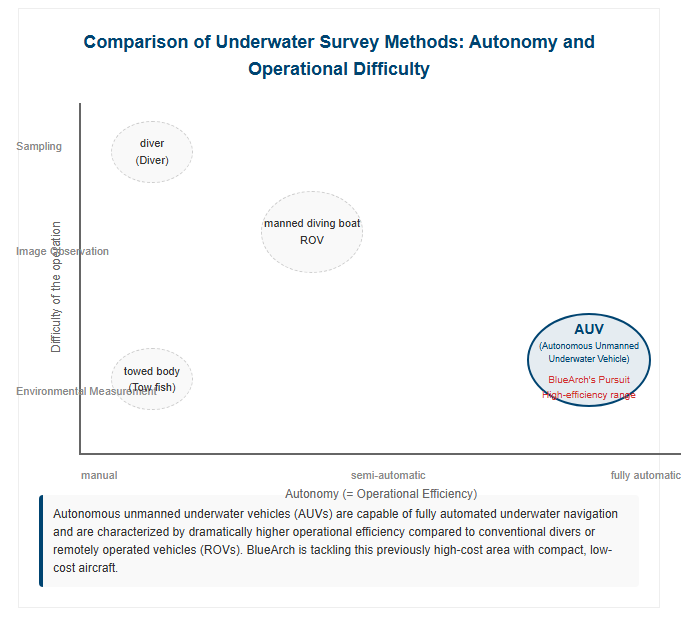
CEO Motoki Muto has a background in business planning such as smart aquaculture at SoftBank Corp. in his previous job. Mr. Muto noted that in the past, it was not uncommon for AUVs to exceed 100 million yen per vehicle, and he is working to transform the current situation where operation required large vessels and was a “technology limited to only a limited number of organizations.” BlueArch’s vision is to become the “world’s No.1 domestic AUV manufacturer,” aiming to realize a future where anyone can explore underwater safely and at low cost, starting from Japan, surrounded by the sea on all sides.
During the era of BlueArch, the predecessor of the company, we conducted research and operation of blue carbon (carbon absorption by marine ecosystems) using AUVs. From this on-site experience, we became convinced of the potential of AUVs to solve challenges such as survey costs and physical burdens in the underwater domain, which led to our current incorporation.
Please refer to the diagram below.
Innovation of the flagship product, “HATTORI Neo”
BlueArch’s flagship product is the long-duration, compact hovering AUV “HATTORI Neo.” This aircraft is compact at about 1.5 meters in length, yet boasts advanced autonomous navigation capabilities. Its biggest feature is the edge AI processing capability, which allows real-time analysis and identification of acquired data on its own. While conventional AUVs typically collected data first and then analyzed it on the ground, HATTORI Neo assesses the situation underwater on its own, enabling efficient observation.
The technical advantage lies in the combination of inexpensive sensors and advanced algorithms. Instead of relying on expensive inertial navigation devices, we integrated sensors such as DVL (Doppler Speed Log), GPS, and IMU with proprietary software, achieving both cost reduction and highly accurate position estimation. The expertise gained from the AUV “HATTORI,” which has been continuously improved over more than 10 years in the Maki Laboratory, is generously applied here.
Furthermore, we are not only manufacturing and selling aircraft, but are also developing a software platform for integrated operation and control of multiple AUVs, as well as an in-house developed simulator that enables pre-design of mission scenarios in virtual spaces. This enables us to easily carry out complex underwater missions.
Founding members with unique backgrounds and a strong support system
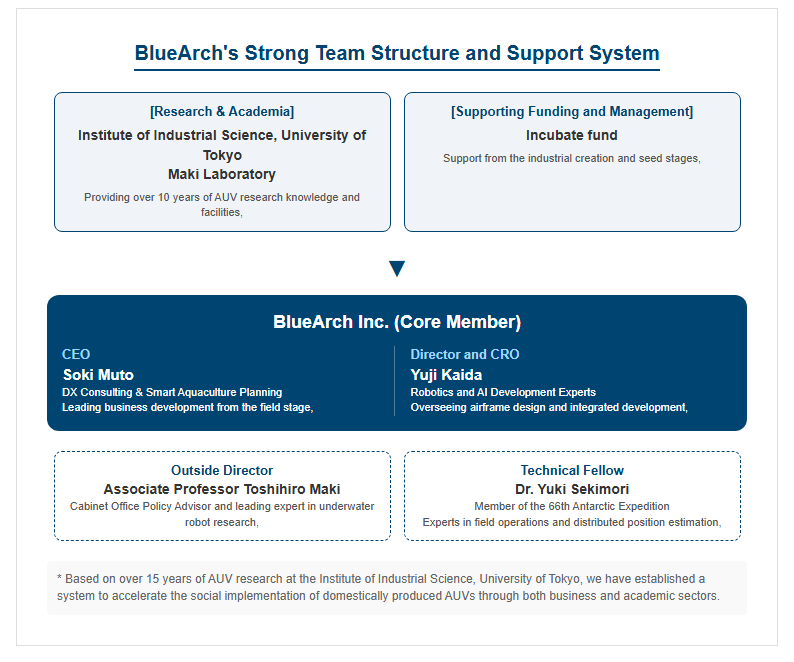
The team behind BlueArch is made up of both business and academia. Joining CEO Muto in charge of management is Mr. Yuji Kaida, Chief Robotics Officer (CRO). Mr. Kaida researched automatic biological tracking technology using AUVs at the University of Tokyo Graduate School and is an engineer with a third-place finish at the RoboCup World Championship, as well as experience developing autonomous robots at SoftBank.
Furthermore, Associate Professor Toshihiro Maki, a leading expert in AUV research, has been appointed as an outside director, and his expertise as a policy advisor to the Cabinet Office is reflected in our business. Additionally, Dr. Yuki Sekimori, who participates as a technical fellow, is a field operations specialist with a proven track record of successfully operating AUVs in the Southern Ocean as a member of the 66th Antarctic Regional Expedition.
According to the announcement in June 2026, the company will conduct a third-party allotment of shares with the Incubate Fund as the subscriber, bringing the capital to 40.5 million yen. Meeting Ryoto Iwasaki, an associate at the Incubate Fund, became the decisive factor in accelerating the incorporation. Mr. Iwasaki is confident that the marine drone industry will become “Japan’s next rice seed,” and he hopes BlueArch will become a leading company in this growth market.
Please refer to the diagram below.
[Background and Importance] Why is ‘Domestically Produced AUVs’ in Need Now?
Fostering the AUV Industry as a National Strategy and Japan’s Current Situation
The Japanese government positions the ocean as one of the key foundational technologies in science and technology, and in 2023 formulated the “AUV Strategy.” Behind this strategy lies a sense of crisis that, while Japan has led the world in AUV research and development, it is lagging behind overseas competitors in industrialization. Currently, many AUVs sold domestically are made overseas, making localization and industrialization urgent from the perspectives of economic security and industrial competitiveness.
The strategy led by the Cabinet Office aims to foster Japan’s AUV industry by 2030 and promote public-private partnership initiatives with an eye toward overseas expansion. In particular, AUVs are expected to be utilized in fields such as the installation and maintenance of offshore wind power, marine resource development, and security, with AUVs being explicitly supported as a means to solve social issues such as labor shortages and productivity improvement.
The establishment of BlueArch aligns perfectly with the direction of this national strategy. Associate Professor Maki points out the past when government-led projects tended to end as one-off projects, and states that entities like BlueArch, where startups themselves take the initiative in industrialization, are seizing unprecedented opportunities.
Redefining the Challenges and Potential of Japan, a Maritime Powerhouse
Japan’s Exclusive Economic Zone (EEZ) boasts the sixth largest area in the world, much of which includes deep seas. In May 2025, the Japan Agency for Marine-Earth Science and Technology (JAMSTEC) unveiled the “Urashima 8000,” capable of submerging to depths of 8,000 meters, demonstrating technology capable of covering about 98 percent of Japan’s EEZ. However, these high-performance large aircraft have extremely high operating costs and are insufficient to cover the vast ocean.
Therefore, the spread of “small, low-cost machines” promoted by BlueArch becomes crucial. As local fishermen and private companies who previously could not afford expensive aircraft can now use AUVs, the volume of ocean observation data will explode. For example, by conducting efficient surveys using AUVs to address the reduction of seaweed beds (isobari) caused by severe seawater temperature rises, it becomes possible to create blue carbon credits that balance environmental conservation and economic viability.
To pioneer the “last frontier,” such as marine resources and energy—areas humanity has not yet fully utilized—free underwater access at the private level is necessary, not only for some research institutions. BlueArch aims to truly unlock Japan’s potential as a maritime power by turning AUVs into everyday mobility like “ships” into social infrastructure.
[Future Developments] Utilization of AUVs as Social Infrastructure
Pilot Experiments and Results Expanding from Blue Carbon Surveys
BlueArch’s technology has already entered the stage of concrete social implementation. According to the announcement in May 2026, the “Blue Carbon Survey and Credit Creation Demonstration Using Wireless Autonomous Underwater Drones” has begun in collaboration with Kanagawa Prefecture. Until now, measuring the area of seaweed beds has involved divers directly diving in by ships, which has been a challenge due to significant costs and physical burdens.
In July 2026, a measurement demonstration targeting Kajime will be conducted on Jogashima in Miura City, Kanagawa Prefecture. In this demonstration, an AUV launched from land will navigate fully autonomously, precisely mapping the distribution of seagrass beds. Once this method is established, it will be possible to certify and sell blue carbon credits by AUVs for the first time in Japan, and it is expected to serve as a new source of revenue for fishing organizations.
Additionally, in collaboration with Kanagawa Prefecture, demonstrations of remote control combining surface drones (USVs) and underwater drones are also being conducted. BlueArch does not stick to its own technology; instead, it expands the range of achievable missions through partnerships with other companies and local governments. It is precisely this accumulation of data in real-world environments that drives the company’s further refinement of its technology.
Roadmap for mass production and global expansion toward 2030
BlueArch has plans to dramatically expand its business within the next few years. CEO Muto has clearly stated that next year (2027), the company aims to establish a system capable of mass-producing several dozen AUVs per month at a pace of several dozen or more. For hardware manufacturing, we will work in cooperation with external partner companies, focusing on our strengths in software development and integrated design capabilities.
As a goal by 2030, we aim for AUVs to become established as maritime ‘information infrastructure.’ In the future, we aim to provide a wide range of solutions worldwide, including inspection of submarine communication cables, maintenance of offshore wind power facilities, and even exploration of deep-sea resources. Furthermore, research on ‘group control’ technology, which emphasizes multiple robots in a way, is being advanced mainly by Sekimori Fellow and others, aiming to establish scalable survey methods.
How can Japan’s high research standards be established as a “sustainable business”? BlueArch’s challenge will be one answer to the challenge of social implementation of technology. This new industry, born from Japan, surrounded by the sea on all sides, holds the potential to fundamentally transform the use of oceans worldwide.
[#AUV #BlueArch #スタートアップ #海洋産業 #経済ビジネス #ロボティクス #東京大学 #ブルーカーボン]


コメント