- The Full Picture of the New Mac Studio Powered by the M5 Ultra
- The Evolution of Unified Memory and the Dramatic Acceleration of Matrix Operations
- 100x Lower Latency Enabled by RDMA Technology
- Automated cluster control using the open-source software exo
- Achieving Exceptional Cost Performance and Complete Data Protection
- Specification Constraints and Systemic Challenges in Practical Application
The Full Picture of the New Mac Studio Powered by the M5 Ultra
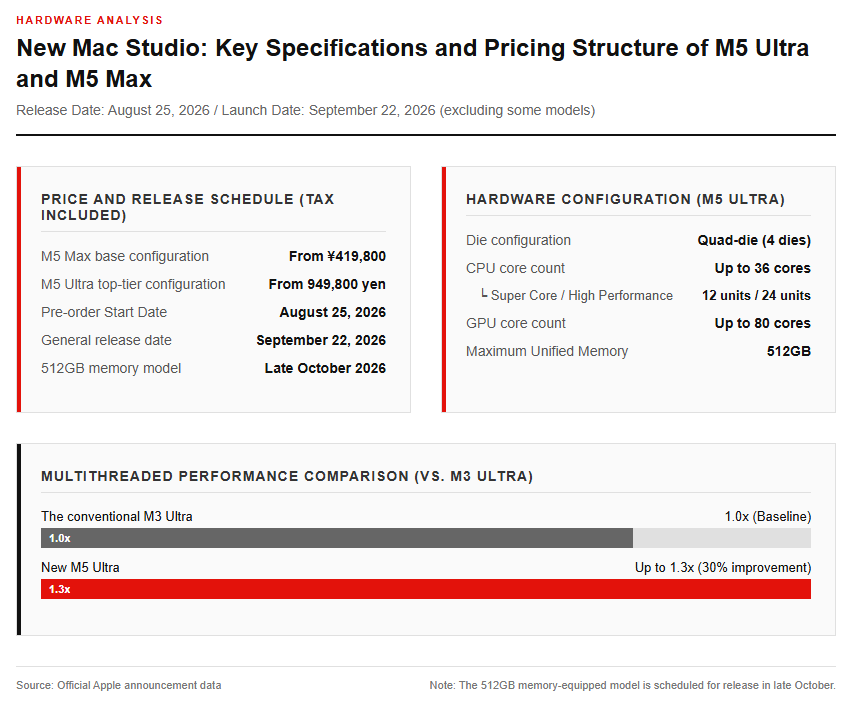
On August 25, 2026, Apple officially announced the new Mac Studio, a desktop personal computer powered by its latest custom silicon, the M5 Max and M5 Ultra. Pre-orders started on August 25, 2026, the same day as the announcement, and the official release date is set for September 22, 2026. The base price starts at 419,800 yen including tax for the M5 Max-equipped model, and 949,800 yen including tax for the high-end M5 Ultra-equipped model. Among them, the model equipped with up to 512GB of unified memory, which is best suited for running large language models in local environments, is scheduled to be released slightly later in late October 2026. The M5 Ultra adopts a quad-die configuration for the first time in the M-series, successfully securing a physically extremely large circuit area by connecting a total of four silicon dies. Key specifications include up to a 36-core CPU combining 12 super cores and 24 high-performance cores, and up to an 80-core GPU, with multi-threaded performance improved by up to 1.3 times compared to the conventional M3 Ultra chip. The following image shows the appearance of the new machine.
The Evolution of Unified Memory and the Dramatic Acceleration of Matrix Operations
The biggest reason the new Mac Studio is attracting overwhelming attention as a local AI execution environment lies in the capacity of its unified memory, which can now be configured up to 512GB, and its data transfer speed. The unified memory bandwidth of the M5 Ultra has increased by approximately 50 percent compared to the previous-generation chip, reaching a staggering speed of 1.2TB per second on a standalone machine. This design, in which the CPU and GPU directly share the same large-capacity memory pool, makes it possible to run massive large language models with countless parameters entirely in a local environment at hand, without relying on external cloud services. Furthermore, Apple has integrated Neural Accelerators that operate directly on a per-core basis into the M5 Ultra’s GPU. This significantly optimizes matrix multiplication processing, which accounts for the majority of inference processing in large language models, achieving dramatic growth in peak AI computing performance of up to 4.3 times that of the M3 Ultra and up to 9.8 times that of the early M1 Ultra.
Communication Innovation and Distributed Execution Software Enabling Clustering
100x Lower Latency Enabled by RDMA Technology
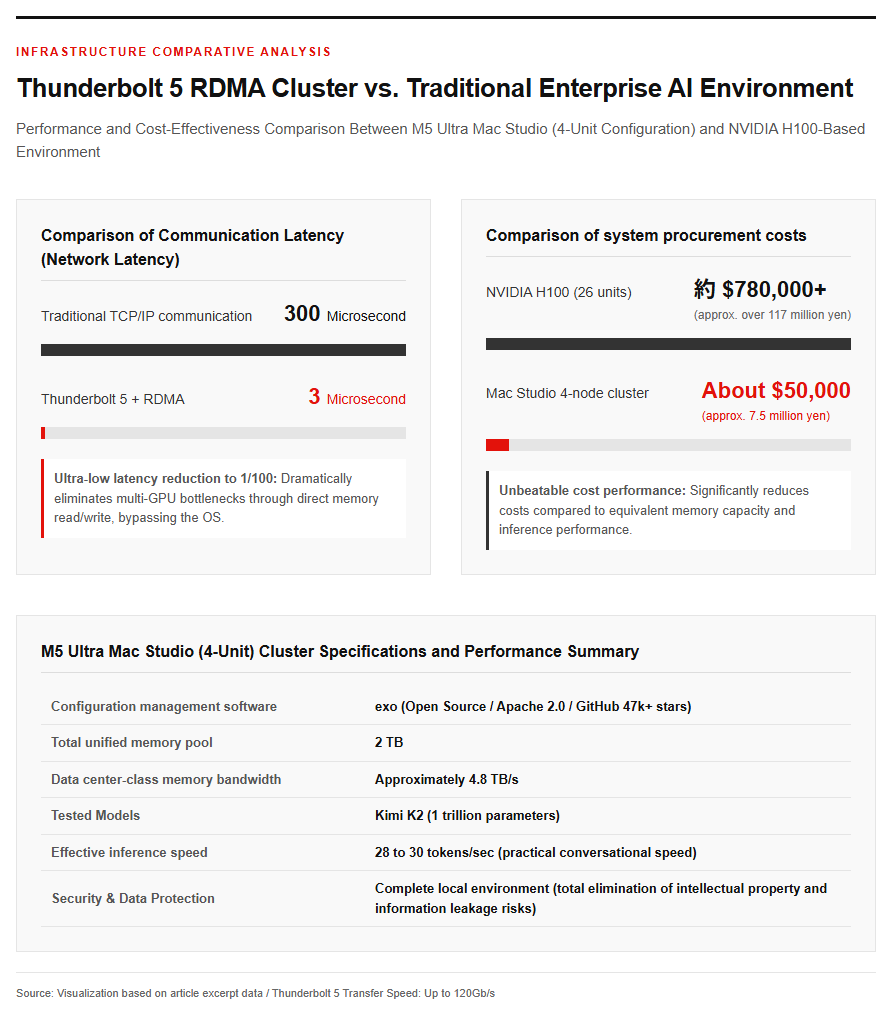
Traditionally, in cluster systems where multiple computers are connected to jointly execute a single process, network latency of data flowing between machines has been the biggest obstacle. In conventional communication via standard TCP/IP protocols, round-trip processing through the OS occurs during data transfer, resulting in a significant latency of approximately 300 microseconds. To solve this problem, Apple officially enabled support for RDMA technology utilizing Thunderbolt 5 ports in the macOS Tahoe 26.2 software update. RDMA is a technology that allows direct reading and writing of another machine’s memory without routing through the OS, and it is a communication method that has been widely used when interconnecting multiple high-performance GPUs in data centers. As a result, connection latency via Thunderbolt 5—which boasts transfer speeds of up to 120 Gb/s on the Mac Studio—has been reduced to a mere 3 microseconds, achieving a dramatic acceleration in communication of approximately 1/100th compared to conventional connection methods.
Automated cluster control using the open-source software exo
Playing an extremely crucial role in making multiple Macs function as a single AI supercomputer is exo, an open-source software whose development is led by US-based EXO Labs. Released under the Apache 2.0 license, this software has garnered high global attention, earning over 47,000 stars on GitHub. When users launch this software on each machine, the network-connected devices automatically detect each other, eliminating the need for complex manual initial setup. Furthermore, it is equipped with a feature that automatically configures how to split and process models based on a real-time understanding of system connection status. This software supports tensor parallelism—which splits individual tensor operations themselves across multiple machines for parallel execution—making it possible to build a data center-class memory bandwidth of approximately 4.8 TB/s in a personal environment, using a clustered setup of four Mac Studios equipped with M5 Ultra chips.
Future Prospects and Practical Challenges Facing Local AI Environments
Achieving Exceptional Cost Performance and Complete Data Protection
A clustered environment connecting four Mac Studios equipped with M5 Ultra chips can build a massive unified memory pool totaling 2TB. The equipment procurement cost for building this system totals approximately $50,000 (around 7.5 million yen). However, if one were to attempt to achieve equivalent memory capacity and inference performance using NVIDIA’s enterprise-grade H100 GPUs, it would require 26 GPUs, pushing the system price to over $780,000 (around 117 million yen). In addition to this overwhelming cost-performance ratio, because all processing can be completed within a local desktop environment, there is the extremely powerful advantage of completely protecting an organization’s critical data from intellectual property risks such as the leakage of confidential information or copyright infringement, which are concerns when using cloud services. In fact, it has been confirmed that this four-unit cluster environment can run Kimi K2—a massive model with a scale of 1 trillion parameters—at high speeds with practical conversational speeds of 28 to 30 tokens per second. The system diagram below shows the four-unit configuration.
Specification Constraints and Systemic Challenges in Practical Application
On the other hand, several challenges still remain to be addressed in order to operate this innovative desktop cluster technology stably in daily business operations and production environments. First, there is a specification constraint that the number of machines constituting the cluster must always be a power of two, such as 2 or 4, in order to unleash high-speed tensor parallel processing capabilities. Furthermore, it has been reported that as the conversation history becomes longer and the amount of input text to be processed (context length) increases, the time required for inference processing grows significantly, resulting in a dramatic decrease in generation speed. In addition, the Thunderbolt 5 cables used for connections must be wired in a mesh structure that directly covers all nodes, and the macOS operating system must also be aligned to the exact same version. The current control beta software may also cause unexpected crashes when processing a large number of concurrent requests, and further optimization and reliability improvements are indispensable for putting it into practical use as a completely independent server system.
Reference page
- 【GitHub – exo-explore/exo: Run frontier AI locally.】https://github.com/exo-explore/exo
【#LocalLLM #AppleSilicon #MacStudio #M5Ultra #Thunderbolt5 #DistributedComputing】

コメント