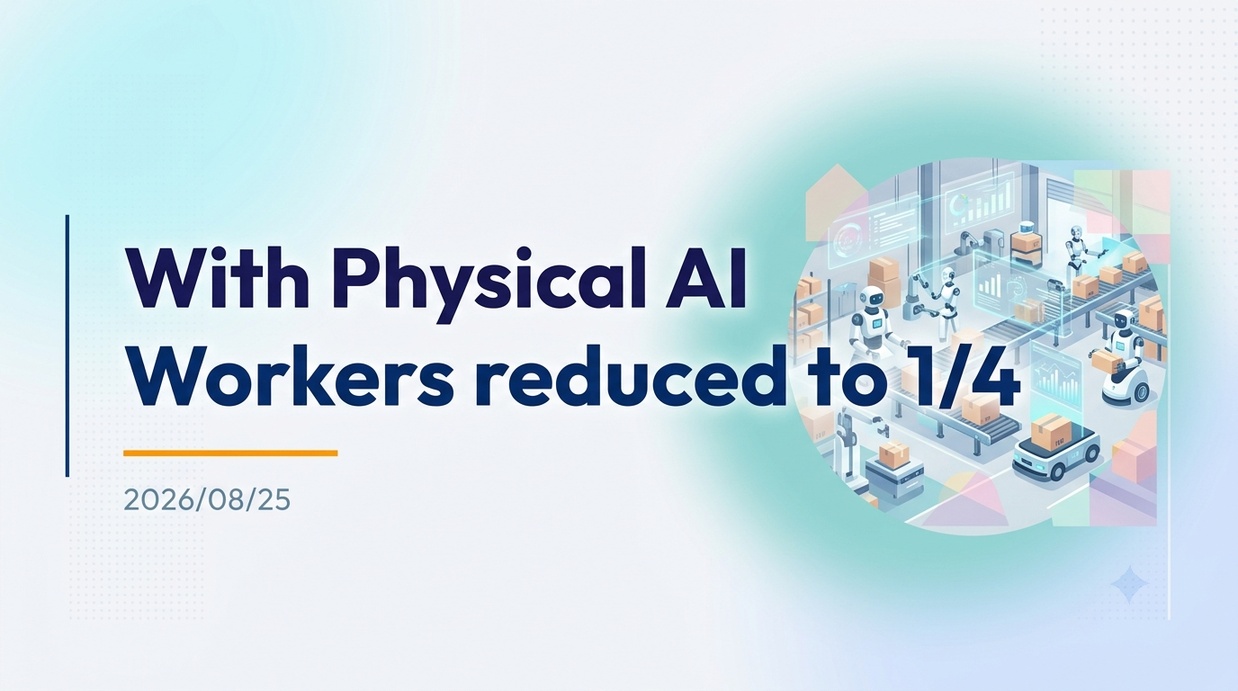
Driven by the adoption of physical AI such as Hitachi’s LogiRiSM, technological innovations are underway that improve sorting and transportation productivity by approximately fourfold, theoretically enabling the number of on-site workers to be reduced to one-fourth. Behind this are three major trends: structural labor shortages due to the declining birthrate and aging population, the crisis of collapse in logistics and construction sites caused by tightened overtime regulations from 2024, and the expansion of generative AI technology into real-world applications.
- Section 1-1: Quadrupling the speed of sorting operations brought by Hitachi’s LogiRiSM
- Section 1-2: Proof from Pilot Experiments: Negotiating Tasks Reduced by a Quarter
- Section 2-1: Technologies for Converting Experts’ Intuition and Know-how into Data
- Section 2-2: Evolution of the Simulation Space “Sim-to-Real”
- Section 3-1: Safety, Division of Responsibility, and Labor Union Concerns
- Section 3-2: From the 2026 Dawn of Physical AI to Full-Scale Adoption in 2030
Section 1-1: Quadrupling the speed of sorting operations brought by Hitachi’s LogiRiSM
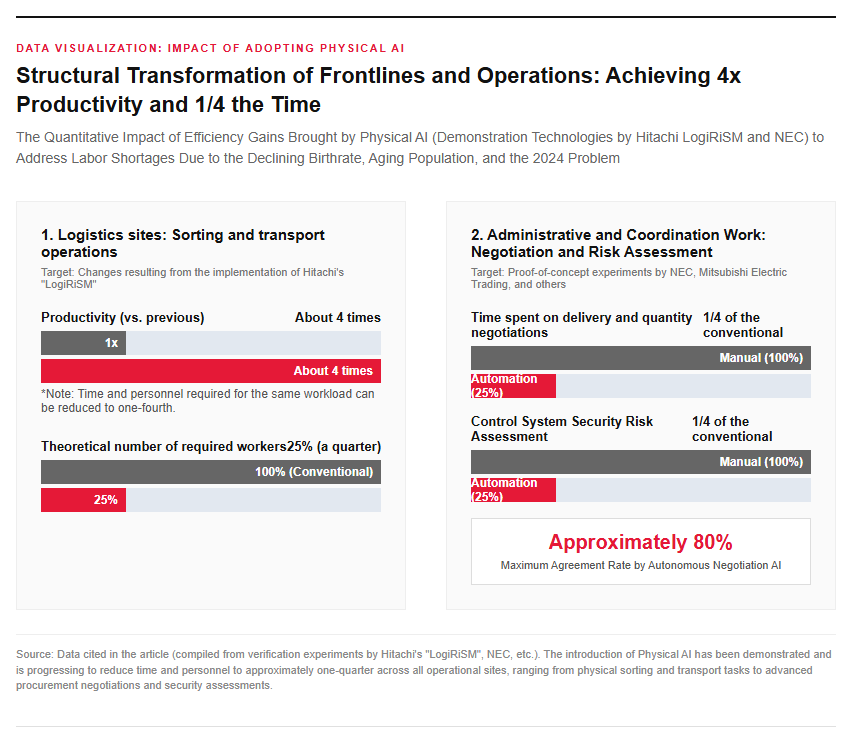
Hitachi, Ltd. has announced “LogiRiSM,” a transport plan optimization AI engine that evolves material handling equipment throughout logistics centers into physical AI. This engine monitors the status of various equipment in real time and improves the productivity of sorting operations by approximately fourfold compared to conventional methods. An approximately fourfold increase in productivity means that the number of workers required to handle the same workload can be reduced to one-fourth, or that operating time can be cut to one-fourth, which holds immense significance for workplaces facing increasingly severe labor shortages.
In the logistics industry, the ripple effects of stricter overtime regulations for truck drivers—which began in 2024—are spreading, with bankruptcies driven by labor shortages hitting record highs and the collapse of on-site operations becoming a tangible reality. Amid these circumstances, automating non-standard tasks that conventional industrial robots could not handle, as well as sorting and transport processes requiring real-time situational judgment, has become an essential prerequisite for business continuity rather than a mere cost-cutting measure. Hitachi’s Physical AI is gaining attention as a technology that directly tackles this challenge.
Section 1-2: Proof from Pilot Experiments: Negotiating Tasks Reduced by a Quarter
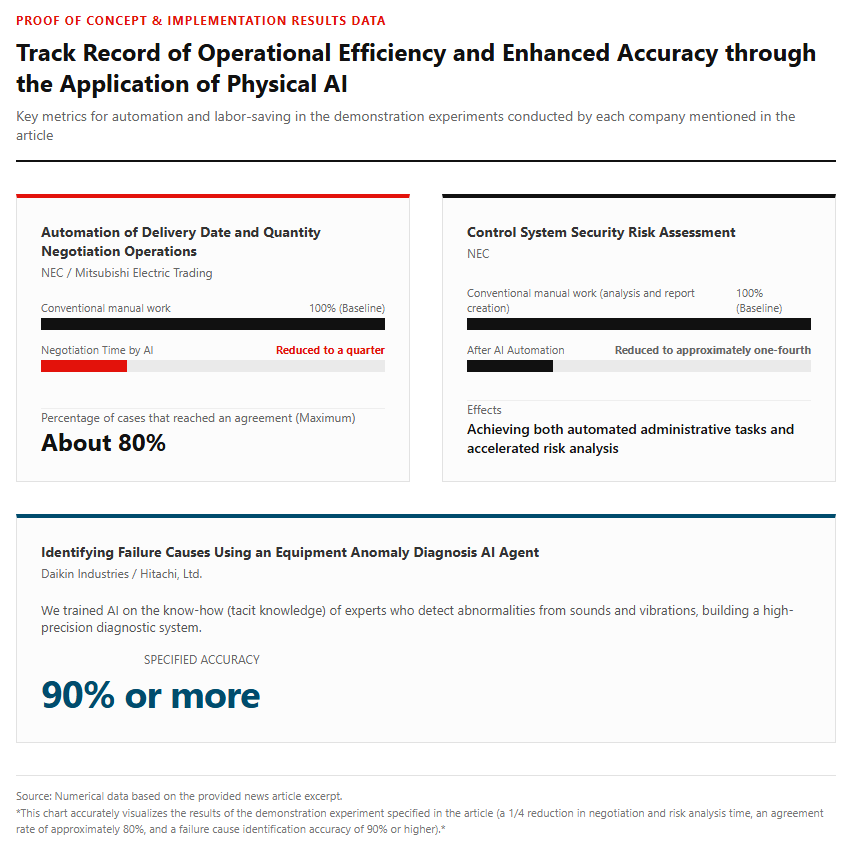
Streamlining operations is seeing the application of Physical AI not only in physical factory work, but similarly in coordination tasks such as procurement and negotiation. NEC has successfully reduced negotiation time to one-quarter of the conventional duration in a joint verification test with Mitsubishi Electric Trading to automate delivery date and quantity negotiations. According to the announcement, by utilizing AI capable of autonomous negotiation in this verification experiment, up to approximately 80 percent of all cases reached an agreement.
Furthermore, NEC has also developed technology to automate security risk assessments for control systems, and has confirmed that it can reduce the time required for risk analysis and report creation to approximately a quarter compared to manual execution. In this way, in systems where the physical and digital spaces are closely integrated, the optimization of on-site work planning and the automation of administrative processes are progressing hand in hand, rapidly driving the optimization of overall operations. The following figure illustrates the time-reduction process by the negotiation automation AI.
Technical Background of Physical AI and Visualization of Tacit Knowledge
Section 2-1: Technologies for Converting Experts’ Intuition and Know-how into Data
The reason why efficiency gains through physical AI are so important right now is because Japanese industry faces the critical issues of a shortage of skilled workers and the extinction of expert craftsmanship. For many years, Japan’s manufacturing industry has been supported by the advanced techniques and tacit knowledge—such as intuition and “knacks”—of experienced artisans. However, due to aging demographics and a decrease in young entrants to the workforce, this knowledge is in danger of being lost before it can be codified into explicit knowledge.
To address this challenge, efforts are underway to digitize tacit knowledge and pass it on to AI. Suzuki has partnered with AI startup Ollo to introduce “Ollo Factory,” a skills transfer system for manufacturing sites, at its domestic plants. The system uses AI to analyze work footage captured by smartphone cameras and other devices, and uses skeleton estimation technology to visualize and standardize the differences in movements between experts and novices, significantly reducing the time required to acquire skills. In addition, Daikin Industries and Hitachi have developed an equipment anomaly diagnosis AI agent, training the AI on the know-how that experienced workers use to detect abnormalities from sound and vibration, thereby building a system capable of identifying the causes of failures with an accuracy of over 90 percent.
Section 2-2: Evolution of the Simulation Space “Sim-to-Real”
In the training of physical AI, the shortage of high-quality on-site data has become a bottleneck for global commercialization. To resolve this data shortage, the utilization of high-definition simulation technology (Sim-to-Real) is essential. FANUC has deepened its collaboration with NVIDIA, making its lineup of robot products compatible with NVIDIA’s simulation platforms, “Omniverse” and “Isaac Sim.”
Developers can train and test AI models by placing robots in photorealistic virtual spaces that faithfully replicate physical laws such as friction, gravity, and lighting conditions. This allows verification to proceed in a virtual space without actually shutting down the factory, dramatically reducing implementation costs and risks. By supporting OpenUSD-based digital twins, equipment and robots from different manufacturers can be handled in an integrated manner within the same environment, facilitating the optimization of the entire factory. An image of building a digital twin in a simulation space is shown below.
Challenges in Practical Application and Future Points to Watch
Section 3-1: Safety, Division of Responsibility, and Labor Union Concerns
On the other hand, the adoption of physical AI also faces several limiting factors, risks, and major challenges such as pushback in the workplace. Because physical AI possesses physical force, misidentifications or misjudgments directly lead not only to factory shutdowns and equipment damage, but also to physical harm to humans. This irreversibility puts the brakes on the speed of implementation. In addition, labor unions harbor strong concerns regarding changes to the employment structure.
Labor unions at South Korea’s Hyundai Motor and Kia are taking a hardline stance, demanding full employment guarantees accompanying the introduction of AI and robots, as well as an upgrade to prior consultation processes. Similarly in Japan, concerning transparency and accountability in AI-based performance evaluations, the IBM Japan labor union filed a petition for relief, leading to a settlement on August 1, 2024, mediated by the Tokyo Metropolitan Labor Relations Commission. The settlement terms include disclosing the titles of all factors considered byেলthe AI, disclosing the AI’s proposed content regarding any questions or doubts, and conducting good-faith labor-management consultations, serving as an important guideline for corporate AI operations going forward.
Section 3-2: From the 2026 Dawn of Physical AI to Full-Scale Adoption in 2030
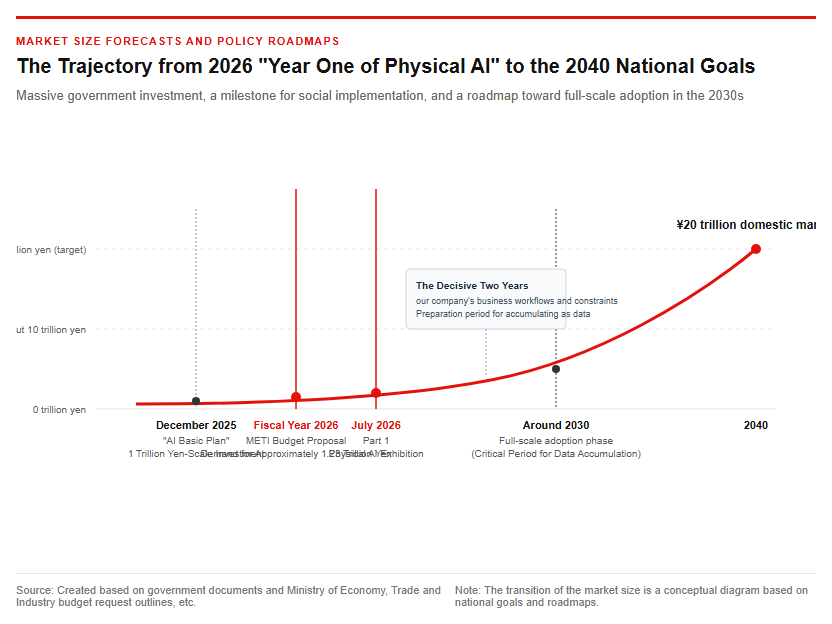
Despite facing these challenges, the Japanese government approved the “Basic Plan for AI” at a Cabinet meeting in December 2025, setting forth a policy to prioritize the development of physical AI alongside an investment scale of approximately 1 trillion yen. Furthermore, in the Ministry of Economy, Trade and Industry’s budget request estimates for fiscal 2026 (Reiwa 8), approximately 1.23 trillion yen has been allocated to the AI and semiconductor fields. With events such as the “1st Physical AI Exhibition” being held at Tokyo Big Sight in July 2026, the year 2026 marked a major milestone for societal implementation as the inaugural year of physical AI.
The government has set a national goal of capturing a 20-trillion-yen domestic market by 2040, but it is considered crucial how the next two years are spent accumulating data for the rapid expansion expected around 2030. Because AI models trained on other companies’ operations will not work if applied as-is to one’s own company, preparing to accumulate internal business workflows, constraints, and decision-making criteria as data will be the deciding factor. The figure below shows the future market size forecast and roadmap.
Reference Page
- [Ministry of Economy, Trade and Industry] Overview of the FY2026 METI-Related Budget Proposals, etc.: https://www.meti.go.jp/main/yosan/yosan_fy2026/index.html
- [Ministry of Economy, Trade and Industry (METI)] AI and Semiconductor Industry Infrastructure Strengthening Framework: https://www.meti.go.jp/policy/mono_info_service/ai_semiconductor_frame/ai_semiconductor_frame.html
- [Rakuten Group] Rakuten Unveils Japan’s Largest High-Performance AI Model, Developed as Part of the GENIAC Project: https://global.rakuten.com/corp/news/press/2025/1218_01.html
- [Sakana AI] Building Foundation Models with Evolutionary Algorithms: https://sakana.ai/evolutionary-model-merge-jp/
- [AIST Solutions] Announcement regarding “ABCI 3.0”: https://www.aist-solutions.co.jp/service/ABCI_3.html
【#PhysicalAI #AIRobotics #IndustrialRobots #Automation #LaborSaving #SmartFactory #DigitalTwin】

コメント