In the large-scale renovation project for the Kamakura Museum of Literature, the bidding price exceeded the estimated price, resulting in another unsuccessful auction. Behind this lies a structural crisis of soaring construction materials and labor costs, which are becoming increasingly severe nationwide.
- Key Points of Construction Project Failures and Current Status
- Challenges and Technical Difficulties in the Bidding Process
- Factors Behind the Surge in Construction Material Prices and Labor Costs
- The Execution Gap Faced by Local Governments
- Questions Surrounding the Demolition of the Former Maeda Residence and Cliff Stabilization Measures
- The opacity surrounding the single-source contract for basic design commissioning
- Procurement Strategies for the Preservation of Historical Resources and Public Investment
Key Points of Construction Project Failures and Current Status
An unsuccessful bidding occurred in the renovation and expansion work for the main building of the Kamakura Museum of Literature, which the City of Kamakura is planning with the goal of reopening in the spring of 2029. The City of Kamakura made an official public announcement for this project on July 16, 2026, and conducted a general competitive bidding process with a deadline of August 6 of the same year. However, as a result of the bid opening, the bidding prices exceeded the expected price, resulting in yet another failure to secure a contract. This project is a large-scale renovation that comprehensively addresses aging countermeasures for the main building—a historic structure built in 1931 (Showa 11) that is approaching 90 years of age—barrier-free improvements such as the installation of elevators, and safety measures for steep slopes on the premises. However, due to the rapid soaring of construction costs, an agreement between the estimated price and market realities could not be reached, and the selection of a construction contractor is facing extreme difficulties. This situation highlights the reality that the budget and schedule set for the renovation work itself significantly diverge from the current volatile market environment, raising major concerns about the future progress of the project schedule.
Challenges and Technical Difficulties in the Bidding Process
The recent failure of the bidding is largely due to the extremely high technical difficulty and specialized nature of the Kamakura Museum of Literature’s renovation project. The main building is a valuable modern residence that retains its original design built in 1936 (Showa 11), and in 1996 (Heisei 8) it was designated as Kamakura City’s Landscape Important Building No. 1, holding significant historical value. The detailed construction history and academic valuation of this building are being elucidated through ongoing research, including the thesis review summary shown in the figure below.
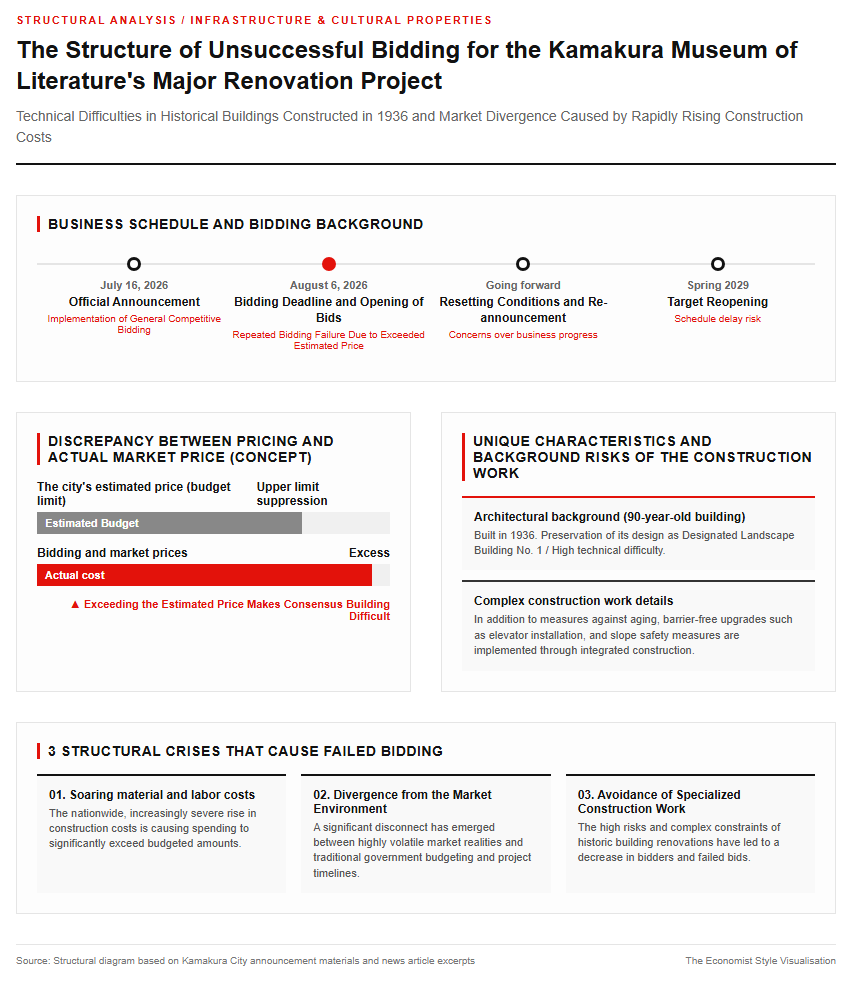
Carrying out construction work to meet modern seismic standards and accessibility requirements without compromising its historical and architectural value requires extremely advanced technical expertise and careful design consideration. In addition, part of the site is designated as a Sediment Disaster Special Caution Zone with a risk of landslides, making the construction management for the accompanying slope protection measures extremely complex. Furthermore, the demolition and removal of the former Maeda Residence, a Western-style building on the site, as well as extension work to newly construct a wooden administration building and a cafe, were commissioned as a single package. Such a combined construction structure of renovation and extension involves high construction uncertainty, forcing contractors to incorporate risk into their estimates, which has been the primary factor driving up bidding prices.
The Structure of Nationwide Public Works Inflation
Factors Behind the Surge in Construction Material Prices and Labor Costs
Behind the failed bidding at the Kamakura Museum of Literature lies severe inflation plaguing public works projects across Japan. Since 2021, driven by global supply chain disruptions and geopolitical risks, the prices of major construction materials have continued to rise sharply. According to estimates by the Japan Federation of Construction Contractors, construction material prices surged by approximately 30 percent between January 2021 and early 2024. Furthermore, the public works design labor cost, which serves as the basis for cost estimation, has been raised for 12 consecutive years, with the nationwide average increase rate for fiscal 2024 hitting a 10-year high of 5.9 percent over the previous year. The nationwide average daily wage has reached approximately 1.4 times its 2015 level of 16,678 yen, climbing to 23,600 yen in 2024. As both material and labor costs are thus being permanently driven up, estimated prices for public projects formulated in the past quickly become obsolete, creating a structural factor that leads to bids exceeding the estimated prices during the bidding process.
The Execution Gap Faced by Local Governments
Under conditions of rapid inflation, the lack of resources and specialized knowledge among local governments to appropriately revise estimated prices—namely, the execution gap—has emerged as a nationwide challenge. While over 80% of large-scale ordering organizations, such as the Ministry of Land, Infrastructure, Transport and Tourism and prefectural governments, take measures such as promptly recalculating estimated prices to match actual market prices or reviewing specifications after public works bidding ends in failure, survey results indicate that this figure remains at less than 30% for basic municipalities at the city, ward, town, and village levels. In Kamakura, too, although a massive budget totaling 2,683,450,000 yen has been allocated for the overall renovation project, it was difficult to perform timely and appropriate estimations that kept pace with wildly fluctuating market prices. Furthermore, administrative psychological constraints associated with accounting inspections—specifically, the tendency to keep estimated prices low out of fear of being criticized for overestimation—also play a role, ultimately triggering a self-perpetuating cycle of commissioning projects with unrealistic low budgets and failed bids.
Contradictions in Renovation Policies and Citizen Concerns
Questions Surrounding the Demolition of the Former Maeda Residence and Cliff Stabilization Measures
On the grounds of the Kamakura Museum of Literature stands the former Maeda residence, a Western-style building constructed in 1971 that was donated by the Kaga Maeda family in 2010. The city has decided to demolish this Western-style building as part of the museum renovation work scheduled to begin in fiscal 2026, citing reasons such as a lack of barrier-free accessibility and its location within a special sediment disaster warning area. However, significant contradictions have been pointed out regarding these reasons for demolition, sparking debate among citizens. In its fiscal 2025 budget, the city has allocated approximately 200 million yen for cliff-side countermeasure expenses to prevent landslides. If this 200 million yen is invested to implement cliff-side countermeasures such as protective walls, the safety of the land will be ensured, and the red zone designation can also be lifted. Despite this, strong criticism persists that the plan to demolish the sturdy reinforced-concrete former Maeda residence at a cost of approximately 70 million yen and newly construct a wooden administration building and rest area on the site is a double expenditure of public funds and is irrational. An urgent petition has also been submitted by citizens demanding that the building be preserved and regenerated in its entirety.
The opacity surrounding the single-source contract for basic design commissioning
The lack of transparency in the procurement process for the renovation project has also become a major issue that is severely shaking public trust in the initiative. On September 28, 2022, Kamakura City concluded a discretionary contract worth 76.01 million yen with a specific contractor, Satow Sogo Keikaku Co., Ltd., for the basic design commission of the Kamakura Museum of Literature renovation. As the reason for this selection, the city explained that it had previously commissioned the company to conduct a deterioration survey and diagnosis from fiscal 2020 to fiscal 2021, and that outsourcing to another company would result in wasted time and expenses due to redundant investigations. However, it has been revealed that a company headed by an individual with personal ties to Mayor Matsuo submitted a bid in the bidding process for that initial deterioration survey. This fact has raised strong doubts about whether fair competition principles were truly functioning, and calls are growing for a thorough investigation through information disclosure and other means, suspecting that it may have been an empty formality designed to justify the subsequent large-scale discretionary design contract.
Future Outlook and the Ideal of Sustainable Public Architecture
As bidding prices exceeded estimates and resulted in another failed tender, concerns are growing over a serious impact on the reopening schedule of the Kamakura Museum of Literature, planned for the spring of 2029. The museum has been closed since April 2023, and delays in starting renovations will directly lead to an even longer period during which citizens and tourists cannot use the facility. To break this deadlock, what is needed is not only a recalculation of estimated prices that faithfully reflects current trends in material prices and labor costs, but also a drastic reform of the bidding system itself. For example, the neighboring city of Yokohama is introducing initiatives starting in fiscal 2026 as a countermeasure against failed bids, such as expanding the scope of re-bidding to 100 million yen or more for construction work and 50 million yen or more for facility work, and revising contractor rating restrictions to establish price brackets in which businesses across multiple ranks can participate. Kamakura City is similarly required to move away from its rigid bidding management of the past and implement flexible and effective countermeasures that lower entry barriers for businesses and prevent tender failures.
Procurement Strategies for the Preservation of Historical Resources and Public Investment
The preservation of historical buildings and the management of public facilities are common challenges facing local governments across Japan, which are grappling with a declining birthrate, an aging population, and severe financial constraints. Although Kamakura City has its own designation system for landscape-important buildings and other structures, the current reality—where valuable historical resources such as the former Maeda residence, donated by the Maeda family in 2010, must be demolished due to management costs, earthquake resistance issues, and the difficulty of barrier-free adaptation—highlights the structural limitations of municipal preservation and utilization capabilities. To prevent the loss of such historical assets, rather than simply repeating cycles of demolition and new construction, it is necessary to establish frameworks that effectively utilize existing stock and regenerate it as hubs for citizen exchange and tourism promotion. Furthermore, in future public investments, a shift toward sustainable procurement strategies is essential, such as leveling construction schedules to reduce the burden on work sites and incorporating citizen-participatory fundraising. The current crossroads facing the Kamakura Museum of Literature poses a weighty question to us on how to reconcile regional culture with sustainable infrastructure development.
Reference Page
- [Regarding the closure and renovation of the Kamakura Museum of Literature] https://www.city.kamakura.kanagawa.jp/b-shisetsu/bungakukan-kyuukan.html
- [Kamakura City Bidding Information Service (Official Announcement Page)] https://ebid-joho.e-kanagawa.lg.jp/DENTYO/GPPI_MENU
【#KamakuraMuseumOfLiterature #FailedBidding #PublicWorks #HistoricBuilding #LocalGovernment #SurgingConstructionCosts #FormerMaedaResidence #KamakuraCity】


コメント