
Nonfarm payrolls surged by 162,000 in August 2026, far exceeding market expectations, according to data released by the U.S. Bureau of Labor Statistics. This robust growth was driven by a strong rebound in service-sector and public education hiring, alongside a welcome rise in the labor force participation rate.
- Nonfarm Payrolls Surge Far Past Market Expectations
- Massive Upward Revisions Erase Recession Fears
- Rising Participation Rates and the Challenge of Long-Term Unemployment
- Rate Hike Speculation Resurges Ahead of September FOMC
- Financial Markets Volatilization Amid Tightening Fears
- Polarized Hiring and the Footprint of Artificial Intelligence
- Gen AI and the Growing Barriers to Entry-Level Employment
Nonfarm Payrolls Surge Far Past Market Expectations
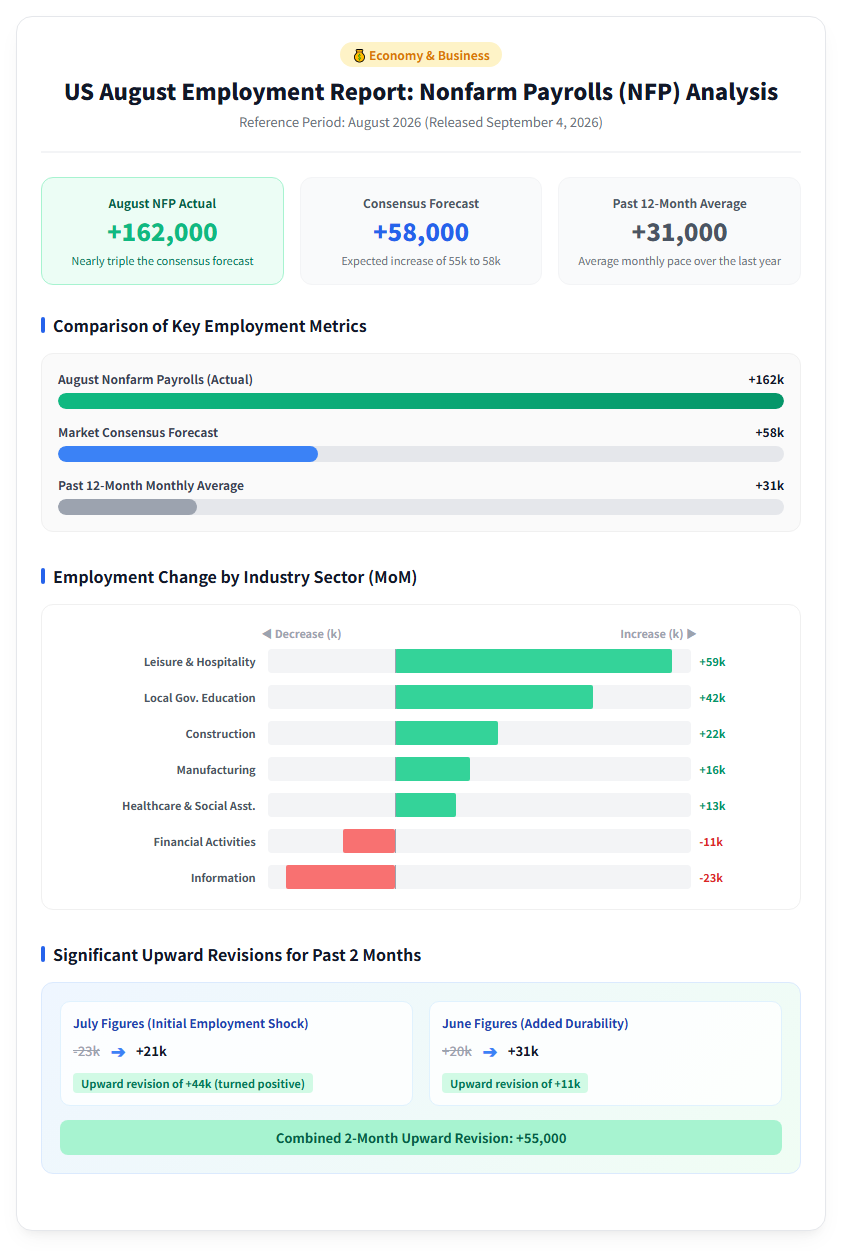
The U.S. Bureau of Labor Statistics announced on September 4, 2026, that nonfarm payrolls grew by 162,000 in August. This remarkable figure nearly tripled the consensus market forecast of 55,000 to 56,000, representing a significant upward deviation from recent trends. To put this expansion into perspective, the average monthly job gain over the preceding twelve months stood at a modest 31,000. This growth spurt was primarily propelled by service industries and local government entities. Leisure and hospitality led the private sector expansion, adding 59,000 jobs, driven largely by restaurants and drinking establishments that capitalized on resilient late-summer consumer demand. Meanwhile, local government education payrolls rose by 42,000, virtually offsetting the declines recorded in previous months. Overall, the August report underscores the fundamental durability of the broader U.S. economy. Please refer to the following dashboard for a detailed breakdown.
Massive Upward Revisions Erase Recession Fears
Another highly significant revelation in the August report was the substantial upward revision of employment data for the preceding two months. Specifically, June payrolls were revised upward from an initial estimate of 20,000 to 31,000, while July payrolls, which had sparked widespread panic with an initially reported contraction of 23,000, were revised to a positive gain of 21,000. Combined, these revisions added 55,000 jobs to the historical record, effectively erasing the narrative of a deteriorating labor market that had dominated financial headlines a month prior. The three-month moving average, which smooths out monthly volatility, consequently recovered to 71,000 from the previously alarming level of 20,000. This stabilization strongly suggests that the U.S. economy is navigating a path toward a soft landing rather than entering a sharp downturn, reinforcing the need for investors to remain focused on longer-term structural trends rather than preliminary data releases.
Rising Participation Rates and the Challenge of Long-Term Unemployment
The U.S. unemployment rate, derived from the household survey, held steady at 4.1% in August. Crucially, this stability represents a highly positive development because it was accompanied by a rise in the labor force participation rate, which climbed from 61.4% to 61.6%. Unlike previous months where declining unemployment was artificially driven by discouraged job seekers exiting the labor market, this month saw an influx of individuals actively returning to search for work. In another positive sign, the number of employees working part-time for economic reasons, often referred to as involuntary part-time workers, declined by 414,000. Nonetheless, structural challenges persist. The number of long-term unemployed individuals who have been out of work for 27 weeks or more rose by 159,000, pushing the median duration of unemployment to 11.4 weeks. This divergence highlights a growing friction in the labor market, where long-term job seekers face elevated barriers to re-entry despite overall robust hiring.
Monetary Policy Outlook and Market Realignments
Rate Hike Speculation Resurges Ahead of September FOMC
The stronger-than-expected labor data immediately reshaped market expectations surrounding the Federal Reserve’s monetary policy trajectory. Anticipation of rate cuts or a pause at the upcoming Federal Open Market Committee meeting scheduled for September 15 to 16 deteriorated rapidly. The implied probability of a 25-basis-point rate hike rose to roughly 60%, specifically 60.4% according to the CME FedWatch Tool, up from approximately 49.4% prior to the release. In response to this economic resilience, Citigroup abandoned its previous forecast of near-term monetary easing in late 2026. The bank now expects the Federal Reserve to hold interest rates steady until mid-2027, projecting three consecutive 25-basis-point rate cuts starting only in June 2027, followed by further reductions in September and December. Meanwhile, political pressures continue to mount; former President Donald Trump publicly demanded rate cuts on social media, threatening to halt trade with nations running large surpluses with the U.S. if the Federal Reserve does not comply. Against this complex backdrop, the Consumer Price Index data scheduled for release on September 11 will serve as the final decisive metric for the central bank.
Financial Markets Volatilization Amid Tightening Fears
In the immediate aftermath of the jobs report, financial markets experienced a classic risk-off realignment driven by surging yield expectations. In the fixed-income market, the policy-sensitive 2-year U.S. Treasury yield spiked from 4.37% to a temporary peak of 4.41%, reaching its highest level since January 2025, while the 10-year Treasury yield climbed to the 4.80% threshold. Equity markets retreated under the weight of elevated borrowing costs, with the Dow Jones Industrial Average dropping 271.86 points, or 0.5%, to close at 53,414.25, and the S&P 500 falling by 0.4%. The foreign exchange market witnessed intense volatility; the US Dollar initially surged against the Japanese Yen, rising from the 156.00 level to 156.75, before aggressive yen-buying pressures linked to Bank of Japan tightening expectations dragged the pair back down to a low of 155.36, eventually settling near 156.26. Alternative assets also faced downward pressure, with gold prices retreating sharply, and Bitcoin temporarily dipping below the \$80,000 mark.
Structural Shifts and the Shadow of Technological Automation
Polarized Hiring and the Footprint of Artificial Intelligence
While the aggregate headline figures present a picture of a robust labor market, granular industry data reveals a deep polarization. Physical-labor-intensive sectors such as manufacturing, construction, and healthcare demonstrated continued resilience, adding jobs steadily. Conversely, the information sector lost 23,000 jobs, while financial activities saw a decline of 11,000 payrolls, primarily driven by contractions within the finance and insurance subsectors. Many economists attribute this persistent stagnation in white-collar and knowledge-intensive industries to the rapid integration of generative artificial intelligence. As enterprises deploy AI models to automate routine cognitive tasks such as basic data processing, technical documentation, and administrative reporting, administrative headcount requirements are being structurally reduced. This shift marks an early but distinct sign of a broader restructuring occurring within high-exposure white-collar professions.
Gen AI and the Growing Barriers to Entry-Level Employment
A comprehensive research paper published by the Stanford Digital Economy Lab in August 2026, titled Canaries in the Coal Mine?, offers empirical evidence of how generative AI is shifting labor dynamics. The study reveals that while AI exposure has not triggered mass layoffs among incumbent workers, it has created a severe hiring slowdown that disproportionately affects young professionals aged 22 to 25. Specifically, employment of young workers in highly AI-exposed occupations stands 19% below the level it would have reached had it kept pace with their peers in low-exposure roles. This divergence has steadily widened since the introduction of ChatGPT in late 2022. As illustrated in the following diagram, the employment trajectories of younger and older cohorts have drifted dramatically apart in highly exposed fields.
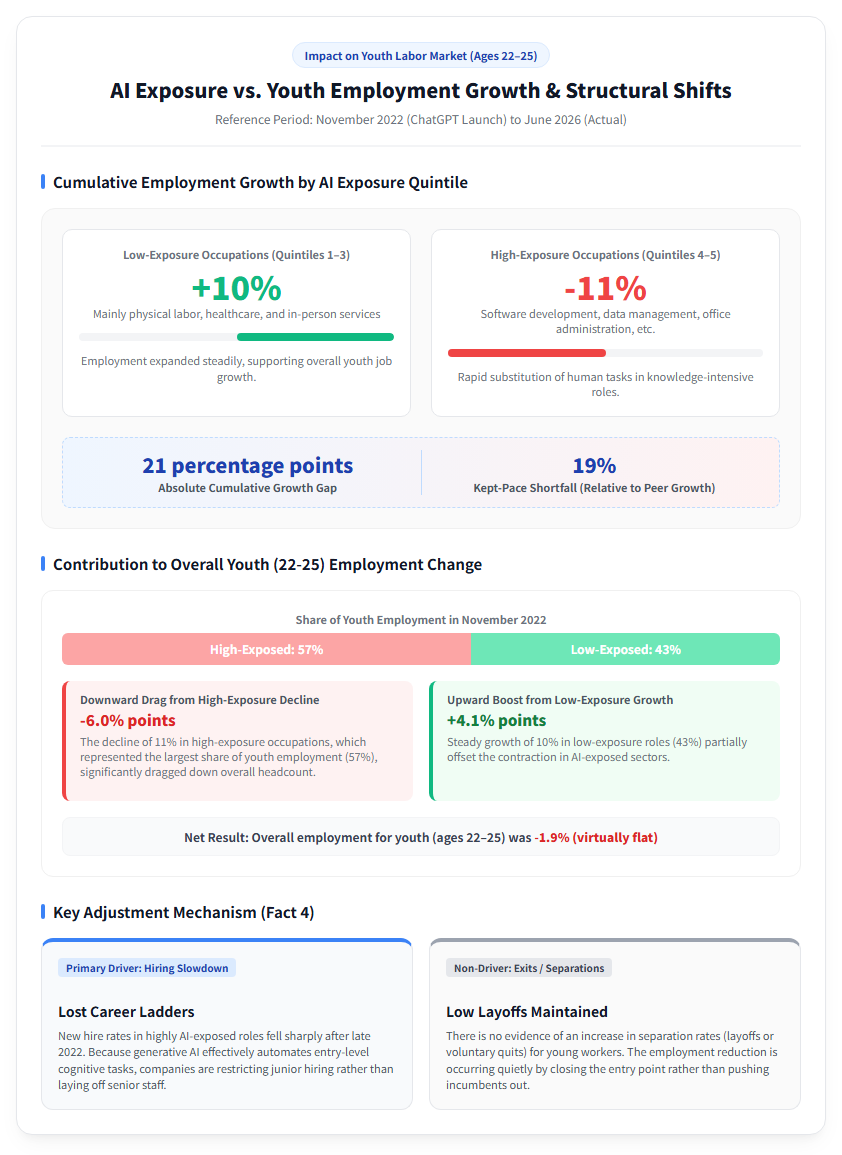
This phenomenon is driven by a pronounced hiring slowdown rather than increased job separations. Because generative AI tools excel at executing entry-level tasks, corporations are leveraging the technology to enhance the productivity of experienced senior staff while severely restricting the intake of junior employees, raising profound concerns about the long-term viability of traditional career ladders.
References
- 【U.S. Bureau of Labor Statistics “The Employment Situation — August 2026″】https://www.bls.gov/news.release/empsit.nr0.htm
- 【Stanford Digital Economy Lab “AI Economic Indicators”】https://digitaleconomy.stanford.edu/project/indicators/
【#US_Employment #Labor_Market #Monetary_Policy #FOMC #Interest_Rates #Generative_AI #Youth_Employment #Economy】


コメント