In collaboration with the Financial Services Agency, the Children and Families Agency launched the “Kodomo Mannaka Leading Bank” initiative, offering financial support to businesses promoting child-rearing assistance. By providing low-interest loans and management consulting through regional financial institutions, the program aims to foster a virtuous cycle connecting corporate growth with enhanced support for child-rearing.
- First Selection of 14 Regional Financial Institutions Nationwide in July 2026
- Hands-On Support and Financing Development Expected from Regional Financial Institutions
- The Child-Related Market Expands to ¥10.9 Trillion Amid Accelerating Declining Birthrates
- Low-Interest Loans and Management Consulting Benefits for Local SMEs
- Establishing a Sustainable Financial Model Beyond Government Subsidies
- Potential Regional Certification, Tax Incentives, and Preferential Public Procurement
First Selection of 14 Regional Financial Institutions Nationwide in July 2026
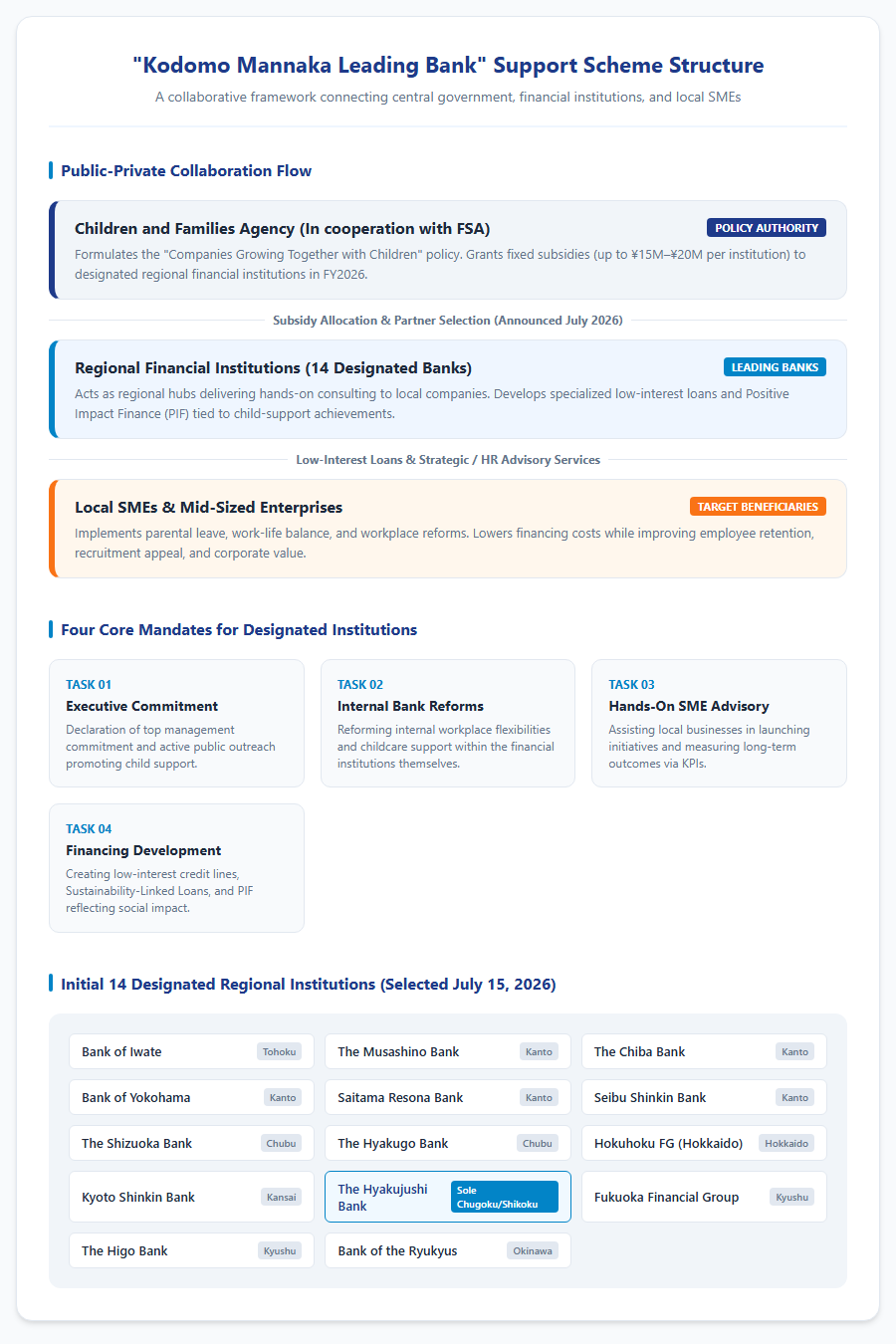
On July 15, 2026, the Children and Families Agency, in cooperation with the Financial Services Agency, hosted the “Kodomo Mannaka Leading Bank Announcement Event” to officially disclose 14 regional financial institutions selected under the FY2026 subsidy program for promoting the “Companies Growing Together with Children” initiative. High-profile officials, including Hitoshi Kiyokawa, Minister of State for Child Policies, and Satsuki Katayama, Minister of State for Financial Services, attended the event, signaling unified momentum between the central government and financial institutions. The underlying “Companies Growing Together with Children” concept seeks to enhance corporate value by supporting children, youth, and child-rearing families. The designated institutions include Bank of Yokohama, The Chiba Bank, The Musashino Bank, The Bank of Iwate, The Shizuoka Bank, Kyoto Shinkin Bank, Seibu Shinkin Bank, The Hyakugo Bank, The Hyakujushi Bank, Fukuoka Financial Group, The Higo Bank, Hokuhoku Financial Group (Hokkaido Bank), Bank of the Ryukyus, and Saitama Resona Bank. Notably, The Hyakujushi Bank, the sole selected institution in the Chugoku and Shikoku regions, announced plans to provide specialized consulting in partnership with the Kagawa Labor and Social Security Attorney Association and launch Positive Impact Finance (PIF) tailored for child-supportive companies. Serving as regional hubs, these financial institutions establish a direct pipeline for capital and strategic expertise to local small and medium-sized enterprises (SMEs). Please refer to the diagram below.
Hands-On Support and Financing Development Expected from Regional Financial Institutions
Regional financial institutions designated as “Kodomo Mannaka Leading Banks” are tasked with providing multifaceted hands-on consulting that goes far beyond conventional lending. According to the application guidelines for FY2026, selected institutions must identify local business challenges and support needs within their operating areas while delivering hands-on advisory services to local enterprises. Specifically, they are expected to fulfill four core duties: securing leadership commitment from corporate executives, reforming internal policies within the financial institutions themselves, providing hands-on launch and operational advisory for corporate child-rearing initiatives, and developing as well as distributing specialized investment and loan products focused on children and child-rearing. The central government provides a fixed grant of up to 15 million yen per institution (scaling up to 20 million yen in budget estimates) to fund product development and support infrastructure. Furthermore, financial institutions assist client companies in establishing key performance indicators (KPIs) and evaluating outcomes, such as reduced employee turnover and increased brand recognition. By offering end-to-end guidance from initial management consultation to performance evaluation, the program helps local SMEs build self-sustaining child-supportive business environments.
Background, Market Environment, and Corporate Benefits of the Policy
The Child-Related Market Expands to ¥10.9 Trillion Amid Accelerating Declining Birthrates
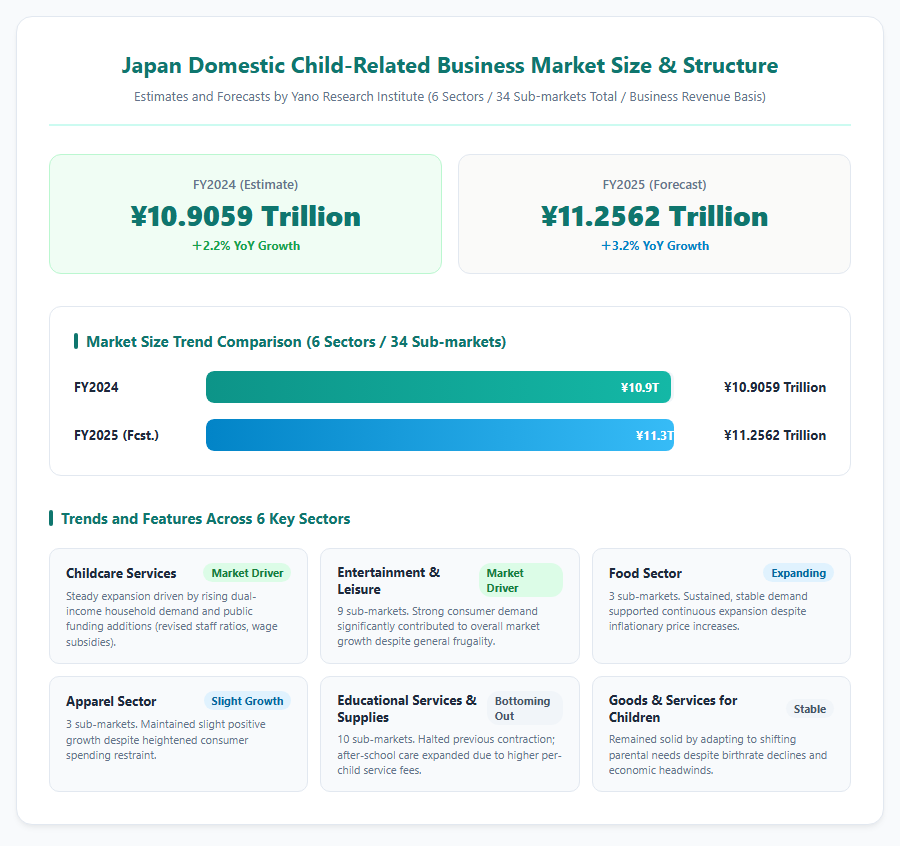
Government efforts to mobilize corporate investment in child-rearing support stem from the urgent need to address declining birthrates alongside the steady expansion of child-related markets. According to a market survey by Yano Research Institute, the domestic child-related market across 34 sub-markets in six sectors reached an estimated 10.9059 trillion yen (approximately 10.9 trillion yen) on a business revenue basis in FY2024, representing a 2.2% year-on-year increase. Despite growing consumer frugality driven by inflation, the market remains resilient, propelled by rising childcare demand among dual-income households and strong sales in entertainment and leisure. The childcare services sector in particular benefited from sustained public funding additions and the FY2024 regulatory revisions that improved childcare worker placement ratios and boosted wage subsidies. Public demand for improved workplace flexibility and family-friendly community environments is exceptionally high, making corporate investments in child support directly advantageous for talent acquisition and brand equity. Consequently, the government is expanding financial backing to reinforce this positive feedback loop between societal value creation and corporate growth. Please refer to the diagram below.
Low-Interest Loans and Management Consulting Benefits for Local SMEs
Participating in the “Kodomo Mannaka Leading Bank” framework offers substantial financial and managerial benefits to regional SMEs. Historically, many smaller enterprises viewed employee childcare benefits and work-life balance programs as additional overhead, making them difficult to prioritize. Under the new framework, accredited companies gain access to preferential low-interest loans and specialized financing options from designated banks. Financial institutions are rolling out tailored products, such as Sustainability-Linked Loans, loans with interest rates tied to social impact targets, and dedicated credit facilities evaluating corporate child-support efforts. Beyond financial terms, SMEs receive expert consulting on labor policies, including paternity leave promotion, employment rule revisions, and workplace flexibility adjustments. This operational advisory equips resource-constrained SMEs with the tools to modernize their working environments, lower employee attrition, and strengthen their recruitment appeal.
Medium- to Long-Term Outlook and Key Points for Future Expansion
Establishing a Sustainable Financial Model Beyond Government Subsidies
A central medium- to long-term objective of the program is achieving financial self-sustainability independent of state subsidies. While the Children and Families Agency provides initial grants to cover product development and consulting setup costs for regional banks, the overarching goal is establishing a market-driven financial model. For financial institutions, empowering client SMEs to secure talent and reinforce business foundations stabilizes loan portfolios and deepens long-term client relationships, contributing directly to regional banking sustainability. Moreover, cultivating family-friendly regional environments encourages young populations to settle locally, fueling broader economic vitality. In its FY2026 budget request, the Children and Families Agency requested 600 million yen for the “Project to Support and Build Environments for Corporate Initiatives Toward a Child-Centered Society,” reflecting continuous commitment to building private-sector-led operational infrastructure.
Potential Regional Certification, Tax Incentives, and Preferential Public Procurement
A major point of interest moving forward is the potential introduction of new corporate certification schemes and institutional incentives by government bodies. Discussions are underway regarding a national “Regional Enterprise Certification” to formally recognize companies demonstrating outstanding child-rearing support, accompanied by potential tax relief measures. Tax incentives would significantly lower capital expenditure and talent investment burdens for SMEs, encouraging broader corporate participation. Furthermore, policymakers are evaluating the inclusion of certified companies in public procurement scoring mechanisms. Similar preferential treatment already exists for companies holding “Eruboshi” (women’s workplace empowerment) or “Kurumin” (childcare support) certifications; extending these advantages to regional child-supportive enterprises would provide a substantial competitive edge in government bidding. Concrete eligibility criteria and implementation timelines are expected to be clarified during upcoming Cabinet decisions and budgetary deliberations, making policy tracking essential for forward-looking businesses.
Reference Pages
- [Children and Families Agency Official Website] https://www.cfa.go.jp/top
- [Yano Research Institute Press Release] https://www.yano.co.jp/press-release/show/press_id/3881
【#ChildrenAndFamiliesAgency #ChildRearingSupport #FinancialSupport #RegionalFinancialInstitutions #SMEs #LowInterestLoans #KodomoMannaka #EconomicNews】

コメント