Chinese smart home brand CHiQ was honored with the AI Home Ecosystem Brand Award at IFA 2026. This milestone is backed by rapid technological innovations within the Chinese consumer electronics industry and a strategic localization approach that harmonizes cultural values with user privacy considerations.
- 1-1: Honoring Practical AI Integration in Everyday Life
- 1-2: A Closer Look at the AI Capabilities of CHiQ’s Flagship Appliances
- 2-1: Distinct Design Philosophies Shaped by Collectivism and Confucian Values
- 2-2: The Product Developer’s Dilemma: Balancing Privacy with User Experience
- 3-1: Blending Sport, Culture, and Local Lifestyles to Penetrate European Markets
- 3-2: Generative AI and the Horizon of Autonomous Smart Home Automation
1-1: Honoring Practical AI Integration in Everyday Life
On September 4, 2026, at IFA 2026—the world’s largest consumer electronics trade show held in Berlin, Germany—CHiQ, an international smart home brand under Sichuan Changhong Electric Co., Ltd., was honored with the prestigious AI Home Ecosystem Brand Award. This accolade was presented as part of the Global Product Technical Innovation Awards (GPTI Awards), which was co-founded in 2014 by the International Data Group (IDG) and the German Chambers of Commerce and Industry (DIHK). CHiQ earned this recognition for its outstanding achievement in building an AI-powered global smart home ecosystem that seamlessly interconnects individual smart devices, offering highly practical real-world utility. This milestone reflects the rapid growth of China’s global smart manufacturing sector. In the first half of 2026, China’s total household appliance export volume reached 360.96 billion RMB, highlighting an industry-wide structural shift away from low-cost product manufacturing toward high-tech, proprietary brand expansion. CHiQ’s triumph at this year’s awards epitomizes this new era of technological exports for the Chinese consumer electronics industry.
1-2: A Closer Look at the AI Capabilities of CHiQ’s Flagship Appliances
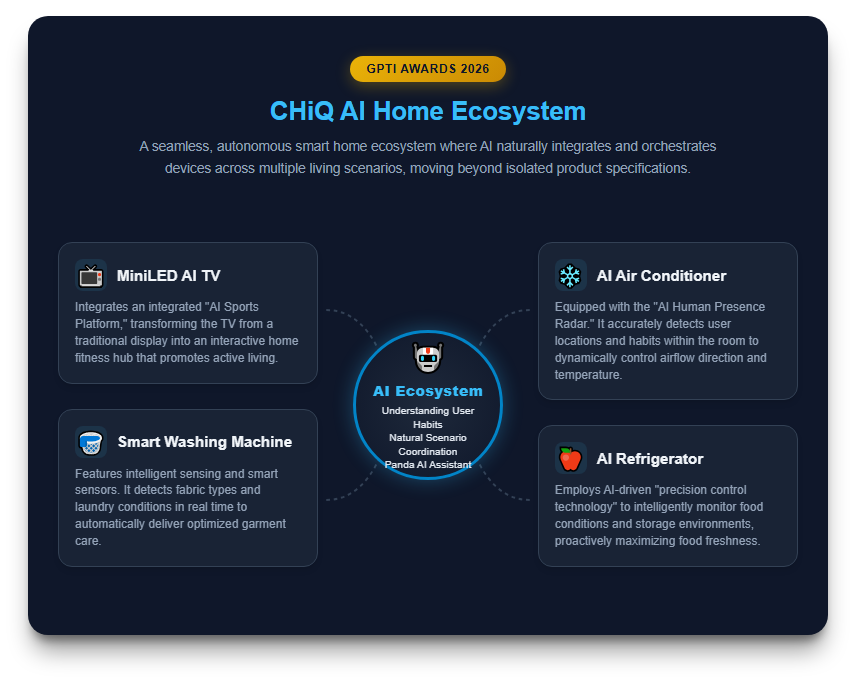
At IFA 2026, CHiQ unveiled a comprehensive new product portfolio of AI-powered flagship appliances, spanning televisions, refrigerators, washing machines, and air conditioners. Each product integrates cutting-edge sensor technology with proprietary AI algorithms, both independently and within an interconnected ecosystem. For instance, the RGB MiniLED AI TV line features an integrated AI Sports Platform, turning the television into an interactive home fitness hub that promotes active living. The latest air conditioners are equipped with the AI Human Presence Radar, which accurately detects users’ locations and habits within a room to dynamically adjust airflow direction and temperature. Furthermore, the AI refrigerator utilizes intelligent precision control technology to maximize food freshness, while the smart washing machine offers optimized garment care through intelligent fabric and load sensing. By moving beyond isolated product specifications, this seamless device orchestration brings the vision of next-generation smart living into reality. Please refer to the diagram below illustrating how these technologies coordinate and operate in everyday household scenarios.
Chapter 2: User Acceptance and Cultural Context in Smart Home Automation
2-1: Distinct Design Philosophies Shaped by Collectivism and Confucian Values
The way smart home AI technologies are accepted varies significantly across different cultural landscapes. In China, where smart home adoption surpassed 78 million households in 2023, product design is profoundly influenced by unique local social norms. According to academic research, Chinese smart home development is deeply intertwined with collectivist values and Confucian principles such as filial piety (xiao), prioritizing family harmony over individual autonomy. For example, “family supervision devices” designed to assist parents in monitoring and caring for their children or elderly family members are highly favored in the Chinese market. In the case of smart desk lamps equipped with monitoring sensors for children, parents welcome the supervision capabilities, while children—raised in a culture that respects parental authority—rarely view this as an invasive breach of privacy. This dynamic stands in stark contrast to Western design standards, which prioritize individual privacy and personal autonomy, serving as a compelling example of culturally-grounded product localization.
2-2: The Product Developer’s Dilemma: Balancing Privacy with User Experience
Despite its benefits, AI-driven automation presents a structural dilemma for developers who must balance data privacy with user experience (UX) convenience. In a semi-structured interview study of 27 Chinese smart home product team members, participants highlighted that while data compliance is prioritized early in the design cycle to align with regulations like China’s Personal Information Protection Law (PIPL, enacted in 2021), a distinct “development paradox” emerges during testing. When developers implement strict privacy safeguards—such as requiring complex security passwords or relying entirely on localized, decentralized data processing—they often receive negative feedback and low ratings from users complaining about cumbersome setups. For users to enjoy the true convenience of smart living, product teams must deploy sophisticated privacy engineering, such as real-time video processing that deletes data immediately after streaming, while maintaining seamless, friction-free operations.
Chapter 3: Localization Strategies and the Future of the Smart Home Ecosystem
3-1: Blending Sport, Culture, and Local Lifestyles to Penetrate European Markets
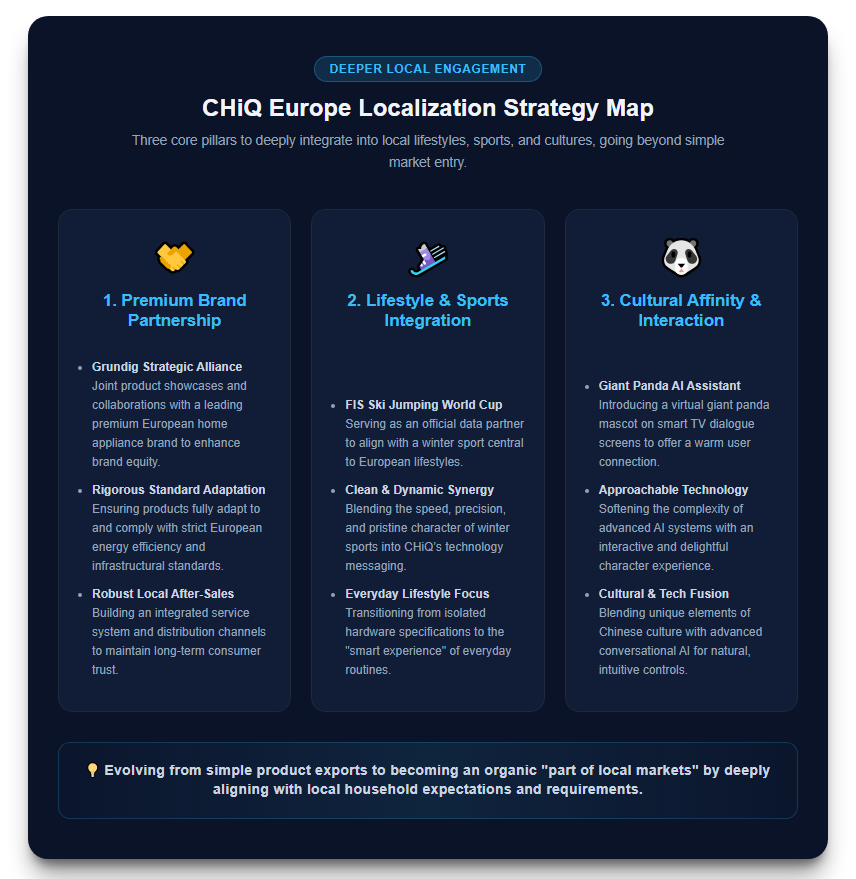
When expanding internationally, adapting to the local lifestyle and culture of each market is just as vital as building a flawless product. To establish a strong foothold in Europe, CHiQ entered a strategic partnership with Grundig, a premium European home appliance brand. This collaboration allowed CHiQ to deeply align with European energy standards, customer service infrastructure, and distribution networks. To connect with local consumers on a personal level, CHiQ became the official data partner of the FIS Ski Jumping World Cup, associating its brand with the clean, fast-paced, and dynamic nature of winter sports. Additionally, CHiQ introduced a playful, panda-inspired virtual AI assistant on its smart TVs and other connected appliances, incorporating a warm element of Chinese culture to make smart interactions more approachable. This thoughtful strategy softens the complexity of advanced technology, delivering an intuitive and culturally resonant smart home experience to diverse global audiences. Please see the image below capturing the brand’s local partnerships and promotional efforts.
3-2: Generative AI and the Horizon of Autonomous Smart Home Automation
The future of smart home automation (SHA) lies in transitioning from static, schedule-based routines to context-aware, autonomous environments that adapt to individual life patterns. According to a July 2024 survey of 167 non-users of home automation, many consumers hesitate to adopt smart home services due to the perceived complexity of configuring trigger-action rules and managing ongoing maintenance. To dismantle these barriers, leading manufacturers like CHiQ and academic researchers are exploring the integration of generative AI and Large Language Models (LLMs) into smart home platforms. By utilizing natural language dialogues, users can orchestrate their entire home appliances seamlessly without writing complex logical parameters. Securing robust data governance while evolving these highly personalized, conversational AI ecosystems represents the next major milestone for the global smart living market.
References
- 【PR Newswire Press Release】https://www.prnewswire.com/jp/news-releases/chiqai-home-ecosystem-brand-awardai-302870175.html
- 【PLOS ONE Academic Article】https://doi.org/10.1371/journal.pone.0352183
【#SmartHome #AITechnology #IFA2026 #TechnologicalInnovation #DataPrivacy #ChinaConsumerElectronics】

コメント