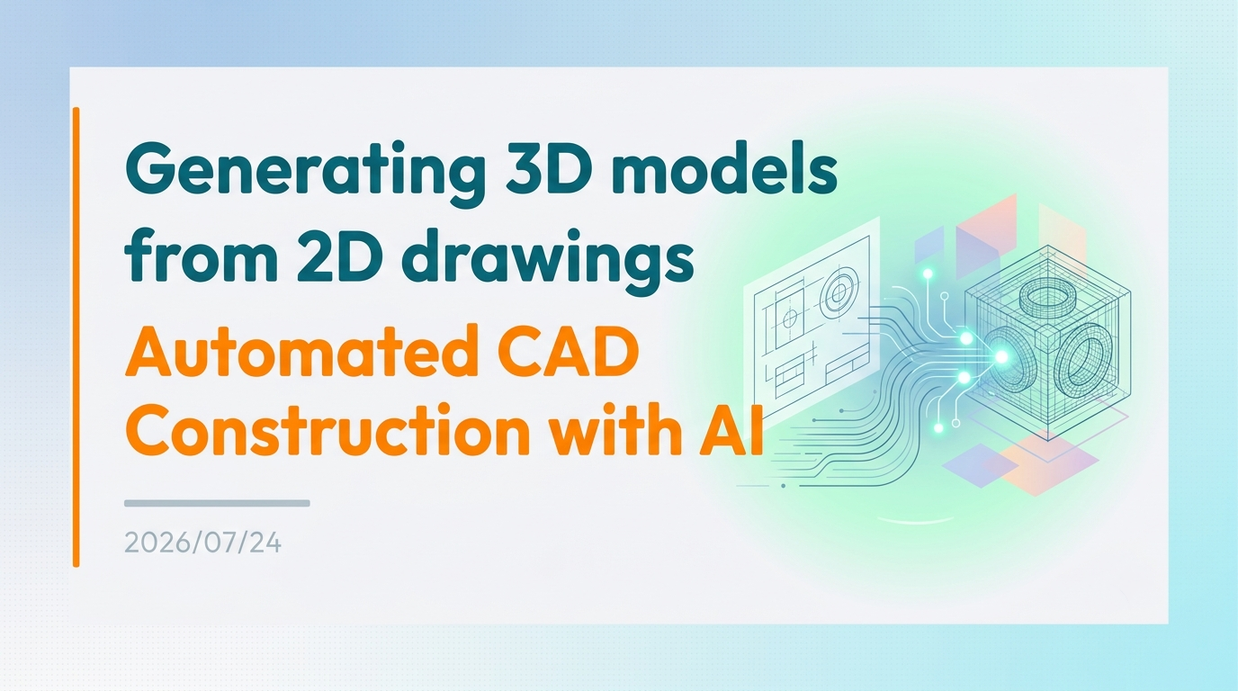
renue Inc. has announced the AI “Drawing Agent,” which autonomously generates 3D CAD models from 2D drawings. By repeatedly repeating the cycle of “analysis, modeling, evaluation, and improvement,” AI has greatly streamlined traditional manual tasks and reached a practical stage where even mechanical movements are replicated.
- Overview and Background of Drawing Agents
- The autonomous cycle of “self-correction” that supports accuracy
- Integration of CAE functions and extraction of structured data
- Movable assembly that realizes a “moving model”
- Comparison with existing methods and verification for implementation
- Linking to business workflows and maximizing ROI
- Future Outlook and Key Points for Manufacturing Sites
Overview and Background of Drawing Agents
Drawing Agent, announced by renue Inc. in March 2026, is a service with the potential to dramatically transform the use of 2D drawings in manufacturing. Simply upload images (PNG, JPG), PDF, or CAD data such as DXF or DWG into your browser, and the AI agent will automatically generate a 3D model. The output formats include the STEP format, which can be opened in major 3D CAD software such as SolidWorks, Fusion, and Inventor, as well as web-friendly formats like STL and GLB. A notable feature of this technology is that it goes beyond simple image conversion, generating “typed CAD” as B-Rep solids. This allows the generated model to be re-edited while retaining its dimensions and operational history, making it highly practical in design settings. Modeling tasks that traditionally required skilled CAD operators to spend hours or days completing them in just a few minutes with AI now simultaneously shortens design time and cut costs. Please refer to the diagram below.
The autonomous cycle of “self-correction” that supports accuracy
What sets Drawing Agent apart from other 2D drawing conversion tools is its “self-correction loop,” where AI checks quality and performs corrections automatically. While typical AI tools generate data in a single shot, Drawing Agent uses Claude Opus to read dimensional and part information from drawings, and a deterministic compiler assembles the CAD model based on that information. The generated model is visualized as renderings and cross-sectional drawings in eight directions, and Gemini scores the quality by comparing these images with the original drawings. If the quality goals are not met, the AI automatically adjusts parameters and runs up to 10 improvement cycles to converge the drawings into the optimal shape. This system enables AI to self-report uncertain areas in orange, successfully reducing human review workload by about 80%. The generation process flows as follows.
Seamless process from design to structural analysis and mechanism verification
Integration of CAE functions and extraction of structured data
With the May 2026 update, Drawing Agent expanded its capabilities from simple shape generation to practical design verification. A CAE function (β version) has been added to the generated 3D model, which specifies fixed surfaces, loads, and materials for structural analysis. AI automatically estimates boundary conditions and material information from drawings, and performs analyses using built-in data from steel (SS400, SUS304), aluminum, resin, and more. This enables rapid strength assessment before using full-scale analysis software, and is expected to reduce pretreatment labor by about 60–70%. Furthermore, for complex products like sneaker rubber outsoles where multiple parts or materials are combined, we achieve high precision by eliminating noise and automatically decomposing materials by material, which cannot be achieved through batch processing. Below is an example of how the analysis results are displayed.
Movable assembly that realizes a “moving model”
In July 2026, Drawing Agent released a “movable assembly” feature that reads joint information from assembly drawings and reproduces movements. This is a groundbreaking technology where AI automatically extracts rotation axes and range of motion from rotary arrows and articulation charts drawn on drawings. For example, if you upload a hinge drawing, you can use the slider on the screen to see how two plates rotate around the pin axis. AI actually runs the generated model to verify it, checking whether joints are loose or rotation centers are not shifted during operation. Furthermore, it supports output in the URDF format standard used in robot development and MJCF format for physical simulation, allowing data including mass and inertial tensors to be directly transferred to the simulation environment. Below is an operation screen to check the mechanism’s movement.
Development and Key Points as the Foundation for Manufacturing DX
Comparison with existing methods and verification for implementation
As of 2026, there are several approaches to 3D 2D drawings, including autonomous tool types like Drawing Agent, interactive agents from bestat, and TRANDIM, a facility-specific tool jointly developed by Sanki Kogyo and WOGO. To effectively 3D your company’s drawing assets, it is essential to verify specific patterns during the PoC (proof of concept) phase. In particular, it is important to verify its ability to handle five common patterns frequently occurring in the field: distortion from scans of old paper drawings, mismatches with changed tolerances, symmetrical parts, material differences, and cases where CAD originals and paper scans coexist. Drawing Agent is designed to integrate with production management, ERP, and existing CAD systems via API, supporting automation across departmental workflows beyond one-time conversion tasks. The main service comparison table is as follows.
Linking to business workflows and maximizing ROI
In 2026, AI for 3D rendering of 2D drawings has clearly transitioned from the research stage to the practical stage. The value of this technology lies not only in reducing design time but also in reusing vast past drawing assets as 3D data to connect to factory digital twins and equipment layout simulations. Additionally, by instantly converting 2D drawings into 3D models and sharing shapes during customer proposals, it has been reported that consensus building during the sales phase is accelerated, reducing rework after receiving orders. When implementing the system, it is important to estimate annual costs not only by license fees but also by including hidden costs such as man-hours for building integration with existing systems and training on-site team members. If processing exceeds 100 pages per month is continuously required, subscription or custom types tend to lower unit costs more easily than data-driven models.
Future Outlook and Key Points for Manufacturing Sites
Looking ahead to Drawing Agent, plans include further complex combinations of multi-joint mechanisms and improved accuracy in handling diverse mechanical elements. Currently, in addition to the official release of the β structural analysis and assembly functions, we aim to develop into a platform that seamlessly connects drawings and simulation by strengthening integration with physical simulation environments. In manufacturing sites, since 2D drawings remain the primary means of information transmission, the widespread use of 3D digitization—including not only shapes but also “movement”—is expected to significantly lower the barriers to digital twin maintenance. The evolution of AI not only by refining the “appearance” but also into “on-site AI” that autonomously verifies structural feasibility will be a crucial turning point for Japan’s manufacturing industry, which is struggling with labor shortages.
Reference Page
-
【Drawing Agent — 2D drawings to 3D CAD, automatically】https://drawing-agent.com/ja
-
[renue Achieves High-Precision 3D Model Generation with Drawing Agent, Adds Automatic Decomposition and Structural Analysis by Material and Part (CAE Function β Version) – PR TIMES] https://prtimes.jp/main/html/rd/p/000000041.000091210.html
-
[Drawing AI ‘Drawing Agent’ releases ‘movable assembly’ feature that generates 3D models of moving joints – PR TIMES] https://prtimes.jp/main/html/rd/p/000000056.000091210.html
-
[Automatically converting 2D drawings into 3D models with AI | Explanation of major services, domestic case studies, and PoC verification patterns – AI Research Institute] https://www.ai-souken.com/article/2d-to-3d-ai-conversion
-
[Sanki Kogyo × Jointly developed the dedicated editing software ‘TRANDIM’ that automatically generates 3D models from 2D drawings of WOGO equipment https://www.sanki.co.jp/news/release/article634.html
[#製造業 #AIエージェント #3DCAD #デジタルツイン #DX #自動化 #エンジニアリング #科学技術]

コメント