
On September 15, 2026, TypeSafe AI, led by former OpenAI researcher Diogo Almeida, unveiled “Jev,” a groundbreaking AI model designed without text generation capabilities. By leveraging a parallel processing approach fundamentally distinct from traditional LLMs, Jev achieves ultra-fast performance and dramatic cost reductions while maintaining task execution quality comparable to GPT-5.6 Terra.
- 1. Founder Diogo Almeida and the Announcement of “Jev”
- 2. The Core Concept of “System One Models”: Breaking the Bottlenecks of LLMs
- 1. Eradicating Hallucinations via Parallel Processing and Confidence Scores
- 2. Unprecedented Cost Performance at $0.042 per Million Input Tokens
- 1. Real-Time Responsiveness in Action: The Doom and Wikipedia Demos
- 2. The Future of Software Development: Key Trends and Outlook
1. Founder Diogo Almeida and the Announcement of “Jev”
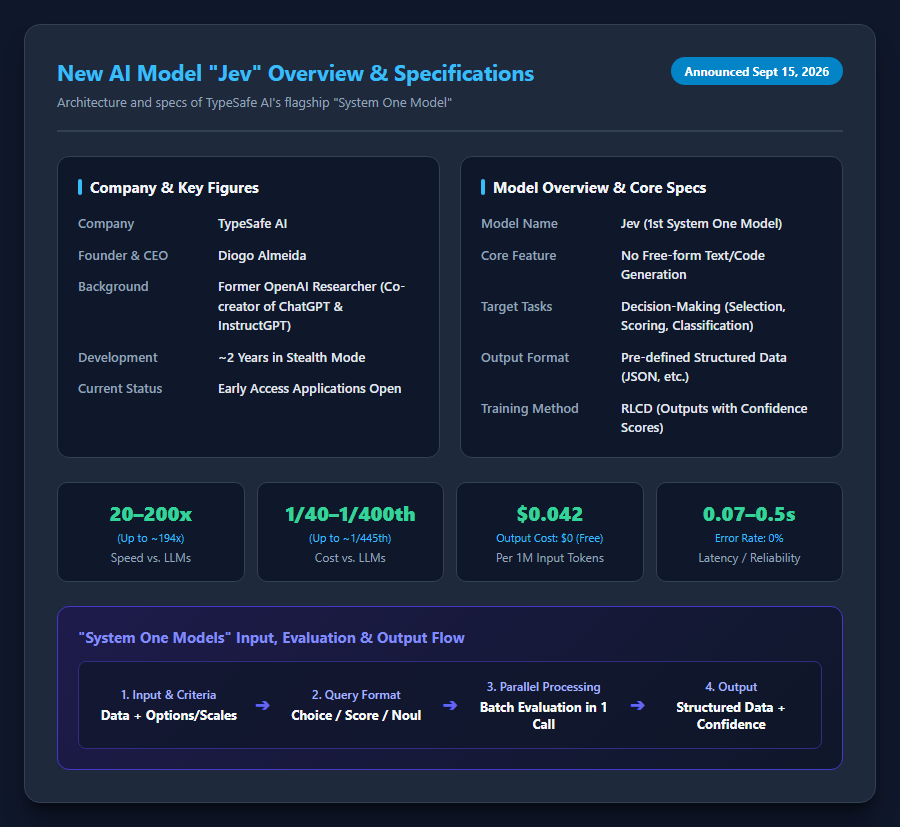
On September 15, 2026, AI startup TypeSafe AI announced “Jev,” a novel AI model that processes tasks using an approach fundamentally different from traditional large language models (LLMs), and opened developer applications for early access. TypeSafe AI is led by CEO Diogo Almeida, a former OpenAI researcher who directly contributed to foundational projects such as ChatGPT and InstructGPT. Following his work co-creating ChatGPT, Almeida spent approximately two years in stealth development before unveiling Jev as the flagship release in the company’s new “System One Models” family.
The defining characteristic of Jev is that it intentionally omits the token-by-token generation of free-form text or code typical of conversational AIs. Instead of outputting natural language text, Jev focuses exclusively on decision-making tasks required within software logic—such as selection, evaluation, and classification. Designed from the ground up to overcome the latency and prohibitive compute costs associated with existing generative AI, Jev has drawn widespread industry attention as a major technical breakthrough.
The diagram below illustrates the overview and organizational background of the newly announced model.
2. The Core Concept of “System One Models”: Breaking the Bottlenecks of LLMs
State-of-the-art LLMs, represented by Anthropic’s Claude and OpenAI’s GPT series, operate by sequentially predicting and generating the next token in a text sequence. This autoregressive text-generation mechanism itself acts as a structural bottleneck in terms of efficiency and speed. In contrast, the “System One Models” proposed by TypeSafe AI represent a new model paradigm engineered to output structured data rather than text conversations.
When issuing instructions or queries to Jev, developers provide the input data alongside pre-defined response choices or evaluation scales. Jev supports three core query formats: “Choice” (selecting one option from multiple candidates), “Score” (evaluating input against a specified scale), and “Noul” (returning the probability of a statement being true as a float between 0 and 1). Jev processes these queries and outputs answers all at once in strict accordance with the predefined data schema. This eliminates the need for complex string parsing in software code to extract numerical values, allowing the resulting structured data to be fed directly into program logic, conditional branches, and aggregation pipelines.
Innovative Mechanics Delivering Ultra-Fast and Low-Cost Computation
1. Eradicating Hallucinations via Parallel Processing and Confidence Scores
The secret behind Jev’s extraordinary speed lies in its computational architecture. While conventional LLMs execute sequential calculations by outputting one token at a time, Jev employs an architecture that computes outputs in parallel. Almeida likens this shift to the historical milestone when Transformers superseded Recurrent Neural Networks (RNNs) by replacing sequential processing with parallel computation. Because multiple evaluation points can be computed simultaneously in a single API call, response latency is squeezed down to between 0.07 and 0.5 seconds—achieving a 20x to 200x speedup over existing LLMs (and approximately 194x under specific benchmark evaluations).
Furthermore, because Jev is architected to return data strictly bounded by the specified schema and options, it structurally prevents hallucinations—the generation of ungrounded or fabricated text. It has recorded a 0% error rate across tool-calling benchmarks. Jev was trained using a proprietary reinforcement learning technique called “Reinforcement Learning for Calibrated Decisions” (RLCD), which enables the model to return precise probability distributions and confidence scores alongside its predictions. Developers can set confidence thresholds to automatically process high-confidence decisions while routing low-confidence outputs to human reviewers, establishing highly reliable operational workflows.
The diagram below compares the architectural differences between parallel processing and traditional sequential generation.

2. Unprecedented Cost Performance at $0.042 per Million Input Tokens
In addition to its speed advantages, Jev introduces a disruptive pricing model and cost efficiency. The officially announced pricing is set at \$0.042 per 1 million input tokens (roughly 6.5 Japanese yen), with output token costs listed as \$0 or so negligible as to be effectively unmeasurable due to the lack of continuous text generation. This translates to an execution cost reduction of 1/40th to 1/400th (and up to approximately 1/445th in specific workflow evaluations) compared to cutting-edge LLMs.
Benchmark data demonstrates that Jev achieves performance quality on par with the flagship model “GPT-5.6 Terra” on task completion accuracy, while slashing per-task execution costs by approximately 99% (to 1/100th). Historically, high API usage costs posed a major barrier for enterprises seeking to deeply embed generative AI into production systems. Jev’s ultra-low-cost pricing structure renders large-scale automated processing and high-frequency evaluation tasks economically viable for the first time.
Practical Applications and Future Market Implications
1. Real-Time Responsiveness in Action: The Doom and Wikipedia Demos
TypeSafe AI has released several compelling demonstration videos highlighting Jev’s practical capabilities. One notable demo showcases Jev autonomously playing the classic FPS game “Doom” in real time. Game state information is ingested into Jev as text and structured data, enabling the model to make instantaneous tactical decisions. Even when continuously executing high-frequency API calls at approximately 10 requests per second, the total execution cost remains remarkably low at around \$7 per hour (approximately 1,090 yen).
Another demonstration, “Wikiracing,” challenges Jev to navigate between Wikipedia articles by selecting the optimal hyperlink from a page’s list of candidates to reach a target destination. Jev demonstrated the ability to select the best path from hundreds or thousands of candidate links instantly without hallucinating, proving its exceptional suitability as a decision engine for high-speed AI agents. In addition to these demos, Jev is currently being evaluated across a wide range of enterprise workflows, including automated routing of customer inquiries, invoice data verification, primary triage of security alerts, and cross-checking outputs generated by other AI models.
2. The Future of Software Development: Key Trends and Outlook
The debut of Jev marks a pivotal turning point in the evolution of AI technology. It shifts the industry paradigm from the exclusive pursuit of massive, human-conversational chat models toward specialized decision engines designed to operate seamlessly and reliably inside software code. As the marginal cost of execution for reasoning and evaluation approaches zero, programming practices are expected to evolve, enabling AI to safely and rapidly replace complex conditional logic and decision trees that developers previously had to write by hand.
TypeSafe AI is currently accepting applications for its Early Access program on its official website, gradually granting access to developers on the waitlist. By decisively shedding free-form conversation in exchange for extreme speed, drastically lower costs, and unyielding reliability, Jev has captured the attention of the broader AI industry as it promises to reshape enterprise automation and software engineering.
References
- [Introducing System One Models & Jev – TypeSafe AI Blog] https://typesafe.ai/blog/introducing-system-one-models-and-jev
- [Introduction – TypeSafe AI Documentation] https://docs.typesafe.ai/introduction
- [TypeSafe AI Official Site] https://typesafe.ai/
【#AI #TypeSafeAI #Jev #GenerativeAI #EmergingTech #ArtificialIntelligence #Programming #TechNews】


コメント