Atsuyoshi Koike, President of Rapidus—a company spearheading Japan’s effort to domesticate next-generation semiconductors—announced a concept to build a semiconductor fabrication plant on the Moon by around 2040. The plan is driven by the expansion of a lunar economy under the Artemis program and the technological benefits of leveraging space’s unique physical environment for chip manufacturing.
- A Vision for 2040 Revealed in the U.S.: Key Highlights and Objectives
- Manufacturing Advantages Provided by Microgravity and Extreme Conditions
- Successful 2nm Prototype Fabrication in Chitose, Hokkaido and Mass Production Readiness
- ¥267.6 Billion in Public-Private Investment and Intense Global Competition
- Formation of a Lunar Economic Zone Led by the Artemis Program
- Overcoming Obstacles Toward 2040 and Future Outlook
A Vision for 2040 Revealed in the U.S.: Key Highlights and Objectives
On September 10, 2026, Atsuyoshi Koike, President and Representative Director of Rapidus, revealed an ambitious concept to construct a semiconductor fabrication plant on the Moon by around 2040 during a keynote address in New York. Highlighting the presence of water resources on the lunar surface—an essential element in semiconductor manufacturing—Koike emphasized that this is “not a joke or a mere pipe dream, but a deeply serious business plan.” An AI-generated concept video depicting the lunar fab was screened at the venue, capturing significant attention from attendees and industry experts.
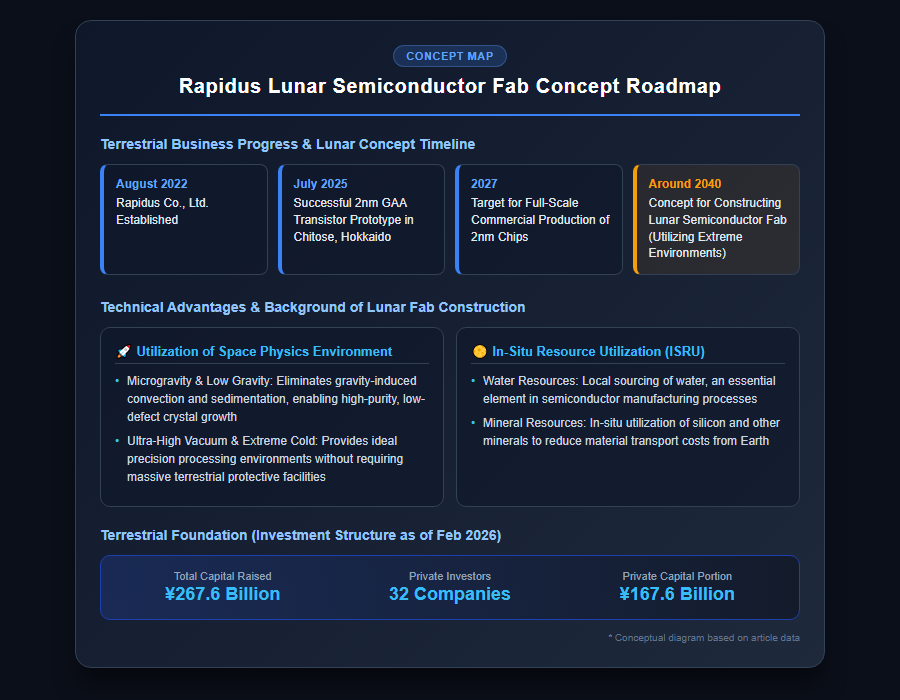
Behind this grand vision lies the broader momentum of space exploration, including lunar cargo transport and crewed missions pioneered by private companies such as Elon Musk’s SpaceX. Koike referenced these commercial space developments, anticipating future reductions in space transport costs and advancements in infrastructure. While manufacturing cutting-edge semiconductors on the Moon poses extraordinary hurdles, setting an extreme long-term goal is also intended to inspire young engineers at Rapidus and ignite their passion for technological innovation. The conceptual overview of the lunar fab project is illustrated below.
Manufacturing Advantages Provided by Microgravity and Extreme Conditions
To answer why a semiconductor plant should be built on the Moon rather than on Earth, unique physical and environmental advantages of space and the lunar surface come into play. In microgravity or low-gravity environments, gravity-induced convection and sedimentation—phenomena unavoidable on Earth—do not occur. This enables the growth of exceptionally uniform, high-purity crystals for semiconductor substrates, offering a technological advantage in producing high-quality materials with minimal defects.
Furthermore, the high vacuum and ultra-low temperatures of space provide ideal conditions for forming ultra-precise circuit patterns. While terrestrial cleanrooms require massive energy and complex facilities to remove airborne particulates and artificially create vacuums, utilizing the natural environment of space could dramatically boost production efficiency and yield quality. In addition, the lunar surface possesses water reserves and mineral resources such as silicon. Developing technologies to extract and utilize these local resources could establish a sustainable, self-sufficient manufacturing ecosystem that significantly reduces the cost of shipping raw materials from Earth.
Rapidus’s Current Standing on Earth and Technical Challenges
Successful 2nm Prototype Fabrication in Chitose, Hokkaido and Mass Production Readiness
While articulating a visionary lunar roadmap, Rapidus’s immediate and highest priority remains establishing commercial mass-production technology for 2-nanometer (2nm) cutting-edge logic semiconductors on Earth. Established in August 2022, the company entered into a strategic partnership with IBM for technology transfer and dispatched engineers to IBM’s Albany Nanotech Complex in New York for joint development. As a result of these efforts, Rapidus successfully fabricated and demonstrated the operation of 2nm transistors featuring the new Gate-All-Around (GAA) architecture at its manufacturing site in Chitose, Hokkaido, in July 2025.
The company initiated the setup of its pilot production line in April 2025 and is rapidly advancing operations toward full-scale commercial manufacturing in 2027. Unlike traditional high-volume foundries, Rapidus is pioneering a novel business model centered on high-mix, low-volume production with ultra-short turnaround times. By offering integrated support from design to manufacturing, the company aims to reduce manufacturing cycle times by roughly 40 percent compared to conventional processes. Rapidus is also building a differentiated customer acquisition strategy through unique AI-assisted design tools.
¥267.6 Billion in Public-Private Investment and Intense Global Competition
The domestic production of advanced semiconductors is designated as a top-priority national initiative, backed by substantial public and private financial support. In February 2026, investment rounds led by the Ministry of Economy, Trade and Industry (METI) and 32 private companies concluded, raising total capital to 267.6 billion yen. While the company began with just 8 founding corporate shareholders contributing 7.3 billion yen, the expansion to 32 participating firms across manufacturing, materials, logistics, and finance establishes a comprehensive supply-chain support structure. Cumulative government backing, including funding via the Post-5G Fund Project, reaches into the trillions of yen.
Nevertheless, the gap between Rapidus and global market leaders remains formidable. Taiwan’s TSMC, the world’s leading contract chipmaker, and South Korea’s Samsung Electronics have already entered mass production for 2nm processes, holding an overwhelming advantage in yield optimization, equipment depreciation, and long-term customer contracts. Given Japan’s past retreat from the semiconductor miniaturization race at the 40nm node, industry experts remain cautious regarding how quickly Rapidus—lacking a track record in commercial fab management—can improve yields and secure profitability.
The Expanding Space Economy and Japan’s Industrial & Policy Support
Formation of a Lunar Economic Zone Led by the Artemis Program
Rapidus’s lunar factory concept aligns closely with global space development trends, most notably NASA’s Artemis program. The Japanese government is a key participant in the U.S.-led Artemis initiative, contributing to projects such as landing Japanese astronauts on the Moon and developing a crewed pressurized rover. Sustaining long-term human activity on the Moon requires not only communication, energy, construction, and mobility infrastructure, but also advanced local data-processing capabilities supported by reliable semiconductor supply chains.
The global space economy is projected to surpass \$1 trillion (approx. ¥150 trillion) between the 2030s and 2040s, driven largely by space-technology application industries such as satellite communications and earth observation. As lunar communications base stations, autonomous rovers, and research facilities operationalize on the Moon, local demand for data-processing chips will surge rapidly. Rapidus’s vision for a lunar chip plant represents a strategic long-term endeavor to serve as a core infrastructure provider within this emerging lunar economic sphere.
Overcoming Obstacles Toward 2040 and Future Outlook
The path to realizing a lunar chip factory by 2040 is fraught with daunting technical and economic hurdles. Transporting heavy manufacturing equipment and precision instruments from Earth to the Moon remains extraordinarily expensive, making high-frequency, low-cost space logistics a mandatory prerequisite. Furthermore, advanced engineering solutions must be developed for extreme lunar environments, including shielding delicate fab equipment from severe radiation and extreme temperature fluctuations, securing stable high-capacity power supplies, and engineering effective heat rejection systems.
Through its Space Technology Strategy and the ¥1 trillion Space Strategy Fund, the Japanese government is aggressively fostering private-sector space development and technological demonstrations. For Rapidus to realize its lunar ambitions, it must first succeed in commercializing 2nm semiconductors on Earth to prove both its technical capability and economic viability. Achieving success on Earth, while deepening collaboration with JAXA, domestic and international space enterprises, and academic institutions to test key elemental technologies, will be crucial to enhancing Japan’s international competitiveness across both the semiconductor and space industries.
Reference Pages
- 【Rapidus Co., Ltd. Official Website】https://www.rapidus.inc/
- 【JAXA Humans in Space Technology Directorate】https://humans-in-space.jaxa.jp/
- 【Cabinet Office Space Policy】https://www8.cao.go.jp/space/
【#Rapidus #Semiconductors #SpaceBusiness #LunarDevelopment #BusinessNews】


コメント