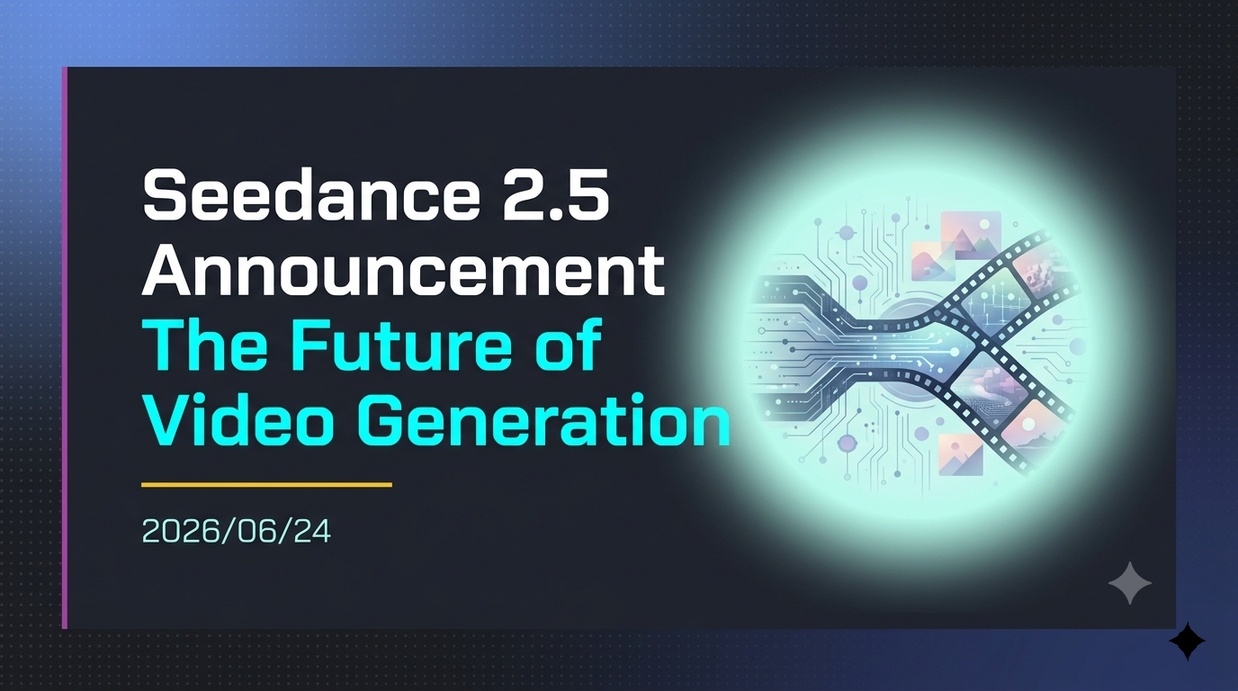
ByteDance has announced its latest video generation model, Seedance 2.5, drawing significant attention from the industry. Behind this is the development of new commercialization strategies to overcome the previous two-second barrier faced by video generation AI and to overcome copyright issues.
- The Impact of Native Video Generation Breaking the 30-Second Barrier
- Ensuring advanced controllability with 50 reference materials
- Native 4K Support and Evolution of Existing Models
- Concerns over copyright infringement and the background of the global publication suspension
- Building a “Derivative Creation” Platform with Official Licenses
- The Future of AI Content Shown by the Partnership with Stephen Chow
- Integration and Efficiency into a Professional Production Workflow
- Laying the Groundwork for Understanding the Physical World Model
- July 2026 Release and Upcoming Highlights
The Impact of Native Video Generation Breaking the 30-Second Barrier
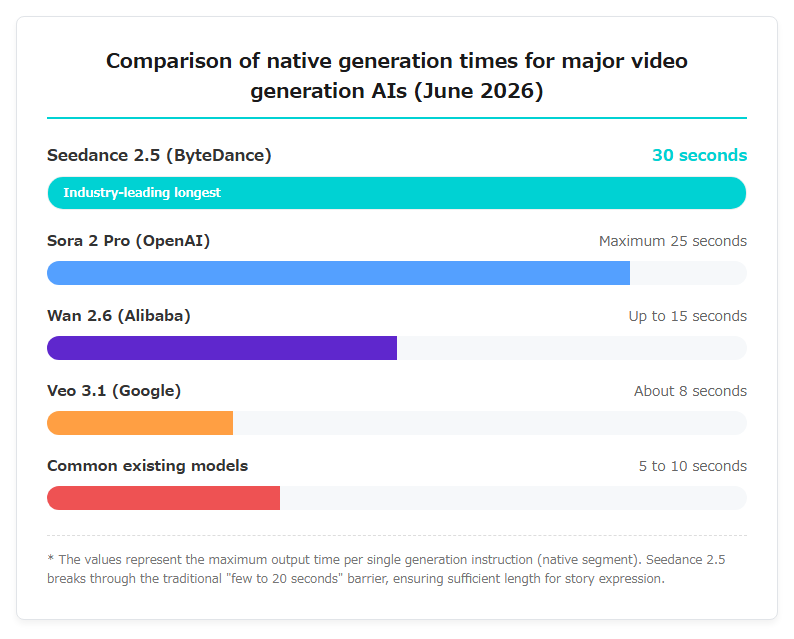
At the 2026 Volcano Engine FORCE Power Conference held on June 23, 2026, Volcano Engine, a subsidiary of ByteDance, officially announced its latest video generation AI model, Seedance 2.5. The most notable feature of this model is its ability to directly output a seamless 30-second native video in a single segment. Traditional major video generation AIs could only generate 5 to 10 seconds at a time, and at most about 20 seconds, so creating story-driven videos required stitching together multiple clips. By breaking through this “few seconds barrier,” Seedance 2.5 succeeded in securing enough length to express not just a single scene but a certain level of story. As a result, the potential for producing high-quality videos solely with AI for short films, video advertisements, and SNS content has greatly expanded. Please refer to the diagram below.
Ensuring advanced controllability with 50 reference materials
Seedance 2.5 not only allows for longer video generation but also dramatically increases user control during the generation process. This model can simultaneously import up to 50 all-modality reference materials, including images and video clips, which is currently the world’s highest spec in the market. By being able to input many reference files, it became possible to precisely control the style of the generated video, the consistency of subjects, and the logic of the story. A notable new feature is the addition of inpainting capability, allowing localized video editing while maintaining screen consistency. This enables creators to fine-tune the people, backgrounds, or local details of the generated videos, eliminating the need to remake the entire video from scratch due to minor flaws, and is expected to significantly reduce the cost of trial and error in commercial video production.
Native 4K Support and Evolution of Existing Models
At the conference, Seedance 2.5 was announced, along with major upgrades to the previous Seedance 2.0 series. After the upgrade, Seedance 2.0 already supports native 4K video generation capabilities, delivering quality that meets the demands of professional video production environments. ByteDance has adopted “Climbing the Peak” as the New Year’s keyword for early 2026, meaning to bravely aim for the peak, and this series of model updates embodies that strategy. The company is advancing its groundwork in the global multimodal AI content creation field to its final stage, aiming to replicate the overwhelming development speed and product strength of the “App Factory” built in the mobile internet era even in the AI era. Seedance 2.5 is currently in internal testing for global enterprises, with an official release scheduled for early July 2026.
Copyright Issues and the New Commercial Ecosystem
Concerns over copyright infringement and the background of the global publication suspension
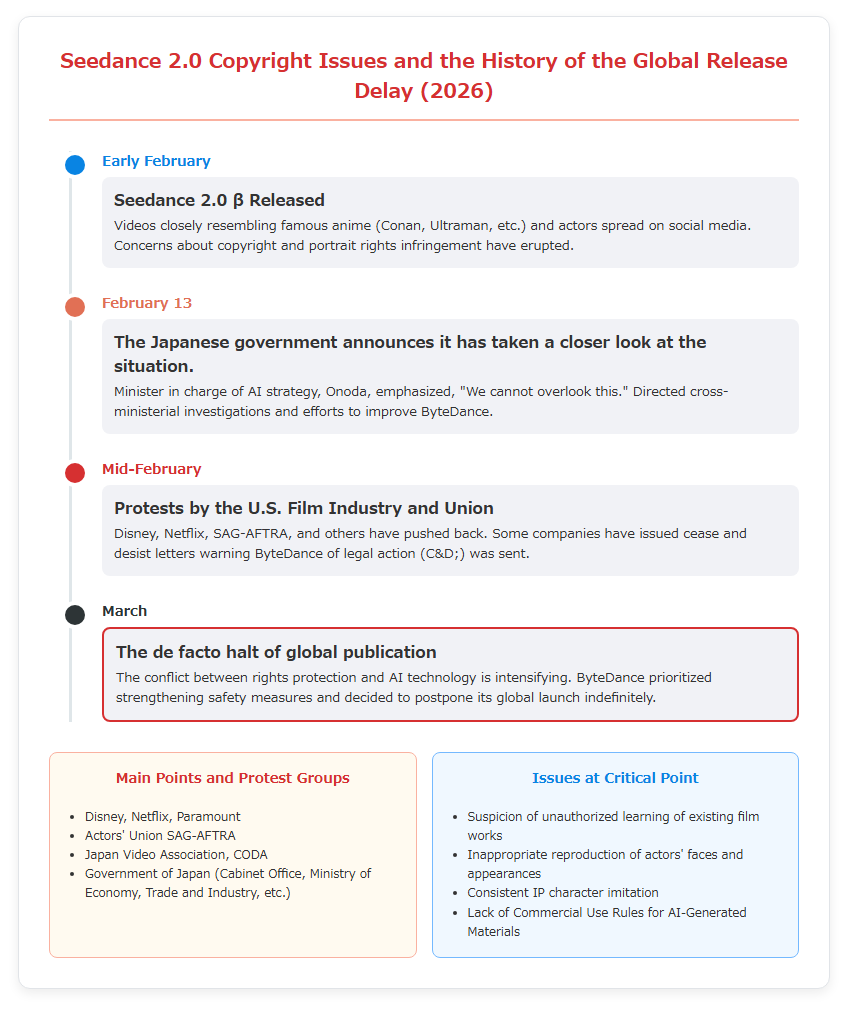
Before the announcement of Seedance 2.5, there were significant social challenges faced by video-generating AI. In early February 2026, ByteDance released the beta version of Seedance 2.0, but a massive spread occurred on social media of videos resembling famous Japanese anime characters and actors. In response, major film companies such as Disney, Netflix, and Paramount, as well as the actors’ union SAG-AFTRA, strongly opposed the decision, and some companies reportedly sent cease and desist notices. The Japanese government is also taking this issue seriously, and on February 13, 2026, Kimi Onoda, Minister in charge of AI Strategy, announced a policy to quickly grasp the situation. As conflicts over copyright and portrait rights protections became more apparent, the global release of Seedance 2.0 was effectively halted or postponed as of March 2026. Please refer to the diagram below.
Building a “Derivative Creation” Platform with Official Licenses
To avoid copyright infringement risks and make AI technology commercially sustainable, ByteDance released a preview of its “AI Copyright Commercialization Platform” at this conference. This system allows users to legally engage in AI-powered creative activities using materials officially licensed from rights holders. By combining this platform with Seedance’s generative capabilities, users can create derivative works using official templates within ByteDance’s ecosystem such as TikTok and CapCut. This initiative aims to shift from the traditional conflict of “unauthorized learning and rights violations” to a form of “symbiosis” that promotes creation while returning benefits to rights holders. As model capabilities themselves will eventually catch up, the company believes that embedding models into high-frequency and legitimate use cases, making them essential to daily workflows, will be the true competitive advantage.
The Future of AI Content Shown by the Partnership with Stephen Chow
As the first step in its new commercialization strategy, ByteDance has welcomed renowned film director Stephen Chow (Chau Xin-chi) as an initial partner for its AI copyright commercialization platform. Through this partnership, three classic IPs of Stephen Chow’s classic films—’King of Comedy,’ ‘God of Cookery,’ and ‘Miracle No. 7’—were licensed. Users can use these official templates to recreate iconic movie scenes or add their own arrangements. Mr. Tan Dai, president of Volcano Engine, announced that the number of creations on the first day of the competition had already surpassed 100,000, proving that this approach has received a very strong response. This suggests that AI-powered video generation has the potential to transform not only professional production from scratch but also the interactive fan market for derivative creation. This model, which extends with AI while protecting IP, will likely serve as a benchmark for the global content industry, including Hollywood.
Future Prospects and Progress to a Global Model
Integration and Efficiency into a Professional Production Workflow
The arrival of Seedance 2.5 dramatically transforms the workflow from pre-production to post-production in video production. In particular, it is expected to be utilized in the process called “previsualization,” which involves visualizing footage before shooting. Creators can input pre-designed assets and camera work instructions into Seedance 2.5, enabling them to produce high-quality previs videos in a short time. Seedance is especially strong in camera movement—that is, it follows camera instructions—and can execute complex movements like pushes, pulls, pans, and dollies exactly as prompted. This allows for detailed verification of angles and movements before actual filming, significantly reducing the high costs and time required for on-site retakes and corrections.
Laying the Groundwork for Understanding the Physical World Model
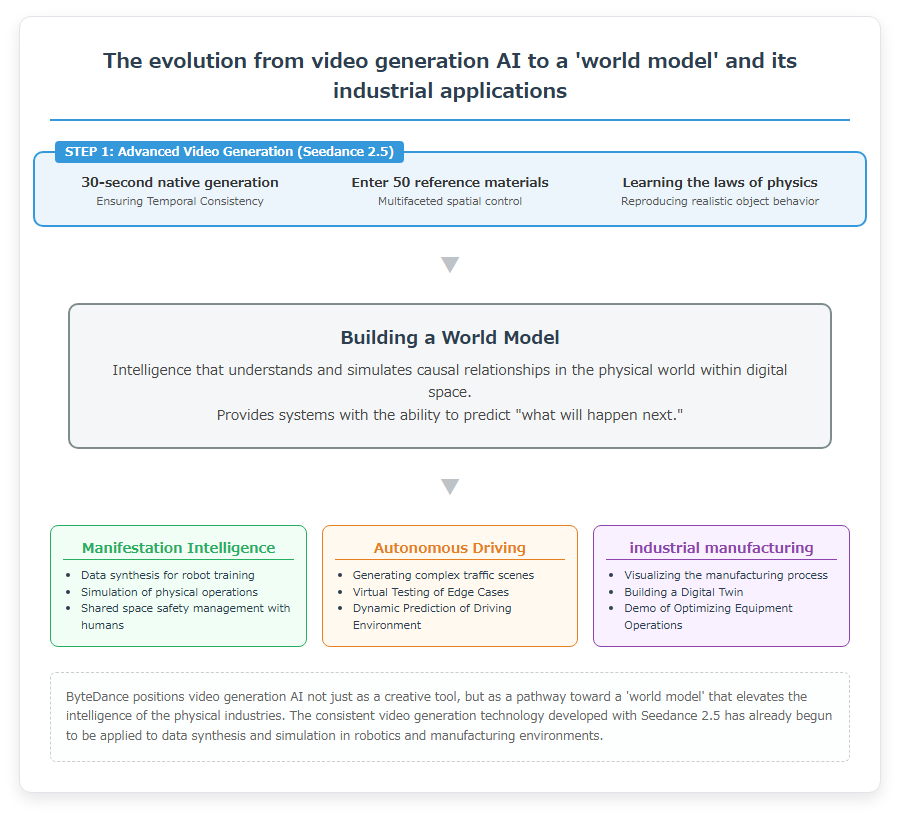
ByteDance positions video generation technology not just as a production tool, but as an important pathway toward a ‘World Model’ that understands and simulates the physical world. The technology cultivated through Seedance has already begun to be applied to real-world industries such as materialized intelligence (robotics), autonomous driving, and industrial manufacturing. For example, AI’s ability to generate consistent videos based on physical laws is utilized for data synthesis for robot training, complex traffic scenario simulations for autonomous driving systems, and even demonstrations of factory manufacturing processes. By learning physical causality and spatial vastness as video generation AI learns, AI will not remain confined to digital screens but will play a role in enhancing the intelligence of systems operating in real physical spaces. Please refer to the diagram below.
July 2026 Release and Upcoming Highlights
Seedance 2.5 is scheduled for official release in early July 2026, with initial availability expected via API and specific platforms. The biggest future focus will be how technically and institutionally this model can suppress the copyright infringement risks that were challenging in previous generations when it is publicly released. ByteDance has clearly stated it will strengthen intellectual property protection and security measures, and the success or failure of its newly established commercialization platform will have a significant impact on the model deployment of other AI companies. Another focus is how competing U.S. models like Sora 2 and Veo 3.1 will keep pace in terms of longer generation times, character consistency, and better camera control. Heading toward the latter half of 2026, video generation AI will move from the “experimental short clip” phase to a longer, controllable, and commercially safe “practical content creation” phase.
[#ByteDance #Seedance #動画生成AI #AI著作権 #世界モデル #2026年AI #火山引擎 #AIニュース]

コメント