On June 22, 2026, NVIDIA announced “NVIDIA Halos for Robotics,” a comprehensive system that fundamentally supports the safety of physical AI and robotics. This technology transfers the vast expertise cultivated in autonomous driving to robotics, forming a crucial foundation for realizing a future where humans and robots work safely and efficiently in the same physical space.
- The birth of the industry’s first full-stack safety system
- Transplanting over 18,000 human years of expertise cultivated through autonomous vehicles
- A three-tier structure integrating hardware, software, and authentication
- Expanding awareness through Outside-In Safety
- Main system and isolated functional safety island
- Multi-layered monitoring mechanisms to prevent AI misidentification
- The Role of the World’s First ANAB-Accredited Testing Lab
- Agility Robotics “Digit” at the forefront of field implementation
- Lowering barriers to entry through ecosystem construction
- Adoption as a Global Safety Standard and Regulatory Leadership
- A future workplace environment that balances safety and productivity
The birth of the industry’s first full-stack safety system
On June 22, 2026, NVIDIA officially announced “NVIDIA Halos for Robotics,” a comprehensive safety system for physical AI and robotics, at the “Automate 2026” exhibition held in Chicago. NVIDIA positions this system as the “industry’s first full-stack safety system,” Its scope covers the entire layer, from hardware as computing semiconductors to operating systems (OS), sensor fusion, applications, and ultimately support for third-party authentication. At its core are the industrial module “NVIDIA IGX Thor,” boasting up to 2,070 FP4 TFLOPS of AI computing performance, the “Holoscan Sensor Bridge” that integrates a wide variety of sensors, and the safety-focused “Halos Core” software stack. NVIDIA’s move to standardize fragmented safety mechanisms that robot manufacturers have built individually as a common industry platform has attracted significant attention as the “ultimate piece” to eliminate the last mile in the commercial deployment of humanoid robots and autonomous machines.
Transplanting over 18,000 human years of expertise cultivated through autonomous vehicles
Halos for Robotics was not developed from scratch; it is built on NVIDIA’s overwhelming track record in the autonomous vehicle (AV) field over many years. The company has spent over 18,600 engineering years on the safe development of autonomous driving systems, accumulated over 7 million lines of safety-verified code, and accumulated more than 330 research papers. By systematically transplanting this vast asset into the robotics field, humanoid robots are able to address the complex risks that may arise in physical environments. Specifically, the design philosophy cultivated through ISO 26262, a stringent functional safety standard in the automotive industry, is connected to standards for industrial robots and machinery such as IEC 61508 and ISO 13849, as well as the latest AI functional safety guidelines ISO/IEC TR 5469. By eliminating the hassle of rebuilding safety standards from scratch and repurposing existing advanced safety assets, the potential to accelerate the evolution of the robotics industry over several years.
A three-tier structure integrating hardware, software, and authentication
Halos’ architecture is designed with a three-tier structure that integrates physical security with digital reliability. The first layer is the hardware foundation, called the “NVIDIA IGX Thor,” which features an independent processing area called the “Functional Safety Island (FSI)” physically isolated from the main computing unit. The second layer is the safe-certified OS “Halos Core,” which runs on this hardware. This is the next-generation version of NVIDIA’s in-vehicle OS, DriveOS, where Linux handles general AI computations and QNX handles safety-critical tasks, so even if abnormalities occur in higher-level AI models, the safety control logic is not compromised. The third layer is the “Halos AI Systems Inspection Lab,” which serves as a bridge to third-party certification bodies. For an overview of the system, please refer to the diagram below.
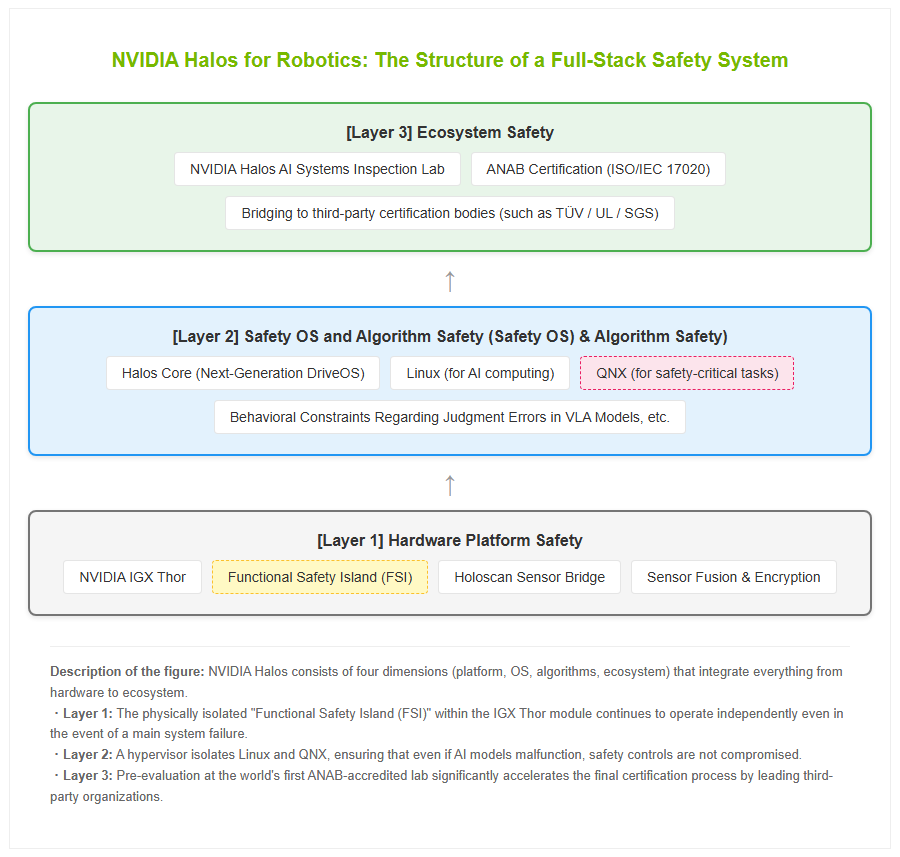
By providing an integrated solution from hardware to software and even compliance verification, robots are meeting the modern needs of evolving from “deterministic executors” to “autonomous agents with uncertainty.”
[Technological Innovation] From ‘Stopping’ to ‘Inferential’ Safety
Expanding awareness through Outside-In Safety
One of the technical highlights of Halos is its innovative design philosophy called “Outside-In Safety.” Traditional robots rely solely on their own sensors (Inside-Out) to check their surroundings, forcing frequent stops and decelerations due to blind spots and sensor recognition limits. In response, Halos integrates a “third-party perspective” that overlooks the entire site into the robot’s perception by utilizing external cameras fixed on factory ceilings and AI agents. For example, external cameras can “visually detect” workers at blind spots in advance, and robots receive this information in real time, enabling them to change routes or adjust their speed to optimal speeds before collision risks arise. This “Outside Safety Blueprint” is available as open source and has enabled robots to extend their recognition range beyond their physical limits.
Main system and isolated functional safety island
What determines Halos’ safety is the built-in “Functional Safety Island (FSI)” in the IGX Thor. This area features independent processors, input/output (I/O), and power supplies, and is physically completely isolated from the robot’s main AI computing system. The significance of this design lies in the fact that even if the robot’s complex AI model or main OS crashes or freezes, an independent safety island continues to operate normally, reliably executing safety functions such as emergency braking. This is a multi-layered defense approach similar to backup control systems in modern aircraft, serving as the last line of defense in industrial environments where millisecond-level real-time performance is required, preventing system failures from being directly linked to physical accidents.
Multi-layered monitoring mechanisms to prevent AI misidentification
The greatest risk of physical AI lies not in traditional mechanical failures, but in the “understanding errors” caused by AI models. For example, a robot might mistake a cardboard box for a human, or vice versa. Halos has established an ‘algorithm safety’ layer to manage these AI uncertainties. Specifically, it imposes physical behavioral constraints on errors in the visual-language-motor model (VLA), and is equipped with a monitoring mechanism that instantly detects when input data to AI exceeds training expectations (such as extreme changes in lighting or camera fogging caused by steam). When these unexpected situations are detected, the system forcibly restores the robot’s safety functions, preventing dangerous actions based on uncertain judgments. This idea—enjoying advanced reasoning powered by AI while supplementing its uncertainty with an independent safety layer—is precisely what enables both safety and productivity.
[Impact on Industry] Standardizing the Barrier to Commercialization: ‘Safety Certification’
The Role of the World’s First ANAB-Accredited Testing Lab
One of the biggest barriers to commercializing robots, especially humanoids that work alongside humans, was the extremely complex and time-consuming safety certification process. To address this challenge, NVIDIA established the “Halos AI Systems Inspection Lab,” specializing in AI and functional safety. This lab was the first in the world to be accredited as an ISO/IEC 17020 inspection body by ANAB (ANSI National Accreditation Board), the U.S. national accreditation body. This enables robot manufacturers and their customers to conduct safety tests, engineering adjustments, and pre-evaluations together with NVIDIA engineers before formally submitting applications to external certification bodies such as TÜV Rheinland, UL Solutions, or SGS. Since reports that pass this pre-inspection process are approved by many major certification bodies, companies can significantly reduce the time and enormous costs associated with traditional fragmented certification work.
Agility Robotics “Digit” at the forefront of field implementation
Agility Robotics, a pioneer in humanoid robotics, was the first to adopt Halos for Robotics and have demonstrated its effectiveness. The company has fully integrated NVIDIA’s IGX Thor and Halos Core into the human detection system of its bipedal robot, Digit. Digit has already been deployed in real-world environments such as Amazon, logistics giant GXO, Schaeffler, and Toyota Motor Corporation’s Canadian manufacturing plant, performing handling and logistics tasks. In the released demo video, Digit wearing a safety vest can be seen smoothly moving between factory conveyors while avoiding human workers. Agility Robotics’ pioneering action symbolizes that humanoids are moving from mere research subjects to true commercial deployments based on strict safety certifications.
Lowering barriers to entry through ecosystem construction
At the core of NVIDIA’s strategy is not to manufacture robots themselves, but to provide the computing and regulatory infrastructure needed by all robot manufacturers, building a massive ecosystem. More than 40 companies have already joined Halos’ Inspection Lab, including Agility Robotics, Boston Dynamics, KION Group, LiDAR manufacturer Hesai Technology, semiconductor giants Infineon and NXP. Additionally, Qt Group has joined as a software tool partner, creating an environment where the safety and compliance of CUDA code running on GPUs and various guidelines can be continuously and automatically checked from the early stages of development. By using Halos components that NVIDIA has pre-evaluated and met standards, companies can focus their resources on developing their own applications, simultaneously raising safety standards and revitalizing the entire industry.
[Future Developments] Standardization and Key Points in the Era of Physical AI
Adoption as a Global Safety Standard and Regulatory Leadership
Through Halos for Robotics, NVIDIA is seeking to establish itself as a “rule-maker” beyond merely providing technology. The company contributed to the issuance of ISO/IEC TR 5469, an international guideline for using AI in safety-related functions, and is currently in a position to support the development of ISO/IEC TS 22440, a new technical specification for AI functional safety. By complying its platform with these international safety frameworks, NVIDIA’s technology stack effectively becomes the global standard, creating a framework where NVIDIA defines the criteria other companies must meet when entering this market. Once robot companies adopt this full-stack and deeply integrate it into their safety certification paths, future supplier switching will incur extremely high costs (buried costs), ensuring NVIDIA will surely take the lead in infrastructure in the physical AI era.
A future workplace environment that balances safety and productivity
The next key focus is how Halos will bring changes to on-site productivity. Traditional safety measures involved forcibly stopping or slowing down when a human approach is detected, but this significantly reduced efficiency in environments where humans and robots work closely. What Halos aims for is advanced collaborative safety where robots can “reason” about their surroundings in real time, share and pass packages with humans, and continue working side by side in narrow aisles. According to Barclays’ forecast, the humanoid robot market is expected to reach $200 billion (about 32.3 trillion yen) by 2035, and what supports this massive industry is nothing more than active safety technologies that no longer require “cages.” Starting from structured spaces like warehouses and factories, and as physical AI permeates unstructured living spaces such as retail, healthcare, and construction, the safety infrastructure provided by Halos should become the lifeline supporting its evolution.
[#NVIDIA #HalosForRobotics #フィジカルAI #ロボット工学 #機能安全 #ヒューマノイド #デジタルツイン #科学技術]
コメント