On July 23, 2026, AMD announced a new AI development platform called “ROCm.ai,” optimized for agent-based AI workloads. Behind this is the current state where AI is evolving from mere generation to autonomous behavior, and bottlenecks in computing infrastructure are evolving.
- Announcement of a new platform for the era of agent AI
- An “AI-native” development environment that breaks down development barriers
- Three core features: ROCm CLI, AMD Skills, Hyperloom
- Introduction of “SAGA” scheduling to maximize GPU utilization efficiency
- A billion strategic partnership with Anthropic
- Adoption of OpenAI and Microsoft Azure vs. Full Stack Showdown
- Roadmap for AI infrastructure toward 2030
- Changing Bottlenecks: Transitioning from GPU to CPU Memory
Announcement of a new platform for the era of agent AI
AMD officially announced “ROCm.ai” as an extension of its next-generation AI software stack at the event “Advancing AI 2026” held in San Francisco on July 23, 2026. This announcement highlights AI’s role as “Agentic AI,” which autonomously thinks, judges, and acts autonomously beyond traditional content generation. This reflects the market trend shifting toward this trend. Agent AI features complex processes that require dozens to hundreds of inference steps, making efficiency a challenge for traditional GPU computing methods. Lisa Su, CEO of AMD, stated that the next phase of AI will be defined by frontier models, agents, and physical AI, emphasizing the importance of building an open platform across the industry. ROCm.ai aims to build on the existing ROCm ecosystem while providing full-stack optimizations to accelerate AI agent execution.
An “AI-native” development environment that breaks down development barriers
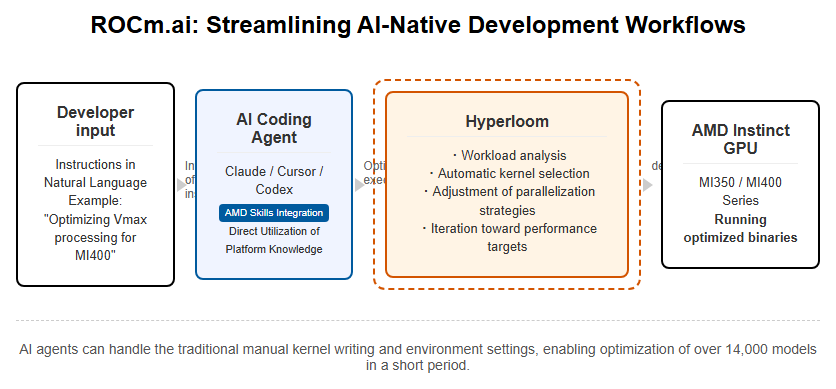
The biggest feature of ROCm.ai is its adoption of an “AI-native” approach, where AI supports the development of AI software itself. Vamshi Bhoppana, AMD’s SVP of AI, pointed out that AI software development is increasingly agent-driven, with developers building and deploying software using natural language processing and AI coding agents. ROCm.ai directly integrates deep knowledge of AMD platforms and ROCm into existing AI coding tools that developers use daily, such as Claude, Cursor, Codex, and GitHub Copilot. This means developers no longer need to load complex documents; they can simply describe the intended workload and performance goals, and AI agents can generate and fine-tune code optimized for AMD hardware. The diagram below shows how ROCm.ai streamlines development workflows.
。
Technical components supporting ROCm.ai
Three core features: ROCm CLI, AMD Skills, Hyperloom
ROCm.ai architecture mainly consists of three main components. The first “ROCm CLI” provides a command-line interface that integrates and manages installation, verification, servicing, updates, and troubleshooting of AI workloads on AMD platforms. The second type, “AMD Skills,” is a mechanism that allows AMD to directly integrate its accumulated hardware and software expertise into coding agents such as Claude and Cursor. This enables external AI tools to autonomously perform kernel optimization and environment variable settings tailored to AMD’s GPU architecture. The third is “Hyperloom,” an AI-assisted system optimization engine. Hyperloom automatically performs workload analysis, kernel selection, and parallelization strategy adjustments, helping you achieve your performance goals. In one lead developer’s example, they used Hyperloom to optimize 14,000 models in a short period and succeeded in gaining insights at an unprecedented speed.
Introduction of “SAGA” scheduling to maximize GPU utilization efficiency
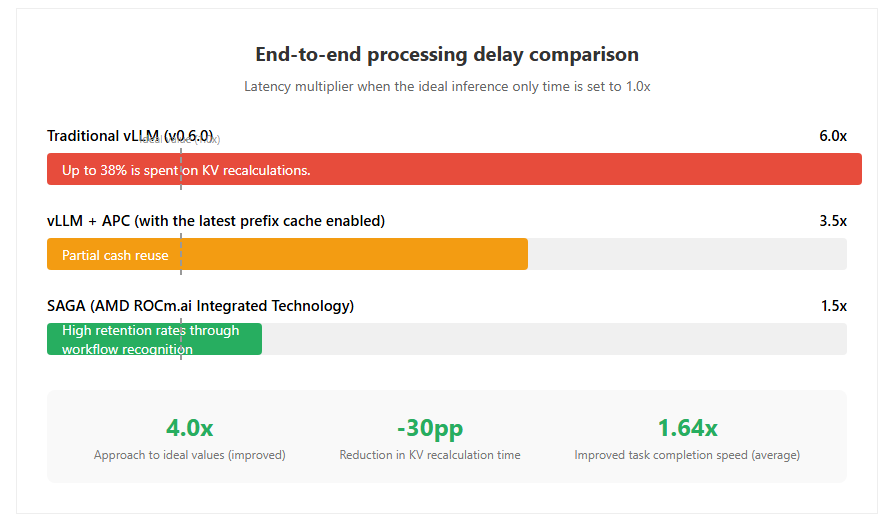
One challenge for Agent AI is the tool-call boundary of external tools that occur during inference steps. If GPU memory (KV cache) is destroyed during this waiting period, it will require massive recalculations upon restart, causing end-to-end latency to balloon by 3 to 8 times. To address this issue, AMD introduced the scheduling method “SAGA,” which treats workflows as atomic units. SAGA predicts the KV cache needed for the next step by pre-constructing the agent’s execution graph (AEG) and retains it in memory or speculatively prefetchs it. This reduces task completion time by approximately 1.64 times compared to conventional systems and improves GPU memory utilization by 1.22 times. The graph below compares the delay reduction effects of SAGA.
。
Solidarity with Industry Partners and Strategic Significance
A billion strategic partnership with Anthropic
In its ROCm.ai deployment, AMD has built strong partnerships with major players in the AI field. Particularly noteworthy is the large-scale partnership with AI lab Anthropic. AMD announced a strategic investment of up to $5 billion (approximately 820 billion yen) in Anthropic, along with the supply of Instinct MI455X GPUs equivalent to 2 gigawatts (GW) of computing power. This partnership goes beyond simply supplying hardware; it also includes engineering collaboration to accelerate AMD’s software development by leveraging Anthropic’s Claude. Specifically, Claude is used to optimize workloads for AMD Instinct GPUs and accelerate ROCm software development. AMD itself has also decided to fully adopt Claude across its internal engineering and product development teams, and is rushing to strengthen its software ecosystem.
Adoption of OpenAI and Microsoft Azure vs. Full Stack Showdown
In addition to Anthropic, AMD is deepening collaborations with major companies such as OpenAI, Meta, and Microsoft. OpenAI is collaborating to optimize GPT-class workloads for AMD Instinct MI455X GPUs and Helios racks by leveraging the company’s Triton framework and ROCm software. OpenAI plans to begin deploying the Helios system in Q4 2026 and accelerate rollout through 2027. Additionally, Microsoft Azure decided to introduce the Helios system for inference processing of cutting-edge models. Until now, NVIDIA held about 95% of the data center GPU market, while AMD held only about 4.5%. However, AMD is aiming to break NVIDIA’s stronghold by shifting from supplying standalone chips to offering a “full-stack AI platform” that integrates racks, networks, and software.
Future Outlook and Key Points
Roadmap for AI infrastructure toward 2030
AMD has shared a detailed roadmap to continue innovation in AI infrastructure through 2030. The next-generation Instinct MI500 series GPUs are scheduled to launch in 2027, and the MI600 series in 2028. On the CPU side, in 2028, the “Florence,” “Ferrara,” and “Fidenza” models based on the Zen 7 architecture will be introduced, and by 2030, they will evolve to the “Ravenna” of Zen 8. Helios, a rack-scale solution, is also equipped with the next-generation MI500 and MI600 series models like the “Helios 500” and Helios 600. AMD predicts that the AI-driven semiconductor market (TAM), which includes everything from data centers to PCs, edge, and embedded processors, will reach a scale of about $2 trillion by 2030, aiming to gain dominance in this massive market.
Changing Bottlenecks: Transitioning from GPU to CPU Memory
According to a report by Morgan Stanley, with the rise of agent AI, system bottlenecks are shifting from the computing power itself (GPU) to the CPUs, memory, and networks, which coordinate computing power. In Agent AI workloads, orchestration processes such as task planning and external API calls can account for 50% to 90% of end-to-end latency, making the importance of CPUs more important than ever. Therefore, going forward, the focus of competition will be not only on developing a single powerful chip but also on how to optimize the entire system and efficiently transmit status among thousands of agents. AMD is accelerating vertical integration of software and systems through ROCm.ai to anticipate this structural change, and the wave of enterprise agent adoption from 2026 to 2027 will be a crucial touchstone for AMD’s strategic success.
Reference Page
-
【AAI 2026: AMD Delivers Full-Stack Compute for the Agentic AI Era :: Advanced Micro Devices, Inc. (AMD)】 https://ir.amd.com/news-events/press-releases/detail/1294/aai-2026-amd-delivers-full-stack-compute-for-the-agentic-ai-era
-
【SAGA: Workflow-Atomic Scheduling for AI Agent Inference on GPU Clusters – arXiv】https://arxiv.org/abs/2504.07347
[#AMD #ROCm #AIエージェント #GPU #人工知能 #半導体 #ソフトウェア開発 #エージェントAI]

コメント