Fujitsu is advancing plans to export and sell “MONAKA,” a general-purpose AI CPU developed using technologies from the Fugaku supercomputer, to global markets including the United States and Asia starting in 2027. Amid exploding demand for AI inference driven by the rapid spread of generative AI, alongside growing power consumption challenges in data centers, this initiative raises high expectations for the resurgence of Japan’s semiconductor industry through cutting-edge, domestically developed logic chips.
- Global Expansion of “MONAKA,” an AI CPU Inheriting Supercomputer Fugaku Technology
- Surge in AI Inference Demand and the Critical Need for Energy-Efficient Computing
- High-Efficiency Processing Engine Powered by 2nm Process and 144-Core Architecture
- Deepening Strategic Partnerships with Global Semiconductor Giants Including NVIDIA and AMD
- Mitigating Data Center Power Consumption and Reducing Total Cost of Ownership
- Technology Integration into Fugaku NEXT and Global Market Outlook
Global Expansion of “MONAKA,” an AI CPU Inheriting Supercomputer Fugaku Technology
Leveraging the advanced technological base cultivated through the development of the supercomputer Fugaku, Fujitsu has established a strategy to export next-generation logic semiconductors specifically tailored for artificial intelligence (AI) processing. The subject of this export initiative is “MONAKA,” a general-purpose Arm-based CPU scheduled for mass production in 2027 and beyond. Moving beyond domestic supply, Fujitsu aims to launch full-scale commercial operations in the United States—home to massive AI data center demand—and rapidly growing Asian markets. A major Japanese IT vendor supplying its own cutting-edge logic semiconductors to global markets represents a groundbreaking milestone, attracting significant attention as a stepping stone toward reviving Japan’s advanced semiconductor industry.
The genesis of this development traces back to February 2022, when the project was selected under the Ministry of Economy, Trade and Industry’s (METI) Green Innovation Fund. While initially conceived as a successor technology to the CPU used in Fugaku, it was strategically positioned to transcend purely academic supercomputing and target the broader AI data center market. Sample shipments began in February 2026, with active verification for practical implementation well underway. Having systematically restructured its legacy hardware operations—including PCs, mobile phones, and semiconductor manufacturing—Fujitsu is capitalizing on its core computational engineering capabilities to chart a bold new trajectory as a high-tech infrastructure provider for the AI era.
Please refer to the diagram below.

Surge in AI Inference Demand and the Critical Need for Energy-Efficient Computing
Driving Fujitsu’s push into AI semiconductor exports is the global explosion of generative AI and large language models (LLMs), which has triggered a massive surge in demand for AI inference. While graphics processing units (GPUs) play a leading role during the training phase of AI models, central processing units (CPUs) are indispensable for efficient data processing during the inference phase, where trained models generate rapid answers and predictions. As AI integration accelerates across enterprise operations, public services, and edge devices, high-performance CPUs that balance processing speed with operational cost control have become vital.
Simultaneously, data centers worldwide face a critical crisis: the exponential rise in power consumption associated with AI workloads. Traditional compute architectures centered heavily on power-hungry GPUs incur massive operational costs (TCO) and consume vast amounts of electricity, creating severe bottlenecks for carbon neutrality and sustainability goals. In response, the industry urgently requires CPU-based architectures designed to maximize compute performance per watt. MONAKA is poised to offer a breakthrough solution by delivering an exceptionally energy-efficient computational foundation, paving the way for sustainable AI infrastructure on a global scale.
Technical Architecture of the Advanced 2nm MONAKA and Global Strategic Alliances
High-Efficiency Processing Engine Powered by 2nm Process and 144-Core Architecture
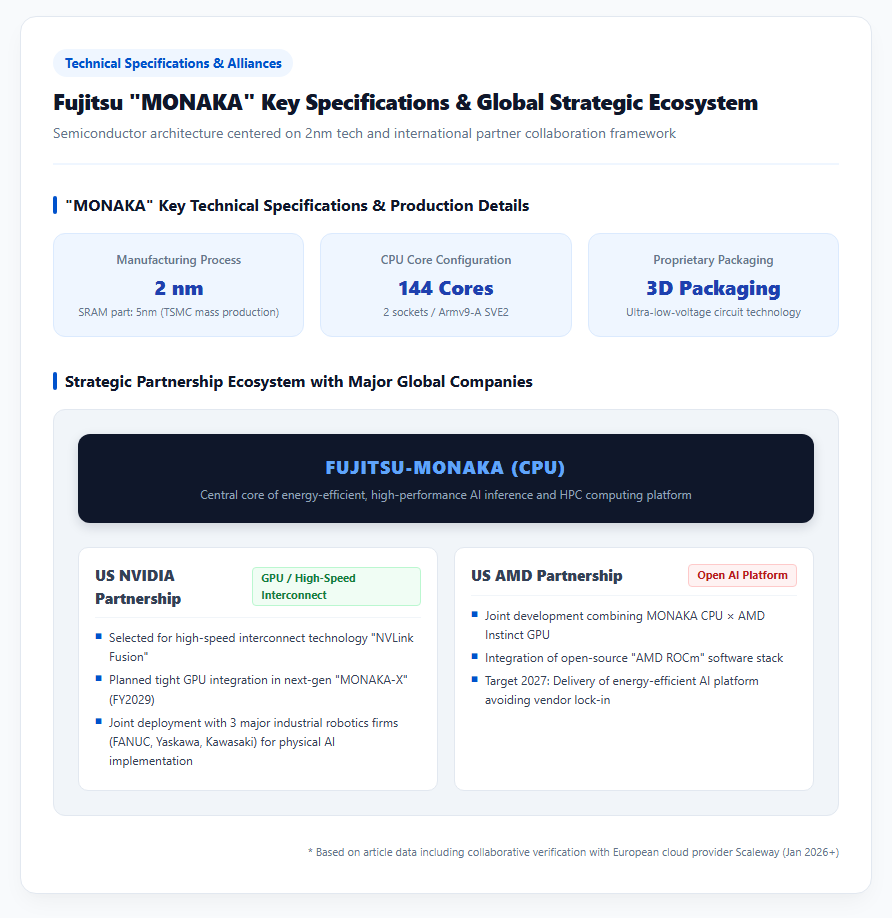
Fujitsu’s proprietary MONAKA CPU is a groundbreaking processor built on cutting-edge 2-nanometer (2nm) manufacturing process technology. Based on the Armv9-A SVE2 architecture, it features a 2-socket configuration housing 144 high-efficiency, custom-designed Fujitsu CPU cores. The design incorporates a wealth of proprietary innovations, including a 3D package structure that enables high-density integration and high-speed interconnects, alongside ultra-low-voltage circuit technologies that drastically cut power consumption. By pairing a 5nm process for SRAM chiplets with advanced packaging techniques, MONAKA achieves a high-level convergence of compute performance and power efficiency.
The roadmap toward mass production is firmly established. In March 2027, mass production will commence on TSMC’s state-of-the-art manufacturing lines in Taiwan, followed by standalone CPU shipments in April of the same year. Designed to cover a broad spectrum of workloads across AI processing, high-performance computing (HPC), and general enterprise data centers, MONAKA offers an ideal solution for operators seeking to transition from legacy systems and curb soaring energy costs. In January 2026, Fujitsu announced a collaborative verification project with European cloud provider Scaleway, testing MONAKA’s real-world data processing efficiency and TCO reduction capabilities.
Please refer to the diagram below.
Deepening Strategic Partnerships with Global Semiconductor Giants Including NVIDIA and AMD
A crucial catalyst for MONAKA’s international rollout and adoption is Fujitsu’s strategic alliances with global semiconductor leaders. Cooperation with U.S.-based NVIDIA expanded rapidly following Fujitsu’s selection as an early partner for NVLink Fusion, NVIDIA’s high-speed interconnect technology. This technology enables high-speed connectivity between NVIDIA GPUs and Fujitsu CPUs, laying the groundwork for tight integration in Fujitsu’s next-generation “MONAKA-X” processor planned for fiscal 2029. Furthermore, Fujitsu has partnered with NVIDIA alongside major industrial robotics manufacturers—including FANUC, Yaskawa Electric, and Kawasaki Heavy Industries—to accelerate the social implementation of physical AI on factory floors.
In November 2024, Fujitsu also entered into a strategic collaboration with U.S.-based AMD. By combining the Arm-based MONAKA CPU with AMD Instinct GPU accelerators and unifying their software stacks (such as AMD ROCm), the two companies are jointly developing an open, energy-efficient AI and HPC computing platform. This initiative aims to expand global market adoption by offering flexible, vendor-lock-in-free choices built on open-source ecosystems. Plans are also underway to establish joint customer centers and launch co-marketing initiatives ahead of the platform’s 2027 commercial availability.
Industry Resurgence and Social Significance in the Era of Sovereign AI
Mitigating Data Center Power Consumption and Reducing Total Cost of Ownership
The global deployment of domestic AI semiconductors like MONAKA carries profound societal importance, offering a structural solution to the global data center energy crisis. Data center operators currently navigate formidable challenges, including grid capacity limits, cooling constraints, and escalating TCO driven by rising electricity prices. MONAKA’s remarkable balance of power efficiency and compute capability serves as a vital complement to—and alternative for—traditional GPU-heavy infrastructures, directly contributing to lower operational costs and reduced environmental impact.
Furthermore, establishing high-performance, low-power hardware foundations is central to safeguarding “Sovereign AI”—a country’s ability to maintain digital autonomy. Over-reliance on foreign tech conglomerates and restricted supply chains exposes nations to severe systemic risks, including economic security vulnerabilities, service disruptions, and resource rationing. To autonomously operate AI models and data tailored to a nation’s specific culture, language, and legal frameworks, a stable, self-reliant physical infrastructure of chips and data centers is essential. Fujitsu’s AI semiconductor technologies provide a robust foundation supporting the digital sovereignty of Japan and its global partners.
Technology Integration into Fugaku NEXT and Global Market Outlook
Among upcoming milestones, the development of “Fugaku NEXT”—the successor to the Fugaku supercomputer led by RIKEN—stands out as a flagship initiative. In June 2025, Fujitsu secured the basic design contract for Fugaku NEXT from RIKEN, with design work progressing toward a February 2026 completion target. Fugaku NEXT is set to incorporate “MONAKA-X” (tentative name), an evolved iteration of MONAKA technology, significantly boosting AI acceleration capabilities while preserving the rich software ecosystem developed for Fugaku.
According to Fujitsu’s technology roadmap, following MONAKA’s mass production launch in March 2027, the company plans to introduce the NPU-integrated MONAKA-X in 2029, culminating in MONAKA-XX—a fully unified CPU-NPU architecture—by 2031. Additionally, Fujitsu is considering domestic foundry Rapidus as a potential manufacturing partner for next-generation chips, fostering synergy with Japan’s emerging advanced semiconductor ecosystem. Once a global leader in hardware engineering, Japan’s technological capability is being reborn in a new generation of AI-ready CPUs, positioned to underpin global infrastructure for years to come.
Reference Pages
-
[Fujitsu Press Release] https://pr.fujitsu.com/jp/news/2024/11/1.html
-
[RIKEN News] https://www.riken.jp/pr/news/2025/20250822_1/index.html
-
[Tokyo Electron TELESCOPE magazine] https://www.tel.co.jp/museum/magazine/report/202609_02/
[#Fujitsu #AISemiconductors #MONAKA #FugakuSupercomputer #FugakuNEXT #SovereignAI #2nm #SemiconductorExport]


コメント