Google Cloud launched the public preview of Fault Injection Testing (FIT) in August 2026. This move comes amid a growing demand for chaos engineering—deliberately introducing failures to validate system resilience within increasingly complex cloud environments.
- Key Highlights of the August 2026 Announcement of Fault Injection Testing (FIT)
- Why Cloud Resilience Testing and Chaos Engineering Are Critical Today
- The Two Primary Fault Injection Scenarios Offered in Preview
- Automated Dry-Runs and Emergency Safety Features
- FIT vs. Netflix Chaos Monkey, AWS FIS, and Azure Chaos Studio
- Current Limitations and Expected Evolutionary Directions
Key Highlights of the August 2026 Announcement of Fault Injection Testing (FIT)
On August 26, 2026, Google Cloud launched the public preview of Fault Injection Testing (FIT), a new service designed to proactively validate system resilience by intentionally introducing controlled disruptions within cloud environments. Modern cloud systems rely on highly distributed architectures composed of interconnected microservices and managed services. Consequently, maintaining high availability—ensuring that a failure in one component does not bring down the entire service—has become paramount. FIT empowers developers and system architects to conduct controlled experiments before unexpected, customer-impacting outages hit production environments. This allows teams to verify whether failover and recovery mechanisms operate as designed. In traditional on-premises environments, failure testing typically involved direct actions like severing power to physical servers or pulling LAN cables. However, because direct access to underlying infrastructure is restricted in the cloud, there has been an urgent need for native tools that can execute similar tests safely and automatically. With FIT, Google Cloud users can intuitively integrate failure simulations via the Google Cloud Console, the gcloud command-line interface (CLI), and REST APIs. Global enterprises such as KeyBank and Servier have already begun leveraging FIT to validate their deployment stability.
Why Cloud Resilience Testing and Chaos Engineering Are Critical Today
The urgency surrounding cloud-native resilience testing stems from critical business continuity and compliance risks. Unplanned downtime or severe performance degradation directly damages customer satisfaction and brand reputation. For organizations in regulated industries, such as financial institutions, proving disaster recovery capabilities is mandated by law and industry audits under stringent frameworks like ISO 22301, PCI DSS, and FFIEC. Lacking a reliable verification method can halt major cloud migration projects.
Chaos engineering is the practice of intentionally introducing failures into distributed systems to discover latent weaknesses before they manifest as real outages. While traditional load and stress testing effectively measure predictable capacity limits, they are often insufficient for uncovering cascading failures or hidden architectural flaws triggered by complex interdependencies. Key operational risks that organizations must address include:
- Direct financial losses and brand damage resulting from service outages
- Regulatory penalties and failed audits due to an inability to prove disaster recovery readiness
- Delayed cloud migrations caused by uncertainty around system stability during zonal failures
By repeatedly running safe experiments in environments that closely mirror production, engineering teams can build confidence in their architecture and strengthen their incident response capabilities.
Core Features and Safety Mechanisms of Fault Injection Testing
The Two Primary Fault Injection Scenarios Offered in Preview
In its initial public preview, Fault Injection Testing (FIT) focuses on two foundational failure scenarios critical to cloud architecture. To see how these experiments are structured, refer to the diagram below.
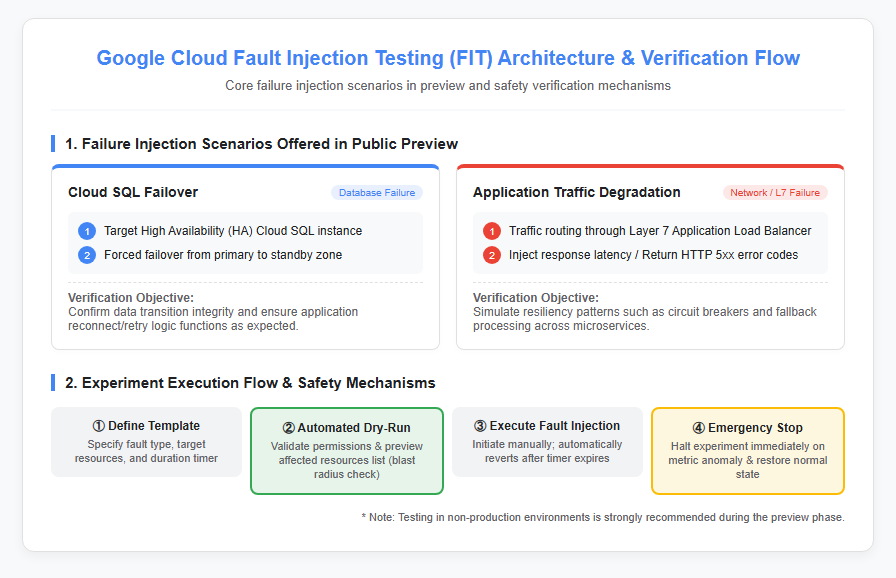
The first scenario is Cloud SQL Failover. This fault triggers an intentional failover of a High Availability (HA) Cloud SQL instance from its primary zone to a standby zone, allowing teams to verify seamless data transition and confirm that application reconnect and retry logic operate as expected.
The second scenario is Application Traffic Degradation. This option selectively injects latency or returns HTTP error codes (such as 5xx errors) via a Layer 7 Application Load Balancer. By doing so, teams can simulate network disruptions and verify that resiliency patterns—such as circuit breakers and fallback mechanisms—function properly across microservices.
Executing an experiment involves the following key steps:
- Creating an Experiment Template: Build a blueprint that defines the fault type, target resources, and duration.
- Assigning IAM Roles: Grant operators the roles/faulttesting.operator role via Google Cloud IAM.
- Requesting Preview Access: Register the target Google Cloud project through a Google Cloud account representative.
By providing these built-in scenarios, FIT standardizes and automates complex failure testing that previously required custom, error-prone scripting.
Automated Dry-Runs and Emergency Safety Features
When conducting failure testing in production or production-like environments, controlling the “blast radius”—the risk of unintended widespread impact—is a primary concern. To ensure safety, FIT incorporates robust defensive safeguards.
Before any fault is introduced, FIT executes a mandatory, read-only simulation known as an automated dry-run. The dry-run validates IAM permissions and generates an up-to-date list of every resource that will be affected by the experiment. Operators can inspect and confirm the scope of impact beforehand, preventing misconfigurations from causing accidental outages.
Once verified, the operator manually initiates the test. FIT runs for the duration specified in the template, automatically reverting faults and restoring resources to their normal state when the timer expires. If real-time monitoring reveals unexpected metric spikes or anomalous behavior, operators can immediately invoke the Stop and Revert feature (a built-in kill switch) to halt the experiment and restore systems instantly. Google Cloud strongly recommends testing FIT in non-production environments first to establish operational familiarity and evaluate integration with existing workflows.
Industry Comparisons, Current Limitations, and Future Outlook
FIT vs. Netflix Chaos Monkey, AWS FIS, and Azure Chaos Studio
Chaos engineering gained widespread adoption after Netflix introduced Chaos Monkey in 2011—an open-source tool designed to randomly terminate virtual machine instances in cloud environments. Major cloud providers have since introduced native managed services: AWS launched AWS Fault Injection Simulator (now AWS Fault Injection Service / FIS) in 2021, and Microsoft Azure announced the public preview of Azure Chaos Studio the same year.
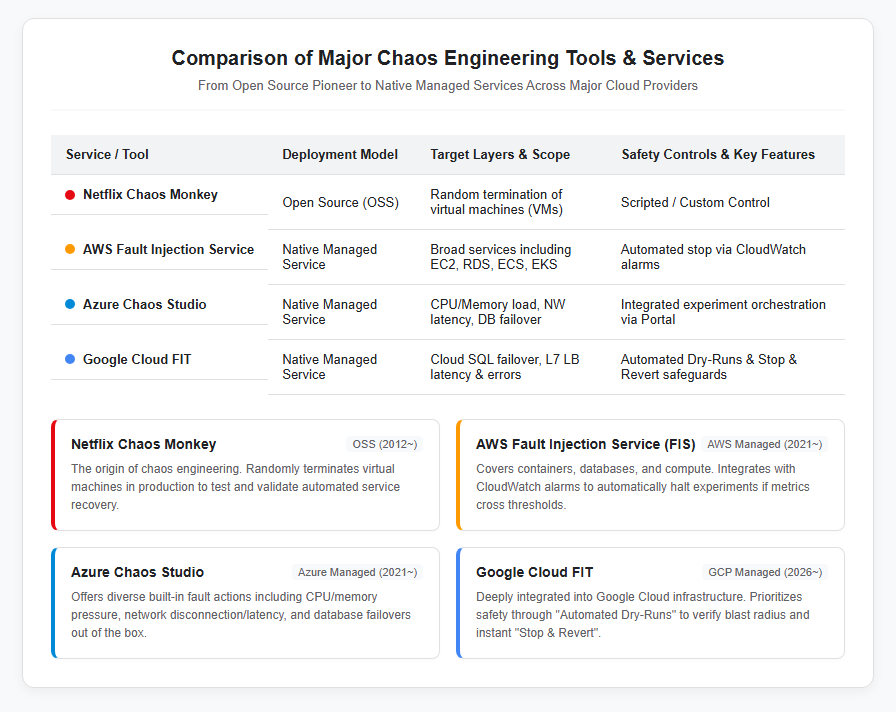
To compare how these leading platforms approach resilience testing, refer to the diagram below.
The key characteristics of each major tool and service include:
- Netflix Chaos Monkey: An open-source tool focused primarily on simulating random virtual machine instance terminations.
- AWS Fault Injection Service (FIS): A fully managed service covering a broad range of AWS resources (EC2, RDS, ECS, EKS) integrated with CloudWatch alarms for automated stop conditions.
- Azure Chaos Studio: A managed service offering diverse fault actions out of the box, including CPU/memory pressure, network latency, and database failovers.
- Google Cloud FIT: A native Google Cloud service emphasizing safety through automated dry-runs and rapid Stop and Revert capabilities, tightly integrated into Google Cloud managed infrastructure.
With all three hyperscalers offering native chaos engineering capabilities, resilience testing has evolved from a niche practice used by tech pioneers into a standard operational process for mainstream enterprises.
Current Limitations and Expected Evolutionary Directions
While the launch of FIT in preview marks an important milestone, its initial capabilities represent an early phase in Google Cloud’s resilience testing roadmap. Industry observers note that offering only two scenarios—Cloud SQL failovers and L7 load balancer latency injection—is insufficient to cover the full spectrum of real-world failure modes.
To evolve into a comprehensive resilience verification platform, FIT will need to address several key expansion areas:
- Compute Infrastructure Faults: Adding support for terminating Compute Engine instances, node crashes in Google Kubernetes Engine (GKE), or kernel panic simulations.
- VPC Network Failure Simulations: Injecting L3/L4 packet loss, network partitions, or subnet isolation to test inter-service communication within VPCs.
- Expanded Database Coverage: Extending fault injection to other data stores such as Spanner, Bigtable, Firestore, and AlloyDB, alongside query delay testing.
- Observability Integration: Automating test evaluation by linking experiment execution directly to Cloud Monitoring metrics and Service Level Objectives (SLOs).
Looking ahead, integrating security failure scenarios and automated CI/CD pipeline triggers will allow organizations to continuously validate and prove system reliability throughout the software development lifecycle.
References
- 【Introducing Google Cloud Fault Injection Testing (FIT) in preview – Google Cloud Blog】https://cloud.google.com/blog/products/networking/introducing-google-cloud-fault-injection-testing-in-preview
- 【Fault Injection Testing Overview – Google Cloud Documentation】https://docs.cloud.google.com/fault-injection-testing/overview
【#GoogleCloud #FIT #ChaosEngineering #CloudResilience #CloudInfrastructure #SRE #FaultInjectionTesting】


コメント