
Almonti Daehan Heavy Stone in South Korea has confirmed molybdenum deposits at the Sangdong Mine in Ningwol County, Gangwon Province, capable of mining for over 60 years. This discovery marks a turning point for South Korea, which relies on China for over 90% of its supply, dramatically strengthening its national resource security.
- Confirmed ’60 years’ worth of reserves at the Sangdong Mine in Ningwol County
- Confidence strengthened with 37% drilling progress and utilization of existing infrastructure
- The “Guardian of High Temperature and High Pressure” Supporting the Semiconductor and Defense Industries
- Clean Energy and the Key to Decoupling from China
- Partnerships with some of the world’s largest refiners and market price trends
- Spillover to the Regional Economy and Korea’s Position in the Global Supply Network
Confirmed ’60 years’ worth of reserves at the Sangdong Mine in Ningwol County
On June 18, 2026, Almonti Korea Heavy Industries (AKTC), a subsidiary of Canada’s Almonti Industries, announced the results of its molybdenum drilling survey near the Sangdong mine located in Yeongwol-gun, Gangwon Province. According to the latest data, the confirmed molybdenum reserves maintain quality comparable to previous sampling surveys, and their scale is estimated to reach a level where stable mining can continue for over 60 years.
This announcement came as the South Korean government declared a national crisis due to the domestic shortage of molybdenum. The Shangdong Mine was once known as one of the world’s largest tungsten mines, but it closed in 1994 due to an influx of cheap Chinese mines. However, in response to recent resource geopolitical changes, the project is set to restart between 2025 and 2026, and the fact that a domestic production base for molybdenum, a powerful strategic mineral, is secured in addition to tungsten holds immeasurable value for the Korean economy. Almonti positions this rare metal, also known as “black gold,” as the heart of advanced and defense industries.
Confidence strengthened with 37% drilling progress and utilization of existing infrastructure
Currently, Almonti Korea Heavy Stone is accelerating a large-scale drilling program to determine the exact size of its molybdenum resources and ore bodies. According to reports as of June 2026, about 37% of all planned drilling operations are at the stage of completion. The company has conducted excavation at a total of 26 sites, and the total length of the excavated tunnels has already reached 12 kilometers. Chairman Lewis Black commented that the grades obtained so far match historical data, further strengthening confidence in the scale and quality of the resource.
Please refer to the diagram below.
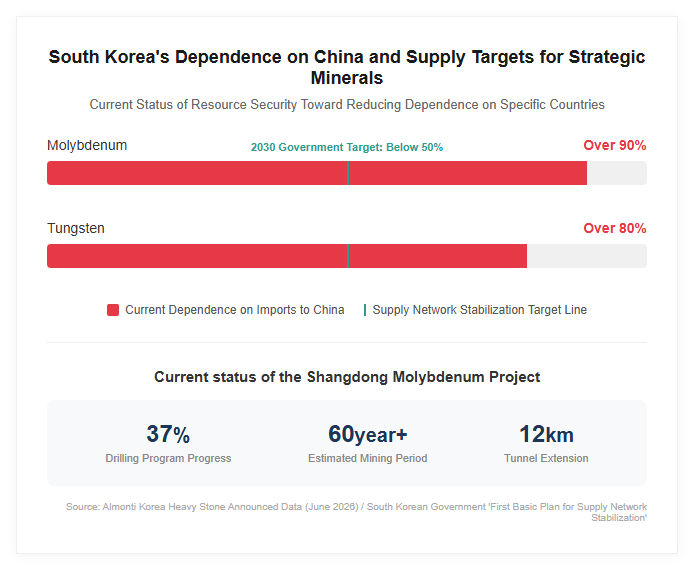
A major strength of this project is its proximity both geographically and geologically to the tungsten mine, which has already begun production since March 2026. The vast infrastructure already built for tungsten production—such as roads, power supply, water resources, and treatment facilities—can be repurposed for molybdenum development, resulting in extremely high logistics and operational efficiency. The company has decided to transition to commercial production without delay as soon as the full details of the ore body are finally confirmed. This fast-paced development system carries the expectations of the domestic industry, which is struggling with supply shortages.
[Strategic Background] Why Molybdenum Is Called the ‘Dream New Material’
The “Guardian of High Temperature and High Pressure” Supporting the Semiconductor and Defense Industries
Molybdenum is described as an indispensable “dream new material” for modern cutting-edge technology due to its excellent physical properties. Its greatest feature is its extremely high melting point of 2623 degrees, which can dramatically improve the strength, heat resistance, and corrosion resistance of materials by adding small amounts to steel or special alloys. For this reason, it has been widely used in aerospace, nuclear power generation, and petrochemical fields, which are constantly exposed to harsh environments of high temperature and high pressure.
In recent years, their importance has especially increased in semiconductor manufacturing processes. As semiconductors become increasingly miniaturized, molybdenum is being used as an abrasive for precision parts and as a sputtering target material, and because its thermal expansion rate is close to that of semiconductor substrates, it is also used as a material for heat sinks (heat sinks). Furthermore, in the defense industry, it is an essential strategic material for manufacturing tank armor, submarine hulls, ammunition, and missile components. In this way, molybdenum serves as the backbone of modern industry, supporting both the growth of the private economy and national security.
Clean Energy and the Key to Decoupling from China
Demand for molybdenum is also exploding in the clean energy sector, which aims for carbon neutrality. In 2020, the World Bank recognized molybdenum as one of six critical minerals essential for the transition to green energy technologies. Specifically, it is known that the usage per megawatt (MW) of wind power technology exceeds that of coal or nuclear power, and as the wind power market is expected to grow at an annual rate of about 9.5% beyond 2030, its importance continues to grow. Additionally, in the production of “green hydrogen,” which is expected to be a next-generation energy source, the adoption of molybdenum disulfide electrodes, which are used for water electrolysis, is also progressing.
Meanwhile, South Korea relies on imports from China for over 90% of its molybdenum supply and over 80% of its tungsten supply. In February 2025, the Chinese government has clearly stated its intention to use resources as diplomatic weapons (weaponization), including introducing a licensing system that strengthens export controls on tungsten and molybdenum mainly to the United States. Under these circumstances, securing 60 years’ worth of reserves domestically in South Korea will be crucial for building a resilient supply chain that resists external pressure.
[Future Outlook] Business Impact and Key Points for Starting Production
Partnerships with some of the world’s largest refiners and market price trends
On the business side, this discovery is already linked to concrete exit strategies. Last year, Almonti Korea Heavy Duty Stone signed a memorandum of understanding (MOU) with SeAH M&S, one of the world’s largest molybdenum oxide refiners. Under this agreement, all molybdenum ore produced at the Upper East mine will be supplied to SeAH M&S. Establishing a consistent domestic value chain—from mining to refining and supplying to industry—directly leads to reducing intermediate costs and ensuring supply transparency.
The market environment is also providing favorable momentum. As of June 2026, the spot price of molybdenum has reached about $82 per kilogram, showing a high increase of about 23.5% over the past year. This is driven by the global adoption of electric vehicles (EVs) and the demand for energy infrastructure upgrades, which are standardizing the demand for high-strength low-alloy (HSLA) steel. Almonti Industries’ stock price has also delivered a year-to-date return of 121.70%, driven by expectations for the Shangdong project, showing very high investor interest. The company’s value, which is considered undervalued, is highly likely to be further reassessed once molybdenum production begins.
Spillover to the Regional Economy and Korea’s Position in the Global Supply Network
The progress of the Upper East Molybdenum Project will serve as a catalyst to dramatically revitalize the regional economy of Ningwol County, Gangwon Province. The full-scale operation of the mine will not only create direct jobs for hundreds of people but also promote the development of related logistics and service industries. It is also an attempt to reclaim the pride of being a ‘mining town’ that accounted for 70% of South Korea’s exports in the 1960s, and local residents and local governments have strongly supported this development.
From a medium- to long-term perspective, South Korea could become a “reliable supply partner” for G7 countries, including the United States and Japan, as a source of supplies other than China. According to the RAND Institute’s 2025 report, the cooperation among Japan, the U.S., and South Korea is key to overcoming vulnerabilities in China-controlled critical mineral supply chains. If South Korea achieves domestic self-sufficiency in molybdenum and can supply surplus to friendly countries, its geopolitical influence in East Asia will increase dramatically. This project, promoted by Almonti Company, holds great potential beyond the profits of a single company to shake the resource security of the entire liberal economic zone.
[#モリブデン #資源安全保障 #韓国経済 #アルモンティ #半導体素材 #重要鉱物 #江原道 #サプライチェーン]


コメント