The Norwegian government has decided to ban the use of generative AI in elementary schools in principle from late August 2026 and to impose phased restrictions beyond secondary education. Behind this is a strong sense of urgency in response to declining grades in international academic surveys, as well as efforts to protect foundational learning such as reading, writing, and calculation by moving away from digital dependence.
- Three-phase implementation plan starting August 2026
- The Principle of ‘Skipping Prevention’ to Protect the Foundation of Education
- Decline in PISA scores and a serious sense of crisis
- Comprehensive policies following smartphone bans
- Debates on the Actual Situation on the Ground and the Effectiveness of Regulations
- Future developments and key points of global attention
Three-phase implementation plan starting August 2026
On June 19, 2026, Norwegian Prime Minister Jonas Gaar Støre announced new educational guidelines through the Prime Minister’s Office and the Ministry of Knowledge (Ministry of Education) that effectively ban the use of generative AI in elementary schools and impose strict phased restrictions even after secondary education. This regulation is scheduled to be applied nationwide in municipalities and schools starting from late August 2026 for the new 2026-27 school year. The most distinctive feature of this measure is that it is not a simple rejection of technology but is designed as a three-stage “hierarchical framework” tailored to children’s developmental stages and cognitive maturity.
Specifically, for students from grades 1 to 7 (ages 6 to 13), an “almost total ban” is imposed, prohibiting them from accessing generative AI themselves during school assignments or classes. In the subsequent lower secondary education stage from grades 8 to 10 (ages 14 to 16), it is assumed that teachers first possess sufficient competence to properly handle AI, and under their direct guidance and supervision, step-by-step and careful trials are permitted. For students aged 17 to 19 in upper secondary education (high school level), it is recommended to actively learn how to use AI appropriately and responsibly, aiming for future university admission or employment. While setting a goal to significantly increase AI utilization in the public sector as part of the national digital strategy, this decision also clearly redefined the priorities of “when, what, and in what order” should be learned in educational settings.
The Principle of ‘Skipping Prevention’ to Protect the Foundation of Education
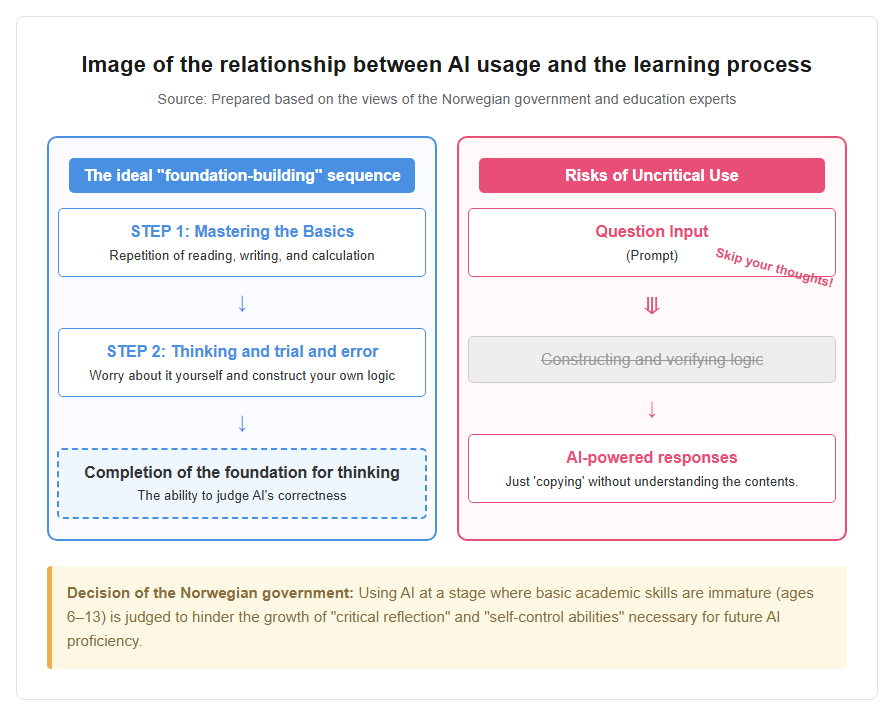
Prime Minister Stolle emphasized at the press conference that the most important thing in school education is to ensure that children acquire the fundamental abilities to read, write, and calculate on their own. Using generative AI uncritically without a critical perspective carries the risk of easily skipping (skipping) the essential stages of trial and error and thinking during the learning process. AI can instantly provide answers when given instructions, but to judge the correctness of those answers or understand the underlying logic, learners need a solid foundational academic ability as a foundation for thinking.
The Norwegian government is strongly concerned that relying too much on convenient tools during early childhood, when the foundation is not yet solidified, may undermine the cognitive abilities, critical reflection, and self-control that should be developed. Education Minister Kari Nessa Nortun reflected on the drawbacks caused by the inadequate introduction of digital devices in the past and stated that the same mistakes must not be repeated. The diagram below illustrates the relationship between AI usage and the learning process.
This policy is an attempt to nationally protect analog basic education as a preparation period so that children will not become “the ones used by AI,” but rather as tools and “masters of AI” in the future.
The Decline in Academic Performance and the Return to ‘Digital Transformation’ Behind the Background
Decline in PISA scores and a serious sense of crisis
The main background behind the Norwegian government’s extremely bold decision is a strong sense of crisis over the recent apparent decline in basic academic achievement in the country. The government cites the results of the International Programme on Learning Achievement (PISA) and the International Reading Comprehension Survey (PIRLS) by the Organisation for Economic Co-operation and Development (OECD) as strong evidence. In the 2022 PISA survey, the math score of 15-year-olds in Norway dropped significantly by 33 points compared to the previous 2018 survey, falling well below the OECD member countries’ average.
A similar serious decline is observed in reading comprehension and science domains, with the proportion of students below the basic proficiency level of “Level 2” surging from 19% to 31% in mathematics. Similarly, reading has dropped from 19% to 27%, and science has dropped from 21% to 28%, with an estimated 41% of Norwegian students failing to meet minimum standards in at least one subject. For the country, which once boasted a “Nordic model” of free and high-quality education, this figure was shocking and forced a fundamental revision of its education policies. It is too early to conclude that the spread of generative AI is the direct main cause of declining academic ability, but the government judged that “it is dangerous to allow unlimited access to tools that simplify the thinking process in the current situation where basic academic skills are declining.”
Comprehensive policies following smartphone bans
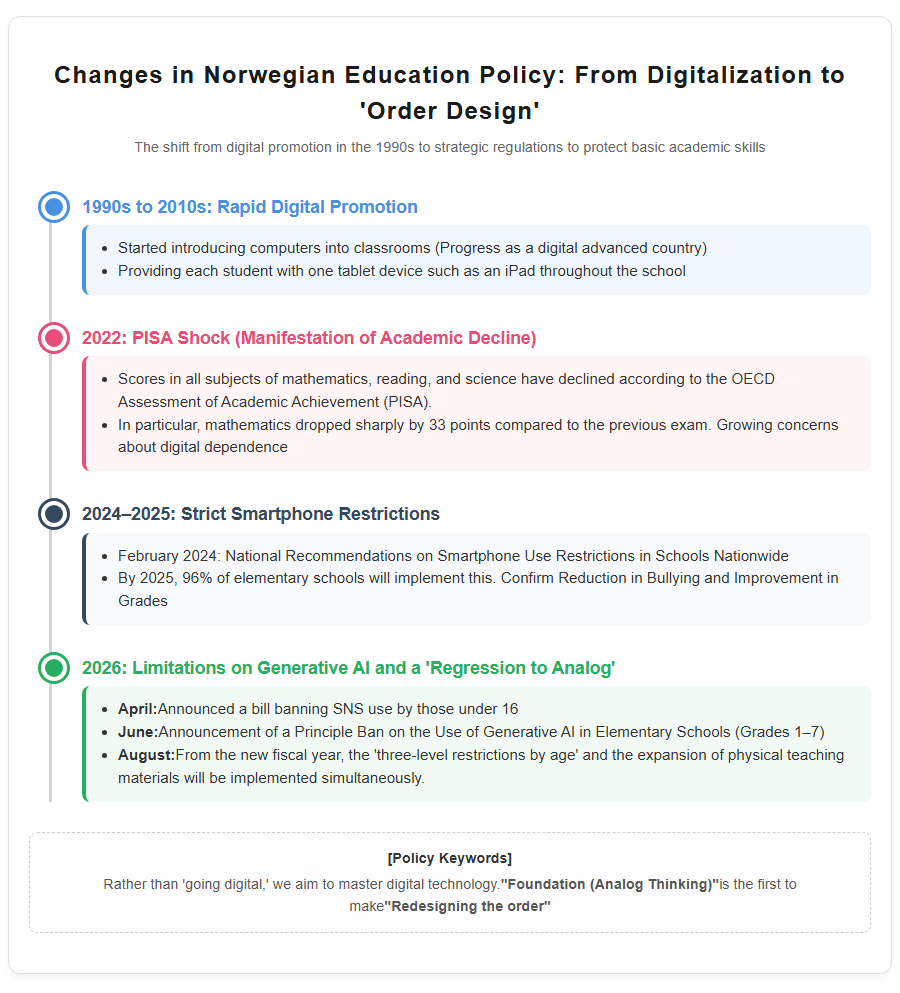
This generation of AI restrictions is positioned as an extension of Norway’s series of “de-digital” policies. Norway has been actively advancing the introduction of computers in classrooms since the 1990s, but now there is a clear shift away from its excessive digital dependence. Specifically, as of February 2024, a national recommendation strictly restricting smartphone use in schools was already issued, and by 2025, 96% of elementary schools will implement it.
Some studies have reported concrete outcomes such as reduced bullying, improved grades, and a 60% decrease in mental health care visits due to this smartphone ban. Furthermore, the government has announced plans to submit a bill to the Diet within the year banning social media use by those under 16 in April 2026, and is accelerating efforts to bring back “paper and pen” to classrooms, including expanding budgets for purchasing physical books. Minister of Education Noltun argues that even in early childhood education, rules should be updated so that screens do not interfere with reading aloud or books. The following chart summarizes the evolution of Norway’s education policy.
Thus, AI regulation is not a one-off move but functions as part of a comprehensive strategy to protect children’s healthy development and learning environments.
Challenges in Effectiveness and the Future of International Educational Models
Debates on the Actual Situation on the Ground and the Effectiveness of Regulations
While national guidelines have been presented, two major challenges have emerged: effectiveness in educational settings and impact on the education industry. According to a survey conducted by the Norwegian Ministry of Education in 2025, 65% of primary school principals and 89% of middle school principals already say their students are using generative AI in some form, indicating that the spread of technology is far outpacing government regulatory speed. Usage becomes noticeable around fifth grade (about age 10), and even if access within schools is blocked, it is impossible to fully control usage via smartphones or personal devices at home, highlighting the limitations of its effectiveness.
Additionally, the Education Federation, Norway’s largest teachers’ union, welcomes clear guidelines but expresses concerns that a blanket ban across all grades in primary schools is “highly interventional,” and that debate on when AI education should begin is still needed. For the EdTech industry as well, this policy will require a fundamental rethink of its business model. Companies offering AI as learning partners, such as Khanmigo’s Khan Academy, risk being excluded from the European market if they cannot strictly prove “which age group and what educational controls are built-in” in the future. Under the EU AI Act, AI in education is considered “high risk” and requires strict transparency.
Future developments and key points of global attention
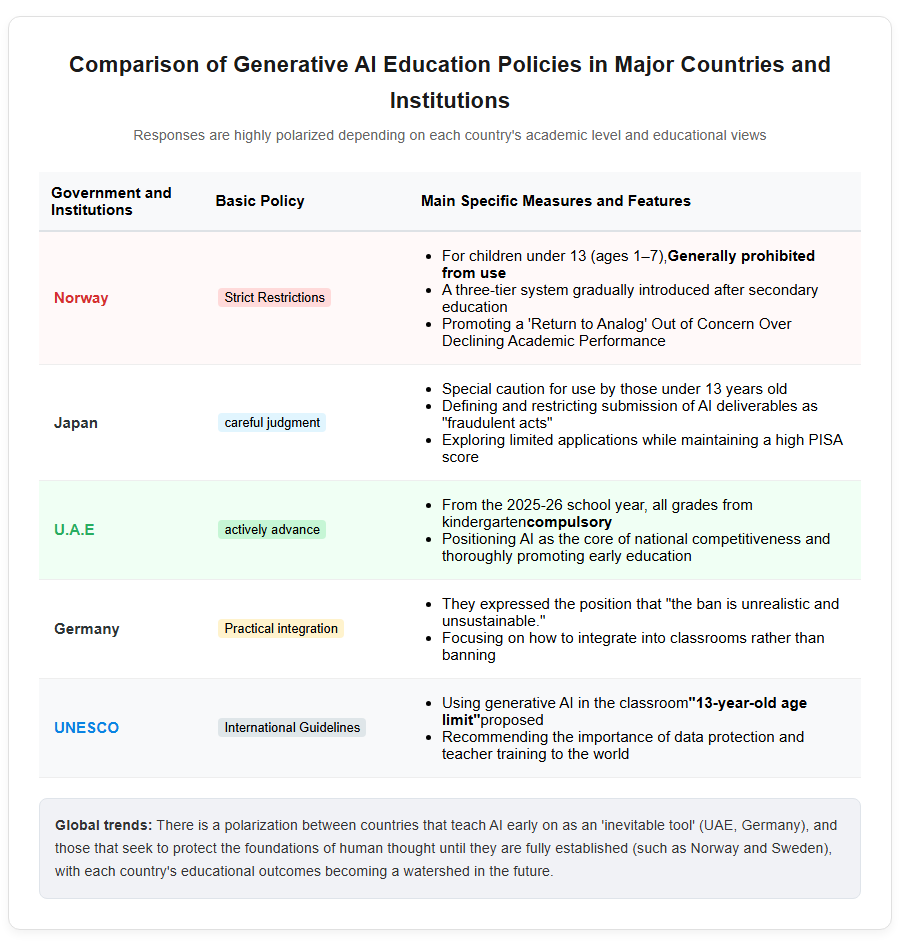
Norway’s decision has sent significant ripples through education policies around the world. Similar smartphone regulations and screen usage restrictions are intensifying in European countries such as Sweden, Denmark, and the Netherlands, with Norway’s case serving as one “reference model.” UNESCO also proposed a 13-year age limit for generative AI use in classrooms in its 2023 guidelines, and Norway’s policy aligns with this.
On the other hand, countries like the United Arab Emirates (UAE) have made AI compulsory from kindergarten, and countries like Germany, considering blanket bans unrealistic, are seeking to actively promote its use, leading to a polarization in global education policies. In Japan, the GIGA School initiative has completed the deployment of one device per student, but the Ministry of Education, Culture, Sports, Science and Technology’s guidelines currently only call for careful consideration, and there are no clear age-based restrictions like Norway’s. Going forward, the results of follow-up studies in Norway will focus worldwide on how “de-digitalization” and “AI restrictions” actually contribute to academic performance improvement and child welfare. The following chart compares AI education policies in major countries.
Norway’s experimental policies should serve as an important touchstone for the difficult challenge of preserving fundamental human thinking while enjoying the benefits of technological innovation.
[#生成AI #ノルウェー #教育政策 #基礎学力 #デジタルデトックス #PISA #EdTech #科学技術]

コメント