SUBARU has clearly shifted its production system to a “mixed production” core system, where gasoline and electric vehicles (BEVs) are assembled on the same line. Behind this lies a strategy to flexibly respond to uncertainties in BEV demand and geopolitical risks through collaboration with Toyota Motor Corporation.
- Next-generation manufacturing began at the core Yajima Factory
- A reversal approach that matches ‘equipment’ rather than vehicles
- The importance of “flexibility” to avoid factories dedicated to BEVs
- Headwinds from Trump tariffs and strengthened bridge production
- Oizumi New Factory’s Challenge of the ‘Triple Half’ Innovation
- Sustainable corporate value born from adaptability to change
Next-generation manufacturing began at the core Yajima Factory
At the Yajima Plant (Ota City, Gunma Prefecture), the heart of Subaru’s production, a new production system has been unveiled. This factory, covering an area of approximately 550,000 square meters and employing around 5,900 people, is now in full swing production of the new BEV “Trailseeker,” announced on April 9, 2026. This new SUV received 1,962 orders within about two months of its launch, showing a strong start with a monthly sales target of about 4 times its target of 250 units. The biggest feature of the Yajima Plant is its “mixed production,” where BEVs, gasoline vehicles, and even Toyota-branded vehicles are assembled sequentially on the same production line using completely different systems and manufacturing methods. As shown in the photo below, not only Subaru BEVs but also its sibling Toyota “bZ4X Touring” and left-hand drive models for North America are mixed across the lineup.
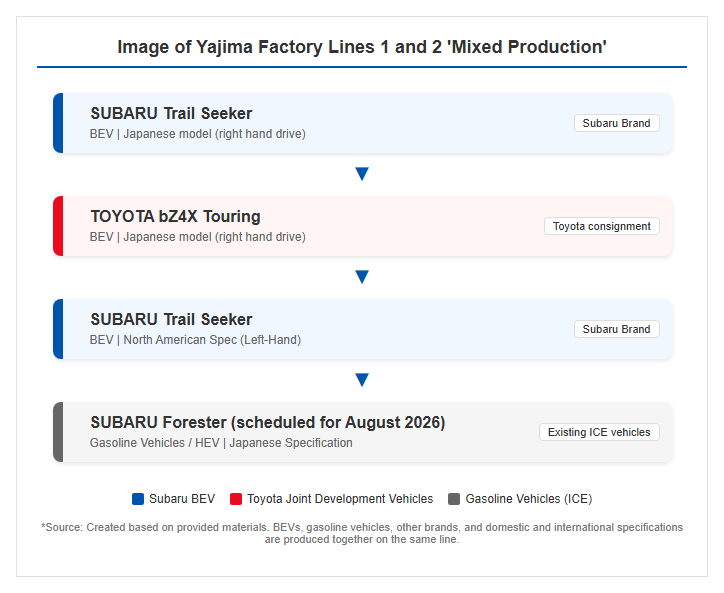
By maintaining this challenging production, we have established a system that can respond immediately to market demand fluctuations. In August 2026, the flagship gasoline vehicle “Forester” is also scheduled to join this lineup, further enhancing Subaru’s flexibility.
A reversal approach that matches ‘equipment’ rather than vehicles
What sets Subaru’s mixed production apart from conventional methods lies in the flexibility of the production equipment to change shapes to fit the vehicle. Typically, in mixed production conducted by other companies like Toyota and Mazda, it is common to standardize vehicle-side designs and align equipment hardpoints to improve production efficiency. However, Subaru is also responsible for contract manufacturing of models like the “bZ4X” within its alliance with Toyota, so it cannot demand that the other party’s design be tailored to its own line. To address this, Subaru developed advanced technology that hydraulically moves the base of the hanger supporting the vehicle body, allowing the support position to be automatically changed for each vehicle model. This made it possible to assemble vehicles with different design philosophies on the same line. The diagram below illustrates how the movable standard works.
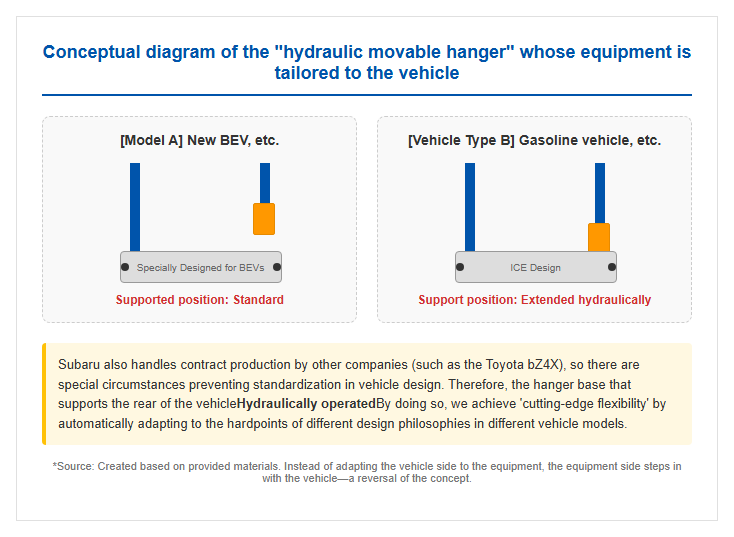
Furthermore, by shifting from the conventional belt conveyor system to lines utilizing groundless automated guided vehicles (AGVs), it has become easier to add processes and change layouts. This idea of “the equipment approaching the vehicle” is precisely the unique winning strategy for Subaru, a small manufacturer, to survive.
[Background of Management and Strategy] Risk management to survive uncertain times
The importance of “flexibility” to avoid factories dedicated to BEVs
The reason Subaru insists on such a flexible production system is the sluggish global demand for BEVs and the unpredictable VUCA (Volatility, Uncertainty, Complexity, Ambiguity) era. In the past, the automotive industry regarded “BEV-only factories as the future,” but now it is forced to develop hybrid vehicles (HEV) and internal combustion engine (ICE) vehicles in parallel. For manufacturers like Subaru, which sell about one million units annually, investing huge sums to build dedicated BEV lines, resulting in lower utilization rates and heavier fixed costs poses a critical management risk. At its May 2026 earnings briefing, Subaru announced a postponement of the introduction of its in-house developed BEVs, which is part of a flexible decision to shift resources to gasoline vehicles, which currently have strong demand. By jointly developing with Toyota, we aim to shift our structure to a structure that can reliably generate profits no matter how the market shifts, while adopting strategies that suppress investment risks while absorbing the latest technologies.
Headwinds from Trump tariffs and strengthened bridge production
One of Subaru’s biggest management risks is its high dependence on the North American market, which accounts for 71% of global sales. In the United States, import tariffs will be raised from the previous 2.5% to 27.5% in April 2025, and later reduced to 15%, but they still remain a major factor putting pressure on operating profits. To avoid being swayed by changes in exchange rates or political environments, Subaru has introduced the concept of “bridge production.” This system allows the same model to be produced at both the domestic factory in Gunma and the production site (SIA) in Indiana, USA, allowing flexible adjustments in production allocation according to market conditions.
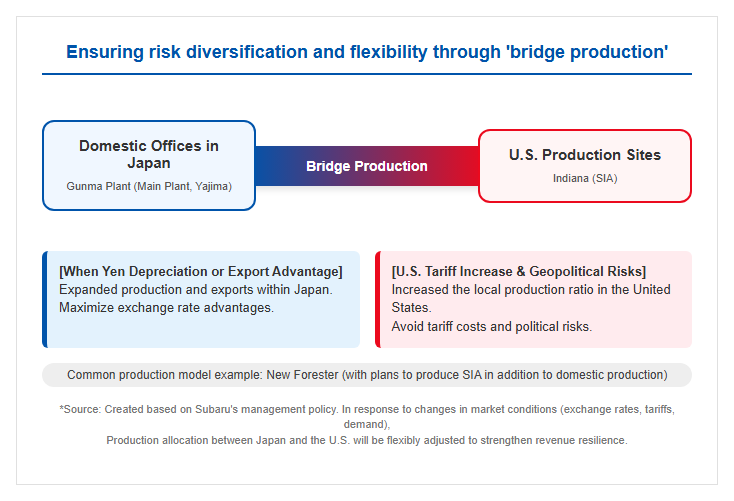
For example, if tariffs rise in the U.S., U.S. production can be increased, and if the yen weakens, exports from Japan can be increased. The new “Forester,” which won the Japan Car of the Year award in 2025, is also planned to begin production at SIA in the future. Strengthening resilience through production technology is the foundation that supports Subaru’s brand strategy to face the headwinds of tariffs.
[Mid- to Long-Term Outlook] Continuously Evolving Factories and 2030 Goals
Oizumi New Factory’s Challenge of the ‘Triple Half’ Innovation
The expertise in mixed production honed at the Yajima Factory will be carried over to the new factory currently under construction in Oizumi Town, Gunma Prefecture. The concept of the new factory is “a continuously evolving factory,” aiming to be a system that can adapt to new vehicles simply by rewriting the factory’s software, similar to “SDV,” where cars evolve through software updates. Here, Subaru is taking on the challenge of a unique initiative called the “Triple Half,” which cuts production time, development period, and parts in half. By simplifying basic tasks and assembling large variation tasks by vehicle model into “sub-processes” separated from the main line, the line balance is maintained. Additionally, there are plans to build a system where AI automatically transports parts to where they are needed, reducing logistics staff by 50%. Furthermore, by introducing “physical AI” robots that independently assess and operate based on their surroundings, we pursue the optimal balance between humans and automation, aiming to become a competitive manufacturing hub that will remain effective even 10 years from now.
Sustainable corporate value born from adaptability to change
Subaru has set goals for 2030 to achieve “industry-leading profitability” and “ROE of 10% or higher.” Additionally, by the early 2030s, the company plans to expand global sales to 1.2 million units plus alpha. This shift in production system is not just about cost reduction or BEV compatibility, but also about strengthening the company’s “adaptability to change” based on the company’s manufacturing spirit that has continued since the 1950s “Subaru 360.” On May 15, 2026, it announced a treasury stock buyback with a maximum of 150 billion yen, focusing on management with capital costs in mind. At one point, there were plans to allocate about 1.2 trillion yen in investment to electrification, but in response to changes in the market environment, we have been making agile management decisions, such as reallocating resources to next-generation engine vehicles. Not only has Subaru acquired not only the “asset” of a new factory but also a “system” to survive in an uncertain future, which will be a long-term strength. By refining brand strength and increasing added value that makes customers say, ‘I’m buying because it’s Subaru,’ we are aiming to overcome this once-in-a-century transformation.
[#スバル #トヨタ方式 #混流生産 #電気自動車 #製造業 #経営戦略 #BEV #自動車産業]

コメント