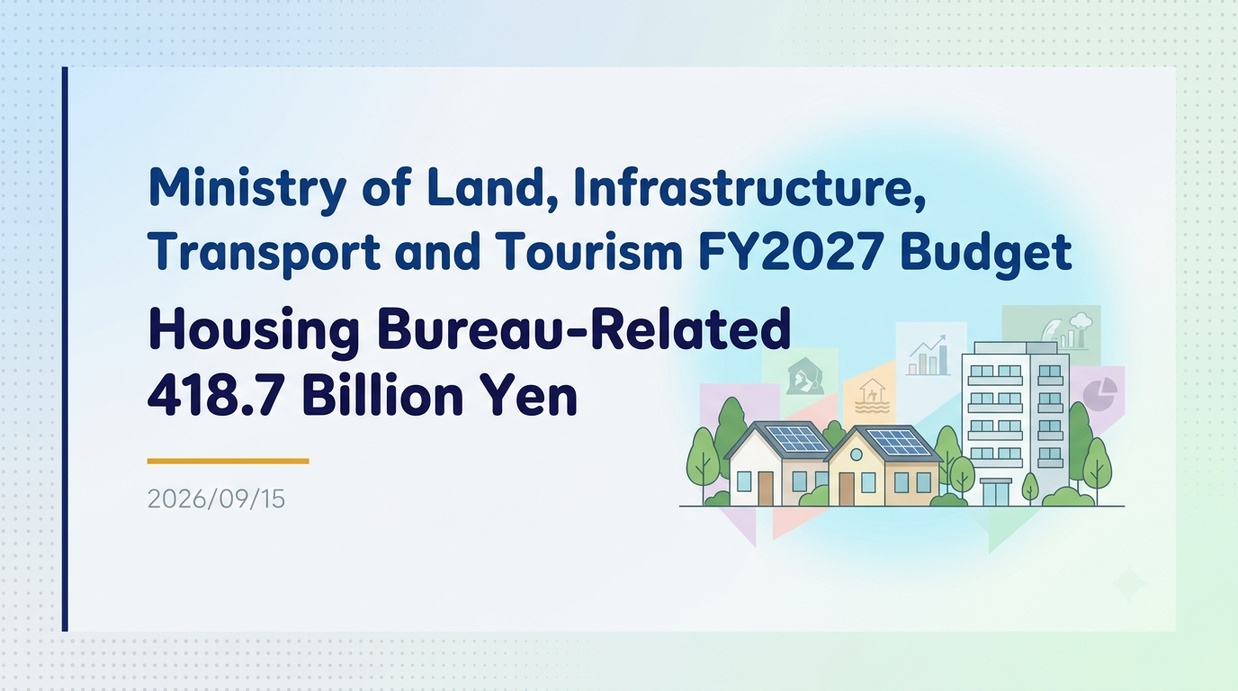
On August 28, 2026, Japan’s Ministry of Land, Infrastructure, Transport and Tourism (MLIT) released its fiscal 2027 budget request, seeking 418.7 billion yen for housing bureau initiatives—a roughly 2.5-fold increase over the previous fiscal year. This dramatic surge responds to complex challenges, including the effective utilization of aging housing stock, accelerated decarbonization, and enhanced disaster preparedness against increasingly frequent natural hazards.
- Summary of the 418.7 Billion Yen Request: A 2.5-Fold Jump Year-Over-Year
- Shift Away from Supplementary Budgets Toward Initial-Budget-Led Funding
- Financial Support for Vacant Home Rentals and the Evolving Role of JHF
- Post-Noto Earthquake Measures: Disaster Prevention in Dense Communities and Seismic Breaker Subsidies
- The Mirai Eco Housing 2027 Program and Inter-Ministerial Framework
- Impact on Home Selection and Key Focus Areas Amid the Transition to “GX ZEH”
- Official MLIT Documentation
- Energy Efficiency Labeling & Policy Materials
Summary of the 418.7 Billion Yen Request: A 2.5-Fold Jump Year-Over-Year
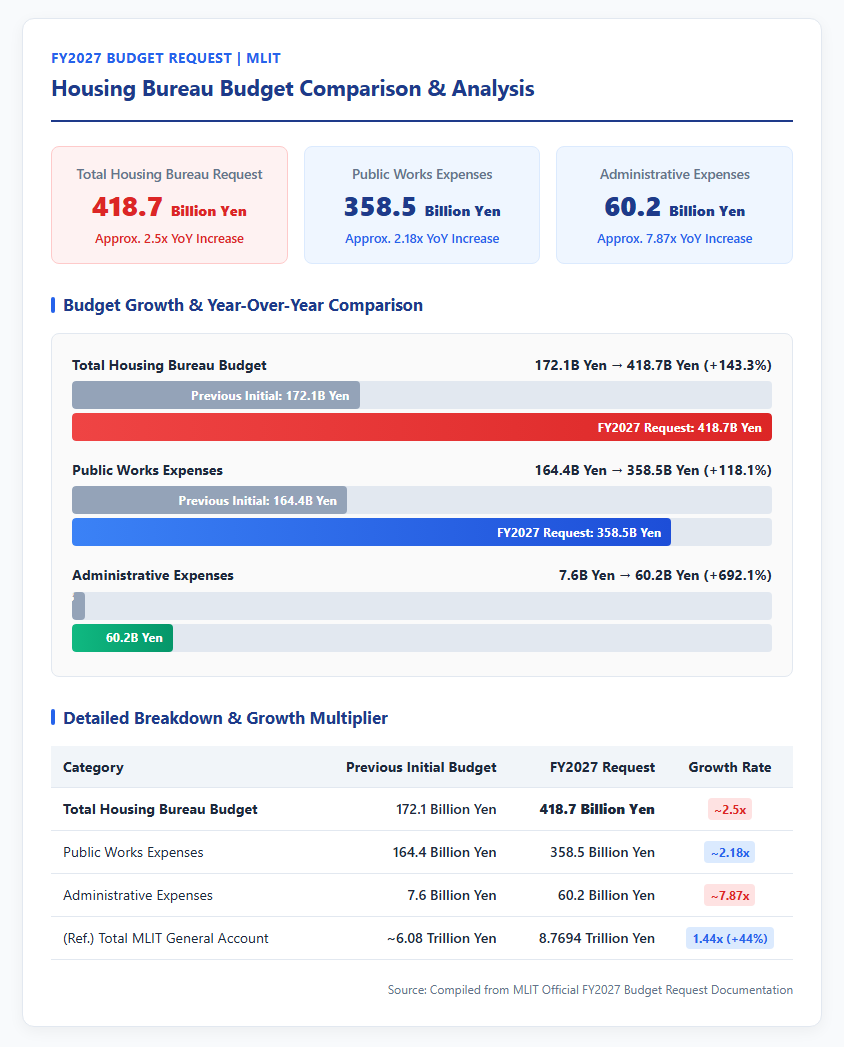
In the FY2027 budget request announced by MLIT on August 28, 2026, the overall general account request reached 8.7694 trillion yen, representing a 44% increase over the original budget for the previous fiscal year. The Housing Bureau’s budget request stands out sharply, skyrocketing from 172.1 billion yen in the previous year’s initial budget to 418.7 billion yen—a nearly 2.5-fold expansion. A detailed breakdown shows public works expenses rising from 164.4 billion yen to 358.5 billion yen (a 2.18-fold increase), while administrative expenses surge nearly 7.87-fold from 7.6 billion yen to 60.2 billion yen.
Driving this massive budget expansion is a confluence of pressing issues across Japan: the growing crisis of vacant homes (akiya), an aging existing housing stock, the urgent push for decarbonization to mitigate global warming, and the need to bolster resilience against frequent, severe natural disasters. MLIT’s Housing Bureau highlighted five key priorities: “Ensuring safe housing and living conditions, and developing quality urban environments,” “Effective utilization of existing housing stock and forming a vibrant secondary market,” “Securing diverse housing options where everyone can live with peace of mind,” “Promoting energy efficiency and decarbonization in housing and building sectors,” and “Securing workforce capacity and boosting productivity.” These priorities demonstrate a decisive commitment to fundamentally restructuring Japan’s living environments in response to changing societal needs, rather than merely maintaining existing systems.
Shift Away from Supplementary Budgets Toward Initial-Budget-Led Funding
A major structural shift in this year’s budget request lies in the government’s approach to budget allocation. Over the past four fiscal years (FY2023 through FY2026), energy-efficiency subsidies for housing—such as the Child-Rearing Eco-Home Support Program and Mirai Eco Housing Program—were traditionally funded through autumn supplementary budgets approved by the Cabinet between late October and late November. Consequently, reviewing the initial budget request in late August yielded little clarity regarding the full scope of housing subsidy programs for the upcoming fiscal year.
For FY2027, however, the government adopted a new policy aimed at reducing over-reliance on supplementary budgets. For the first time in four years, major housing support programs are listed upfront in the initial budget request. This change enables housing developers and home buyers to anticipate policy frameworks and subsidy structures well in advance, facilitating smoothed construction schedules and balanced project planning. Nevertheless, budget requests represent agency proposals and remain subject to Ministry of Finance review, Cabinet approval in late December, and subsequent parliamentary deliberations.
Harnessing Existing Housing Stock and Enhancing Disaster Resilience in Densely Populated Settlements
Financial Support for Vacant Home Rentals and the Evolving Role of JHF
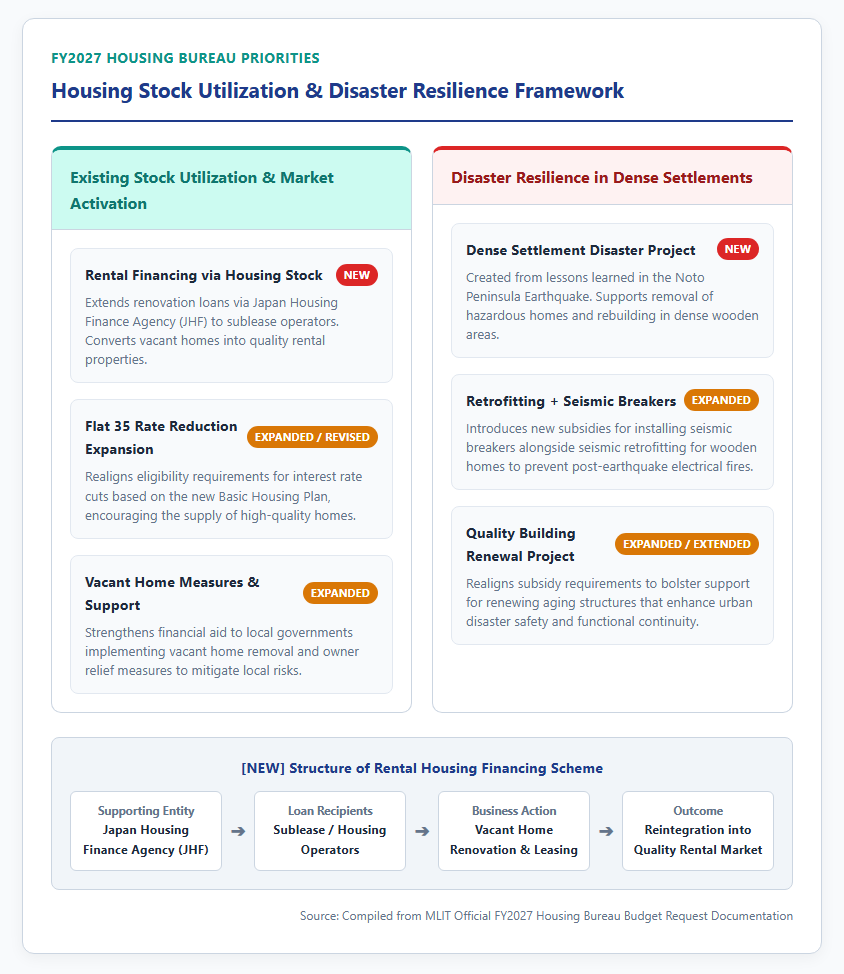
To foster the effective utilization of existing housing stock and build a healthy secondary market, MLIT introduced a new “Rental Housing Financing System Utilizing Existing Housing Stock.” As abandoned vacant homes become an increasingly acute social issue nationwide, revitalizing structurally sound properties and introducing them to the market has become an urgent task. Under this scheme, the Japan Housing Finance Agency (JHF) will extend loans to businesses engaging in renovation and subleasing operations, offering robust financial backing to reintegrate existing housing stock as high-quality rental properties.
In tandem, the interest rate reduction scheme under the “Flat 35” all-period fixed-rate mortgage program (Subsidies for Promoting Quality Housing Development) is undergoing comprehensive review and expansion. Aligned with the new Basic Housing Plan approved by the Cabinet in March 2026, the government is redefining eligibility requirements to encourage the supply of high-quality homes at manageable costs for consumers. Furthermore, expanded funding for the Comprehensive Vacant Home Support Program and Vacant Home Renovation Promotion Initiatives will reinforce financial assistance to local governments carrying out home demolitions and owner relief measures, driving local efforts to mitigate vacant property risks.
Post-Noto Earthquake Measures: Disaster Prevention in Dense Communities and Seismic Breaker Subsidies
From a disaster risk reduction perspective, MLIT created the “Densely Populated Settlement Disaster Prevention Project,” drawing directly from lessons learned during the 2024 Noto Peninsula Earthquake, where fires devastated areas surrounding Wajima City’s Asaichi market. In rural regions and neighborhoods with dense clusters of older homes, non-fireproof structures and poorly maintained vacant properties pose severe risks of rapid, wide-scale fire spread. This new project supports the removal of hazardous vacant homes in dense communities, while improving living environments and streamlining rebuilding processes to raise regional disaster resilience.
Additionally, the expansion of the Housing and Building Seismic Retrofit Project introduces new subsidies for installing “seismic breakers” alongside earthquake retrofitting works for wooden homes. By standardizing measures to prevent post-earthquake electrical fires, the policy aims to significantly reduce secondary disaster risks. Requirements for the Quality Building Development Project—which encourages the renewal of aging structures—are also being revised and extended, establishing a comprehensive suite of support measures to build disaster-resilient communities across both metropolitan centers and rural villages.
Promoting Decarbonized Housing Ahead of 2027 ZEH Standard Revisions
The Mirai Eco Housing 2027 Program and Inter-Ministerial Framework
The budget dedicated to decarbonizing the housing and building sector expanded dramatically to 303 billion yen, roughly 2.92 times the previous fiscal year’s allocation. At the center of this effort is the newly requested “Mirai Eco Housing 2027 Program,” budgeted at 200 billion yen. Anticipating a total scale of 250 billion yen when including Green Transformation (GX) Economic Transition Bonds, the program provides extensive funding for acquiring high-performance energy-saving homes and undertaking thermal insulation retrofits for existing properties.
Inter-ministerial collaboration among MLIT, the Ministry of the Environment (MOE), and the Ministry of Economy, Trade and Industry (METI) continues to anchor national housing energy policies. MOE requested 98 billion yen for its “Accelerated Support Project for Housing Energy Efficiency and CO2 Reduction through Insulated Windows” and 50 billion yen for the “Decarbonization-Oriented Housing Adoption Support Project.” Meanwhile, METI requested subsidies for high-efficiency water heaters. Together, these initiatives form a comprehensive residential energy-efficiency campaign combining window insulation retrofits, high-efficiency water heaters, and enhanced building envelope insulation.
Impact on Home Selection and Key Focus Areas Amid the Transition to “GX ZEH”
Behind this budget expansion lies a major overhaul of Zero Energy House (ZEH) standards scheduled for April 2027. Under the rebranded “GX ZEH” standard, the required thermal insulation performance will shift from the current Insulation Grade 5 to a mandatory “Grade 6 or higher.” Furthermore, primary energy consumption reduction targets will tighten from at least 20% to at least 35%. For detached houses, installing energy storage batteries with an initial effective capacity of at least 5 kWh and Home Energy Management Systems (HEMS) will become virtually mandatory alongside solar power equipment.
While these requirements are expected to raise initial construction costs compared to traditional homes, they offer substantial benefits in monthly utility bill savings and enhanced disaster resilience. With mandatory energy efficiency compliance implemented in April 2025 and mandatory ZEH compliance looming in 2030, home buyers and builders from FY2026 onward must evaluate options through a long-term lens, considering future asset value and operational costs rather than settling for minimum compliance. As subsidy amounts and specific criteria are finalized throughout the upcoming budget review process, close attention will be paid to the Cabinet’s budget draft decision in late December.
Reference Pages
Official MLIT Documentation
- [MLIT Explanatory Materials on the Building Energy Efficiency Act and Building Standard Law] https://www.mlit.go.jp/common/001627103.pdf
Energy Efficiency Labeling & Policy Materials
- [MLIT Energy Efficiency Labeling System] https://www.mlit.go.jp/shoene-label/
【#MLIT #BudgetRequest #HousingEnergyEfficiency #MiraiEcoHousing #ZEH #VacantHomeMeasures #DisasterPreventionSubsidies】


コメント