GMKtec has unveiled the “EVO-X5 Pro,” a mini PC equipped with up to 192GB of unified memory. This announcement addresses a surging demand for “Agentic PCs” capable of running 300-billion-parameter large language models locally and autonomously, reducing cloud dependence while safeguarding confidential data.
- Key Highlights and Development Background
- Inference Innovation: How 192GB Memory Transforms Local LLMs
- Integrated Design: 16-Core Zen 5, Powerful iGPU, and NPU
- Thermal Engineering and Expandability Supporting 160GB VRAM Allocation
- Security and Enterprise Reliability for 24/7 Operations
- Market Impact and Trends in the Agentic PC Era
Key Highlights and Development Background
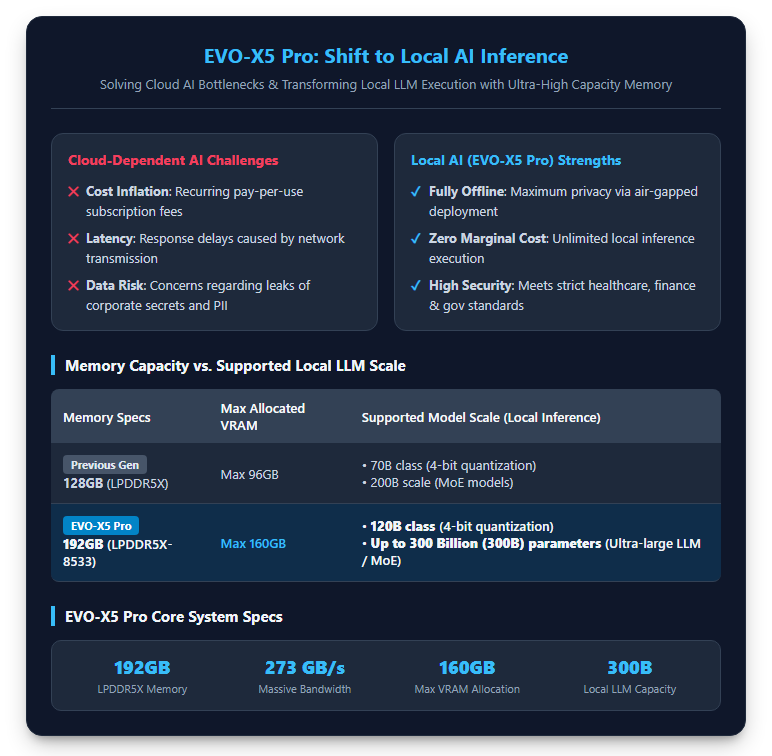
On September 5, 2026, at IFA 2026 in Germany, mini PC manufacturer GMKtec officially announced its flagship AI mini PC, the EVO-X5 Pro. This groundbreaking desktop AI computing platform combines AMD’s latest flagship processor, the Ryzen AI Max+ PRO 495, with up to 192GB of LPDDR5X unified memory. Its defining feature is the capability to perform fully offline, local inference on large language models (LLMs) with up to 300 billion (300B) parameters without relying on cloud infrastructure. In the evolving generative AI market, recurring monthly cloud subscription costs, latency issues, and the risk of confidential corporate data leaks have become critical concerns. Consequently, the concept of the Agentic PC—designed to run AI autonomously on local hardware—has gained massive momentum, with the EVO-X5 Pro engineered as a core platform for this shift. Operating seamlessly in air-gapped environments, the system is expected to find strong adoption across sectors requiring stringent data governance, such as healthcare, finance, and government institutions. Please refer to the figure below.
Inference Innovation: How 192GB Memory Transforms Local LLMs
The EVO-X5 Pro incorporates ultra-fast LPDDR5X-8533 memory, delivering a massive memory bandwidth of approximately 273 GB/s. Featuring a unified memory architecture shared between the CPU and GPU, the system allows up to 160GB of its 192GB total memory pool to be dynamically allocated as dedicated VRAM. In traditional mini PCs and desktop systems capped at 128GB or less, local execution was generally limited to 70B quantized models or 200B Mixture-of-Experts (MoE) architectures. Expanding this capacity to 192GB brings 120B 4-bit quantized models and massive 300B-class LLMs into the realm of local deployment on a single compact system. This enables advanced AI workloads—such as multi-file automated code generation, complex document summarization, and confidential internal consulting—to run locally without costly enterprise server GPUs. Compared to building equivalent VRAM capacity using traditional desktop GPUs, the EVO-X5 Pro dramatically reduces upfront hardware investment, footprint, and power consumption.
Technical Specifications and Architecture of the Ryzen AI Max+ PRO 495
Integrated Design: 16-Core Zen 5, Powerful iGPU, and NPU
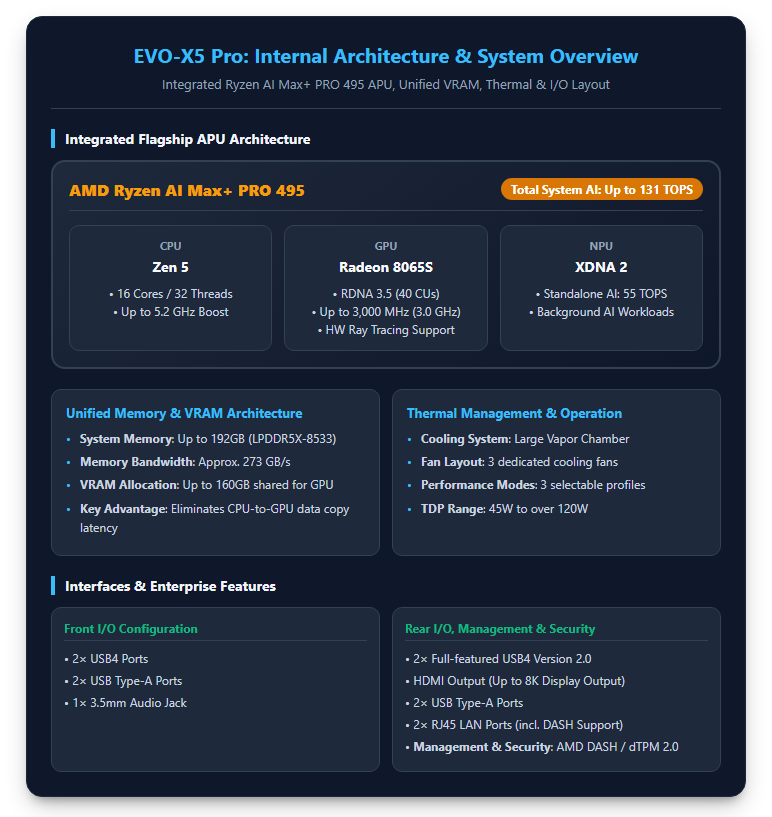
At the heart of the EVO-X5 Pro lies the Ryzen AI Max+ PRO 495, AMD’s flagship APU designed specifically for local AI inference and professional workloads. Built on the Zen 5 architecture, the CPU features 16 cores and 32 threads with a boost clock of up to 5.2 GHz, delivering top-tier desktop multithreaded performance for complex data processing and compilation tasks. Graphical duties are handled by the integrated Radeon 8065S GPU based on the RDNA 3.5 architecture, featuring 40 compute units, clock speeds up to 3,000 MHz (3.0 GHz), and hardware ray tracing support. Its graphical prowess rivals discrete mobile GPUs like the GeForce RTX 4070 Laptop GPU and desktop RTX 4060. Furthermore, the integrated XDNA 2 NPU provides up to 55 TOPS of dedicated AI performance, bringing total system AI processing power to 131 TOPS to efficiently drive background AI assistants with minimal power consumption.
Thermal Engineering and Expandability Supporting 160GB VRAM Allocation
To sustain high-performance AI inference under prolonged workloads, the EVO-X5 Pro integrates an advanced thermal management system. The compact chassis houses a large vapor chamber and three dedicated cooling fans, allowing users to switch between three performance modes. Operating seamlessly across TDP ranges from 45W to over 120W, the cooling system prevents thermal throttling while maintaining quiet operation. Despite its compact desktop footprint, the system boasts extensive connectivity. The front panel features two USB4 ports, two USB Type-A ports, and a 3.5mm audio jack. The rear panel offers two full-featured USB4 Version 2.0 ports, HDMI output (supporting up to 8K resolution), two USB Type-A ports, and two RJ45 LAN ports. This comprehensive port selection supports external GPU (eGPU) enclosures, multi-display setups, and multi-system clustering for distributed computing environments. Please refer to the figure below.
Significance for Enterprise Markets and Future Outlook
Security and Enterprise Reliability for 24/7 Operations
Beyond individual power users, the EVO-X5 Pro is engineered for demanding enterprise and institutional deployment. GMKtec has conducted rigorous continuous 24/7 reliability testing to validate the system as a dependable, always-on local AI server. To streamline enterprise fleet management, the PC supports industry-standard AMD DASH remote management technology, featuring a dedicated DASH-enabled RJ45 LAN port on the rear. This allows IT administrators to perform out-of-band health monitoring, BIOS configuration, and secure system updates remotely. On the security front, an onboard discrete TPM 2.0 (dTPM 2.0) chip provides hardware-level encryption to safeguard sensitive credentials and prevent unauthorized tampering. These features establish a secure, air-gapped AI execution environment for processing electronic medical records, analyzing unreleased legal contracts, and handling municipal data.
Market Impact and Trends in the Agentic PC Era
From late 2026 onward, the AI industry trend is shifting from conversational text generation toward Agentic PCs capable of autonomously planning and executing complex multi-step tasks. The EVO-X5 Pro stands out as a flagship product in this new hardware category. While official pricing and regional release dates remain unannounced, its high-capacity memory and top-tier APU suggest a professional-grade price tag. Nevertheless, configuring an equivalent VRAM environment using discrete NVIDIA desktop GPUs (such as dual high-end graphics cards costing \$2,500 to \$3,400 each) requires a massive tower PC with significantly higher power consumption and total cost of ownership. In contrast, the EVO-X5 Pro offers exceptional economic efficiency within a power budget of 100W to 140W and a palm-sized footprint. Following its debut at IFA 2026, major manufacturers have announced competing 192GB mini PCs, signaling a major paradigm shift toward standardized local AI development environments.
References
- 【GMKtec Official Website】https://www.gmktec.com/
- 【AMD Official Specifications】https://www.amd.com/ja/products/processors/laptop/ryzen-pro/ai-max-pro-400-series/amd-ryzen-ai-max-plus-pro-495.html
【#GMKtec #EVOX5Pro #MiniPC #LocalLLM #Ryzen #AgenticPC #AIWorkstation #IFA2026】

コメント