
Hikari Tsushin, Inc. has announced a takeover bid (TOB) for Leopalace21 Corporation in partnership with two investment funds, aiming to fully acquire and privatize the company in a transaction valued at approximately 270 billion yen. The move is driven by opportunities to generate business synergies utilizing Leopalace21’s management portfolio of roughly 540,000 rental units, while pursuing medium- to long-term structural reforms insulated from short-term stock market fluctuations.
- Summary of the ¥270 Billion TOB and Tender Offer Terms
- Over 52% Premium to Share Price and Negotiation History
- Recovery from Construction Defect Issues and the Need for Structural Reform
- Transition to a Privatized Model and Medium-Term Business Strategy
- Deploying Services across 540,000 Managed Units and Expanding Client Acquisition
- Post-TOB Schedule and Market Impact
Summary of the ¥270 Billion TOB and Tender Offer Terms
On September 14, 2026, Hikari Tsushin, Inc., a major provider of information technology, telecommunications, and energy services, announced the launch of a takeover bid (TOB) for the common shares and stock acquisition rights of major rental housing operator Leopalace21 Corporation via its subsidiary, K891 Co., Ltd. The tender offer period runs for 30 business days from September 15, 2026, to October 30, 2026, with the offer price set at ¥1,000 per common share. The total transaction value is expected to reach up to approximately ¥267.6 billion (¥267,668 million), making it a major M&A deal. Prior to the settlement start date following a successful TOB, the bidding vehicle will transition to a consortium structure owned 34.0% by Hikari Tsushin, 33.0% by a fund managed by private equity firm MBK Partners, and 33.0% by a fund operated by OHANAPANA, a wholly owned subsidiary of NEC Capital Solutions.
The Hikari Tsushin Group is already the largest shareholder of Leopalace21, holding an 18.11% stake (59,188,300 shares) through consolidated subsidiaries and investment partnerships. The TOB targets all remaining outstanding shares excluding Hikari Tsushin’s current holdings. The minimum planned purchase threshold is set at 158,716,000 shares (a 48.56% ownership stake), with no upper limit on the number of shares to be acquired, as the bidders aim for full ownership. Leopalace21’s Board of Directors has formally expressed its support for the TOB and resolved to recommend that shareholders and optionholders tender their shares and stock acquisition rights. For a detailed summary of the acquisition structure, refer to the diagram below.
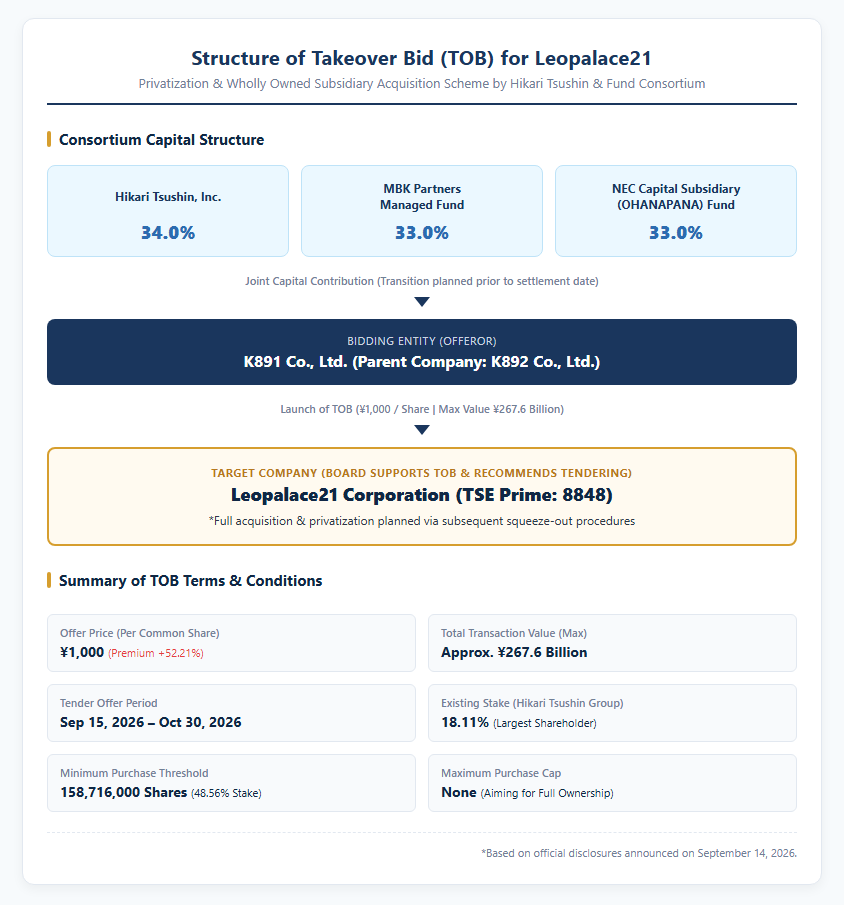
Upon successful completion of the offer and subsequent squeeze-out procedures, Leopalace21 is expected to be delisted from the Tokyo Stock Exchange and privatized.
Over 52% Premium to Share Price and Negotiation History
The tender offer price of ¥1,000 per share represents a 52.21% premium over Leopalace21’s closing price of ¥657 on the Tokyo Stock Exchange Prime Market on September 11, 2026, the business day prior to the announcement. Furthermore, it offers a premium of 56.49% over the simple average closing price of ¥639 over the past month, 54.32% over ¥648 over the past three months, and 54.08% over ¥649 over the past six months. This level exceeds the median premium (approximately 47% to 53%) observed in comparable delisting and privatization transactions in Japan in recent years.
Reaching this offer price involved extensive and rigorous negotiations between the two parties. Hikari Tsushin initially submitted an expression of interest on December 19, 2025, proposing a purchase price of ¥800 per share. In response, an independent special committee established by Leopalace21 requested a revised proposal, taking the view that the initial price failed to adequately reflect the company’s intrinsic value and minority shareholder interests. Subsequently, the proposed price was raised incrementally to ¥900 in May 2026 and ¥950 in June, before a final offer of ¥1,000 was presented in July. The special committee obtained a fairness opinion from an independent third-party valuation firm, Plutus Consulting, confirming that the price was fair from a financial perspective, and ultimately resolved to accept the ¥1,000 offer. This represents a 25.0% increase from the initial proposal.
Acquisition Background and Leopalace21’s Management Challenges
Recovery from Construction Defect Issues and the Need for Structural Reform
Leopalace21 launched its full-scale sales of urban-style apartments in 1985 and expanded its footprint nationwide by providing rental housing for single occupants. However, in 2018, the discovery of widespread construction defects—including missing or inadequate fireproof partition walls in attic spaces and non-compliant ceiling structures—severely damaged the company’s credibility. Declining occupancy rates and massive repair expenses pushed Leopalace21 into a severe financial crisis, resulting in a net loss attributable to owners of the parent of ¥80.2 billion for the fiscal year ended March 2020 and nearly wiping out its net assets. That same year, the company secured ¥57.2 billion in financial support from U.S. investment firm Fortress Investment Group to spearhead its turnaround. Through rent adjustments, cost reductions, and strengthened corporate sales, Leopalace21 reported net sales of ¥444.82 billion and an operating profit of ¥35.966 billion for the fiscal year ended March 2026, demonstrating a solid recovery in core profitability.
Despite this operational rebound, the business environment surrounding Leopalace21 remains demanding. While competitors actively invested and expanded their operations, Leopalace21 suffered a period of stagnant growth as its management resources were consumed by addressing the defect issues. In its core sublease business, maintaining the number of managed units is critical; however, due to aging properties and other factors, the unit count has declined from approximately 570,000 in the fiscal year ended March 2020 to roughly 540,000 in the fiscal year ended March 2026. Moreover, the company faces an urgent need to restructure its business model to enhance medium- to long-term corporate value, including shedding non-core assets—such as the loss-making elderly care (silver) business—and adapting to new lease accounting standards (ASBJ Statement No. 34) taking effect in April 2027.
Transition to a Privatized Model and Medium-Term Business Strategy
Addressing Leopalace21’s structural challenges requires upfront capital investments and cost-intensive initiatives, including renovating and redeveloping existing properties, resuming new property development, and renegotiating contract terms with property owners. However, remaining a publicly traded company exposes Leopalace21 to intense market scrutiny regarding quarterly financial performance and short-term stock price fluctuations. Given that market confidence among capital and financial markets has not yet fully recovered from past crises, executing a multi-year, large-scale structural overhaul while maintaining a public listing was deemed exceptionally difficult.
By opting for privatization through this TOB, Leopalace21 can execute bold management reforms from a medium- to long-term perspective without being constrained by short-term stock market evaluations. Key advantages and expected outcomes of privatization include:
- Securing an environment dedicated to long-term structural reforms free from quarterly earnings pressure and stock volatility
- Stabilizing its financial foundation backed by the capital power and creditworthiness of Hikari Tsushin, MBK Partners, and NEC Capital Solutions
- Enabling aggressive investments in profit-sharing initiatives for property owners, talent recruitment, and employee training for property development
Although delisting carries potential drawbacks—such as the loss of access to equity financing from capital markets and potential impacts on corporate visibility and public trust—Leopalace21 concluded that the benefits of privatization far outweigh the disadvantages, given its long-established brand recognition and the strong support system provided by the consortium members.
Expected Synergies and Future Outlook
Deploying Services across 540,000 Managed Units and Expanding Client Acquisition
The combination of the Hikari Tsushin Group and Leopalace21 through this transaction is expected to generate powerful operational synergies. The primary strength lies in integrating Leopalace21’s nationwide management network of approximately 540,000 single-occupancy rental units with Hikari Tsushin’s diverse portfolio of products and formidable sales organization. The key synergy initiatives planned include:
- Introducing infrastructure services to tenants: Offering electricity, gas, broadband internet, mobile plans, water servers, payment processing, insurance, and guarantee services provided by the Hikari Tsushin Group, alongside value-added management services like temporary power activation during vacancies and centralized call-center support
- Expanding tenant acquisition via corporate sales channels: Leveraging Hikari Tsushin’s extensive corporate client network to attract new corporate tenants for Leopalace21, where corporate housing accounts for roughly two-thirds of total occupancy
- Tapping into demand for foreign worker housing: Partnering with Hikari Tsushin Group’s foreign worker support services to capture housing demand from technical interns and specified skilled workers, thereby boosting occupancy rates
These initiatives are expected to enhance the added value of managed properties, increase tenant satisfaction, and secure new, stable streams of recurring service revenue. For an overview of the customer-base synergy structure, refer to the image below.
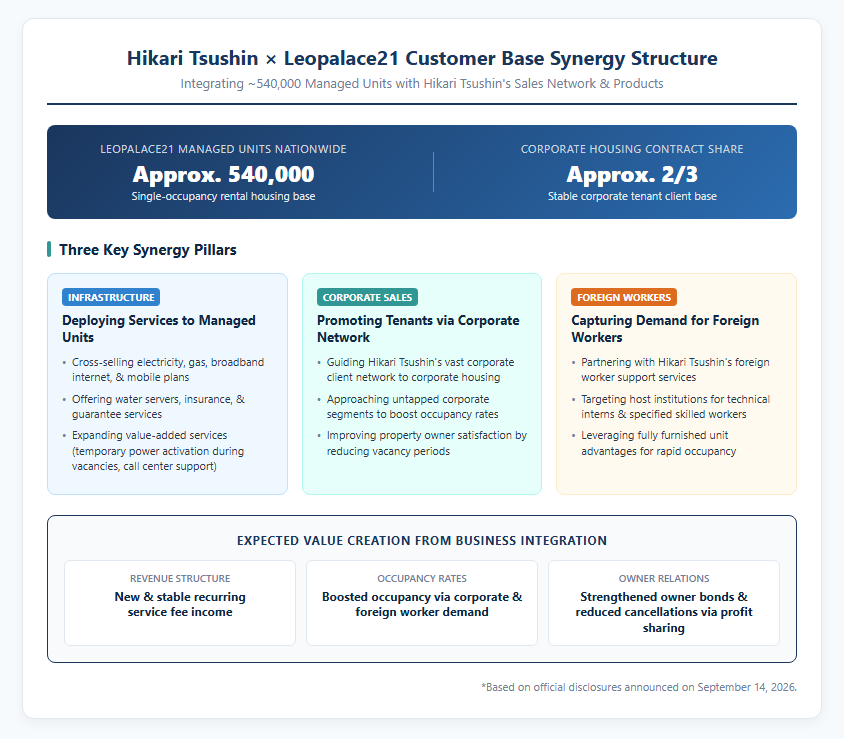
This integration positions Leopalace21 to evolve beyond traditional apartment rental management into a comprehensive residential and communications infrastructure platform.
Post-TOB Schedule and Market Impact
The procedure toward making Leopalace21 a wholly owned subsidiary following the completion of the TOB will proceed in stages. The tender offer period concludes on October 30, 2026, with settlement scheduled to begin on November 9, 2026. If the bidders do not acquire all outstanding shares through the TOB, they plan to request that Leopalace21 convene an extraordinary general meeting of shareholders around January 2027 to approve a reverse stock split pursuant to Article 180 of the Companies Act. Through this squeeze-out process, shareholding will be consolidated entirely among the bidders and special related parties, leading to the delisting of Leopalace21 shares from the TSE Prime Market.
For minority shareholders who do not tender their shares in the TOB, cash proceeds equivalent to the TOB offer price of ¥1,000 per share will ultimately be distributed following court approval for the sale of fractional shares, ensuring economic fairness for general shareholders. Having weathered construction defect crises, activist investor battles, and private equity-led restructuring, Leopalace21 is now entering a new chapter under a leading telecommunications and office automation distributor. Its privatization stands out as a landmark restructuring case within the real estate rental industry and the Japanese M&A landscape.
Reference Pages
- [Hikari Tsushin, Inc. / K891 Co., Ltd. Timely Disclosure Documents] https://disclosure2.edinet-fsa.go.jp/
- [Leopalace21 Corporation Construction Defect Response & IR Information] https://www.leopalace21.co.jp/info/
【#Economy #HikariTsushin #Leopalace21 #TOB #MA #Delisting #WhollyOwnedSubsidiary #RealEstate】

コメント