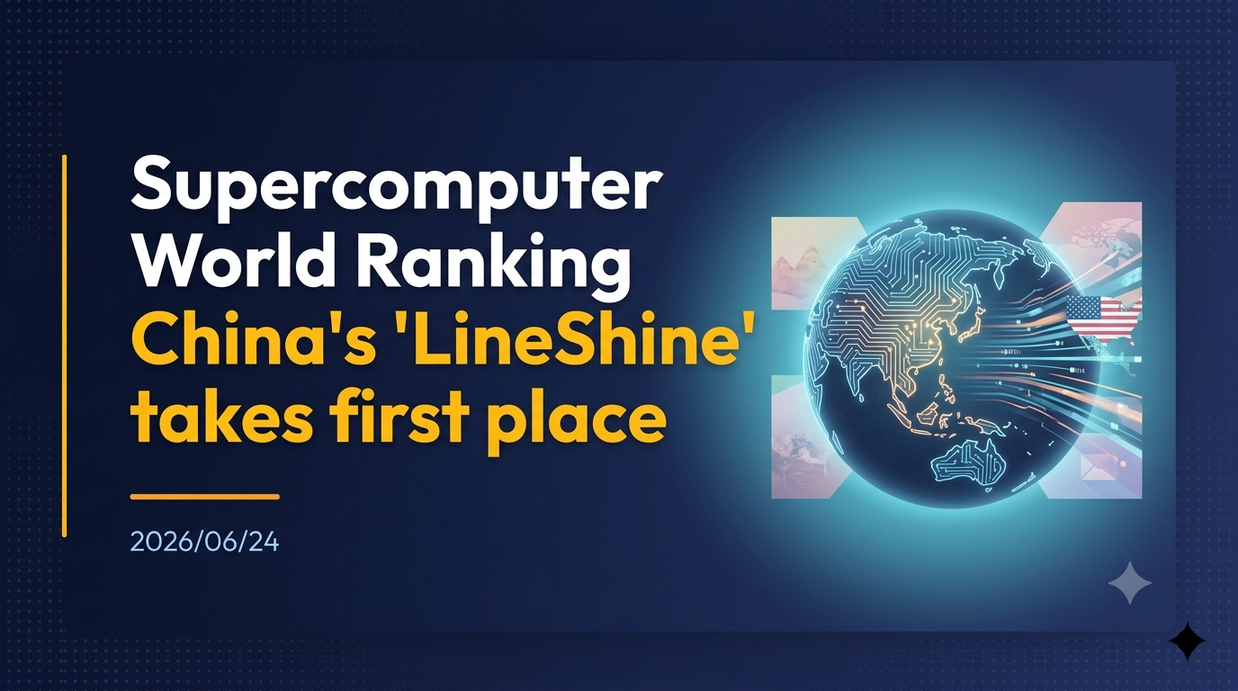
China’s supercomputer “LineShine” debuted at number one in the world rankings for June 2026. The background is China’s strong demonstration of self-sufficiency in computing infrastructure through domestic technology, amid U.S. export restrictions on advanced semiconductors.
- Results of the June 2026 “TOP500” and LineShine’s Achievements
- Overwhelming Performance Superiority: World’s First to Surpass ‘2 Exa’
- Proprietary CPU “LX2” and Memory Hierarchy Innovation
- The ‘de-GPU’ strategy that leveraged U.S. export controls
- The resumption of information disclosure demonstrates China’s confidence and self-reliance
- The Reality of AI Competition: The Gap Between Rankings and Practical Performance
- Japan’s Strategy: Expectations for Fugaku NEXT and ‘Rikyū’
- The New Order of the Exascale Era and Notable Technology Trends
Results of the June 2026 “TOP500” and LineShine’s Achievements
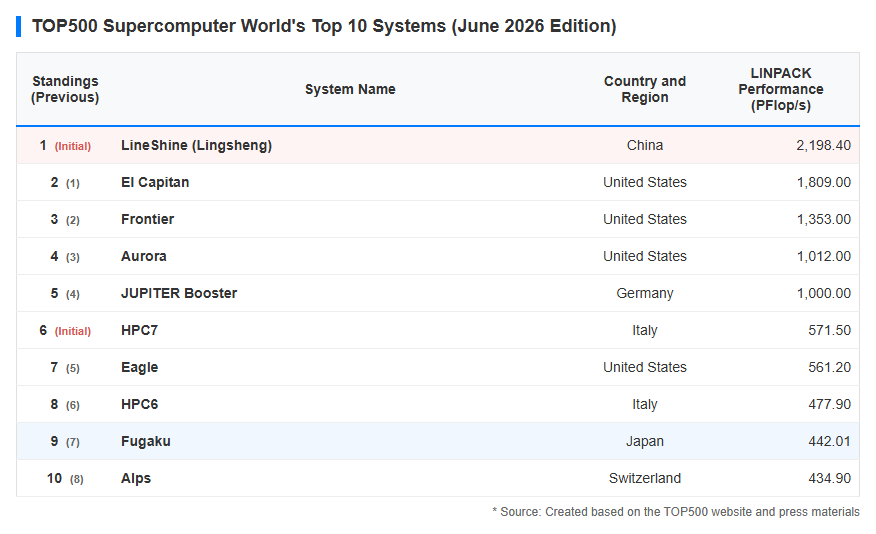
The June 2026 edition (67th edition) of the “TOP500,” a ranking competing in the world’s supercomputer computing speeds, was announced on June 23 at the international conference “ISC 2026” held in Hamburg, Germany. The most notable item in this ranking was the Chinese system “LineShine,” which debuted and took the top spot. This was the first time in about eight and a half years since November 2017 that a Chinese player claimed the world’s number one spot.
LineShine is a massive computing system installed at the National Supercomputer Center (NSCS) in Shenzhen, China. Surpassing the U.S. “El Capitan,” which had held the top spot until now, and reclaiming the world’s computing power throne from the U.S. carries immense significance not only in science and technology but also geopolitically. Meanwhile, Japan’s proud RIKEN Fugaku dropped from 7th place to 9th place. The table below shows the transition of higher-level systems.
Overwhelming Performance Superiority: World’s First to Surpass ‘2 Exa’
LineShine recorded LINPACK performance of 2,198.40 PFlop/s (approximately 2.198 exaflops), becoming the world’s first system to surpass the 2 exaflops milestone in effective performance. This means it can stably and continuously execute approximately 219 Kyo8,400 trillion floating-point operations per second. Previously, the US El Capitan held the top record with 1.809 exaflops, and LineShine has achieved a processing speed that exceeds that by more than 20%.
The system is also enormous, equipped with a total of 13,789,440 cores, consuming 42,220.00 kW (approximately 42.22 megawatts) of power. The theoretical performance value is even higher, at 2,735.82 PFlop/s. With this update, the global exascale supercomputer lineup has expanded to five units: three in the United States, one in Europe, and one in Asia (China). LineShine’s overwhelming computing power is expected to be applied in cutting-edge scientific fields such as global climate simulations and the study of the highly complex human brain.
An unprecedented design philosophy that took on the challenge without a GPU
Proprietary CPU “LX2” and Memory Hierarchy Innovation
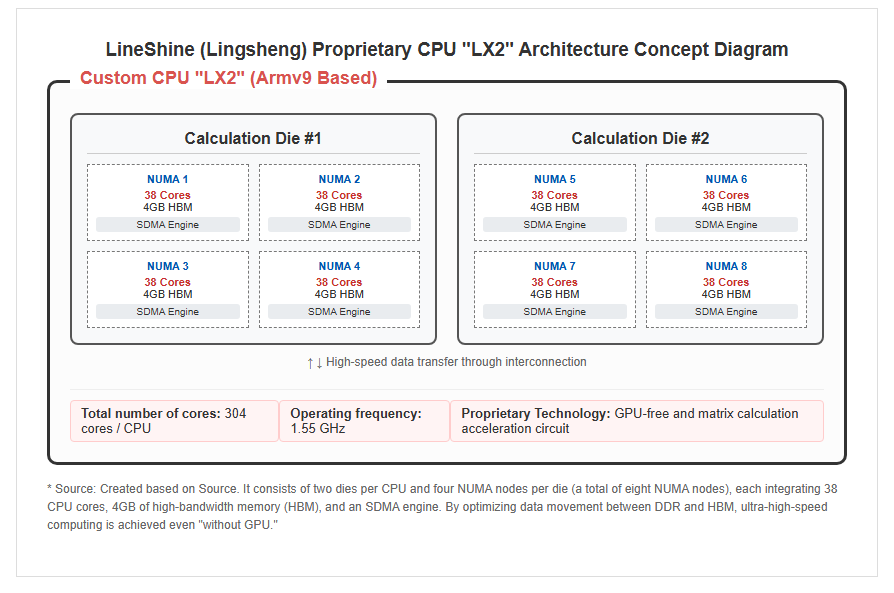
The most notable technical feature of LineShine is that it does not use GPUs (image processing units) to accelerate computation, but is composed solely of custom CPUs designed by the company. In today’s global supercomputer development, GPUs like Nvidia, which excel in parallel computing, are mainstream, but LineShine uses its proprietary “LX2” chip, based on Arm’s instruction set Armv9. This LX2 chip is equipped with 304 cores, each running at 1.55GHz per CPU.
The internal architecture is also sophisticated, with two compute dies per CPU, each adopting a configuration of four NUMA (Non-uniform memory access) modules. Each NUMA integrates 38 CPU cores and 4GB of high-bandwidth memory (HBM), and by accelerating data transfer via a dedicated SDMA engine, extremely high processing efficiency is achieved. This design directly embeds special circuits to accelerate matrix and vector computations inside the chip, a philosophy that resonates with Japan’s former “Fugaku.”
The ‘de-GPU’ strategy that leveraged U.S. export controls
China’s insistence on building ultra-high-speed systems using only CPUs is due to U.S. export restrictions on advanced semiconductors to China. To block China’s technological pursuit, the United States has strictly restricted exports of high-performance AI chips and GPUs. Instead of acquiring the regulated GPUs, China chose to advance standard microprocessors (CPUs) to avoid sanctions and secure the world’s fastest position.
Experts point out that this achievement has exposed a de facto “loophole” in the U.S. sanctions network. This was because it demonstrated that even without procuring GPUs, it is possible to build a world-class computing infrastructure centered on domestic technology. Japanese government officials also speculate that this new aircraft is intended by China to showcase the capabilities of its own technology. The tightening of U.S. regulations has ironically accelerated China’s independent semiconductor development and innovation capabilities, ushering in a new phase of the battle over advanced technologies between the two countries. The following diagram shows a conceptual design diagram.
Geopolitics and International Competition: A New Phase in the US-China Technological Hegemony Struggle
The resumption of information disclosure demonstrates China’s confidence and self-reliance
Since November 2023, China has been holding back on system registration and test results disclosure in the TOP500, possibly due to U.S. vigilance. It had long been speculated that China secretly possessed world-class machines, but this time, China has deliberately deliberately participated in the rankings and sought certification, drawing attention. This can be seen as a strong expression of confidence in achieving technological independence even under export restrictions.
Experts analyze that by publishing detailed specifications, China is trying to convince the world that “U.S. export controls are no longer meaningful.” In fact, LineShine is said to have been independently developed without direct funding from the Chinese government, and the design team’s lack of burden in submitting international test results also seems to have contributed to the announcement. In every aspect—science, security, and geopolitics—the US-China technological supremacy struggle is intensifying, and this reclaim of the top spot has become a symbolic event.
The Reality of AI Competition: The Gap Between Rankings and Practical Performance
While LineShine took first place in overall performance, there is also a cautious view that this does not immediately mean China’s absolute dominance in the AI field. In the AI processing power metric “HPL-MxP,” LineShine ranks 4th globally with 7.92 Exaflop/s. Additionally, while major U.S. tech companies like Microsoft, Google, and Amazon have independently built AI-focused computing infrastructures, many of them have not submitted systems aiming to rank in the TOP500.
According to experts, if these cloud providers submit their systems to the rankings, China’s “world’s fastest” might not even make it into the top five. For example, the xAI system “Colossus” led by Elon Musk is already being suggested to possess computing power surpassing that of the U.S. government’s supercomputers. Not only rankings, but also the actual efficiency of AI training and inference will determine the future dominance of the competition.
Future Developments and Focus: Pursuit of Practicality and Next-Generation Competition
Japan’s Strategy: Expectations for Fugaku NEXT and ‘Rikyū’
While China and the United States compete for higher LINPACK performance, Japan is focusing not just on the numbers of computing speed, but on providing practical computing power. RIKEN and Fujitsu are developing ‘Fugaku NEXT’ (development codename) as the next-generation model for ‘Fugaku.’ Although Fugaku dropped in the TOP500 rankings, it maintained third place in the “HPCG” ranking, which measures simulation performance emphasized for industrial use, and continues to maintain a strong presence.
Additionally, in June 2026, the name of the supercomputer for developing “AI for Science” will be decided as “Rikyu,” accelerating efforts to solve specific scientific challenges. In Japan, a strategy is being promoted to enhance evaluation closer to real-world applications by combining the comprehensive capabilities of flagship machines with dedicated machines specialized for specific research purposes. Going forward, as Professor Takebe of the University of Tsukuba points out, Japan, the United States, and China will each adopt their own technological philosophies and compete at advanced levels, including AI computing power.
The New Order of the Exascale Era and Notable Technology Trends
With the arrival of LineShine, the world of supercomputers has truly entered a full-fledged ‘post-exascale’ era. Going forward, not only computational speed but also energy efficiency will be emphasized. In the June 2026 “Green500” rankings, France’s “KAIROS” maintains the top spot, and how to improve computing performance per power consumption is a common challenge for next-generation HPC (High Performance Computing).
Even more noteworthy is the rise of new architectures specialized for quantum computing and AI. U.S. President Donald Trump has signed an executive order aiming to secure an advantage over China in the quantum field, expanding the battle over cutting-edge computing resources from traditional scientific computing to the quantum domain. As China boasts domestically produced semiconductors, we cannot take our eyes off how the US and Japan will use innovative designs to counter them, and to follow the technology trends of the late 2020s.
[#スーパーコンピュータ #TOP500 #LineShine #半導体自給率 #米中対立 #エクサスケール #科学技術]

コメント