Prime Minister Sanae Takaichi announced at the Liberal Democratic Party (LDP) executive board meeting on September 15, 2026, her plan to conduct LDP executive personnel changes on September 16 and execute a Cabinet reshuffle on September 17. The move is aimed at implementing key policy initiatives—including a temporary reduction in the consumption tax rate on food—while stabilizing her administration and solidifying her foundation for reelection in the LDP presidential election scheduled for September 2027.
- Background and Framework of the Mid-September Reshuffle
- The “Presidential Election First” Strategy and Neutralizing Rivals
- Reducing Food Consumption Tax to 1% and the Challenge of Securing Revenue
- “Responsible Active Fiscal Policy” and the Structure of Public Opinion
- Convocation of the Extraordinary Diet Session and Foreign Policy Impact
- The 2027 LDP Presidential Election and Year-End Fiscal Revisions
Background and Framework of the Mid-September Reshuffle
At the LDP executive meeting on September 15, 2026, Prime Minister Sanae Takaichi informed party leaders that she would announce new party executives on September 16 and execute a Cabinet reshuffle on September 17. Regarding the appointments, Prime Minister Takaichi emphasized her commitment to enhancing the administration’s policy execution capability so that the public can tangibly experience economic prosperity and social stability. This reshuffle prioritizes policy continuity and stability, with key structural positions expected to remain intact. On the party side, Vice President Taro Aso, Secretary-General Shunichi Suzuki, Policy Research Council Chairman Takayuki Kobayashi, and Acting Secretary-General Koichi Hagiuda are expected to be retained in their current roles. In the government, key figures including Chief Cabinet Secretary Minoru Kihara, Minister of Finance Satsuki Katayama, Minister for Foreign Affairs Toshimitsu Motegi, and Minister of Defense Shinjiro Koizumi are also slated to remain in office.
The diagram below illustrates the relationship between personnel appointments and policy execution.
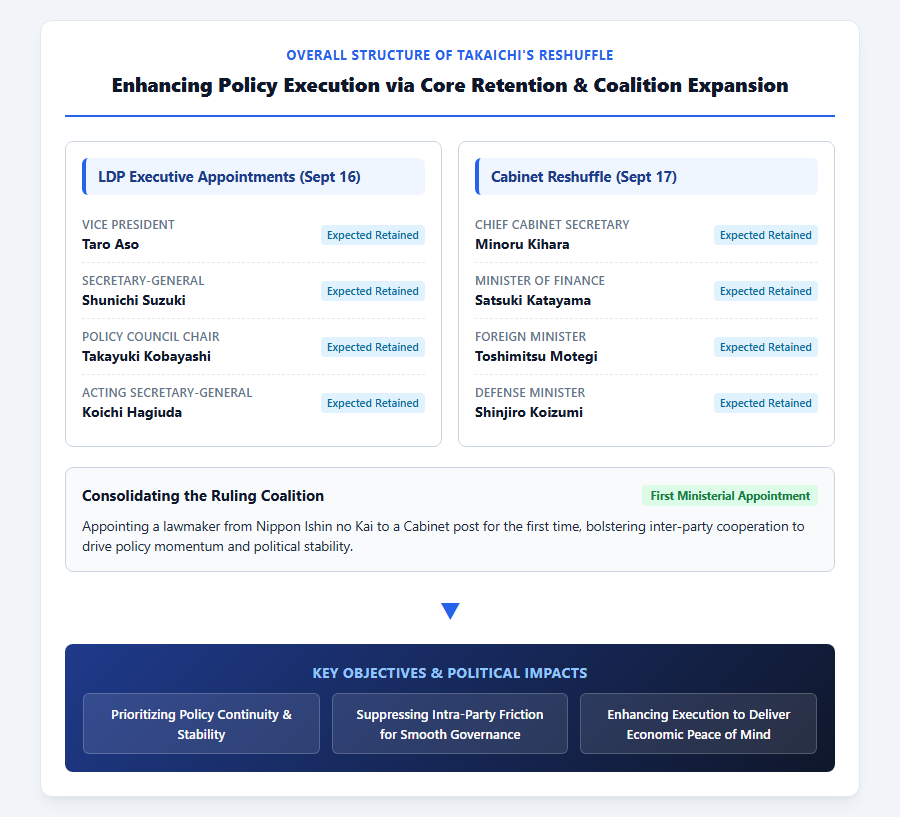
Furthermore, to reinforce the ruling coalition, negotiations are underway to appoint a lawmaker from Nippon Ishin no Kai (Japan Innovation Party) as a Cabinet minister for the first time. By tightening cooperation between the primary coalition partners, the administration aims to bolster its policy momentum and consolidate its political backing. The choice to limit the changes to a minor, targeted reshuffle rather than a sweeping overhaul reflects a deliberate intention to minimize intra-party friction and maintain seamless governance.
The “Presidential Election First” Strategy and Neutralizing Rivals
Political analysts point out that the primary motivation behind this political maneuvering is to fortify the administration’s power base with an eye toward the LDP presidential election scheduled for September 2027, ultimately aiming for an uncontested reelection. By keeping prominent rivals who competed fiercely in the previous presidential race—such as Shinjiro Koizumi, Toshimitsu Motegi, Yoshimasa Hayashi, and Takayuki Kobayashi—in pivotal Cabinet and party positions, Takaichi seeks to integrate them directly into the government framework. Entrusting them with high-profile responsibilities serves as a strategic embrace designed to physically and politically preempt potential challenges or anti-administration coalitions from forming within the party.
Additionally, strong consideration has been given to maintaining party harmony. Lawmakers belonging to former factions and the former Abe faction, who preserved or expanded their influence following the House of Representatives election, are being actively utilized to forge a practical all-party alignment. Nevertheless, dissatisfaction remains rooted among certain party members regarding unresolved “politics and money” scandals and perceived favoritism toward specific factions. Carefully balancing appointment allocations and maintaining strategic checks and balances through this reshuffle are thus seen as crucial steps to prevent anti-Takaichi factions from uniting and to preserve strict party discipline.
Economic Policy and Fiscal Discipline: Market Reactions
Reducing Food Consumption Tax to 1% and the Challenge of Securing Revenue
One of the Takaichi administration’s top legislative priorities is a tax reform package that temporarily reduces the consumption tax rate on food and beverages from the current 8% to 1% for a period of two years. On September 11, 2026, the LDP approved the outline of this tax reform bill, setting the stage for formal Cabinet approval on September 15 following final coordination with Nippon Ishin no Kai. This tax cut represents a massive fiscal stimulus package on the scale of 5 trillion yen annually, structured as a household support measure combined with refundable tax credits targeted at low-income earners. However, a clear framework for permanently securing the massive 5 trillion yen in required annual funding has yet to be established.
Market participants remain concerned that revenue uncertainties could amplify fears over Japan’s fiscal health, potentially triggering higher 10-year Japanese Government Bond (JGB) yields and currency volatility. To alleviate these market anxieties, Prime Minister Takaichi is adjusting plans to reappoint Finance Minister Satsuki Katayama. A former Ministry of Finance official, Katayama supports active fiscal policy while maintaining a strong commitment to fiscal discipline, and she possesses a proven track record in international negotiations, including joint US-Japan foreign exchange interventions. Retaining Katayama is viewed by financial markets and the U.S. Trump administration as a reassuring signal that Japan will not engage in unchecked fiscal expansion.
“Responsible Active Fiscal Policy” and the Structure of Public Opinion
Public evaluation of the Takaichi administration’s “Responsible Active Fiscal Policy” reveals a nuanced duality marked by both high expectations and persistent anxiety. According to a nationwide public opinion poll conducted jointly by The Yomiuri Shimbun and the Waseda University Institute for Advanced Social Sciences, the approval rating for the Takaichi Cabinet’s performance averaged 5.3 out of 10 points. This represents the highest rating recorded across seven similar surveys conducted since 2017, surpassing the previous record of 5.2 points held by the Abe Cabinet in July–August 2019. In policy-specific evaluations, 64% of respondents supported active fiscal spending under the banner of responsible expansion, significantly outnumbering the 33% who opposed it.
The chart below shows the breakdown of public evaluation regarding key policies.
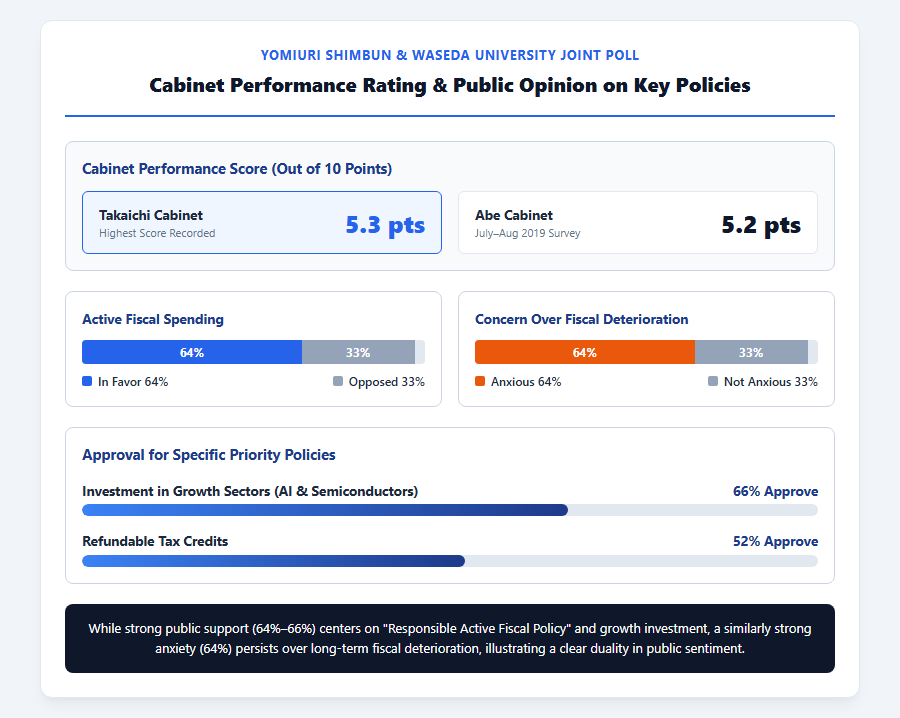
Specifically, 66% of respondents praised expanded investments in cutting-edge growth sectors such as artificial intelligence (AI) and semiconductors, while 52% approved of the implementation of refundable tax credits. On the other hand, an equal 64% expressed anxiety regarding potential long-term fiscal deterioration, highlighting that concern over fiscal sustainability is just as widespread as support for economic stimulus. Navigating the delicate balance between stimulating economic growth and preserving fiscal soundness will serve as a crucial litmus test for the administration.
Medium- to Long-Term Outlook and Governance Key Points
Convocation of the Extraordinary Diet Session and Foreign Policy Impact
Following the Cabinet reshuffle, the government and ruling coalition are preparing to convene an extraordinary Diet session on either October 2 or October 5, 2026. This schedule is designed to provide newly appointed ministers with adequate preparation time for parliamentary debates and inter-party negotiations on crucial legislation, including the consumption tax reduction bill and supplementary budgets. In financial markets, the Bank of Japan (BOJ) is widely expected to implement an additional 0.25% interest rate hike during its Monetary Policy Meeting on September 17–18, 2026. Analysts are closely watching shifting financial conditions, particularly as U.S. Treasury Secretary Scott Bessent signals concern over yen weakness.
On the diplomatic and national security front, Beijing had previously mounted strong pushback against Prime Minister Takaichi’s past statements concerning a potential Taiwan crisis. However, subtle shifts in China’s diplomatic stance have emerged, such as the conspicuous removal of demands for Takaichi to “retract” her remarks from official Chinese statements. Analysts attribute this shift to China’s domestic economic slowdown, its reliance on direct investment from Japan (which reached \$3 billion in 2025), and broader U.S.-China geopolitical tensions. Leveraging strategic leverage in areas like semiconductor manufacturing equipment and advanced materials, Japan is expected to navigate complex diplomatic terrain while balancing security deterrence with economic pragmatism.
The 2027 LDP Presidential Election and Year-End Fiscal Revisions
The primary focal point for future governance lies in how active fiscal policies might be recalibrated during the autumn supplementary budget negotiations and the formulation of the next fiscal year’s draft budget toward the end of the year. In defense policy, under the five-year, 43 trillion yen defense buildup plan, heavy investments are earmarked for standoff defense capabilities such as long-range missiles, uncrewed assets, and the space and cyber domains. Whether the administration can present credible spending restraint measures and revenue sources alongside these massive outlays will dictate financial market confidence.
Within the LDP, former factions (excluding the Aso faction) are increasingly regrouping and holding meetings, signaling underlying power struggles fueled by dissatisfaction over the treatment of lawmakers involved in past financial scandals and overall executive management. For Prime Minister Takaichi to maintain her governing coalition and achieve an uncontested reelection in the September 2027 party presidential election, she must successfully reconcile the competing demands of tax relief and fiscal prudence. The ultimate trajectory of the Japanese economy hinges on her ability to drive long-term growth strategies while guaranteeing political stability.
Reference Pages
- 【Ministry of Finance】https://www.mof.go.jp/public_relations/finance/202401/202401l.pdf
【#TakaichiAdministration #CabinetReshuffle #LDPPersonnel #ConsumptionTaxCut #ResponsibleActiveFiscalPolicy #JapaneseEconomy #FiscalDiscipline】

コメント