In September 2026, Salesforce announced a major expansion of its Agentforce AI platform, introducing “Job-Ready Agents” designed for specific high-value operational roles and a long-horizon runtime for autonomous task execution. This move comes amid surging enterprise demand for autonomous AI workflow automation and an intensifying battle for dominance in the global CRM market.
- Deployment of Job-Ready AI Agents
- Building a Runtime Environment for Long-Horizon Autonomous Tasks
- Granular Control via Agent Script and Multi-Agent Collaboration
- Fierce Competition and Rivalry in the CRM Market
- Organizational Restructuring and Workforce Realignment in the AI Shift
- Proven Results and Dramatic Gains Among Early Adopters
- Market Valuation and Key Trends to Watch
Deployment of Job-Ready AI Agents
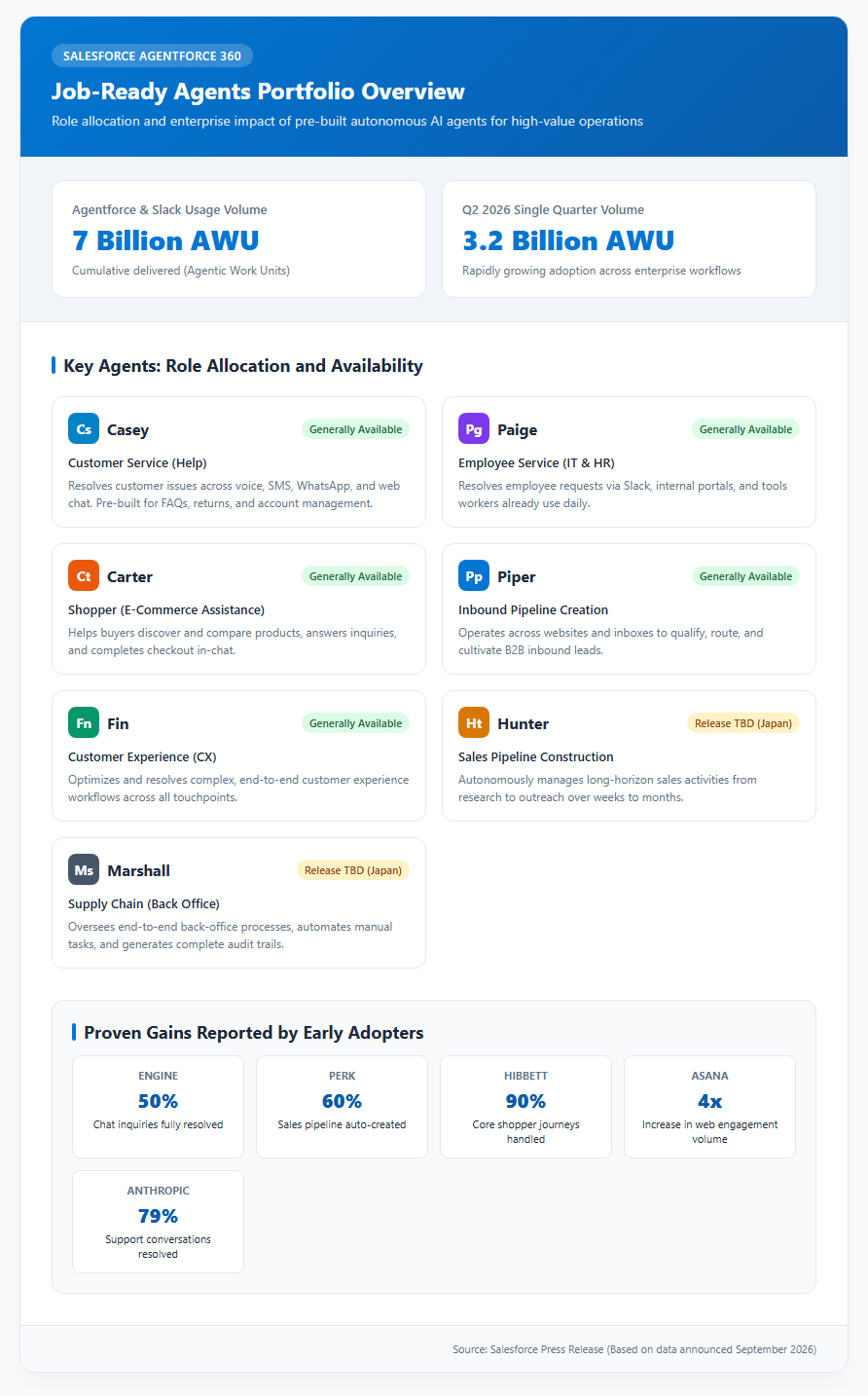
In September 2026, Salesforce announced “Job-Ready Agents,” a new portfolio of pre-built AI agents designed to immediately handle high-value operational tasks across sales, service, commerce, and back-office functions. While traditional AI tools were largely limited to single Q&A interactions, these newly introduced agents are pre-configured to execute complex workflows directly by tapping into enterprise customer contexts and business processes already stored within Salesforce. The currently available line-up includes “Casey” for customer support, “Paige” for internal IT and HR employee services, “Carter” for e-commerce shopping assistance, “Piper” for B2B inbound pipeline creation, and “Fin” for optimizing customer experience workflows. In addition, “Hunter” for sales pipeline management and “Marshall” for supply chain oversight have joined the agent lineup. According to Salesforce, cumulative usage across Agentforce and Slack has reached 7 billion Agentic Work Units (AWUs), with 3.2 billion recorded in Q2 2026 alone, underscoring the rapid adoption of autonomous AI in enterprise environments. The diagram below illustrates the roles and capabilities of these key AI agents.
Building a Runtime Environment for Long-Horizon Autonomous Tasks
At the heart of these newly unveiled technical innovations is the “long-horizon runtime,” an execution environment that enables AI agents to pursue complex objectives spanning days to weeks. Traditional AI chatbots were built around single-turn conversations, leaving them ill-equipped for tasks like sales prospecting or deal risk assessment that demand sustained follow-ups and ongoing decision-making. The new runtime incorporates three foundational capabilities: persistent memory to maintain context across user sessions, sustained execution to resume or modify plans as circumstances change, and dynamic steering to adapt agent behavior based on real-time user feedback. The sales agent “Hunter” serves as the flagship agent running on this long-horizon runtime, autonomously orchestrating everything from strategy formulation to deal execution while seeking human approval for key decisions. Salesforce plans to progressively expand this runtime across its entire agent portfolio.
Granular Control via Agent Script and Multi-Agent Collaboration
To balance autonomous AI decision-making with strict corporate security and compliance rules, Salesforce utilizes “Agent Script,” its proprietary open-source programming language. Agent Script combines the probabilistic reasoning of Large Language Models (LLMs) with deterministic business logic and enterprise guardrails, delivering fine-grained control and exceptional reliability. Additionally, Salesforce has made Multi-Agent Orchestration generally available, allowing diverse AI agents to collaborate as a unified team across different roles and systems. Furthermore, the skill-building feature within “Agentforce Coworker”—which lets employees teach an AI agent a workflow once and deploy it enterprise-wide—is slated for general availability in autumn 2026, while “Agent Optimizer,” designed to analyze and iteratively improve agent performance, is scheduled to launch in October 2026. Together, these tools enable enterprises to establish sophisticated AI-human collaboration frameworks under robust governance.
Industry Dynamics and Strategic Background
Fierce Competition and Rivalry in the CRM Market
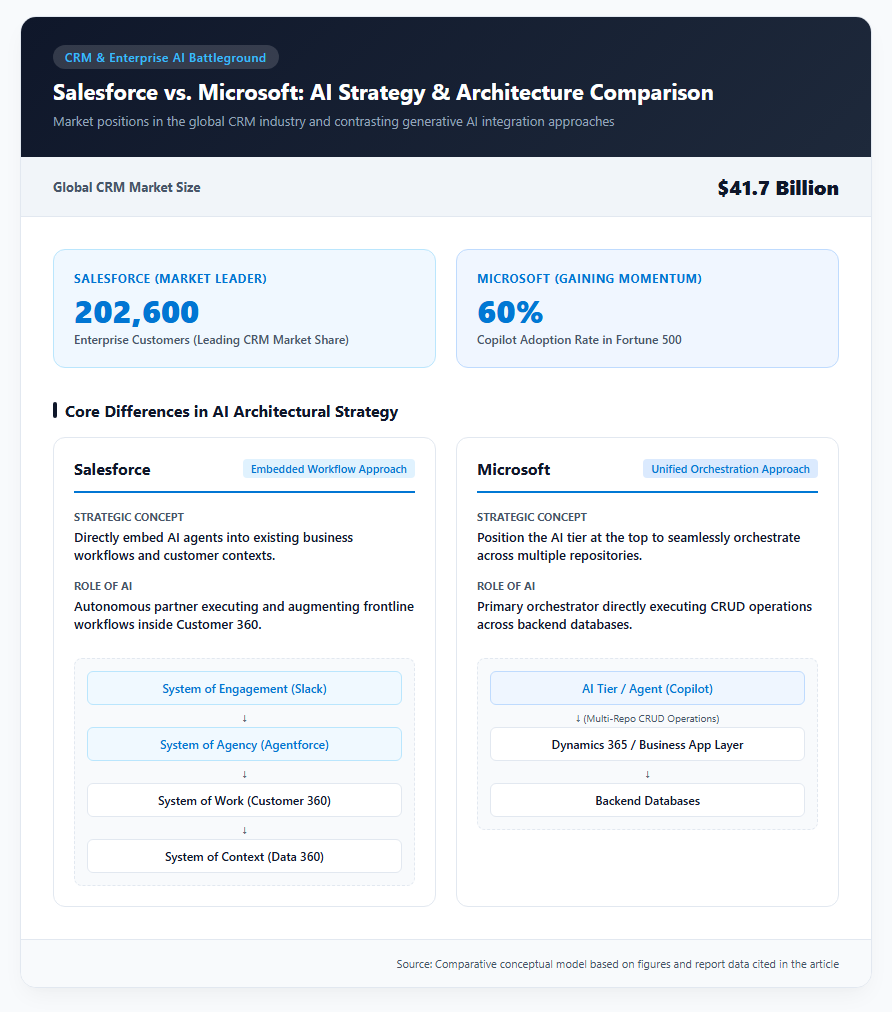
In the \$41.7 billion global CRM market, the battle for supremacy between Salesforce and Microsoft continues to intensify. Salesforce maintains its market leadership backed by an extensive customer base of 202,600 companies, while Microsoft is aggressively expanding through Dynamics 365, having already deployed its “Copilot” across 60% of Fortune 500 enterprises. Microsoft CEO Satya Nadella envisions the AI tier as an overarching orchestration layer where agents handle “multi-repository CRUD operations,” rendering traditional application logic secondary. In contrast, Salesforce CEO Marc Benioff has publicly criticized competing AI solutions, advocating instead for an approach that deeply embeds autonomous agents into established operational workflows. Beyond market share, the two tech giants are locked in a fundamental conflict over defining the standard architecture for enterprise software in the generative AI era. The conceptual diagram below compares the distinct AI strategies of both companies.
Organizational Restructuring and Workforce Realignment in the AI Shift
Underpinning this product expansion is an aggressive organizational restructuring centered around an AI-first strategy. In early February 2026, Salesforce initiated workforce reductions impacting fewer than 1,000 employees across marketing, product management, data analytics, and Agentforce-related teams. This followed a major downsizing in August 2025, when the company trimmed its customer support workforce from 9,000 to approximately 5,000 after AI tools successfully automated nearly 50% of customer service interactions. CEO Marc Benioff explained that deploying AI agents allowed Salesforce to address over 100 million previously unhandled customer inquiries, freeing up operational capacity to reallocate resources toward AI engineering and direct sales generation. This shift illustrates how AI-driven workflow automation is fundamentally reshaping the organizational structures of enterprise software vendors.
Business Impact and Future Outlook
Proven Results and Dramatic Gains Among Early Adopters
Early adopters deploying Agentforce are already reporting dramatic efficiency gains and tangible financial returns. At Engine, the help agent “Eva” fully resolved 50% of chat inquiries and reduced handle times by 15%, delivering over \$2 million in annual cost savings. At Perk, 60% of outbound sales pipelines were generated automatically by “Hunter,” while Hibbett routed 90% of its core customer purchase journeys through an AI agent deployed in just six weeks. Furthermore, Asana saw web engagement volume quadruple using “Piper,” and Anthropic achieved a 79% autonomous resolution rate for support conversations handled by “Fin.” Reddit also achieved a 46% increase in case deflection and slashed average response times from 8.9 minutes to 1.4 minutes, proving that AI automation drives direct improvements in customer experience alongside operational cost reductions.
Market Valuation and Key Trends to Watch
Wall Street analysts have expressed strong confidence in Salesforce’s AI agent roadmap and platform strategy. Following initial evaluations at Dreamforce, Mizuho Securities raised its price target on Salesforce stock from \$265 to \$280 in September 2026, forecasting a gradual organic revenue re-acceleration heading into fiscal year 2027. Similarly, Cantor Fitzgerald set a price target of \$300, reflecting growing optimism around Salesforce’s AI monetization strategy. Looking ahead, a critical benchmark will be whether Salesforce’s four-tier architecture—positioning Slack as the “Agentic OS” alongside “Data 360” and “Customer 360″—gains deep traction in enterprise operations. Furthermore, a key long-term focus will be whether Salesforce can leverage its enterprise security and partner ecosystem to maintain a competitive moat against the growing trend of enterprises building in-house AI solutions.
Reference Pages
- [Salesforce Expands Agentforce | Salesforce Japan Press Release] https://prtimes.jp/main/html/rd/p/000000401.000041550.html
[#Salesforce #Agentforce #AIAgents #CRM #DX #GenerativeAI #ITBusiness]
コメント