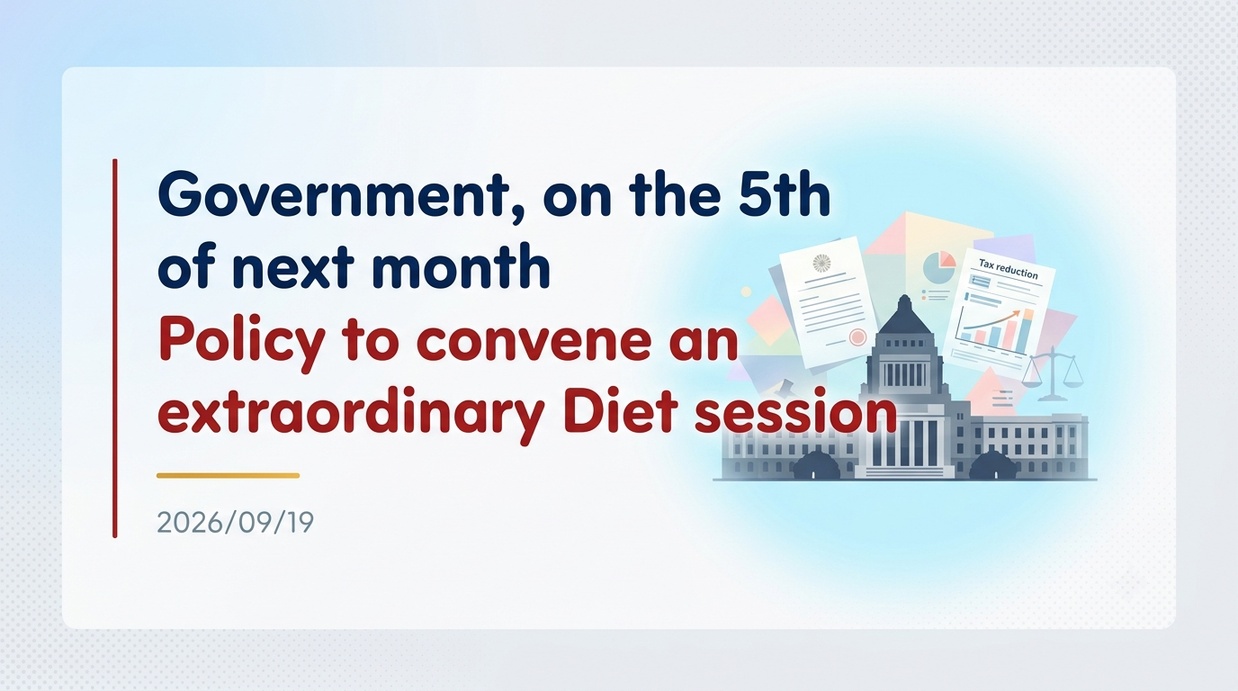
The Japanese government has decided to convene an extraordinary session of the Diet on October 5, 2026. The move aims to secure early passage of top-priority administration bills, including a measure to lower the consumption tax rate on food to 1% and a bill to reduce the number of seats in the House of Representatives.
- 69-Day Session Schedule and the Government’s Objectives
- The Core “Food Consumption Tax Cut to 1%” Bill
- Political Battles Surrounding the House of Representatives Seat Reduction Bill
- Direct Benefits to Households and Shifts in Consumer Behavior
- Fiscal Concerns, Long-Term Interest Rates, and Market Impact
- Minority Ruling Coalition in the House of Councillors and Opposition Dynamics
- Roadmap to the April 2027 Implementation and Key Milestones
69-Day Session Schedule and the Government’s Objectives
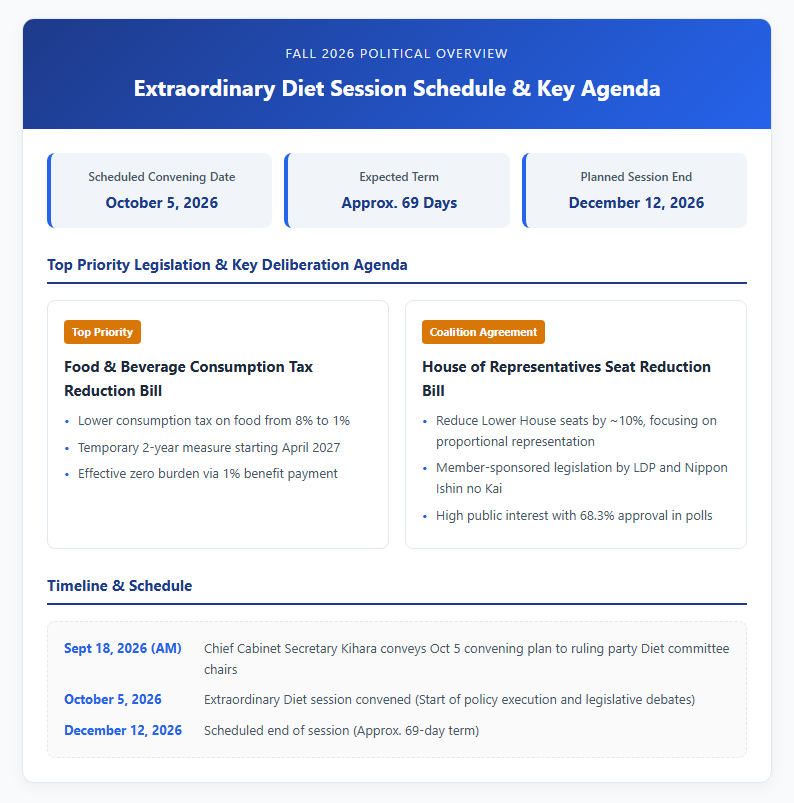
The government and ruling coalition have finalized plans to convene an extraordinary Diet session on October 5, 2026. Chief Cabinet Secretary Minoru Kihara conveyed this decision during a morning meeting on September 18, 2026, to Murai Hideki, Chairman of the LDP Diet Affairs Committee, and Isozaki Yoshihiko, Chairman of the LDP Diet Affairs Committee in the House of Councillors. The session is expected to run for approximately 69 days, concluding on December 12. For the Second Takaichi Reshuffled Cabinet, led by Prime Minister Sanae Takaichi, this marks its first major parliamentary debate focused on policy execution. Behind the decision to convene at this time is the administration’s strong desire to swiftly enact legislation for inflation relief and key campaign promises, moving them rapidly into the implementation phase. Please refer to the diagram below.
Active debate between the ruling and opposition parties is expected throughout the session.
Key points:
– Scheduled Convening Date: October 5, 2026
– Expected Session Length: 69 days, through December 12, 2026
– Major Deliberation Agenda: Consumption tax reduction bills on food and beverages, House of Representatives seat reduction bill
Following the launch of the reshuffled Cabinet, close attention is being paid to where the battle lines will be drawn between the ruling and opposition camps.
The Core “Food Consumption Tax Cut to 1%” Bill
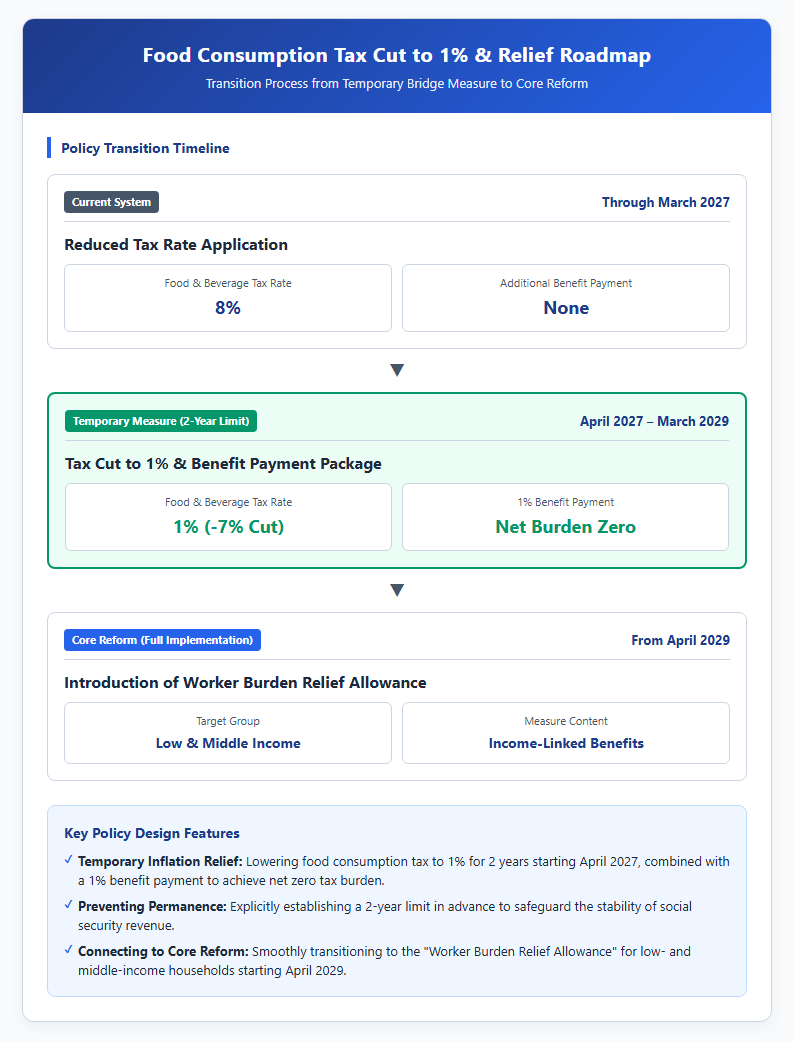
The primary focal point of the extraordinary Diet session is the deliberation on consumption tax reduction bills targeting food and beverages. Based on the tax reform outline approved by the Cabinet, the plan lowers the consumption tax rate on food from the current 8% to 1% for a temporary two-year period starting April 2027. Furthermore, by combining this with a benefit payment equal to 1% of the tax rate, the mechanism effectively reduces the tax burden to zero. Prime Minister Takaichi positions this as a temporary bridge measure against inflation, with plans to officially introduce a “Worker Burden Relief Allowance” targeting low- and middle-income households starting April 2029. Because consumption tax serves as a stable revenue source for social security, concerns over fiscal discipline remain, making thorough debate—including over funding sources—a key feature of the upcoming session. Please refer to the diagram below.
Key measures overview:
– Implementation Period: 2 years, from April 2027 to March 2029
– Tax Rate Adjustment: Consumption tax rate on food and beverages lowered from 8% to 1%
– Effective Zero Burden: Concurrent 1% benefit payment to eliminate net tax impact
– Future Roadmap: Transition to Worker Burden Relief Allowance starting April 2029
Political Battles Surrounding the House of Representatives Seat Reduction Bill
Alongside the consumption tax cut, a major political flashpoint is the bill to reduce seats in the House of Representatives. Submitted as member-sponsored legislation by the Liberal Democratic Party (LDP) and Nippon Ishin no Kai under their coalition agreement, the bill aims to cut the total number of Lower House seats by approximately 10%, focusing primarily on proportional representation seats. Public interest is remarkably high, with opinion polls showing 68.3% of respondents in favor of seat reduction. On the other hand, opposition parties have pushed back strongly, arguing that the reduction could make it harder for minority viewpoints to be reflected in national politics. Prime Minister Takaichi maintains a firm stance on fulfilling this coalition promise, making consensus-building in the House of Councillors—where the ruling coalition lacks a majority—the ultimate key to the bill’s passage.
Key points of debate:
– Scale of Reduction: Approximately 10% reduction of Lower House seats, focused on proportional representation
– Public Opinion Trends: 68.3% in favor, 21.7% opposed
– Sponsoring Entities: LDP-Ishin ruling coalition
– Opposing Arguments: Concerns over diluting diverse public representation and impacting smaller political parties
Economic Impact, Household Living, and Market Effects
Direct Benefits to Households and Shifts in Consumer Behavior
If the reduction of the food consumption tax rate to 1% is realized, it is expected to bring noticeable changes to household finances and consumer spending. Estimates based on Ministry of Internal Affairs and Communications survey data indicate that for an average multi-person household spending around 51,000 yen per month on food and beverages (excluding dining out), the measure yields an annual expenditure reduction of approximately 40,000 yen. A monthly saving of roughly 3,300 yen eases the daily shopping burden. Markets are closely watching where these freed-up funds—totaling approximately 4.8 trillion yen in combined tax cuts and benefits—will flow. It is anticipated that consumers may channel this additional purchasing power into purchasing small luxuries, higher-quality groceries, or casual dining out.
Expected scope of impact:
– Household Savings Effect: Annual burden reduction of approximately 40,000 yen per household (~3,300 yen/month)
– Economic Ripple Effect: Combined tax cuts and benefit payments generate ~4.8 trillion yen in additional spending capacity
– Affected Industries: Food manufacturers (confectionery and beverages), supermarkets, and casual dining chains
Fiscal Concerns, Long-Term Interest Rates, and Market Impact
Regarding the massive consumption tax cut, market participants and experts have pointed out concerns over fiscal sustainability. With budgetary requests for the FY2027 budget exceeding 143 trillion yen—the largest on record—market evaluation of the Takaichi administration’s “Responsible Active Fiscal Policy” remains divided. Public opinion polls reveal that 82.2% of respondents feel the government must clearly specify funding sources when lowering the food tax rate to 1%. Indications of relaxed fiscal discipline have pushed long-term Japanese interest rates higher at times, warranting close attention to interest rate and foreign exchange markets, particularly among foreign investors. Prime Minister Takaichi has stated her intention to secure market confidence through transparent communication and clear policy messaging.
Market challenges and responses:
– Budget Request Scale: Record high exceeding 143 trillion yen
– Public Demand: 82.2% of the public call for explicit alternative funding sources
– Market Concerns: Unease over potential fiscal deterioration putting upward pressure on long-term interest rates
– Government Policy: Ongoing dialogue with markets and consistent explanation of active fiscal strategy
Political Landscape and Key Focal Points for Diet Management
Minority Ruling Coalition in the House of Councillors and Opposition Dynamics
The single biggest obstacle in managing the extraordinary Diet session lies in the “minority ruling coalition” dynamic in the House of Councillors. While the LDP and Nippon Ishin no Kai coalition holds a stable majority in the House of Representatives, opposition cooperation is indispensable for passing bills in the Upper House. Prime Minister Takaichi believes that the core objective of easing the burden on low- and middle-income earners is a priority shared across party lines, signaling an intent to engage in careful advance negotiations. However, opposition parties are preparing to aggressively grill the administration over political funding issues and the lack of backing revenue sources. Whether the government agrees to bill revisions will be a decisive factor in determining the outcome of Diet deliberations.
Diet management challenges:
– Upper House Situation: Ruling coalition lacks a majority, creating a “minority government” structure
– Opposition Stance: Broad alignment on relief goals, but sharp questioning over revenue sources
– Government Response: Respecting cross-party input while seeking broader legislative consensus
Roadmap to the April 2027 Implementation and Key Milestones
If the relevant bills pass during the extraordinary Diet session, the government will accelerate full-scale preparations for the 1% food consumption tax rate implementation set for April 2027. A transition and public awareness period of roughly six months is anticipated to allow businesses time for system and register upgrades. Concurrently, detailed system design will proceed for a smooth transition to the “Worker Burden Relief Allowance” scheduled for April 2029. On the political calendar, the House of Councillors election looms in the summer of 2028, making the eventual restoration of normal tax rates at the end of the two-year temporary period a significant medium-to-long-term political challenge. Observers are keeping a close watch to see if the Takaichi administration can deliver on its pledge of “Decisiveness, Challenge, and Execution.”
Upcoming timeline and milestones:
– October–December 2026: Deliberations on tax reduction and seat reduction bills in the extraordinary Diet session
– April 2027: Commencement of the 1% food consumption tax rate (limited to 2 years)
– Summer 2028: House of Councillors election
– April 2029: Transition to the Worker Burden Relief Allowance system
Reference Pages
- [Liberal Democratic Party Official Website] https://www.jimin.jp/
【#ExtraordinaryDietSession #ConsumptionTaxCut #JapaneseEconomy #TakaichiCabinet #FiscalPolicy #SeatReduction】
コメント