A worker with disabilities employed through a third-party disability employment business has developed a severe lung condition that was officially recognized as an occupational injury. Underlying this incident is a systemic issue where corporate management has become a mere formality in the push to meet statutory hiring quotas, leaving proper workplace environment standards sidelined.
- Hypersensitivity Pneumonitis and Dust Exposure at Farm-Type Facilities: The Reality of Workers’ Comp Recognition
- Substandard Working Conditions Behind Token Employment and the Breach of Duty of Care
- Rapid Escalation to the 2.7% Statutory Quota in July 2026 and Growing Corporate Anxiety
- Institutional Contradictions and the Explosion of Outsourced Employment
- Mandatory Provider Registration Decided by Labor Policy Council in August 2026
- Transition from Token Compliance to Human Capital Management and Corporate Action
Hypersensitivity Pneumonitis and Dust Exposure at Farm-Type Facilities: The Reality of Workers’ Comp Recognition
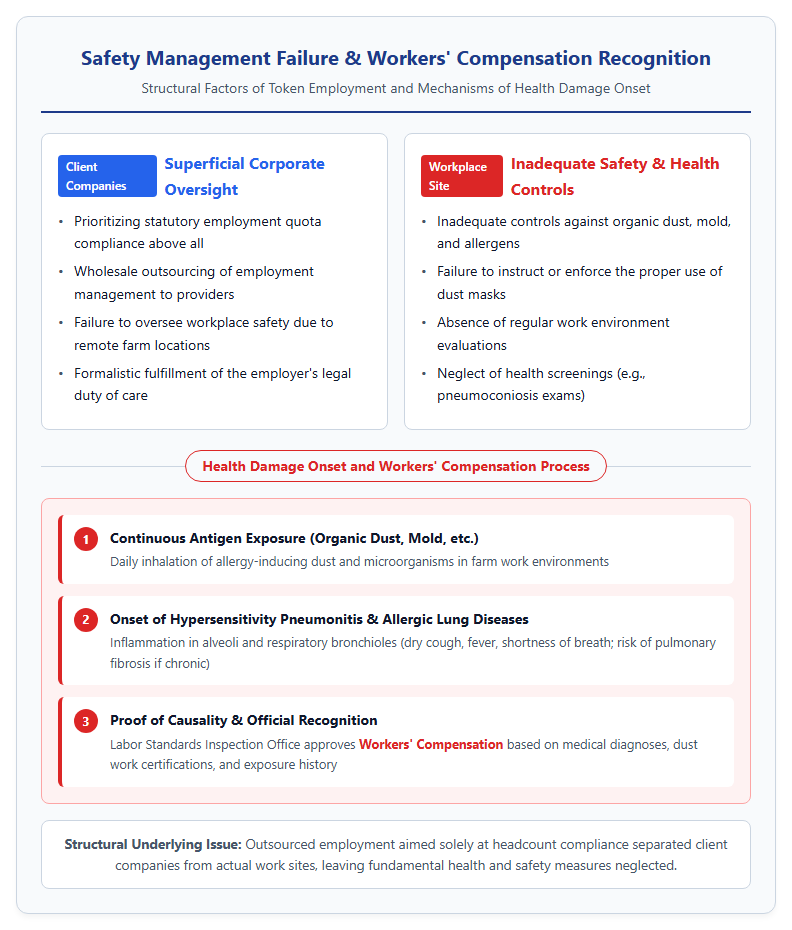
In facilities operated by third-party disability employment businesses—which provide agricultural farms and other work sites on behalf of hiring companies—cases of workers with disabilities suffering from health damage due to dust and allergic lung diseases such as hypersensitivity pneumonitis have come to light, leading to official workers’ compensation claims being approved. According to materials from the Japanese Respiratory Society, hypersensitivity pneumonitis is an allergic disease causing inflammation in and around the alveoli and respiratory bronchioles due to repeated inhalation of antigens such as organic dust, mold, or chemicals present in the workplace environment. Symptoms include fever, dry coughing, and shortness of breath; prolonged exposure to these antigens risks chronic inflammation, leading to pulmonary fibrosis and irreversible lung stiffening. In this recent workers’ compensation ruling, a direct causal relationship was recognized between the worker’s condition and inadequate environmental controls against organic dust generated during farm work. Official recognition of occupational lung diseases places significant weight on workplace exposure history, medical diagnoses, and employer certification of dust-producing operations. This ruling has exposed how safety and health management have been routinely neglected at these outsourced employment sites.
Substandard Working Conditions Behind Token Employment and the Breach of Duty of Care
At the core of this tragedy lies a fundamental failure of the duty of care by client companies utilizing disability employment services, alongside the hollowed-out administrative oversight of service providers. As highlighted during a press conference by the Minister of Health, Labour and Welfare on May 12, 2026, numerous cases have surfaced where companies leave hired workers with disabilities without meaningful tasks or outsource employment management wholesale to intermediaries. By law, employers bear the responsibility to fairly evaluate the capabilities of workers with disabilities, implement proper employment management, and maintain rigorous health and safety measures. However, under models where employment is confined to remote outdoor farms or satellite offices far from corporate headquarters, corporate HR departments easily fall into a structural habit of ignoring actual workplace conditions and safety standards. Despite operating in environments where specific allergens and dust are generated, critical health management measures—such as enforcing dust mask usage, conducting regular work environment assessments, and scheduling clinical screening for pneumoconiosis—were neglected. The practice of prioritizing numerical headcount over the life and health of workers represents a profound risk to corporate labor compliance.
Rising Statutory Quotas and the Structural Expansion of Disability Employment Businesses
Rapid Escalation to the 2.7% Statutory Quota in July 2026 and Growing Corporate Anxiety
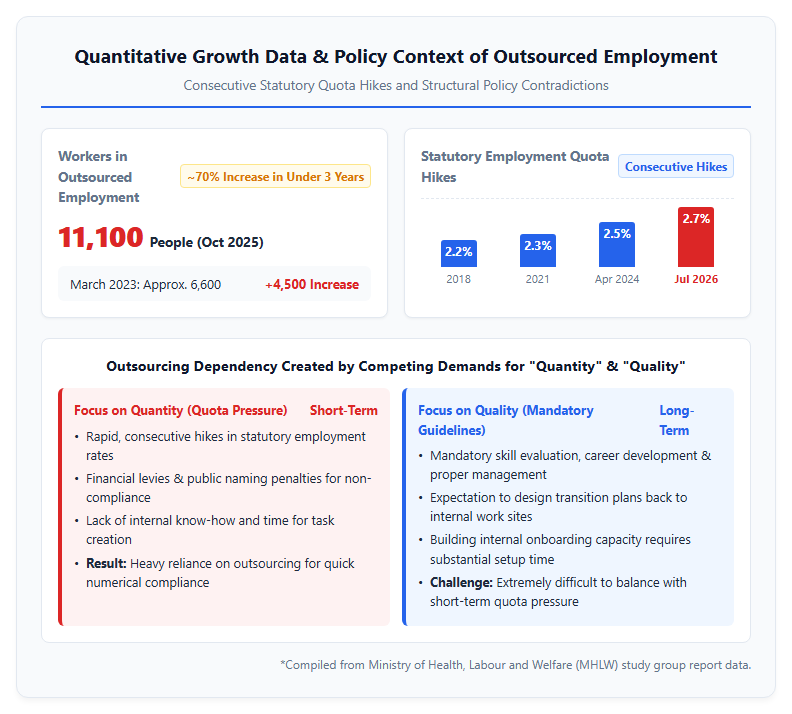
The landscape surrounding corporate disability employment in Japan has reached a major turning point due to a series of recent regulatory reforms. According to a report by a Ministry of Health, Labour and Welfare (MHLW) study group, the statutory disability employment rate for private companies was raised to 2.5% in April 2024 and subsequently increased to 2.7% in July 2026 in rapid succession. Concurrently, the reduction of exclusion rates and expansion of covered enterprise sizes have sharply raised the compliance hurdle, particularly for mid-sized firms with under 400 regular employees and companies without special-purpose subsidiaries (tokurei kaisai). Identifying suitable tasks within the core business and adapting workplace environments to various disability profiles require substantial time and specialized know-how. Faced with impending compliance deadlines, corporate HR managers found themselves under intense pressure. Capitalizing on this desperation, third-party placement businesses offering farm-type and satellite-office models heavily marketed the promise of “meeting employment quotas without burdening internal operations,” rapidly establishing themselves as the default solution for struggling firms.
Institutional Contradictions and the Explosion of Outsourced Employment
The number of individuals with disabilities working through third-party placement services has surged dramatically. Data from MHLW surveys reveals that the number of disabled workers employed through these services jumped from approximately 6,600 as of March 2023 to nearly 11,100 by October 2025—an increase of roughly 70 percent in under three years. Driving this surge is a structural contradiction in public policy, where a framework prioritizing “quantity” runs simultaneously alongside one advocating for “quality.” Because failure to meet statutory quotas incurs financial penalties (disability employment levies) and public naming-and-shaming, companies were driven to adopt outsourcing as a rational short-term tactic to fill numerical gaps. Consequently, while companies successfully avoided monthly penalty levies, “token employment”—where employers remain unaware of the names, faces, or daily tasks of their disabled staff—became widespread. The distortion of a policy design that treats numerical targets as an absolute mandate allowed business models that sideline worker safety and individual potential to flourish.
MHLW Regulatory Tightening and the Redefinition of Corporate Employment Responsibility
Mandatory Provider Registration Decided by Labor Policy Council in August 2026
Recognizing the severity of issues such as complete outsourcing of management and deteriorating work environments, the Ministry of Health, Labour and Welfare shifted decisively toward stricter regulation of third-party employment services. On August 31, 2026, during a meeting of the Disability Employment Subcommittee of the Labor Policy Council, the MHLW submitted a regulatory plan that was broadly approved by representatives from labor, management, and disability advocacy groups. A cornerstone of the proposal is making business registration a statutory requirement for service providers that supply work environments and jobs on behalf of hiring companies. This framework will allow government authorities to comprehensively monitor provider operations and enforce administrative guidance or oversight against non-compliant vendors. The MHLW intends to submit an amendment to the Act on Employment Promotion, etc. of Persons with Disabilities to the ordinary Diet session next year. Guidelines are also being drawn up to clarify the obligations of client companies, requiring them to monitor actual workplace conditions, submit regular reports, and design transition plans toward direct internal placement.
Transition from Token Compliance to Human Capital Management and Corporate Action
In light of this recent workers’ compensation ruling and impending regulatory overhaul, traditional tactics of relying on third-party vendors for superficial compliance will no longer be viable. Within the framework of sustainability reporting and ESG investing, disability employment is increasingly evaluated not merely as social responsibility or legal compliance, but as a core element of Human Capital Management (HCM). Major ESG rating agencies, such as MSCI, rigorously assess not just raw employment figures, but the quality of support structures, workplace integration, and diversity across job roles. Isolating disabled employees in remote external farms solely to evade penalty levies carries severe reputational risks, including negative press coverage, stock price depreciation, and downgraded ratings from institutional investors. Moving forward, companies must closely monitor the compliance of external providers while actively transitioning toward skill-building employment models—such as creating digital/DX roles and offering internal IT training. Developing workers with disabilities into active, equal contributors within safe and healthy working environments is indispensable for sustainable corporate growth and long-term value creation.
Reference Pages
- [Ministry of Health, Labour and Welfare “Report of the Study Group on the Future of the Disability Employment Promotion System”] https://www.mhlw.go.jp/stf/newpage_70028.html
【#DisabilityEmployment #WorkersCompensation #HypersensitivityPneumonitis #DisabilityEmploymentBusiness #MHLW #StatutoryEmploymentRate #ESG #HumanCapitalManagement】
コメント