Daicel Corporation and AVITA Corporation will launch a trial of patrol and equipment inspection utilizing quadruped robots and Physical AI at Daicel’s Otake Plant starting in December 2026. The initiative addresses key manufacturing challenges, including aging equipment, a shortage of experienced technicians, and the need to reduce hazardous work.
- Autonomous Navigation Overview: Quadruped Robots Powered by Physical AI
- Role Division Between Daicel and AVITA & Human-in-the-Loop Technology
- Aging Chemical Plants and the Shortage of Skilled Technicians
- Enhancing Sensory Inspections and Enabling Remote Inspection Work
- Growth Forecasts for Physical AI in National Strategy and Market Research
- Product Liability and Contract Practice Challenges Around Post-Shipment Updates
Autonomous Navigation Overview: Quadruped Robots Powered by Physical AI
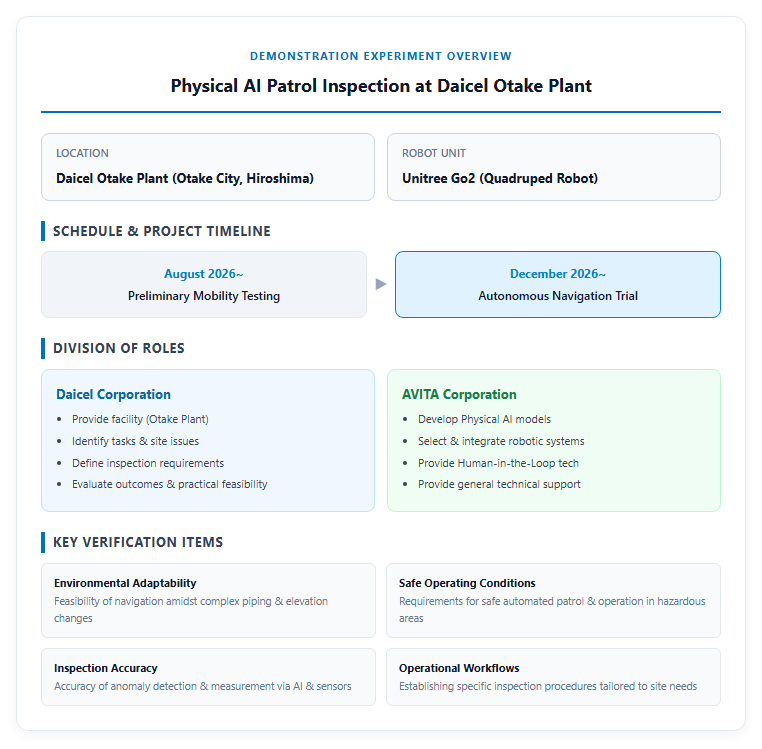
On September 17, 2026, Daicel Corporation and AVITA Corporation announced that they will launch a joint demonstration project in December 2026 at Daicel’s Otake Plant in Otake City, Hiroshima Prefecture, aimed at realizing next-generation smart factories powered by Physical AI. Ahead of this announcement, the two companies began preliminary mobility tests within the Otake Plant in August 2026. Starting in December 2026, the trial will transition to a phase involving autonomous quadruped robot navigation inside actual manufacturing facilities.
The main objective of this demonstration is to assist and eventually replace manual plant patrols and facility inspections traditionally performed by human workers. For initial testing, the companies have deployed Unitree Go2, a quadruped robot manufactured by China’s Unitree Robotics. The trial will comprehensively evaluate the feasibility of deploying robots in harsh plant environments featuring intricate piping and elevation changes, as well as the necessary conditions for safe operation, inspection accuracy standards, and specific operational procedures. Refer to the image below for visual context.
Based on the verification results and operational challenges identified on-site, the companies plan to refine robot hardware choices and system configurations to best suit operational needs moving forward.
Role Division Between Daicel and AVITA & Human-in-the-Loop Technology
In this project, Daicel—which possesses extensive operational expertise in chemical plant management—and AVITA—which specializes in AI and robotics—have established a clear division of roles. Daicel provides the factory environment at its Otake Plant, defines facility inspection requirements and targeted tasks, identifies on-site operational challenges, and evaluates trial outcomes to assess practical implementation. AVITA, on the other hand, is responsible for developing AI models tailored to plant environments and inspection tasks, selecting and controlling integrated robotic systems, and providing comprehensive technical support.
At the technical core of this initiative is Physical AI technology, which executes physical tasks in real-world spaces via robotic systems. AVITA is deploying a Human-in-the-Loop Physical AI framework that combines advanced AI autonomous control with remote human assistance when needed. In this setup, the AI performs initial assessments based on sensor data, calling for human intervention only in high-uncertainty scenarios. By establishing this framework, the project aims to build a continuously scalable, automated inspection system that maintains high safety standards in demanding industrial environments.
Manufacturing Challenges and Background Behind Technology Adoption
Aging Chemical Plants and the Shortage of Skilled Technicians
This trial is driven by structural and severe challenges facing Japan’s chemical industry as a whole. Many chemical plants and large-scale industrial complexes built during Japan’s period of high economic growth face aging infrastructure, making facility maintenance increasingly vital. Simultaneously, the industry is witnessing a rapid decline in veteran technicians—workers whose sensory instincts have traditionally detected subtle equipment anomalies, such as minute pitch changes in rotating machinery, subtle pipe vibrations, or faint odor variations—due to aging and mass retirements.
Furthermore, routine patrol and inspection duties in chemical plants often entail hazardous conditions, such as working at heights or in confined spaces, as well as exposure to severe weather, extreme heat, or freezing cold. Amid intensifying labor shortages, mitigating physical strain and accident risks for workers while maintaining high safety and productivity standards has become an urgent priority. Shifting away from traditional labor-intensive maintenance models toward site innovation powered by cutting-edge technology is now imperative.
Enhancing Sensory Inspections and Enabling Remote Inspection Work
Daicel has long pursued digital transformation and workplace environment improvements across its manufacturing sites. In 2022, the company launched joint research with QiBITech and Kushinada Kiko, culminating in field tests scheduled to begin in December 2025 at its Aboshi Plant in Himeji City, Hyogo Prefecture. This initiative aims to commercialize an inspection system designed to enhance sensory inspection capabilities and enable remote work. The system utilizes cameras and various sensors to gather visual, auditory, and tactile data, employing AI-driven normal/abnormal inference algorithms to detect equipment irregularities. Refer to the conceptual diagram below.
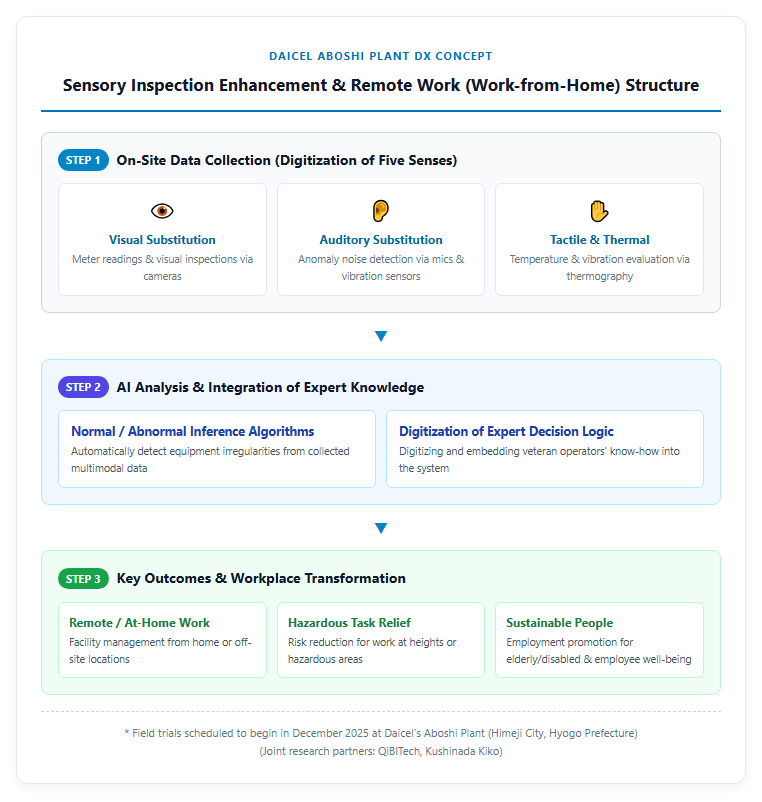
Furthermore, by digitizing and embedding veteran experts’ decision-making logic into the system, Daicel aims to establish an environment where facility management and inspections can be conducted remotely from home or off-site locations. This approach not only liberates human workers from hazardous tasks but also opens up employment opportunities for elderly and disabled individuals, marking a significant step toward Daicel’s sustainable management vision of Sustainable People (employee well-being).
Future Outlook for Physical AI and Legal Issues in Social Implementation
Growth Forecasts for Physical AI in National Strategy and Market Research
Unlike generative AI, which operates purely within cyberspace, Physical AI interacts directly with the physical world by perceiving environments through sensors and executing tangible actions via actuators. Consequently, it is gaining rapid global attention. A market research report by Fuji Chimera Research Institute highlights significant growth prospects for Physical AI across manufacturing, heavy industry, logistics, and infrastructure maintenance. In March 2026, the Japanese government unveiled its AI Robotics Strategy, establishing a national target to capture a 20 trillion yen market by 2040.
Additionally, in Japan’s FY2026 budget, a total of 1.2 trillion yen was allocated to the AI and semiconductor sectors, with approximately 380 billion yen specifically designated for Physical AI-related fields, accelerating public-private deployment. Successful demonstrations in chemical plants and heavy industries operating under harsh conditions hold strong potential for cross-industry application—such as in construction, logistics, and security—promising to drive productivity gains across the broader economy.
Product Liability and Contract Practice Challenges Around Post-Shipment Updates
While the deployment of Physical AI advances rapidly, addressing new legal and contractual questions has become equally critical. In April 2026, Japan’s Ministry of Economy, Trade and Industry (METI) published its Guidelines on the Interpretation and Application of Civil Liability in AI Utilization. The document categorizes AI into Assistance/Support and Reliance/Substitution types based on usage patterns, clarifying the scope of duty of care for both users and providers. Because Physical AI decisions lead directly to physical actions, allocating responsibility and determining tort liability in the event of an accident become highly complex.
Moreover, Physical AI systems possess the unique characteristic that their performance and autonomous operational scope evolve through post-shipment software updates and continuous learning. Key practical legal issues include whether product liability applies to defects emerging after an update, how to define Operational Design Domains (ODDs), and how to establish systems for logging and managing operational data. Successfully commercializing this technology requires ongoing safety evaluations and clear pre-arranged contractual frameworks between participating entities.
Reference Pages
- 【Daicel Corporation News Release】https://www.daicel.com/news/2026/20260917_1324/
- 【Daicel Corporation Press Release】https://www.daicel.com/news/2025/20251009_1164/
- 【METI Guidelines on the Interpretation and Application of Civil Liability in AI Utilization】https://www.meti.go.jp/press/2026/04/20260409001/20260409001.html
【#PhysicalAI #Daicel #AVITA #Robotics #SmartFactory #PlantMaintenance #IndustrialDX】


コメント