On September 18, 2026, the Bank of Japan decided at its Monetary Policy Meeting to raise its policy interest rate to around 1.25%. Prompted by upside inflation risks driven by rising crude oil prices and a weak yen, monetary normalization is accelerating at an unprecedented pace, coming just three months after the previous rate hike in June.
- First Rate Hike in Three Months Marks Highest Level Since 1995
- Policy Board Vote Split and Growing Vigilance Over Inflation Risks
- Immediate Market Reaction in FX and Stocks and Underlying Drivers
- Corporate Earnings, Capital Investment, and Disparities by Company Size
- Generational Divide in Household Impact and Mortgage Rate Trends
- Future Pace of Rate Hikes and the Debate Over the Neutral Rate
First Rate Hike in Three Months Marks Highest Level Since 1995
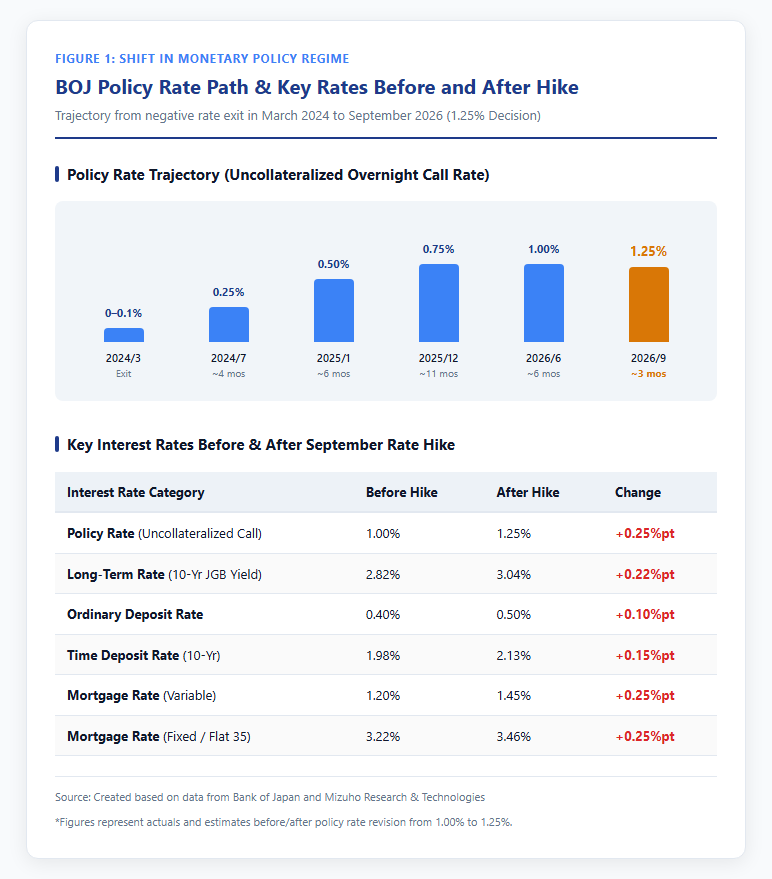
At its Monetary Policy Meeting concluded on September 18, 2026, the Bank of Japan (BOJ) decided to raise its target for the uncollateralized overnight call rate—its benchmark policy rate—from around 1.00% to around 1.25%. The new rate takes effect on September 24, 2026, following the national holiday. Since ending its negative interest rate policy in March 2024, the BOJ had implemented rate hikes roughly every six months—in July 2024, January 2025, December 2025, and June 2026. However, this latest decision comes just three months after the June meeting, representing a significant acceleration in the central bank’s policy tightening schedule.
A policy rate of 1.25% represents the highest level in approximately 31 years, dating back to April 1995 when the rate was lowered to 1.00%. The BOJ has not executed consecutive rate hikes within a three-month window since 1990, marking a clear shift from its previously cautious approach to monetary normalization. Furthermore, with this increase, the benchmark rate crosses above the lower bound (1.1%) of the nominal neutral interest rate range (1.1% to 2.5%) estimated by the BOJ in March, signaling an accelerated departure from decades of ultra-low interest rates.
Please refer to the diagram below.
Policy Board Vote Split and Growing Vigilance Over Inflation Risks
The decision was passed by a 7–2 majority vote among the nine Policy Board members, comprising the Governor, Deputy Governors, and Member Commissioners. The two dissenting votes were cast by Commissioners Toshichiro Asada and Ayano Sato, both of whom advocated maintaining the current rate given recent consumer price trends and broader economic conditions. Meanwhile, separate dissents emerged regarding the inflation outlook: certain board members argued that underlying inflation had already reached the 2% target, highlighting a complex diversity of perspectives within the Policy Board.
Behind the BOJ’s decision to hike rates ahead of schedule lies heightened vigilance regarding upside inflation risks. In its official statement, the BOJ noted that underlying consumer inflation is approaching its 2% target. Compounding these concerns are rising crude oil prices due to escalating tensions in the Middle East, persistent weakness in the yen, and expanding global demand for AI technologies, which together continue to drive up domestic corporate goods prices and threaten to pass through to consumer prices. The rate hike was thus positioned as a preventive measure to keep underlying inflation from overshooting the 2% target and exerting adverse effects on the broader economy.
Impact on Financial Markets and the Macroeconomy
Immediate Market Reaction in FX and Stocks and Underlying Drivers
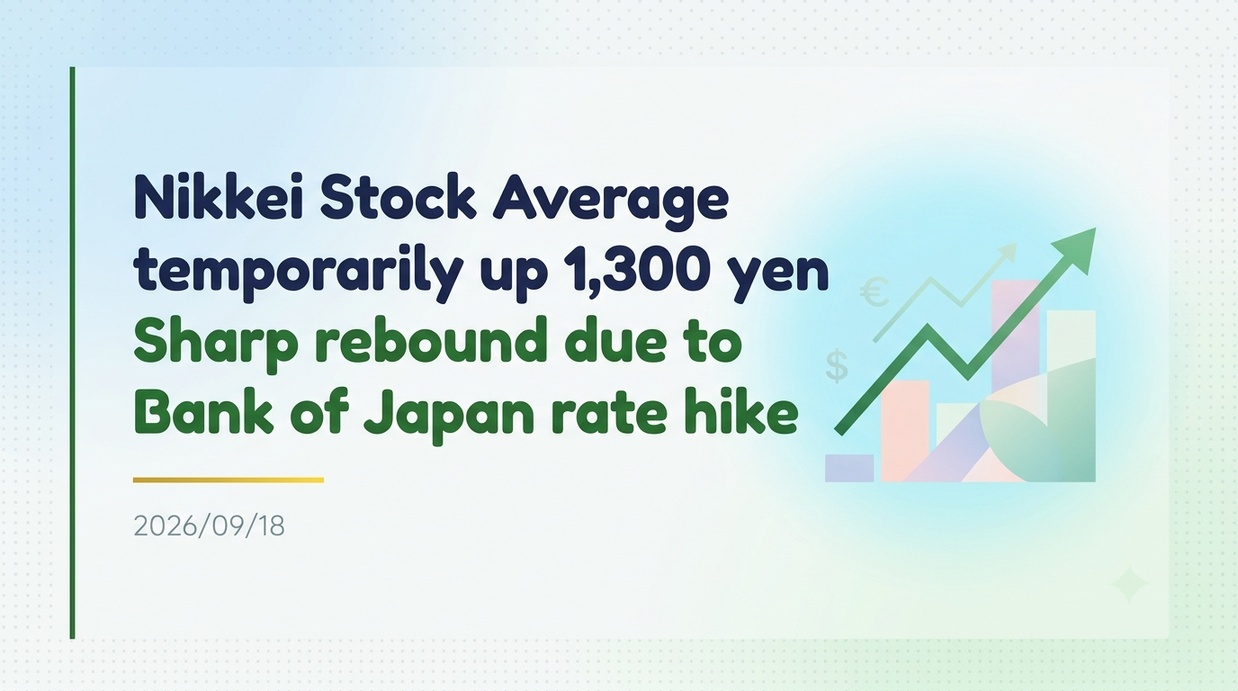
Immediately following the BOJ’s announcement, financial markets experienced unexpected price movements. Upon the release at 11:54 AM on September 18, 2026, the USD/JPY exchange rate spiked by approximately 70 pips within a single minute, moving from around 156.16 yen to 156.85 yen per dollar in a sharp move toward yen depreciation. Concurrently, the stock market rallied, with the Nikkei 225 Stock Average surging by nearly 500 yen from around 64,660 yen to 65,190 yen. Although interest rate hikes typically trigger yen appreciation and stock declines, the market exhibited the exact opposite reaction.
This market response was primarily driven by prior market pricing and the specific wording of the central bank’s policy statement. Because a 25-basis-point rate hike at the September meeting was almost 100% priced in by market participants, the formal decision was treated as a “sell the fact” event. Additionally, both dissenting votes came from dovish members favoring a hold, and the statement omitted explicit language signaling a further acceleration in the pace of future hikes, alleviating market fears of an overly hawkish stance. Furthermore, because the U.S. Federal Reserve (FRB) had implemented a 25-basis-point rate hike the previous day, the policy rate differential between the U.S. and Japan did not narrow significantly, providing continued support for yen selling.
Corporate Earnings, Capital Investment, and Disparities by Company Size
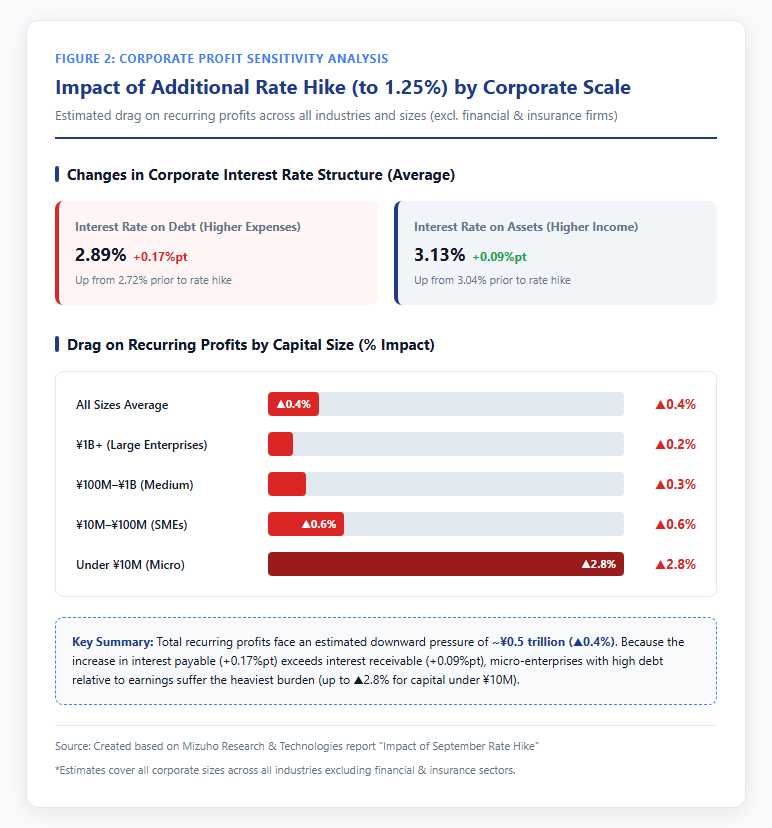
Higher interest rates directly affect corporate financial health and profitability. According to estimates by Mizuho Bank (Mizuho Research & Technologies), raising the policy rate to 1.25% is projected to reduce recurring profits across all industries and sizes (excluding financial and insurance firms) by 0.4%, creating a downward pressure on earnings of approximately 0.5 trillion yen. Because the interest rate on interest-bearing debt is estimated to rise by 0.17 percentage points (from 2.72% to 2.89%), while the rate on interest-bearing assets rises by only 0.09 percentage points (from 3.04% to 3.13%), the increase in interest expenses will outweigh the gain in interest income.
The severity of this impact varies considerably depending on corporate scale. Large enterprises with capital of 1 billion yen or more will see a modest 0.2% reduction in recurring profits, and medium-sized firms (capital between 100 million and 1 billion yen) will experience a 0.3% drop. In contrast, small and medium-sized enterprises (SMEs) with capital between 10 million and 100 million yen face a 0.6% decline, while micro-enterprises with capital under 10 million yen face a severe 2.8% drag on profits. Smaller businesses tend to carry higher levels of debt relative to their earnings, making them particularly vulnerable to rising borrowing costs. This disparity raises concerns over growing polarization between large and small companies in funding future capital expenditure and wage increases.
Please refer to the diagram below.
Household Impacts and the Long-Term Rate Outlook
Generational Divide in Household Impact and Mortgage Rate Trends
The September rate hike will affect Japanese households differently depending on age and financial balance sheet composition. Mizuho Bank’s analysis indicates that for households as a whole, increased interest income from bank deposits will exceed higher mortgage payments, generating a net positive financial impact of approximately 0.4 trillion yen per year (an average gain of roughly 6,000 yen annually per multi-person household). This net gain is supported by ordinary deposit rates rising by 0.10 percentage points to 0.50% and 10-year time deposit rates rising by 0.15 percentage points to 2.13%.
However, among households holding outstanding debt, the net impact turns negative, averaging an annual loss of about 19,000 yen per household. Younger households carrying heavy mortgage balances face the heaviest burden, with annual net losses estimated at 50,000 yen for those under 29, and 41,000 yen for those in their 30s. Variable-rate mortgage rates are projected to increase by 0.25 percentage points to 1.45%, while fixed-rate mortgage rates (such as Flat 35) are expected to rise to 3.46%. While the “5-year rule” applied to many variable-rate mortgages prevents immediate changes in monthly payment amounts, the higher rate increases the interest portion of each installment and will eventually result in higher monthly payments upon review. Conversely, older households aged 60–69 (net gain of +20,000 yen) and 70 and over (+21,000 yen) will benefit from substantial interest income on their accumulated financial assets.
Future Pace of Rate Hikes and the Debate Over the Neutral Rate
With the policy rate reaching 1.25%, Japanese monetary policy has transitioned from the initial exit phase from “unprecedented monetary easing” into a new operational regime. Financial market focus has shifted to the ultimate terminal rate and the pace of further tightening. Nomura Securities forecasts in its main economic scenario that additional rate hikes will take place in January 2027 and April 2027, bringing the terminal policy rate to between 1.75% and 2.00%. Nomura also outlines a risk scenario where rate hikes occur as early as December 2026 if upside inflation pressures intensify.
As the policy rate crosses above the lower estimate of the neutral interest rate (1.1%), the key issue moving forward will be how the BOJ communicates its policy path. The central bank can no longer rely solely on the framework of “normalizing abnormally low rates” and must clearly articulate whether future hikes represent active monetary tightening to suppress demand or continued adjustments to the degree of monetary accommodation. Market participants will closely monitor upcoming BOJ decisions and press conferences for clarity on how the bank navigates domestic fiscal policy interactions and external currency pressures.
Reference Pages
- [Statement on Monetary Policy] https://www.boj.or.jp/mopo/mpmdeci/mpr_2026/index.htm
【#BankOfJapan #PolicyRate #InterestRateHike #JapaneseEconomy #MonetaryPolicy #Mortgages #ForeignExchange】

コメント