Conceptual renderings for the new Hankyu Mukogawa Station—a joint initiative by Hankyu Corporation, Amagasaki City, and Nishinomiya City in Hyogo Prefecture—have been officially released, with concrete plans moving forward toward full-scale construction in autumn 2026 and an opening by the end of fiscal 2031. The project aims to eliminate a long-standing transit gap between Mukonoso and Nishinomiya-kitaguchi stations, fostering inter-city collaboration across the Mukogawa River and boosting real estate value along the line.
- 1. Overview and Design Renderings of Hankyu Mukogawa New Station Targeting a Late FY2031 Opening
- 2. Funding Structure, Budget Increase to 8.6 Billion Yen, and Public-Private Collaboration
- 1. Surrounding Infrastructure Upgrades and Urban Visions Led by Amagasaki and Nishinomiya Cities
- 2. Public Intent Surveys: High Expectations Balanced Against Quality-of-Life Concerns
- 1. Hankyu Kobe Line Timetable Adjustments and Capacity Preservation Challenges
- 2. Real Estate Value Trends, Construction Timelines, and Key Milestones
1. Overview and Design Renderings of Hankyu Mukogawa New Station Targeting a Late FY2031 Opening
The tentative Mukogawa New Station will be constructed directly atop the Mukogawa River Bridge on the Hankyu Kobe Line, positioned roughly 1.6 kilometers from Mukonoso Station and 1.7 kilometers from Nishinomiya-kitaguchi Station. The 3.3-kilometer stretch between these existing stations represents one of the longest gaps on the line, making a mid-way station a sought-after addition for decades. In September 2026, Amagasaki City released official public briefing documents featuring detailed station designs alongside architectural renderings. The facility will feature two staggered side platforms capable of accommodating eight-car trains, built directly over the river flow to form a rare, integrated bridge-and-station structure nationwide. Ticket gates will be constructed on both the eastern bank in Amagasaki City and the western bank in Nishinomiya City, ensuring seamless access across municipal boundaries. On-site preparatory work is scheduled to begin around summer 2026, followed by full-scale construction starting in autumn 2026 outside the river flooding season, aiming for operational launch by the end of fiscal 2031.
2. Funding Structure, Budget Increase to 8.6 Billion Yen, and Public-Private Collaboration
This project is led jointly by Hankyu Corporation, Amagasaki City, and Nishinomiya City under a basic agreement signed in April 2025. Although initial cost projections ranged from 5.0 billion to 5.6 billion yen, a comprehensive reassessment reflecting refined engineering designs and macroeconomic inflationary pressures on labor and construction materials raised the total estimated cost to approximately 8.6 billion yen. The updated budget will be split equally among the three entities, with one-third funded by Hankyu Corporation, one-third by Amagasaki City, and one-third by Nishinomiya City, leveraging national government subsidies for the municipal shares. According to financial projections from Nishinomiya City, the economic revitalization and population influx driven by the station are expected to yield 138 million yen annually in personal municipal tax revenue, plus 98 million yen in fixed asset and urban planning taxes, generating an estimated total tax revenue increase of roughly 236 million yen per year. Despite the significant upfront capital expenditure, stakeholders anticipate long-term financial returns through regional economic growth and expanded tax bases.
Community Impact and the Evolution of Urban Development Visions
1. Surrounding Infrastructure Upgrades and Urban Visions Led by Amagasaki and Nishinomiya Cities
Parallel to station construction, comprehensive urban planning initiatives are underway to enhance the surrounding neighborhoods. In July 2024, Amagasaki City unveiled its local development vision centered on the core principle of creating a peaceful, fulfilling living environment that encourages community interaction. Designated as a living hub in the city’s master plan, the strategy prioritizes walkable neighborhoods and green public spaces. Planned improvements include reconfiguring local road networks, renovating parks, establishing bicycle parking, repurposing spaces under elevated tracks, and enhancing pedestrian access to the Mukogawa riverbed greenbelts. Please refer to the diagram below.
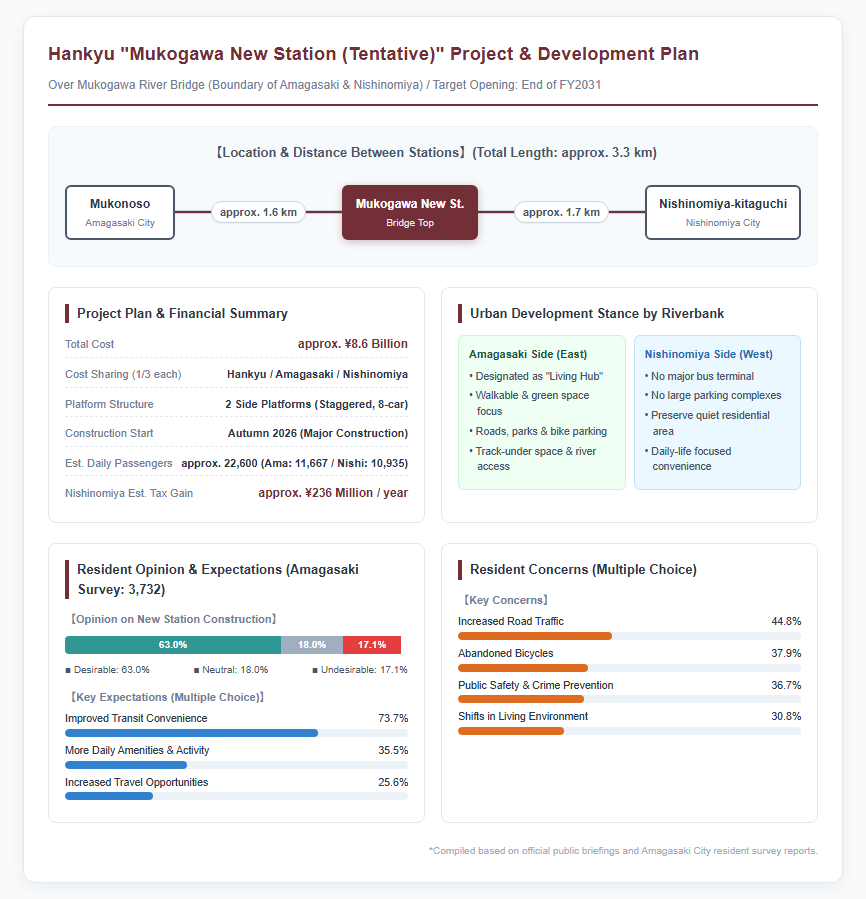
On the opposite bank, Nishinomiya City is taking a different approach by eschewing large bus terminals or major parking complexes, opting instead for community-focused enhancements that preserve the quiet, established residential atmosphere. By establishing the new station as a transit hub, the project connects two municipal living zones previously divided by the river, promoting a walkable lifestyle centered on foot and bicycle travel.
2. Public Intent Surveys: High Expectations Balanced Against Quality-of-Life Concerns
Local support for the project remains strong. In a survey conducted by Amagasaki City that gathered 3,732 responses, 63.0% of respondents favored the station installation, rating it as desirable or somewhat desirable. Improved transportation convenience emerged as the top expectation at 73.7%, followed by the growth of daily amenities and commercial activity at 35.5%, and increased motivation to go out at 25.6%. Approval rates were notably higher among residents living closest to the site and among younger demographics. Conversely, residents expressed tangible concerns regarding neighborhood changes. Increased traffic volume was the leading worry at 44.8%, followed by abandoned bicycles at 37.9%, crime prevention and public safety at 36.7%, and general shifts in the living environment at 30.8%. Municipal leaders and railway operators must actively address these concerns by balancing enhanced mobility with traffic safety measures, crime prevention, and the preservation of quiet residential surroundings.
Railway Operations and Real Estate Market Outlook
1. Hankyu Kobe Line Timetable Adjustments and Capacity Preservation Challenges
The operational impact on the Hankyu Kobe Line has drawn substantial attention from railway analysts and commuters. The new station will serve local trains exclusively, with projected daily passenger traffic reaching approximately 10,935 riders on the Nishinomiya side and 11,667 riders on the Amagasaki side, totaling around 22,600 passengers. Adding a station stop will increase local train travel times by an estimated 1 minute and 10 seconds to 1 minute and 30 seconds. Because the Hankyu Kobe Line operates on a high-density timetable with 10-minute headway patterns during peak hours, this additional travel time directly affects schedule coordination with express, commuter express, and limited express trains. Railway planners must recalibrate minor timing adjustments, including train passing maneuvers at Nishinomiya-kitaguchi and Rokko stations, as well as turn-around times at Osaka-Umeda and Shinkaichi terminals. Integrating the new stop into rush-hour schedules while maintaining current passenger capacity and strict punctuality remains a primary operational hurdle.
2. Real Estate Value Trends, Construction Timelines, and Key Milestones
The establishment of Mukogawa New Station is poised to reshape local property dynamics. Neighborhoods previously located more than a 15-minute walk from the nearest railway access—such as Mukonosohonmachi in Amagasaki City, as well as the Takagi and Kawarabayashi elementary school districts in Nishinomiya City—will transition into prime walking zones offering direct transit to Osaka-Umeda. Real estate historical data demonstrates that land appreciation and housing demand typically surge during planning confirmation and construction launch rather than after station opening. Properties within a 10-minute walk stand to gain the most immediate asset value appreciation. Following preliminary on-site preparations starting around summer 2026 and major construction commencement in the autumn non-flooding season, the project will move steadily toward its late FY2031 launch goal. Observers eagerly await how this unique river-spanning station will catalyze public-private synergy and drive regional revitalization.
Reference Pages
- 【Hankyu Kobe Line Mukonoso–Nishinomiya-kitaguchi New Station Project Information】https://www.nishi.or.jp/
- 【(Tentative Name) Mukogawa Area Hankyu New Station Overview】https://www.city.amagasaki.hyogo.jp/kurashi/tosi_seibi/douro/1041313/index.html
- 【Hankyu Corporation Official Corporate Website】https://www.hankyu.co.jp/
【#HankyuKobeLine #MukogawaNewStation #UrbanDevelopment #HankyuRailway #NishinomiyaCity #AmagasakiCity #RailwayNews】


コメント