On June 23, 2026, NTT West Japan announced the establishment of next-generation AI-enabled data centers in Osaka City, Osaka Prefecture, and Fukuoka City, Fukuoka Prefecture. Against the backdrop of rapidly increasing demand for power and data processing due to the spread of generative AI, NTT Group aims to accelerate the deployment of its AI-native infrastructure “AIOWN.”
- Next-generation AI hubs to be established in Osaka and Fukuoka
- The AIOWN Concept and the Importance of Liquid Cooling Technology
- The Accelerated Competition for AI Infrastructure Domestically and Internationally
- Social friction and restoring trust in security
- Roadmap for Expansion to 1GW by Fiscal Year 2033
- IOWN’s global standardization and expectations for stock prices
Next-generation AI hubs to be established in Osaka and Fukuoka
The new plan announced by NTT West holds extremely significant meaning in the domestic digital infrastructure strategy. The newly constructed “Osaka South Data Center” is located in Chuo Ward, Osaka City, Osaka Prefecture, with an IT road capacity of 8MW and scheduled for completion in fiscal year 2031. This hub will serve as the core of an urban network data center supporting generative AI, following the already concentrated Dojima and Sonezaki areas. Meanwhile, the “Hakata Data Center” to be built in Hakata Ward, Fukuoka City, Fukuoka Prefecture, is aiming for completion in fiscal 2029 with an IT road capacity of 5MW.
The selection of these locations is driven by a clear regional strategy. In the Osaka area, a future shortage of data center supply is expected, making the expansion of urban infrastructure an urgent task. Additionally, the Fukuoka area is becoming increasingly important as a landing point for submarine cables connecting Asia and Japan, and is expected to serve as a gateway hub to strengthen interconnection with Osaka and Tokyo. The diagram below shows the strategic layout of the newly established data centers.
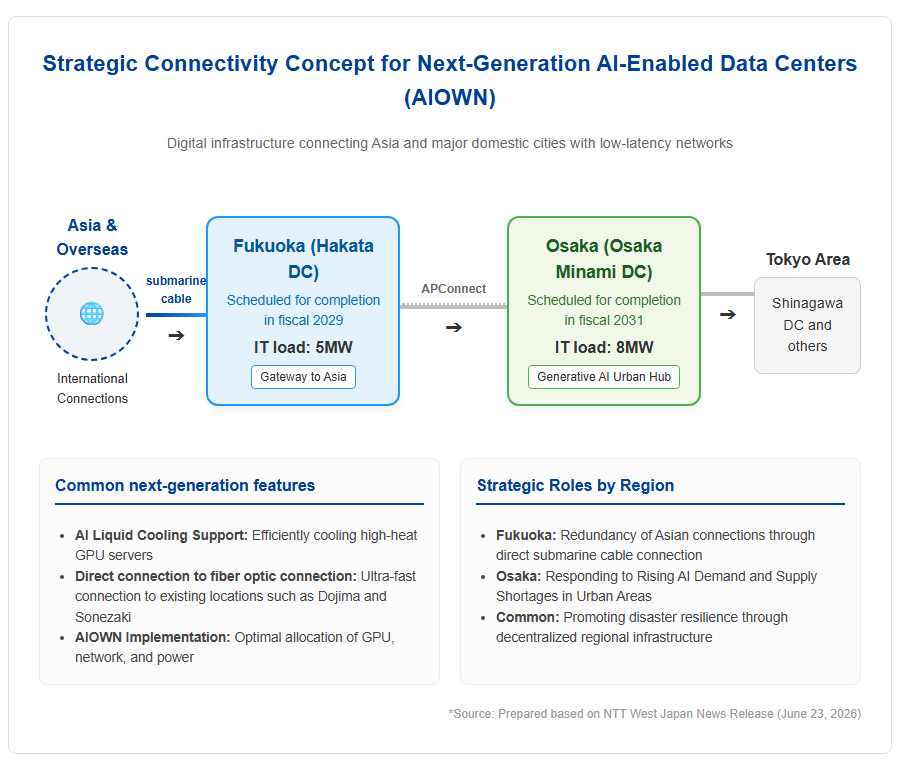
These facilities serve as the foundation for digital infrastructure that contributes to industrial revitalization and regional revitalization across western Japan through direct fiber optic connections and inter-site connections via “APConnect.”
The AIOWN Concept and the Importance of Liquid Cooling Technology
The newly established data center plays a crucial role in supporting the promotion of the next-generation infrastructure platform “AIOWN,” proposed by the NTT Group. AIOWN is an AI-native infrastructure that optimally allocates GPU, communication networks, and power according to AI usage scenarios, providing a secure environment including edge devices. As generative AI workloads shift from learning to inference and data processing demands expand, building low-latency and highly efficient networks is required.
Its most significant technical feature is the AI-designed liquid cooling system installed on some floors. High-performance GPU servers used in generative AI generate heat that traditional air cooling systems cannot handle. The NTT Group is advancing the introduction of cold-plate systems that send coolant directly to the server and “skid-type CDUs (Cooling Refrigerant Distribution Units)” that package cooling piping. Additionally, by using hybrid dry coolers that utilize outside air, we have achieved “chillerless liquid cooling” without the need for conventional chillers (cooling water production equipment), and have been verified to significantly reduce power consumption. By incorporating these cutting-edge cooling technologies into urban facilities, we aim to maximize AI processing power within limited power resources.
Market Environment and Competitive Strategies
The Accelerated Competition for AI Infrastructure Domestically and Internationally
Currently, in Japan, the “GPU battle” is intensifying over acquiring AI semiconductors centered on NVIDIA GPUs and building data centers to operate them. SoftBank, the leading company, is investing a total of 170 billion yen from fiscal 2023 to 2025, accelerating the construction of one of the largest AI computing platforms in Japan. In response, NTT has formed a coalition with Toyota Motor Corporation and announced a plan to jointly invest about 500 billion yen by 2030 to develop AI infrastructure for automobiles.
As part of the NTT Group’s overall strategy, we plan to invest a total of 8 trillion yen by 2028 in growth areas such as AI, data centers, and optoelectronic integration (IOWN). This announcement by NTT West Japan is part of this massive investment plan and serves as a groundwork to respond to the explosive increase in AI demand from domestic and international companies. Globally, major U.S. IT giants like Amazon and Microsoft invest trillions of yen annually in their capital expenditures, but NTT is aiming to establish its own unique economic zone, leveraging its overwhelming network of over 160 data centers across 47 prefectures and its low-power consumption through IOWN.
Social friction and restoring trust in security
The rapid expansion of data center construction has also highlighted new challenges such as friction with local communities. In residential areas of Hino City and Saitama City in Tokyo, the oppressive atmosphere of massive buildings, worsening sunlight, noise from emergency generators, and residents’ concerns over heat exhaust have led to numerous petition campaigns and lawsuits against construction. Data centers are highly confidential for security reasons, and limited information disclosure is also a contributing source of friction. At NTT West Japan as well, coexistence with the local community is essential when developing new bases, requiring careful explanations and environmental measures.
Furthermore, the NTT West Japan Group is in the process of regaining trust following past incidents of unauthorized customer information takeaway. The company has set forth its transformation into a ‘security-first company,’ and as of March 2026, is generally proceeding with measures to prevent recurrence of information security enhancements as planned. Specifically, we are thoroughly implementing technical and organizational measures such as introducing a VDI (Virtual Desktop) environment that leaves no data on operating devices, prohibiting the use of USB memory in principle, and strengthening privileged account management. The construction of this new data center can be seen as a touchstone for implementing the latest physical security and zero-trust environments, and for rebuilding secure digital infrastructure.
Medium- to Long-Term Outlook
Roadmap for Expansion to 1GW by Fiscal Year 2033
The NTT Group has announced a long-term roadmap to significantly expand investment in its data center business to meet the rapidly growing AI demand, especially among domestic companies. Currently, the group-wide data center receiving capacity is about 300MW, but by fiscal 2033, we plan to more than triple it to about 1GW (1 gigawatt). The current Osaka and Fukuoka bases form the core of this effort, and in 2029, new AI-enabled data centers and large-scale facilities are planned to open in Shinagawa Ward and Tochigi City in Tokyo.
This plan is key to building a distributed data center network that combines urban, suburban, and remote locations. For urban hubs like Shinagawa, we will introduce liquid-cooled equipment to operate GPUs that serve as inference infrastructure, and in suburban areas like Shirai City, Chiba Prefecture, we will establish one of Japan’s largest data center campuses. Additionally, small container-type data centers will be deployed in each region, enabling real-time AI processing with minimal latency. The Ministry of Internal Affairs and Communications’ “Digital Infrastructure Development Plan 2030” also advocates for regional decentralization and resilience of data centers, and NTT’s strategy is closely linked to realizing the Digital Rural City Nation Concept as a national policy.
IOWN’s global standardization and expectations for stock prices
The biggest theme determining NTT’s future prospects is the spread and global standardization of the next-generation communication infrastructure “IOWN.” IOWN aims to reduce power consumption by one-hundredth, communication capacity by 125 times, and latency by one-hundredth by one-hundredth by using optical technology. Full-scale adoption is targeted by 2030, and by integrating this group of data centers with IOWN technology, a world-leading ultra-low power AI infrastructure will be completed.
From an investor’s perspective, NTT’s stock price is hovering around 150 yen, with low capital adequacy ratios and restrictions under the NTT Act as key factors. However, the expected 16th consecutive dividend increase and a high dividend yield of around 3.5% indicate stability as an infrastructure stock. Analysts believe that while a short-term sharp rise in stock prices is structurally difficult, if IOWN’s commercialization and data center demand begin to contribute to earnings over a 3–5 year span, the stock could move to a higher stage. Looking ahead 10 years, if optoelectronic convergence infrastructure is adopted as the global standard, it is analyzed that stock prices could rise two to three times. NTT West Japan’s new base will be a crucial piece in shaping this grand vision of the future.
[#NTT西日本 #データセンター #AIOWN #生成AI #IOWN #液冷システム #地方創生 #経済ビジネス]

コメント