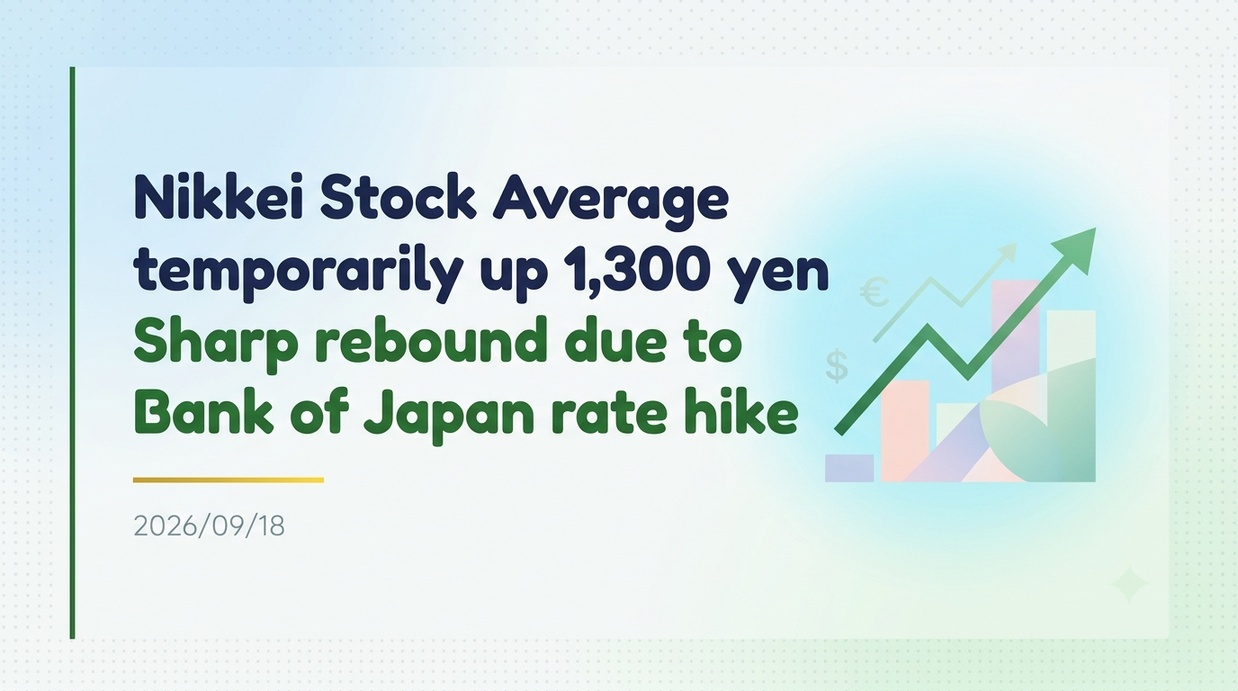
Following the Bank of Japan’s rate hike decision, the equity market experienced significant volatility, with the Nikkei 225 Stock Average recording a sharp rally of over 1,300 yen at one point. This movement was driven by monetary policy normalization efforts, market short-covering following the resolution of key event risks, and sharp fluctuations in the foreign exchange market.
- Policy Rate Hike at the Monetary Policy Meeting and the Sharp Stock Rally
- Futures Trading and Yen Carry Trade Unwinding Driving Market Swings
- Rising Borrowing Costs and Corporate Resilience in Earnings
- Mortgage Rate Hikes and the Housing Channel Spillover to Household Consumption
- Transition to a “World with Interest Rates” and the Structure of U.S.-Japan Rate Differentials
- Future Trajectory and Key Risk Factors for Investors
Policy Rate Hike at the Monetary Policy Meeting and the Sharp Stock Rally
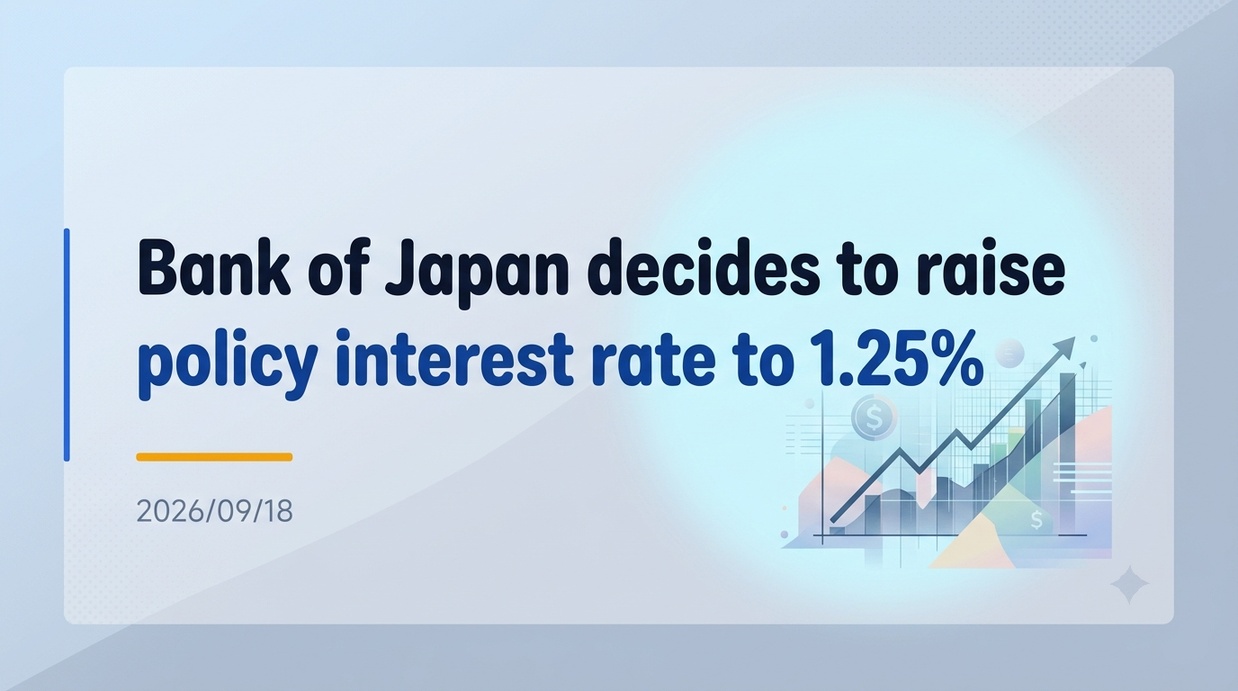
The Bank of Japan decided at its Monetary Policy Meeting to implement an additional interest rate hike following the termination of its negative interest rate policy, raising its uncollateralized overnight call rate target from 0–0.1% to around 0.25%. In addition, the central bank announced a quantitative plan to reduce its monthly purchases of long-term Japanese government bonds (JGBs) by approximately 400 billion yen each quarter, aiming to scale back purchases to around 3 trillion yen per month by the January–March quarter of 2026. Although the market had partially priced in the likelihood of a rate hike through prior media reports, sharp price swings erupted across foreign exchange and stock markets immediately following the official announcement. While trading initially lacked clear direction, relief following the removal of policy uncertainty and short-covering after the event passed triggered strong buying momentum, pushing the Nikkei 225 up by more than 1,300 yen at one point. Historically, market reactions to interest rate shifts have been exceptionally dynamic; for instance, following a record drop of 4,451.28 yen (-12.4%) on August 5, 2024, the Nikkei surged by 3,217.04 yen (+10.23%) the very next day on August 6. The latest sharp gain represents another symbolic episode where anxieties over rising interest rates collided with positive assessments of Japan’s economic normalization.
Futures Trading and Yen Carry Trade Unwinding Driving Market Swings
Behind the intense fluctuations that saw the stock market surge over 1,300 yen lies a rapid unwinding of futures positions and yen carry trades by overseas speculative investors. The yen carry trade—a strategy of borrowing low-yielding Japanese yen to invest in higher-yielding currencies and risk assets such as equities—had expanded significantly during the prolonged era of global monetary easing. According to data from the U.S. Commodity Futures Trading Commission (CFTC), net short (selling) yen positions against the dollar held by speculators stood at 182,000 contracts in July 2024, and reached a record high of 267,000 contracts in June 2026. However, a confluence of factors—including the BOJ’s rate hike decision, joint currency interventions by the Japanese government and BOJ totaling 5.5 trillion yen, and fluctuations in U.S. economic indicators—prompted a massive, simultaneous unwind of positions premised on yen depreciation. A report by Japan’s Financial Services Agency (FSA) analyzing Nikkei 225 futures data on the Osaka Exchange noted that during periods of market stress, market liquidity rapidly dried up, concentrating buy and sell orders into narrow time windows and amplifying price volatility. Please refer to the diagram below.
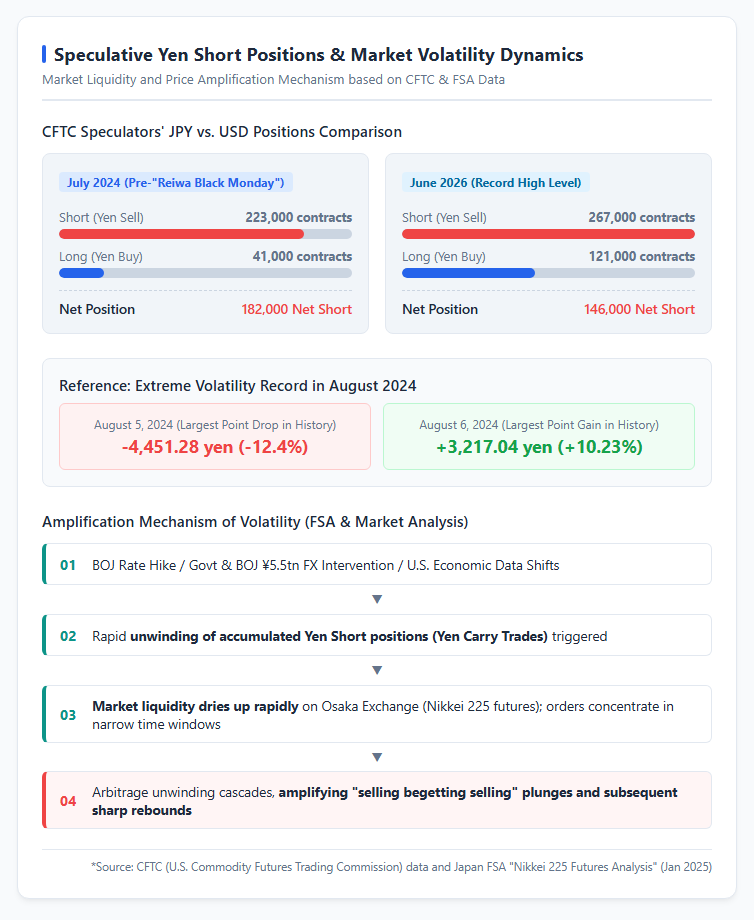
These structural mechanics served as a primary catalyst for the market’s severe short-term swings.
Impact of Monetary Tightening on Corporate Management and the Japanese Economy
Rising Borrowing Costs and Corporate Resilience in Earnings
Increases in the policy rate directly impact corporate funding costs through commercial banks’ short-term prime lending rates and corporate loan rates. According to estimates by Teikoku Databank covering approximately 100,000 companies holding interest-bearing debt, a 0.25% increase in borrowing rates would raise annual interest expense by an average of 640,000 yen per firm. This is calculated to reduce ordinary profits across all industries by an average of 2.0%, potentially pushing approximately 1,700 companies (1.6% of the total) into ordinary losses. By industry, the real estate sector—which relies heavily on interest-bearing debt—is expected to be hardest hit, with interest expenses rising by an average of 2.76 million yen per company and ordinary profits falling by an average of 5.1%. Conversely, the construction industry faces a relatively modest profit reduction of 1.3%, highlighting noticeable disparities across sectors. However, unlike during past deflationary periods, ongoing inflationary conditions have enabled businesses to pass on rising raw material and labor costs through price adjustments. Thanks to continuous efforts to improve profitability, corporate resilience against interest rate increases has strengthened steadily compared to previous survey periods.
Mortgage Rate Hikes and the Housing Channel Spillover to Household Consumption
The transmission mechanism through which monetary policy changes ripple through the real estate market into the broader economy is known as the “Housing Channel,” and it exerts a profound influence on household consumption. Analysis by the Japan Research Institute shows that variable-rate mortgages account for 70% to 75% of total outstanding mortgage debt in Japan, creating a structure where rate hikes quickly affect existing borrowers alongside new home buyers. While many financial institutions employ risk-mitigation rules such as the “5-year rule” and the “125% rule” to prevent sudden spikes in monthly payments, these mechanisms merely defer principal repayment by increasing the proportion of interest paid. If the policy rate rises incrementally, households headed by individuals aged 39 and under are estimated to face an average annual payment increase of nearly 400,000 yen, representing a squeeze equivalent to roughly 6% of their disposable income. Please refer to the diagram below.
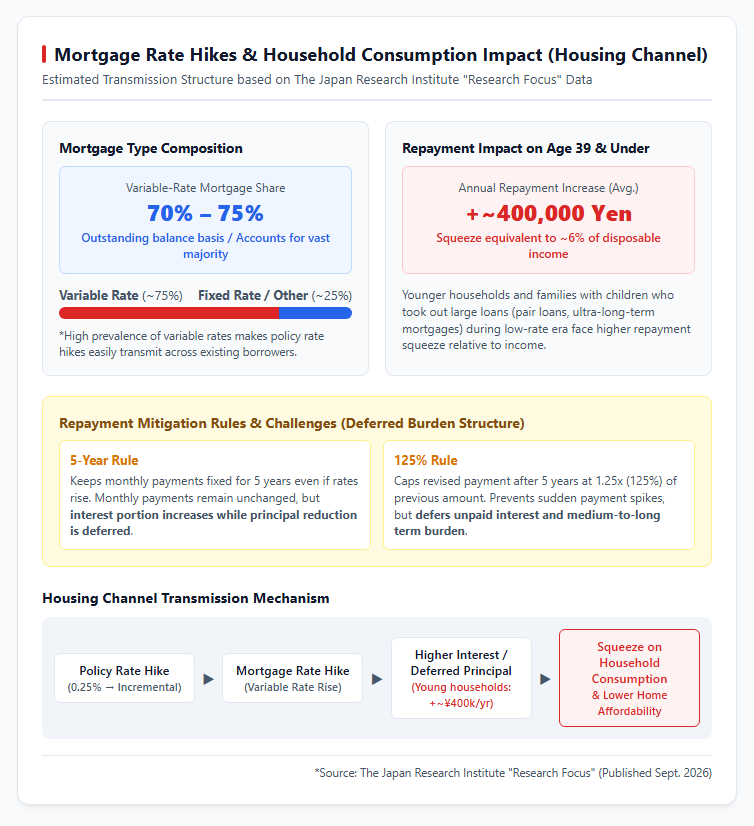
For young households and families with children who took on substantial mortgages relative to their income during the low-rate era, this added burden, combined with rising living and education expenses, threatens to dampen medium- to long-term personal consumption. Furthermore, if interest rates rise while urban housing prices remain elevated, the home-purchasing power of younger generations will erode, raising concerns over widening wealth inequality across generations.
Structural Shifts in Financial Conditions and Future Market Outlook
Transition to a “World with Interest Rates” and the Structure of U.S.-Japan Rate Differentials
Japan’s economy has completed a structural transition from decades of ultra-low interest rates and Yield Curve Control (YCC) into a genuine “world with interest rates.” The Bank of Japan has signaled an intention to raise policy rates incrementally toward neutral levels if economic and price developments align with its Outlook Report, taking into account that real interest rates remain deeply negative. The BOJ estimates Japan’s nominal neutral interest rate to lie roughly between 1.1% and 2.5%. As the policy rate rises toward 1.00% or 1.25%, policy discussions will transition from “adjusting ultra-accommodative monetary conditions” to evaluating a “neutral stance on economic activity.” Market focus centers not only on the pace of BOJ rate increases but also on the policy stance of the U.S. Federal Reserve (FRB) and the rate at which the U.S.-Japan interest rate differential narrows. In a scenario where the U.S. maintains elevated interest rates while Japan pursues gradual hikes, the interest rate gap will not disappear entirely. Consequently, movements in the USD/JPY exchange rate will continue to exert complex effects on equity market valuations by influencing corporate export profitability and import costs.
Future Trajectory and Key Risk Factors for Investors
In gauging the future trajectory of financial markets, investors must carefully evaluate not only the timing and pace of further BOJ rate hikes but also Japan’s overall economic growth potential and corporate earnings trends. The foremost factor for investors to monitor is whether wage increases, exemplified by the annual shunto wage negotiations, spread broadly to small and medium-sized enterprises (SMEs) to sustain a “virtuous cycle of wages and prices” backed by resilient consumer spending. Should upside risks to inflation intensify, the BOJ may accelerate its pace of rate hikes, introducing potential short-term volatility into equity prices. The second key factor is macroeconomic trends and growth scenarios across major economies. Whether the U.S. economy achieves a soft landing while avoiding a severe downturn, or falls into a hard landing, will heavily dictate global investor risk appetite. If corporate capital expenditure appetite and pricing power demonstrate resilience against higher borrowing costs, the stock market is expected to recover onto a structural growth path following temporary volatility like the 1,300-yen surge. Operating in a new environment of rising interest rates makes it ever more critical to evaluate macroeconomic indicators alongside microeconomic corporate earning power.
Reference Pages
- 【Bank of Japan】Governor Press Conference Materials
【記者会見】植田総裁(7月31日分) : 日本銀行 Bank of Japanwww.boj.or.jp

【#Nikkei225 #BankofJapan #RateHike #MonetaryPolicy #JapaneseEconomy #StockMarket】
コメント