On September 18, 2026, the Bank of Japan decided at its Monetary Policy Meeting to raise its policy interest rate to around 1.25%, with Governor Kazuo Ueda declaring that monetary policy has entered a “new stage” as underlying inflation approaches the 2% target. While the central bank moves swiftly to address upside inflation risks driven by rising crude oil prices and a weak yen, close attention is being paid to the impact of rising interest rates on household mortgage burdens and government debt sustainability.
- A Consecutive Rate Hike in Just Three Months and the 7–2 Split Vote
- Governor Ueda Signals a “New Stage” and the Future Trajectory of Rate Hikes
- Market Divergence: Yen Depreciation and Stock Gains Following the Rate Hike Announcement
- External Pressures: US Treasury Statements and Energy-Driven Import Inflation
- Generational Divide: Rising Mortgage Burden vs. Higher Interest Income on Savings
- Corporate Profit Divergence and Expanding Government Debt Servicing Costs
A Consecutive Rate Hike in Just Three Months and the 7–2 Split Vote
On September 18, 2026, the Bank of Japan (BOJ) decided by a majority vote at its Monetary Policy Meeting to raise its uncollateralized overnight call rate target from around 1.0% to approximately 1.25%. This brings the policy rate to its highest level since April 1995, reaching a 31-year peak. Coming just three months after the previous rate hike in June 2026, this represents the shortest interval between consecutive rate increases since 1990. The decision passed with a 7–2 majority. Two newly appointed Policy Board members under the Cabinet of Prime Minister Sanae Takaichi, Toichiro Asada and Ayano Sato, voted against the hike, advocating to keep rates on hold to further assess economic fundamentals and policy effects. Behind the central bank’s decision is heightened vigilance over upside risks to consumer prices, driven by elevated import costs stemming from crude oil price surges amid Middle East tensions and excessive yen weakness in foreign exchange markets.
Please refer to the graphic below.
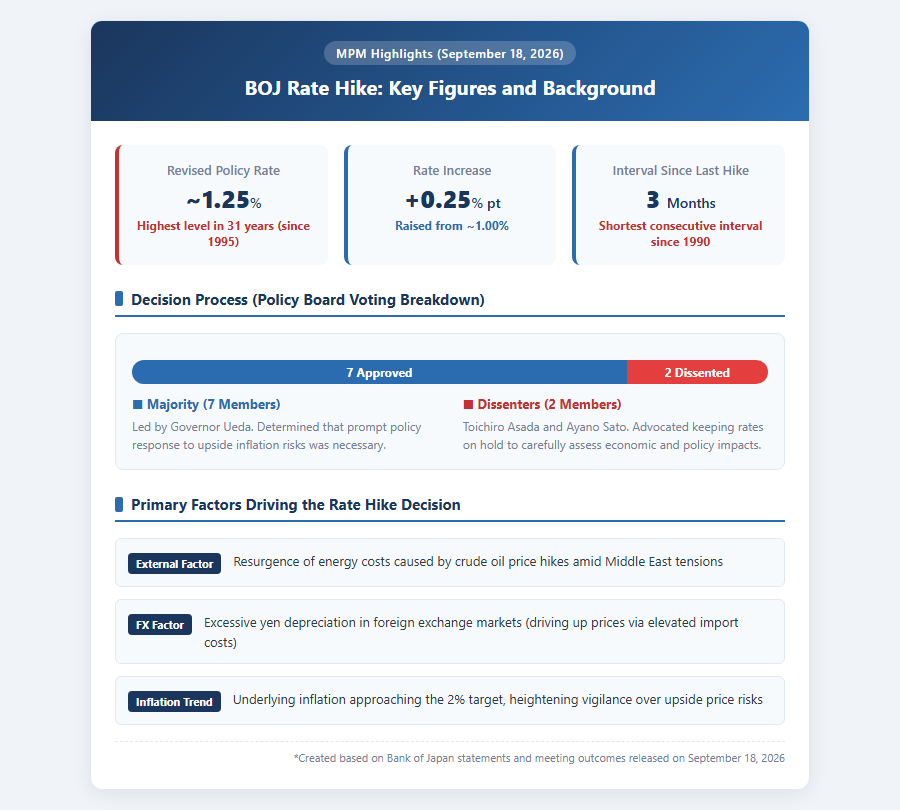
To tackle accelerating inflation, the BOJ decided to expedite the timing of its policy adjustment.
Governor Ueda Signals a “New Stage” and the Future Trajectory of Rate Hikes
At the press conference following the policy meeting, Governor Kazuo Ueda emphasized that underlying inflation—excluding volatile temporary factors—is nearing the 2% target, marking an entry into a “new stage” for Japan’s monetary policy. Governor Ueda explicitly stated that the central bank will not rule out larger interest rate hikes or consecutive increases in upcoming meetings. At the same time, he stressed a data-dependent stance, explaining that the BOJ has not established a fixed tightening schedule, such as hiking once every three months, and will re-evaluate policy at each meeting based on available economic and inflation data. Furthermore, he noted that pinpointing the exact level of Japan’s neutral interest rate or ultimate terminal rate in advance is challenging, indicating that the bank will gauge the appropriate destination through incremental policy adjustments. He also cautioned against raising rates too rapidly, which could excessively tighten financial conditions or trigger sharp corrections in asset prices like equities and real estate.
Financial Market Reactions and Policy Pressures from the International Environment
Market Divergence: Yen Depreciation and Stock Gains Following the Rate Hike Announcement
Immediately following the announcement of the rate hike to 1.25%, foreign exchange markets saw the yen weaken against the US dollar to the 157 yen range, hitting a two-week low—a reaction contrasting with the typical appreciation that accompanies rate hikes. Market participants had already heavily priced in a September rate increase. Consequently, the presence of two dissenting votes and the BOJ’s omission of explicit forward guidance regarding the timing of the next hike became the primary focus. As investor attention shifted from the rate hike itself to the future pace of tightening, growing expectations of a cautious approach to short-term rate hikes triggered yen selling. Conversely, equity markets welcomed the resolution of near-term uncertainty, with the Nikkei 225 Stock Average closing up approximately 1.4% from the previous day, while 10-year Japanese government bond (JGB) yields declined, demonstrating complex market dynamics.
Please refer to the graphic below.
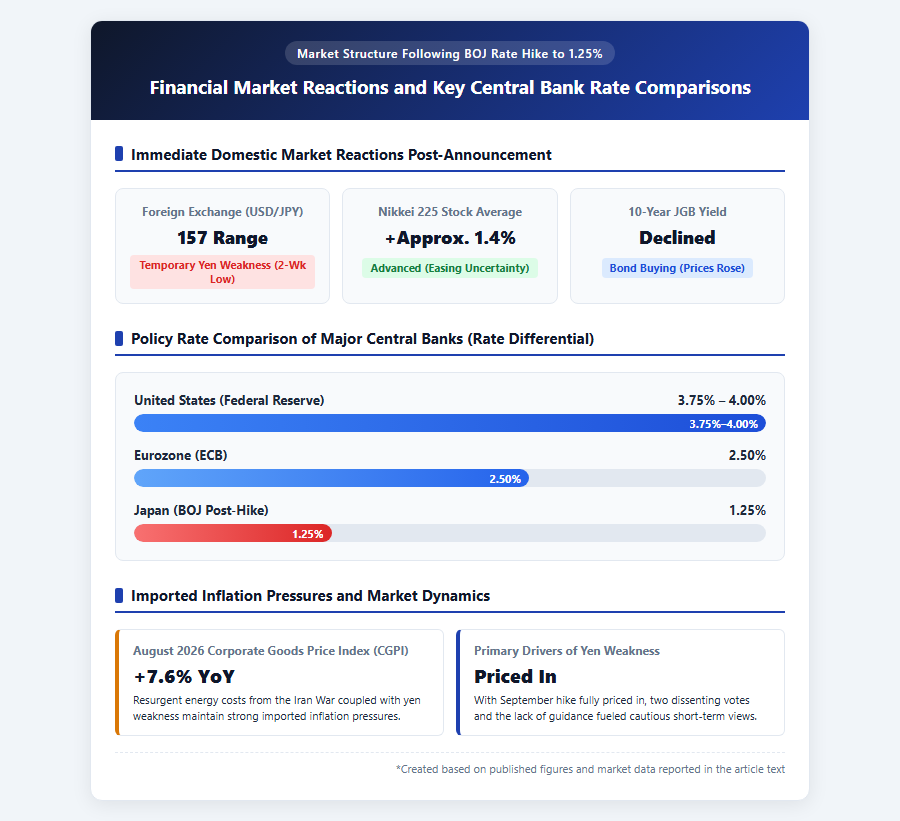
Market participants continue to closely monitor the BOJ’s pace of monetary easing adjustment and incoming economic indicators.
External Pressures: US Treasury Statements and Energy-Driven Import Inflation
Accelerating the BOJ’s pace of rate hikes is driven not only by domestic price trends but also by strong international pressures and external environmental shifts. Geopolitical risks, including the outbreak of the Iran War in February 2026, caused energy costs to surge, driving Japan’s Corporate Goods Price Index (CGPI) up by 7.6% year-on-year in August 2026. In response to these acute import inflation pressures, US Treasury Secretary Scott Bessent expressed strong support during a meeting with BOJ Governor Ueda for decisive Japanese monetary and market policy actions to curb excessive yen weakness. With the US Federal Reserve’s target interest rate standing at 3.75%–4.00% and the European Central Bank’s (ECB) key rate at 2.5%, the interest rate differential between Japan and major overseas economies remains substantial even after the BOJ’s move to 1.25%. This persistent gap maintains underlying pressure for further rate hikes to support the yen and contain imported inflation.
Real Economic Impacts on Households, Businesses, and Fiscal Health, and Long-Term Outlook
Generational Divide: Rising Mortgage Burden vs. Higher Interest Income on Savings
The policy rate hike to 1.25% directly impacts the commercial interest rate landscape. According to estimates by Mizuho Research & Technologies, ordinary deposit rates are projected to rise to 0.50% and 10-year time deposit rates to 2.13%, while variable-rate mortgages are expected to increase to 1.45% and fixed-rate mortgages to 3.46%. Nationally, Japanese households hold roughly 2,200 trillion yen in financial assets. As a result, increased interest income from deposits and government bonds, combined with higher equity dividends, will outweigh rising mortgage interest payments, generating a net positive impact of 400 billion to 4.1 trillion yen annually for households overall. However, individual household impacts diverge sharply across demographic lines. Younger households in their 20s and 30s with recent mortgage debt, as well as low-to-middle-income families, face a direct squeeze from higher monthly repayment costs. Conversely, older demographics with substantial accumulated financial assets benefit from increased interest yields, creating a pronounced asset effect.
Please refer to the graphic below.
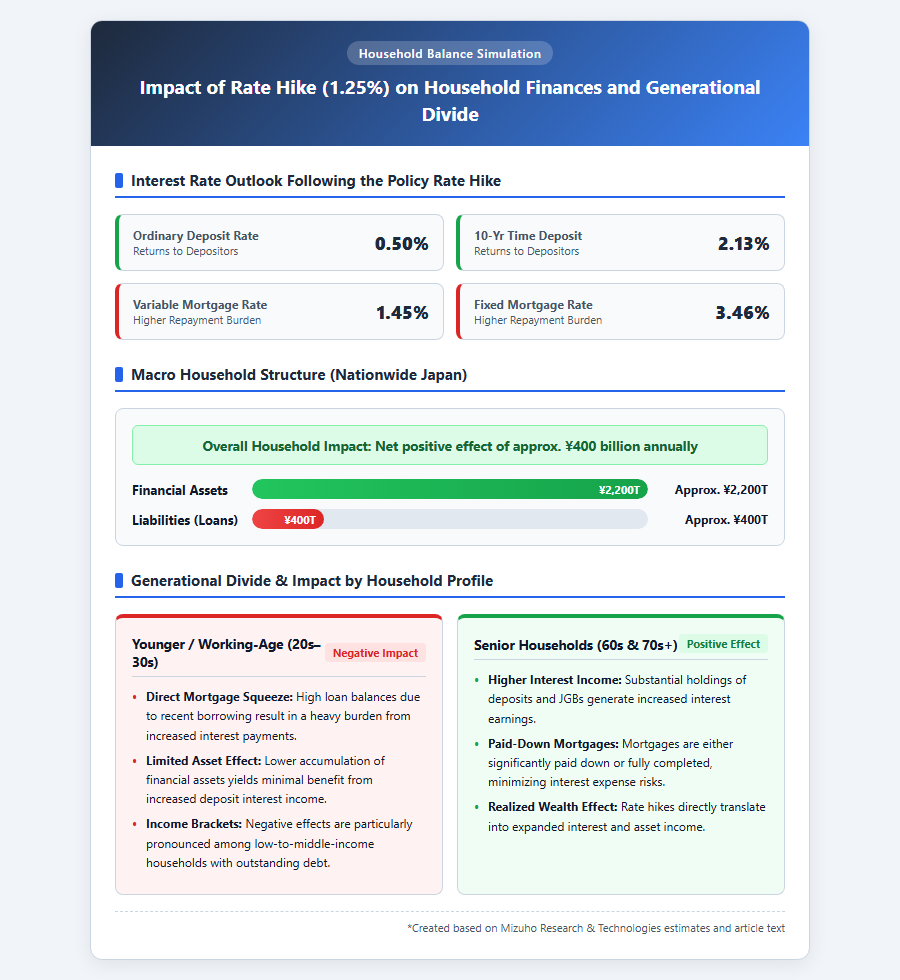
Differences in household balance sheets are highlighting a significant generational disparity in the face of rising interest rates.
Corporate Profit Divergence and Expanding Government Debt Servicing Costs
Rising interest rates and currency fluctuations exert a profound influence on corporate management and public finance. Overall, the corporate sector is projected to maintain earnings growth, supported by sales gains aligned with nominal GDP expansion and progress in passing on cost increases to selling prices. However, in debt-reliant non-manufacturing sectors—such as real estate, accommodations, food services, and healthcare/welfare—as well as among small and medium-sized enterprises (SMEs), surging interest expenses pose a substantial risk to ordinary profits. In government fiscal operations, rising long-term interest rates will gradually inflate debt-servicing costs. As the “interest rate bonus”—a condition where nominal GDP growth exceeds long-term interest rates—disappears, projections warn that if the policy rate exceeds 1.5%, Japan’s debt-to-GDP ratio will fail to stabilize and instead diverge over the long term. Achieving sustainable growth for the Japanese economy will require enhancing corporate productivity to withstand higher interest rates, alongside careful balance and coordination between fiscal and monetary policy.
References
- 【Impact of the September Rate Hike on Households and Companies – Mizuho Research & Technologies】https://www.mizuhobank.co.jp/corporate/mhri/research/report/pdf/express-jp260910.pdf
【#BankOfJapan #PolicyRate #InterestRateHike #KazuoUeda #MonetaryPolicy #ForeignExchange #Mortgage #JapaneseEconomy】


コメント