The Bank of Japan is set to raise its policy rate from around 1.0% to 1.25% at its monetary policy meeting on September 17–18, 2026. This decision is driven by growing upside risks to inflation, propelled by rising service prices, elevated crude oil costs, and a weakening yen.
- Outline of the 1.25% Policy Rate Increase and Key Meeting Takeaways
- Inflation and Exchange Rate Upside Risks Driving the Decision
- Exit from Quantitative and Qualitative Easing and the Return to a “World with Interest Rates”
- Direct Effects on Variable-Rate Mortgages and Savings Rates
- Ripple Effects on Equities, Foreign Exchange, and Risk Assets
- Rising Corporate Borrowing Costs and Sectoral Resilience
- Expected Pace of Future Hikes and Key Economic Indicators
Outline of the 1.25% Policy Rate Increase and Key Meeting Takeaways
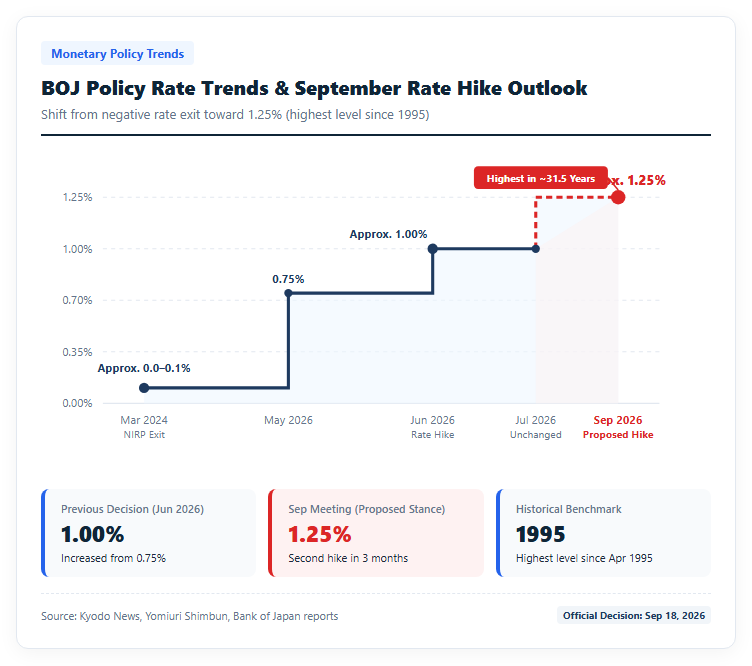
The Bank of Japan (BOJ) has entered discussions to raise its uncollateralized overnight call rate target—the benchmark policy rate—from the current level of approximately 1.0% to 1.25% at its upcoming Monetary Policy Meeting on September 17–18, 2026. If officially approved, this rate hike will mark the BOJ’s first increase in just three months since it raised the rate from 0.75% to 1.0% in June 2026. Since ending its negative interest rate policy in March 2024, the BOJ had been adjusting rates in gradual steps roughly every six months. The upcoming move represents a clear acceleration in the pace of normalization.
A policy rate of 1.25% would be the highest in approximately 31 and a half years, dating back to April 1995. This shift marks a decisive departure from the prolonged era of ultra-low interest rates and solidifies Japan’s transition into an economy defined by positive interest rates. Financial markets had already priced in a 60% to over 90% probability of this additional rate hike, meaning the decision aligns closely with prevailing market expectations.
The following chart provides a visual overview of recent policy rate trends and the proposed rate hike.
This decision is not merely a temporary adjustment; it symbolizes a historic turning point in Japan’s monetary policy architecture. The BOJ intends to finalize its stance after carefully evaluating economic indicators and inflation trends right up to the meeting.
Inflation and Exchange Rate Upside Risks Driving the Decision
The primary catalyst for this additional rate hike is the rising risk that underlying inflation will overshoot the BOJ’s 2% price stability target. BOJ Governor Kazuo Ueda has highlighted three main upside risks to prices: first, surging demand driven by expanded investments in artificial intelligence and labor-saving technologies; second, skyrocketing crude oil prices caused by heightened tensions in the Middle East; and third, upward pressure on import prices stemming from a persistent trend toward yen depreciation.
Monetary authorities are paying particularly close attention to the fact that price increases are taking root in the service sector as companies pass on rising labor costs, expanding beyond energy and food items. In August 2026, 195 major food manufacturers raised prices on 2,311 items—an 80% jump compared to 1,262 items in the same month of the previous year—with an additional 4,531 items scheduled for price hikes in September 2026.
Downward pressure on the yen in foreign exchange markets and diplomatic signals from the United States have also served as critical catalysts. At the end of July 2026, the Japanese and U.S. governments executed a joint currency intervention. In late August 2026, U.S. Treasury Secretary Scott Bessent met with Governor Ueda and expressed support for decisive monetary policy measures aimed at correcting the weak yen. These evolving domestic and international conditions have jointly provided the BOJ with a strong impetus to move forward with further tightening.
Exit from Quantitative and Qualitative Easing and the Return to a “World with Interest Rates”
Following the introduction of Quantitative and Qualitative Monetary Easing (QQE) in April 2013, the BOJ maintained large-scale monetary stimulus for more than a decade. However, the central bank pivoted toward policy normalization by ending its negative interest rate policy and abolishing Yield Curve Control (YCC) in March 2024.
Reflecting on the 25-year history of monetary easing deployed to combat deflation, while the policies delivered clear benefits such as lower real interest rates and higher stock prices, they also generated significant side effects, including impaired market functionality in the Japanese government bond (JGB) market and squeezed net interest margins for financial institutions. According to the BOJ’s Review of Monetary Policy from a Broad Perspective, returning to a traditional policy framework centered on conventional interest rate manipulation is essential to curb financial risks and market distortions originating from unconventional monetary policy tools.
Raising the policy rate to 1.25% formally re-establishes a financial environment with meaningful interest rates in Japan. With the neutral interest rate estimated to lie between 1.5% and 2.0%, the BOJ plans to incrementally adjust its degree of monetary accommodation in accordance with economic and price conditions. This shift is expected to foster a more efficient allocation of capital and encourage corporate restructuring across the economy.
Impact on the Japanese Economy and Financial Markets
Direct Effects on Variable-Rate Mortgages and Savings Rates
A higher policy rate rapidly permeates consumer finance, directly impacting household budgets. Variable-rate mortgages will experience the most immediate shift. Because variable interest rates are tied to the short-term prime rate, which moves in tandem with the BOJ’s policy rate, borrowers can expect higher applicable interest rates and increased monthly repayments.
For example, on a 40-million-yen, 35-year variable-rate mortgage, an increase in the applicable interest rate from 0.575% to 1.695% would raise monthly payments from 105,000 yen to 128,000 yen—an increase of approximately 23,000 yen per month. Conversely, fixed-rate mortgages have already priced in higher long-term yields, causing applicable interest rates on new loans to continue their upward trajectory. Both current homeowners and prospective homebuyers will need to re-evaluate their financial plans.
The diagram below illustrates the changes in mortgage repayments and deposit interest rates resulting from rising interest rates.
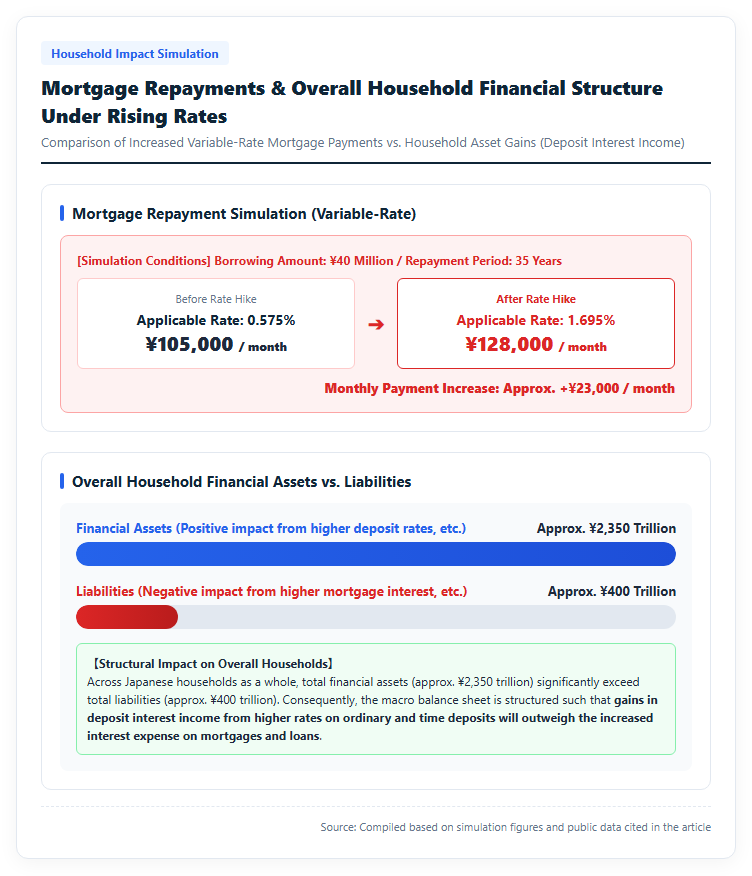
On the other hand, higher interest rates offer tangible benefits for depositors. Financial institutions, ranging from megabanks to online banks, are broadly raising interest rates on ordinary and time deposits. Across Japanese households as a whole, financial assets total approximately 2,350 trillion yen against 400 trillion yen in liabilities. Consequently, the macro household balance sheet is structured such that the gain in interest income from deposits will outweigh the increased interest expense on mortgage loans.
Ripple Effects on Equities, Foreign Exchange, and Risk Assets
In financial markets, narrowing interest rate differentials between Japan and the United States will exert downward pressure on the USD/JPY exchange rate, favoring a stronger yen. The combination of rising Japanese yields and Federal Reserve monetary policy shifts led the USD/JPY rate—which approached 164 yen in late July 2026—to appreciate to the 152-yen range on September 8, 2026. A stabilized exchange rate helps anchor domestic prices by suppressing import costs.
In the equity market, impacts will diverge significantly by sector. Financial equities, particularly bank stocks, stand to benefit from expectations of expanding net interest margins—the spread between lending and deposit rates. Bank stocks demonstrate a strong positive correlation with rising 2-year JGB yields, serving as a primary bullish catalyst. In contrast, non-manufacturing sectors with high interest-bearing debt loads—such as real estate, electric power and gas, and accommodations and dining—as well as emerging growth companies, tend to face market headwinds due to rising capital costs.
Crypto-assets and other risk assets also face mounting pressures. Non-yielding assets like Bitcoin become relatively less attractive as interest rates rise. Furthermore, a strengthening yen creates a dual drag for domestic investors by eroding yen-denominated investment returns even if dollar-denominated prices remain flat. Investors will likely need to rebalance their portfolios in response to these changing dynamics.
Corporate and Household Challenges and Outlook
Rising Corporate Borrowing Costs and Sectoral Resilience
Higher interest rates will fundamentally alter the operational environment for Japanese businesses. According to estimates based on the Financial Statements Statistics of Corporations, the average interest rate on corporate interest-bearing debt is projected to rise from 1.3% in FY2024 to approximately 2.8% by FY2028. If the policy rate reaches 1.5%, total ordinary profits across all corporate sectors are estimated to be suppressed by a cumulative 2.2% (approximately 2.6 trillion yen).
Small and medium-sized enterprises (SMEs) will bear a disproportionate share of this burden. Companies with capital under 10 million yen exhibit a high dependency on interest-bearing debt at 57.6% and a low return on assets (ROA) of 2.8%, making them particularly vulnerable to rising interest expenses. Similarly, capital-intensive industries such as real estate face larger profit contractions due to their extensive leverage.
Conversely, large corporations with abundant cash reserves and manufacturing firms holding substantial interest-bearing assets may experience net positive impacts, as increased interest income offsets higher interest expenses. While Japanese corporate resilience to rate hikes has improved compared to the 1980s, SMEs with limited pricing power face an urgent imperative to strengthen their earning capacity through labor-saving investments and high-value-added business models.
Expected Pace of Future Hikes and Key Economic Indicators
Following the September meeting, market focus will shift to the pace of subsequent rate hikes and the ultimate terminal rate. Market consensus and expert forecasts project that after reaching 1.25% in September 2026, the BOJ will implement additional 25-basis-point hikes roughly once per quarter, bringing the policy rate to 1.75% by December 2026, January 2027, or the April–June quarter of 2027.
Some brokerage forecasts suggest the rate could eventually rise to around 2.5%. Long-term interest rates are also projected to advance toward 3.1% by the end of FY2027, driven by changing supply-demand dynamics as the BOJ reduces its holdings of government bonds. Market participants must recognize that Japan has entered a sustained, multi-stage tightening cycle rather than a one-off adjustment.
The ultimate determinant of Japan’s economic trajectory will be whether a virtuous cycle of continuous wage gains and price pass-through can be sustained. If strong wage increases achieved during annual spring labor negotiations (Shunto) persist and real wage growth takes firm root, the economy will be well-positioned to absorb higher borrowing costs and maintain a trajectory of moderate expansion. Close attention must be paid to BOJ and government policy coordination, alongside global economic developments, including the Federal Open Market Committee (FOMC) meeting on September 16, 2026.
Reference Pages
- [Review of Monetary Policy from a Broad Perspective – Bank of Japan] https://www.boj.or.jp/
【#BankOfJapan #PolicyRate #RateHike #MortgageRates #ExchangeRate #JapaneseEconomy #MonetaryPolicy】


コメント