In August 2026, both the number of corporate bankruptcies and total liabilities in Saga Prefecture exceeded those of the same month in the previous year. Although year-to-date figures for the first half of the fiscal year remain low, underlying structural risks persist, including an increase in voluntary business closures and dissolutions prior to legal insolvency, rising prices, and the final repayment peak of COVID-19 “zero-zero” loans.
- Specific Bankruptcy Figures for Saga Prefecture in August 2026
- Cumulative First-Half Trends for FY2026 and Comparison with the Previous Year
- Surge in Voluntary Exits and Dissolutions to Close Without Debt
- Earnings Squeezed by Inflation, Rising Labor Expenses, and Price Transfer Difficulties
- Impact of the April–September 2026 Repayment Peak and Rising Interest Rates
- Economic Outlook and Survival Strategies for Saga Enterprises
Specific Bankruptcy Figures for Saga Prefecture in August 2026
According to announcements by Teikoku Databank’s Saga Branch and other sources, there were three corporate bankruptcies (defined as legal insolvencies with liabilities of 10 million yen or more) in Saga Prefecture in August 2026. This represents an increase of two cases compared to the single bankruptcy recorded in August 2025. Total liabilities also rose by 9 million yen, reaching 90 million yen up from 81 million yen in the same month of the previous year. Although both the number of cases and total liabilities grew on a single-month basis, a closer examination of the details reveals that these insolvencies were predominantly small-scale cases with liabilities in the tens of millions of yen, indicating that large-scale corporate failures remain suppressed.
Reflecting nationwide trends where bankruptcy risks have escalated across construction, retail, and service sectors, small businesses in Saga Prefecture are visibly struggling under the weight of soaring material costs and severe labor shortages. Please refer to the figure below.
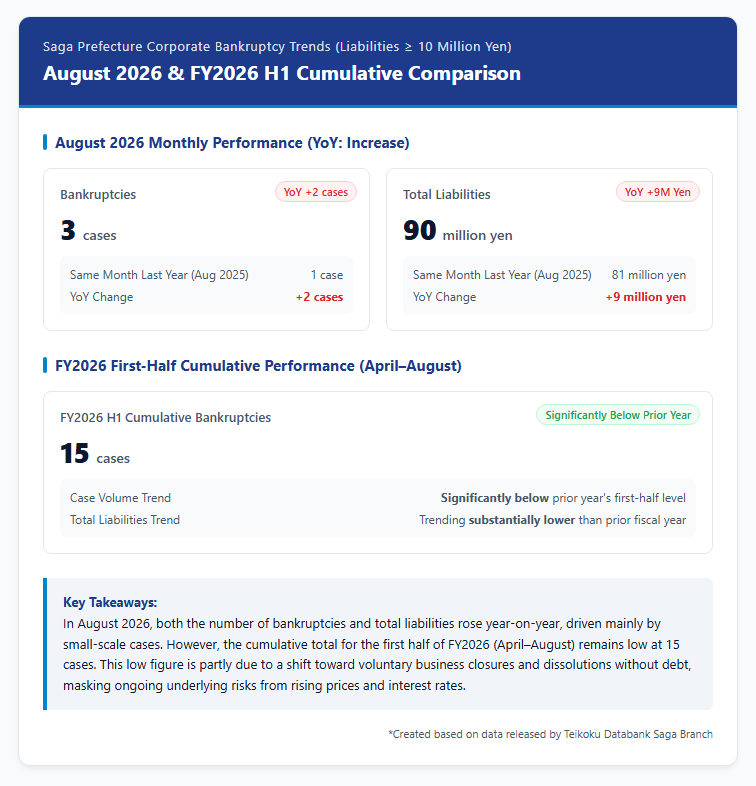
Although the single-month increase in numbers is modest, it serves as an indicator that the operating environment for small and medium-sized enterprises (SMEs) remains extremely challenging. Given ongoing monetary tightening and persistent cost pressures, continuous vigilance regarding liquidity constraints on small businesses is essential.
Cumulative First-Half Trends for FY2026 and Comparison with the Previous Year
Despite the uptick in bankruptcy figures in August 2026, the cumulative number of bankruptcies for the first half of FY2026 (April through August 2026) stands at just 15 cases. This is significantly below the trajectory seen in the first half of the previous fiscal year, indicating that corporate insolvencies across the entire first half have progressed at a relatively subdued pace.
However, in FY2025 (the previous fiscal year), corporate bankruptcies in Saga Prefecture reached 53 cases for the full year—matching the 53 cases recorded in FY2012 and marking the highest level in 13 years. In FY2025, recession-type bankruptcies driven by skyrocketing material expenses and high crude oil prices accounted for the vast majority, with bankruptcy numbers trending upward across the entire Kyushu and Okinawa region. The calm appearance of the first-half figures for FY2026 is largely a reaction to the surge in insolvency during the preceding fiscal year, as well as a shift in how businesses choose to scale down or exit (as detailed below). It is crucial to note that this does not signify a genuine recovery in corporate performance within the prefecture. Close monitoring of raw material prices and interest rate movements remains imperative.
Business Closures and Deteriorating Earnings Behind the Seemingly Low Insolvency Rates
Surge in Voluntary Exits and Dissolutions to Close Without Debt
The single largest factor keeping the first-half FY2026 bankruptcy figures low is the growing number of companies choosing voluntary closure or dissolution before reaching legal insolvency or bankruptcy. Across many business establishments in Saga Prefecture, an aging population of business owners and a chronic lack of successors pose severe challenges. Consequently, a growing number of managers are deciding to close up shop while they still possess financial leeway, rather than accumulating excessive debt and reaching a total impasse.
Because these voluntary exits are not counted in official “corporate bankruptcy” statistics, overall bankruptcy figures appear misleadingly low. In reality, however, their impact on the local economy—manifested in the decline of regional industries, commercial storefront closures, and job losses—is equal to or greater than that of formal bankruptcies. The quiet market exit of long-cherished small businesses and traditional local industries is gradually eroding the vitality of regional economies, highlighting a harsh reality that cannot be ignored simply because bankruptcy counts are low.
Earnings Squeezed by Inflation, Rising Labor Expenses, and Price Transfer Difficulties
The root causes driving businesses toward voluntary closure or legal insolvency include prolonged spikes in raw material and energy costs, as well as rising labor expenses fueled by workforce shortages. According to survey data published by the Small and Medium Enterprise Agency, the average proportion of cost increases that SMEs have managed to pass on to client companies nationwide is only 54.2%, leaving companies to absorb more than half of the added cost burden out of their own earnings.
The pass-through rate for labor costs is particularly low at 50.0%. Even when companies raise wages to secure necessary personnel, they are often unable to reflect these higher costs in their selling prices. As a result, many businesses find themselves in a trap of “busy without profit”—maintaining order volume yet generating no net margin. Even if top-line revenue is sustained, profit margins are squeezed, causing cash reserves to erode over time and heightening the risk of sudden liquidity crises. Please refer to the figure below.
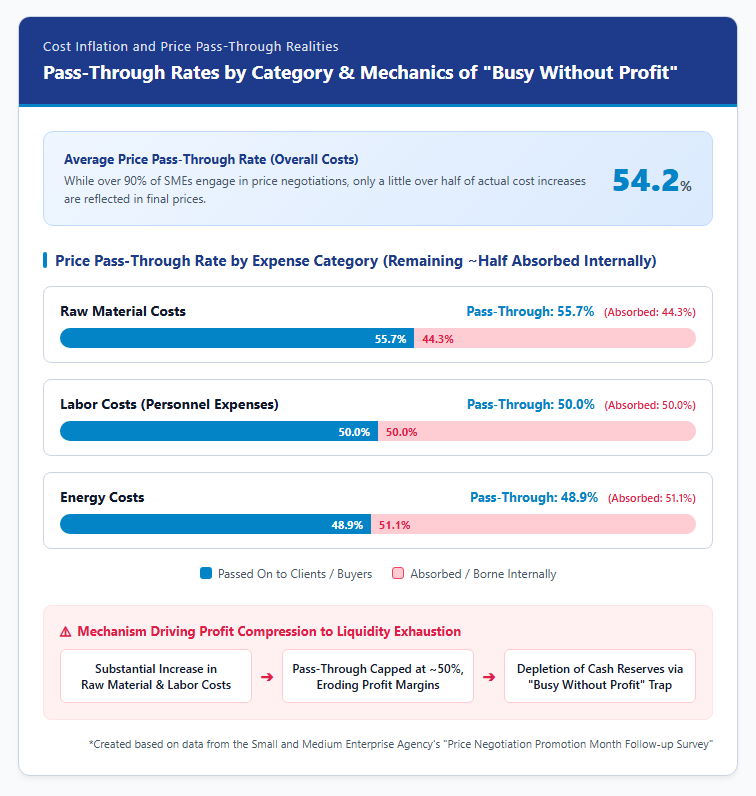
Thorough measures covering both cost management and price negotiations have become absolutely essential.
The Zero-Zero Loan Repayment Peak, Future Risks, and Support Measures
Impact of the April–September 2026 Repayment Peak and Rising Interest Rates
A critical juncture for SME cash flow is the “final repayment peak” of the “zero-zero loans” (effectively interest-free and collateral-free loans) introduced during the COVID-19 pandemic. For businesses that borrowed between 2020 and 2021, the end of their grace periods (set at three to five years) is heavily concentrated between April and September 2026.
Compounding this pressure, commercial bank lending rates have begun to rise following the Bank of Japan’s policy interest rate hike (which reached 1.0% in June 2026). As principal repayments commence alongside increasing interest expenses, cash flows for over-indebted companies are deteriorating rapidly. Businesses that managed to survive through temporary repayment moratoriums now face a heightened risk of being pushed into bankruptcy or voluntary closure as full repayments resume. Management is under urgent pressure to make prompt and appropriate decisions regarding restructuring or orderly exits, including negotiating modified terms with financial institutions and utilizing refinancing guarantee schemes.
Economic Outlook and Survival Strategies for Saga Enterprises
Specialized institutions maintain a cautious stance regarding the future economic outlook for Saga Prefecture. External headwinds compressing corporate profitability are piling up: import costs remain elevated due to historic yen weakness (reaching the 162 yen per dollar range), supply chains face disruptions caused by deteriorating conditions in the Middle East including Iran, and further interest rate hikes by the Bank of Japan remain a distinct possibility.
To survive in such a hostile environment, companies must urgently redraw their cash flow forecasts for the next 13 months to identify when their cash balances will hit their lowest points. Furthermore, leveraging county-level institutional financing—such as Saga Prefecture’s “Management Stabilization Loan (Emergency Measures Fund for Middle East Situation)” offering an annual interest rate of 1.3%—and understanding public support frameworks provided by the Saga Credit Guarantee Association are crucial. Early consultation with main banks and Certified Management Innovation Support Organizations represents the single most effective key to expanding options for business continuity. Multi-faceted networks supporting SMEs across the entire region must be fully utilized.
References
- [Saga Prefecture Management Stabilization Loan (Emergency Measures Fund for Middle East Situation)] https://www.pref.saga.lg.jp/kiji003120010/index.html
【#SagaPrefecture #CorporateBankruptcy #ZeroZeroLoans #SMESupport #ManagementStabilization #InflationMeasures】

コメント