In September 2026, Japan’s Financial Services Agency (FSA) released its Financial Administrative Policy for AY2026, aiming to balance the promotion of growth investments with financial system stability. This initiative comes in response to shifting economic conditions—marked by rising interest rates and growing corporate funding demand—alongside national mandates to upgrade Japan’s status as a leading asset management nation.
- Key Highlights: Organizational Overhaul and the Two Bureau Structure
- Strategic Background: Launching the Financial Strategy for Promoting Growth Investment
- Advancing the Asset Management Nation: NISA Expansion and Asset Owner Reforms
- Legal Frameworks for Startup Support, Crypto-Assets, and FIEA Revisions
- Digital Finance and the AI Era: On-Chain Finance and AX Implementation
- Transforming Regional Finance: From Liquidity Support to Corporate Value Creation
- Future Outlook: Global Business Oversight for Major Banks and IT Resilience
Key Highlights: Organizational Overhaul and the Two Bureau Structure
In September 2026, the Financial Services Agency (FSA) published its “Financial Administrative Policy for AY2026,” outlining a comprehensive framework to strengthen financial functions while preserving overall system stability. As part of this policy, the FSA executed a major structural reorganization, replacing the former Supervisory Bureau with two specialized bodies: the Banking and Securities Supervisory Bureau and the Asset Management and Insurance Supervisory Bureau. Under the newly appointed Senior Deputy Director-General for Supervision, the regulator aims to enhance the integration of micro-prudential supervision of individual financial institutions with macro-prudential oversight of the broader financial system.
Against the backdrop of rising interest rates and expanding corporate capital needs, the policy places strong emphasis on monitoring Asset Liability Management (ALM) and liquidity risk across financial institutions. Furthermore, the agency is reinforcing measures to prevent financial crime, strengthen cyber security, and crack down on unfair trading practices, thereby ensuring a safe environment for retail and institutional investors alike. The visual below illustrates the overall structure of this new policy framework.
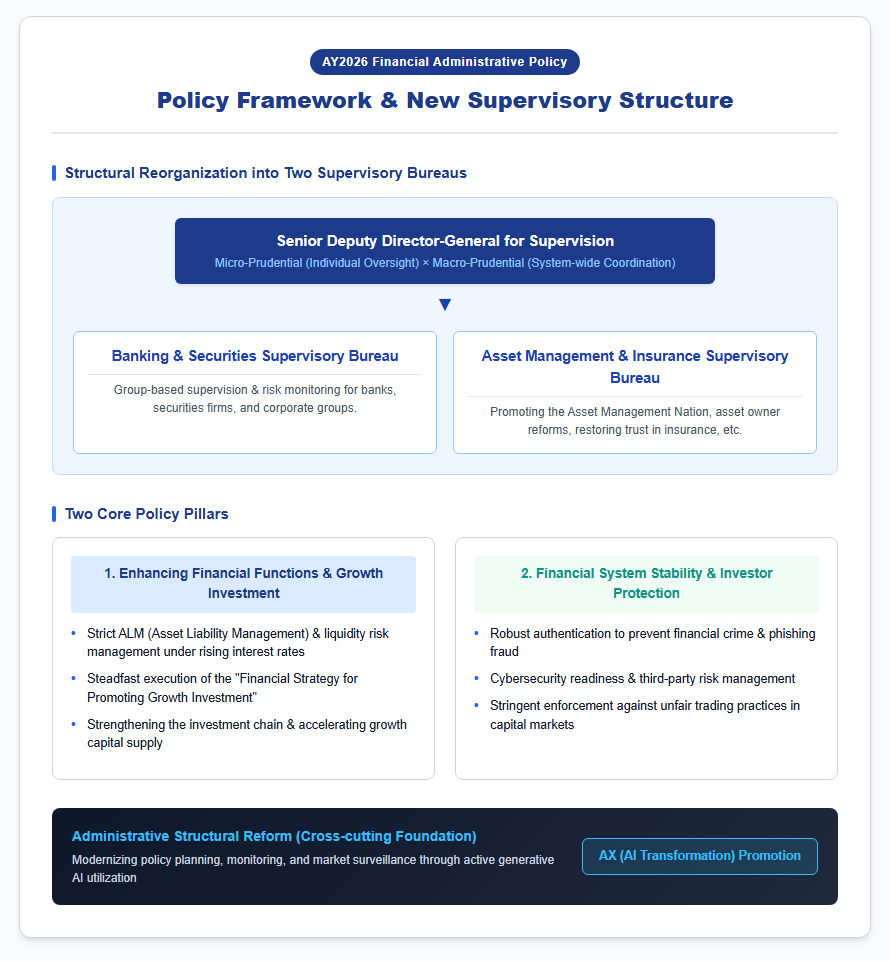
To support these administrative advancements, the FSA is actively driving an AI Transformation (AX) across its own operational processes, leveraging generative AI to modernize policy planning, monitoring, and market surveillance.
Strategic Background: Launching the Financial Strategy for Promoting Growth Investment
The overarching driver behind the new policy is the “Financial Strategy for Promoting Growth Investment: Upgrading the Asset Management Nation,” formulated by the government in July 2026. This strategy is designed to channel capital into key strategic sectors, facilitating corporate restructuring and creating a virtuous cycle of growth funding. It includes initiatives across the entire investment chain—ranging from household wealth formation to corporate growth financing and strengthening asset owner capabilities.
As Japan transitions into an era of higher interest rates, conventional capital supply mechanisms and risk management protocols are no longer sufficient to handle increasingly diverse corporate funding demands and complex financial risks. In response, the FSA is accelerating regulatory reforms to fortify capital markets, expand the corporate bond market, and bolster early-stage startup financing.
Moreover, sustainability and impact investments are being prioritized to align societal problem-solving with economic growth. Creating a collaborative public-private mechanism to supply growth capital has become an indispensable prerequisite for securing Japan’s long-term economic expansion.
Accelerating Growth Investment, Capital Markets, and Digital Finance Reform
Advancing the Asset Management Nation: NISA Expansion and Asset Owner Reforms
Japan’s ambition to become a world-class asset management hub is yielding significant results as it enters a new phase. Following the launch of the overhauled NISA (Nippon Individual Savings Account) framework, total NISA accounts reached 26.47 million by the end of March 2025, with cumulative purchases reaching 59.3 trillion yen. This trajectory comfortably surpasses the government’s target of reaching 56 trillion yen by December 2027, demonstrating a clear household shift from traditional savings to active investment.
In parallel, reforms to corporate-type Defined Contribution (DC) plans and Individual-type Defined Contribution (iDeCo) plans—including raised contribution caps and expanded eligibility—are expanding retirement asset-building opportunities. The Japan Financial Literacy Offer and Promotion Organization (J-FLEC), established in April 2024 and fully operational since August, is actively addressing regional financial literacy gaps by dispatching certified instructors and hosting workplace seminars nationwide.
On the institutional side, adoption of the Asset Owner Principles—which establish fiduciary guidelines for institutional asset owners—has gained substantial momentum. As of April 2025, 207 institutions, including the Government Pension Investment Fund (GPIF) and major life insurance companies, have formally endorsed the principles. This widespread adoption is driving governance enhancements, professional asset management capabilities, and increased operational transparency across the industry.
Legal Frameworks for Startup Support, Crypto-Assets, and FIEA Revisions
To broaden the supply of growth capital while ensuring market fairness, major legislative updates have been enacted. Under the amended Financial Instruments and Exchange Act (FIEA) passed in July 2026, the threshold for exemption from filing a full securities registration statement for general investor fundraising was raised from under 100 million yen to under 500 million yen. Additionally, a simplified disclosure form was introduced for offerings between 500 million yen and 1 billion yen, significantly lowering administrative hurdles for emerging startups.
Regarding crypto-assets, regulatory jurisdiction was officially transferred from the Payment Services Act to the FIEA, establishing crypto-assets as formal financial instruments. This regulatory migration introduces stricter penalties for unregistered operators, establishes insider trading prohibitions, and mandates clear disclosure via whitepapers. These safeguards aim to eliminate market manipulation and foster a secure environment for both retail users and institutional participants.
In sustainability disclosure, prime-listed companies on the Tokyo Stock Exchange will face mandatory reporting and third-party assurance aligned with Sustainability Standards Board of Japan (SSBJ) standards. Beginning in the fiscal year ending March 2027 for companies with a market capitalization of 3 trillion yen or more, these mandatory disclosures will gradually expand to cover smaller market-cap tiers, driving greater transparency in corporate value evaluation.
Digital Finance and the AI Era: On-Chain Finance and AX Implementation
To keep pace with rapid technological advancements, the FSA is modernizing financial infrastructure while digitizing administrative processes. In the summer of 2026, the agency launched the “On-Chain Finance Forum for the AI Era” to address technical, institutional, and supervisory considerations surrounding blockchain-based settlement and transactional frameworks. Furthermore, the agency is expanding public-private policy dialogues across Asia, paving the way for the “Asia Day 2027” conference to deepen international collaboration.
Internally, the FSA Commissioner assumed the role of Chief AI Officer (CAIO) to lead the “FSA AI Transformation Council.” Through this initiative, the agency uses generative AI to analyze policy documents and supervisory data, drastically streamlining inspection and market surveillance workflows.
To assist financial institutions in integrating AI safely and effectively, the FSA updated its “AI Discussion Paper.” These guidelines provide clear practical benchmarks for financial firms leveraging AI, encouraging both internal operational efficiency and the development of high-value digital financial services.
Strengthening Regional Finance, Global Supervision, and Future Outlook
Transforming Regional Finance: From Liquidity Support to Corporate Value Creation
As regional economies undergo structural shifts, the role expected of regional financial institutions is pivoting from traditional liquidity support and collateral-based lending toward active value creation and hands-on business consulting. With the Small and Medium Enterprise White Paper emphasizing the need to boost corporate earning power, initiatives like the “Regional Financial Power Enhancement Plan” (released in December 2025) and the “Asset-Based Lending on Corporate Value” framework (enacted in May 2026) are driving this transition.
The corporate value pledge system allows businesses to secure financing based on the overall value and future potential of their operations rather than physical real estate collateral. This shift requires regional lenders to cultivate advanced “business assessment capabilities.” Consequently, regional banks are expanding non-financial advisory services, including business matching, M&A facilitation, and guidance on digital and green transformations (DX/GX). The chart below outlines this structural evolution in enterprise support.
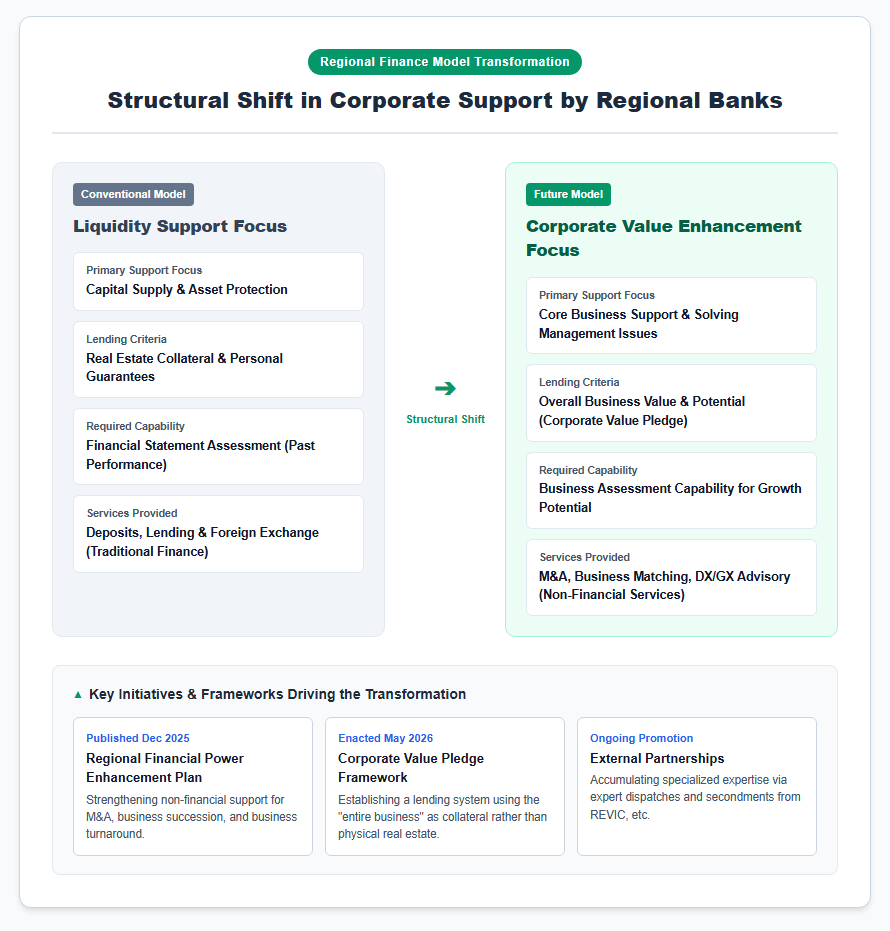
Supported by favorable earnings amid rising interest rates, regional institutions are strategically reinvesting in human capital, professional training, and partnerships with external agencies such as the Regional Economy Vitalization Corporation of Japan (REVIC) to secure long-term profitability.
Future Outlook: Global Business Oversight for Major Banks and IT Resilience
Key focus areas for future financial administration include heightened oversight of global operations at major financial groups and the continuous improvement of IT resilience and cybersecurity. A prime example of expanding global footprints is Mitsubishi UFJ Financial Group’s (MUFG) investment of approximately 680 billion yen in a leading Indian non-bank lender in April 2026, underlining the need for rigorous cross-border risk management.
To prevent overseas shocks from cascading into the domestic financial system, the FSA is collaborating with the Bank of Japan (BOJ) and international regulatory counterparts. Together, they are conducting crisis scenario analyses modeled after Lehman-scale market dislocations to stress-test corporate governance and risk management frameworks at megabanks.
At the same time, in response to a sharp rise in unauthorized access and fraudulent transactions targeting online securities and banking accounts, regulators are mandating phishing-resistant multi-factor authentication (such as passkeys). Managing third-party vendor risks and establishing smooth implementation pathways for sustainability disclosures remain critical priorities for safeguarding the stability and credibility of Japan’s financial ecosystem.
References
- [Overview of the Bill to Partially Amend the Financial Instruments and Exchange Act and the Payment Services Act] https://www.fsa.go.jp/common/diet/221/index.html
- [Regional Financial Power Enhancement Plan] https://www.fsa.go.jp/news/r7/20251219/20251219.html
- [Financial System Report] https://www.boj.or.jp/research/brp/fsr/fsr260421.htm
- [Impact Consortium] https://impact-consortium.fsa.go.jp/
【#FinancialAdministrativePolicy #AssetManagementNation #FSA #RegionalFinance #FIEARevision #CryptoAssets #GrowthInvestment】

コメント