
The Bank of Japan decided to raise its policy interest rate to 1.25% at its September 2026 Monetary Policy Meeting. Driven by the need to counter upside inflation risks stemming from surging crude oil prices and a weaker yen, this decision will have broad ramifications, including higher mortgage rates and increased interest burdens for corporate borrowers.
- Rapid Rate Hike After 3 Months: Background Behind the BOJ’s Decision
- Financial Market Reactions and Interest Rate Formation
- Rising Mortgage Rates and Monthly Repayment Simulations
- Higher Deposit Yields and Intergenerational Impact Disparities
- Rising Debt Service Costs and Earnings Squeeze for Businesses
- Medium-to-Long-Term Economic Outlook in a Rising Interest Rate Environment
Rapid Rate Hike After 3 Months: Background Behind the BOJ’s Decision
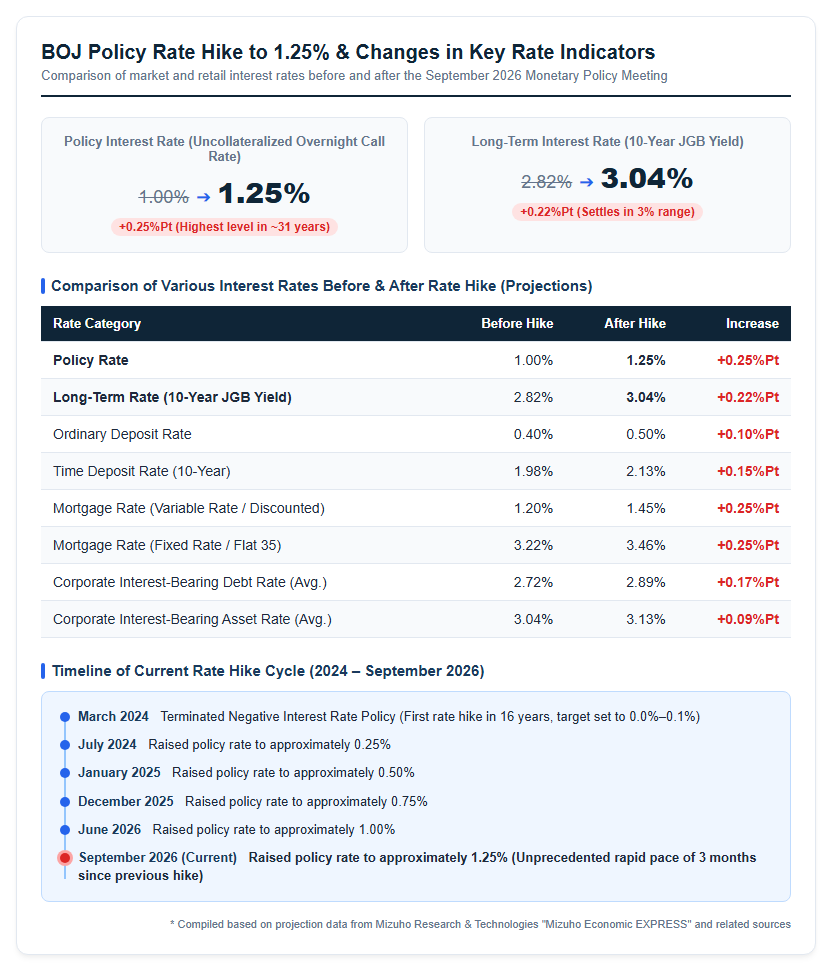
At its Monetary Policy Meeting held on September 17 and 18, 2026, the Bank of Japan (BOJ) decided to raise its target for the uncollateralized overnight call rate from approximately 1.0% to 1.25%. This 0.25 percentage point increase marks the sixth rate hike in the current tightening cycle since ending its negative interest rate policy in March 2024. Coming just three months after the previous increase at the June 2026 meeting, this rapid pace is unprecedented in recent history, pushing the policy rate to its highest level since 1995—a gap of roughly 31 years. Although two of the nine Policy Board members voted against the motion, the decision passed by a majority vote.
The central bank’s swift move to tighten monetary policy reflects heightened vigilance regarding upside inflation risks fueled by a series of external shocks. In early September 2026, escalations in Middle Eastern geopolitical tensions threatened the Bab-el-Mandeb Strait, sending WTI crude oil prices surging to around \$100 per barrel. Concurrently, soaring non-ferrous metal prices driven by global AI demand expansion, coupled with yen depreciation that inflated import costs, accelerated price pass-throughs from upstream to downstream sectors. With underlying inflation approaching the BOJ’s 2% target, policymakers determined that adjusting the degree of monetary accommodation was essential to preemptively curb runaway price spikes. Please refer to the diagram below.
Financial Market Reactions and Interest Rate Formation
The 0.25 percentage point rate increase was widely priced into financial markets ahead of the decision. Between late August and early September 2026, comments from U.S. Treasury Secretary Scott Bessent expressing concerns over Japan’s reflationary policies and yen weakness, alongside hawkish remarks from BOJ Policy Board members, fueled rate hike expectations. Consequently, the overnight index swap (OIS) market indicated a nearly 98% probability of a September rate hike just prior to the meeting, making the eventual decision entirely expected among market participants.
Reaching a policy rate of 1.25% carries profound analytical significance for future monetary policy. According to the BOJ’s estimates released in March 2026, the range for Japan’s nominal neutral interest rate—the rate that neither stimulates nor slows economic growth—stands between 1.1% and 2.5%. With this hike, the policy rate has officially surpassed the lower bound of that neutral corridor. While previous rate hikes were characterized as normalization away from extraordinary monetary easing, monetary policy now transitions into a phase focused on curtailing economic overheating through monetary restraint. As benchmark 10-year Japanese Government Bond (JGB) yields rise into the 3% range, a “world with positive interest rates” across both short- and long-term maturities is firmly establishing itself.
Impact on Households and Changing Mortgage Burdens
Rising Mortgage Rates and Monthly Repayment Simulations
Following the policy rate hike, upward pressure on commercial mortgage rates has intensified. Variable mortgage rates, which closely track the policy rate, are projected to rise by 0.25 percentage points from 1.20% to 1.45% (after discounts) across major urban banks. Similarly, fixed mortgage rates tied to long-term yields, such as the minimum rate for Flat 35 loans, are expected to climb from 3.22% to 3.46%. Because variable-rate loans account for over 70% of Japan’s outstanding mortgage debt, the impact will reverberate not only among prospective homebuyers but also across existing borrowers.
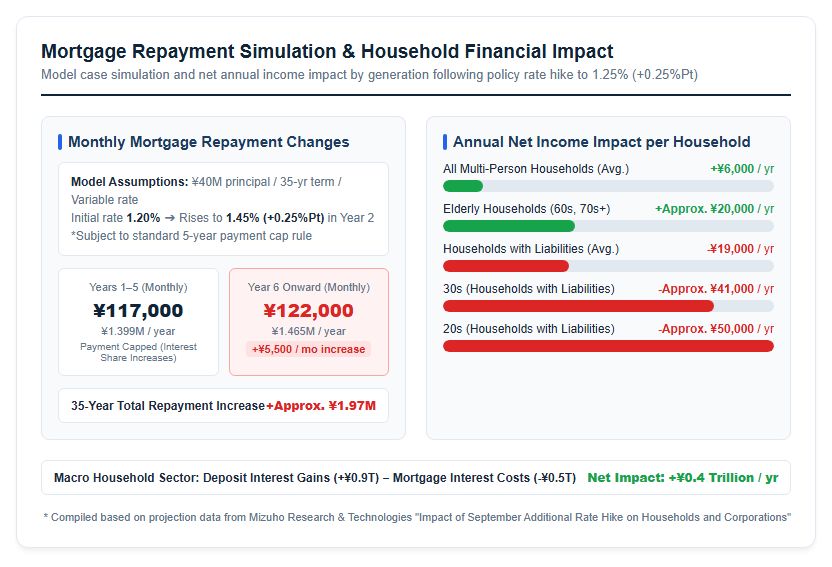
A financial model illustrates the specific shift in repayment burdens. Consider a borrower taking out a ¥40 million, 35-year variable-rate mortgage with principal and interest amortized equally, starting at an initial interest rate of 1.20%, which increases to 1.45% (+0.25 percentage points) in the second year. Under the standard “5-year rule”—which caps monthly payments for five years—monthly repayments remain fixed at ¥117,000 (¥1.399 million annually) for years 1 through 5. However, a larger portion of each payment goes toward interest rather than principal reduction. In year 6, monthly payments adjust upward to ¥122,000 (¥1.465 million annually), representing a monthly increase of approximately ¥5,500 (¥66,000 per year). Over the full 35-year lifespan of the loan, total repayments increase by approximately ¥1.97 million compared to a scenario without rate hikes. Please refer to the diagram below for a visual representation of mortgage repayments.
Higher Deposit Yields and Intergenerational Impact Disparities
Conversely, the policy rate hike brings a positive dimension to households through increased interest income on savings. Ordinary deposit interest rates are anticipated to rise by 0.1 percentage point from 0.4% to 0.5%, while 10-year time deposit rates are expected to increase from 1.98% to 2.13%. On a macro level across all Japanese households, annual deposit interest gains (+¥0.9 trillion) will outweigh the increase in mortgage and debt interest expenses (-¥0.5 trillion), resulting in a net positive economic impact of approximately ¥0.4 trillion per year. For multi-person households, this translates to an average net gain of roughly ¥6,000 per year.
However, this aggregate figure masks severe disparities across age demographics and debt holdings. Older households in their 60s and 70s or above, who have accumulated significant financial assets, stand to benefit substantially, gaining around ¥20,000 annually in interest income. In stark contrast, households carrying liabilities face an average annual loss of approximately ¥19,000. Broken down by age group, households in their 20s face an average annual burden increase of ¥50,000, while those in their 30s incur an added cost of ¥41,000. Rising borrowing costs thus disproportionately squeeze the disposable income of younger families and homebuyers who took on substantial debt during the ultra-low interest rate era.
Corporate Performance Effects and Outlook for the Japanese Economy
Rising Debt Service Costs and Earnings Squeeze for Businesses
The additional monetary tightening directly impacts corporate financial management by raising debt financing costs. Across all business sizes and non-financial industries, higher interest rates are projected to reduce corporate ordinary profits by 0.4%, exerting an aggregate annual earnings drag of approximately ¥0.5 trillion. Large enterprises capitalized at ¥1 billion or more experience a modest profit reduction of 0.2%, whereas small businesses capitalized under ¥10 million face a steep 2.8% profit decline. Smaller companies generally generate lower profit margins relative to their outstanding debt, leaving them far more vulnerable to rate hikes.
According to private research firm estimates, the average corporate borrowing rate reached 1.34% in fiscal 2025, hitting a six-year high. A further 0.25 percentage point rate increase across approximately 168,000 debt-carrying firms nationwide would generate an average annual interest expense increase of ¥460,000 per company, depressing ordinary profits by an average of 1.9%. Consequently, an estimated 2,700 companies (1.6% of the total) are expected to fall from profitability into net operating losses. The real estate sector, burdened by heavy leverage, will be hardest hit, facing an average annual interest burden increase of ¥2.3 million per firm and a 5.4% reduction in ordinary profits.
Medium-to-Long-Term Economic Outlook in a Rising Interest Rate Environment
Regarding the future path of monetary policy, leading economists anticipate that the BOJ will raise the policy rate to 1.5% at its December 2026 meeting, followed by an increase to 1.75% in the first quarter of 2027, before pausing to evaluate broader economic conditions. Should elevated inflation persist, the terminal rate could eventually be pushed to 2.0% or above 2.5%. As the reality of a “world with interest rates” takes hold, the central question is whether the Japanese economy can sustain resilient growth.
To navigate this transition over the medium to long term, corporations must enhance capital efficiency, boost return on invested capital (ROIC), and strengthen profitability through appropriate cost pass-throughs. For households, economic stability hinges on whether wage growth can consistently outpace rising mortgage repayments and living expenses. While substantial base-pay increases have continued since 2025, prolonged inflation and rate hikes risk dampening consumer spending. Public and private sector cooperation in facilitating fair price transfers and embedding wage increases will be crucial to building structural resilience against rising interest rates.
Reference Pages
- 【Bank of Japan】https://www.boj.or.jp/
- 【Japan Housing Finance Agency】https://www.flat35.com/lp/kinri/index.html
【#BankOfJapan #PolicyRate #InterestRateHike #MortgageRates #JapaneseEconomy #CorporateManagement】
コメント