Although the Bank of Japan raised its policy interest rate to 1.25% on September 18, 2026, the market exhibited a paradoxical reaction, with the Nikkei 225 surging and the yen weakening further. This counterintuitive movement was driven by the market having fully priced in the rate hike in advance, alongside a sense of relief following Governor Kazuo Ueda’s cautious stance against rushing into consecutive rate increases.
- Raising the Policy Rate to 1.25% and the Background Behind the Decision
- The Mechanism Behind the Simultaneous Stock Surge and Yen Depreciation
- Global Central Bank Trends and Interest Rate Differential Dynamics
- Crossing the Neutral Rate Threshold and Spillovers to Financial Institutions and the Real Economy
- The Dawn of Corporate and Household Selectivity Under Rising Borrowing Costs
- Fiscal Risks and the Outlook for the Price-Wage Dynamics
- Policy Trajectory Scenarios and Key Economic Indicators to Watch
Raising the Policy Rate to 1.25% and the Background Behind the Decision
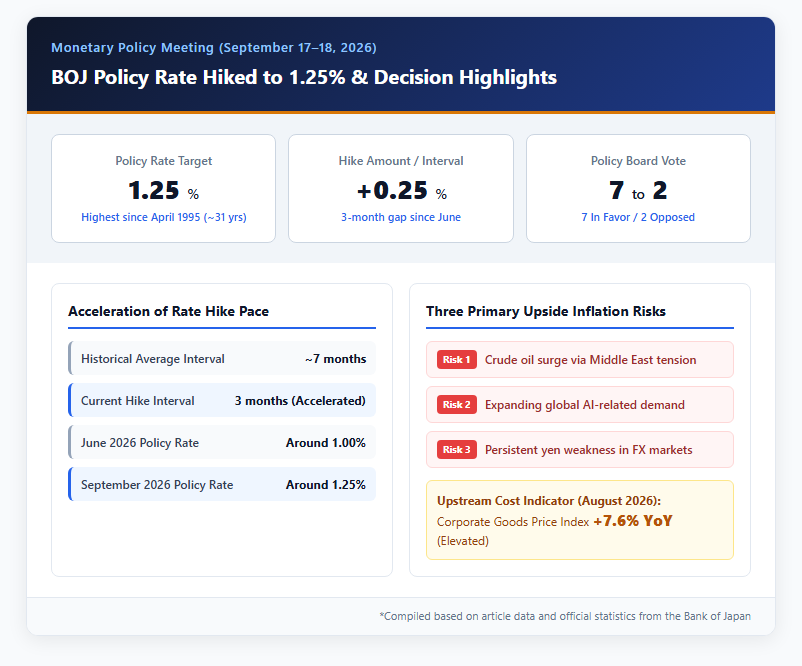
During its Monetary Policy Meeting held on September 17–18, 2026, the Bank of Japan decided by a majority vote to raise its uncollateralized overnight call rate target by 0.25 percentage points to around 1.25%. This marks the highest policy rate level since April 1995, roughly 31 years ago. Coming just three months after the previous increase to 1.00% in June 2026, this move represents a clear acceleration in policy normalization compared to the historical average interval of approximately seven months between hikes. The decision passed by a 7–2 majority vote. The move was catalyzed by three primary upside inflation risks: a persistent surge in the Corporate Goods Price Index (CGPI), which reached 7.6% year-on-year in August 2026; rising crude oil prices stemming from geopolitical tensions in the Middle East; expanding global demand for artificial intelligence infrastructure; and a weak yen in foreign exchange markets. As underlying inflation approaches the central bank’s 2% target, the BOJ is strengthening its preemptive posture to curb the risk of inflation overshooting.
The Mechanism Behind the Simultaneous Stock Surge and Yen Depreciation
On September 18, 2026, despite the monetary tightening announcement, the Nikkei Stock Average rallied sharply on the Tokyo market, gaining 882.70 yen (+1.38%) to close at 65,018.95 yen. Meanwhile, the yen weakened from the upper 156-yen range to the 157-yen range against the US dollar. The main factor behind this counterintuitive market behavior was that the rate hike had already been almost completely priced in by market participants, with overnight index swap (OIS) markets implying a 99% probability of a hike just prior to the meeting. Furthermore, during his post-decision press conference, BOJ Governor Kazuo Ueda refrained from outlining a specific timetable for subsequent hikes, reiterating that future decisions would depend strictly on economic and price data, which eased market anxieties regarding aggressive consecutive tightening. Notably, the Nikkei’s rise was driven predominantly by a handful of high-priced semiconductor and AI-related stocks. In contrast, the broader Tokyo Stock Price Index (TOPIX) dipped slightly by 3.05 points to 4,091.14. On the TSE Prime Market, decliners (1,003 stocks) outnumbered advancers (511 stocks) by nearly two to one, reflecting a highly selective and fragmented market environment.
Global Central Bank Trends and Interest Rate Differential Dynamics
Looking at global central banks, a synchronized monetary tightening trend is taking shape among major economies. The US Federal Reserve raised the target range for the federal funds rate by 0.25 percentage points to 3.75%–4.00% at its Federal Open Market Committee (FOMC) meeting on September 16, 2026, marking its first rate increase in three years and two months. Similarly, the European Central Bank (ECB) raised its main refinancing rate to 2.65% at its Governing Council meeting on September 10, 2026. Although the BOJ lifted its policy rate to 1.25%, the US-Japan interest rate differential remains substantial at 2.75 percentage points. Furthermore, with Japan’s consumer price index rising 1.9% year-on-year as of August 2026, the real policy rate—calculated as the nominal rate minus inflation—remains in negative territory at -0.65%. The BOJ itself acknowledges that domestic financial conditions remain accommodative. The persistence of this real interest rate gap constitutes a structural barrier preventing any significant appreciation of the yen following rate hikes.
Structural Impacts Brought by Shifting Financial Conditions
Crossing the Neutral Rate Threshold and Spillovers to Financial Institutions and the Real Economy
With the policy interest rate reaching 1.25%, it has officially breached the lower bound of the BOJ’s estimated neutral interest rate range of 1.1% to 2.5%. The neutral rate represents a theoretical level that neither accelerates nor restrains economic growth; crossing its lower threshold signifies that Japan’s monetary policy has stepped out of purely accommodative territory and into a regime that begins to exercise economic restraint. In the banking sector, rising interest rates have expanded net interest margins. During the April–September 2025 interim financial results, core net operating profits among listed regional banks surged by 30% compared to the same period of the previous year. On the other hand, as long-term yields rose—with the 10-year Japanese government bond (JGB) yield briefly touching 3.000%—unrealized losses on yen-denominated bonds held by financial institutions expanded.
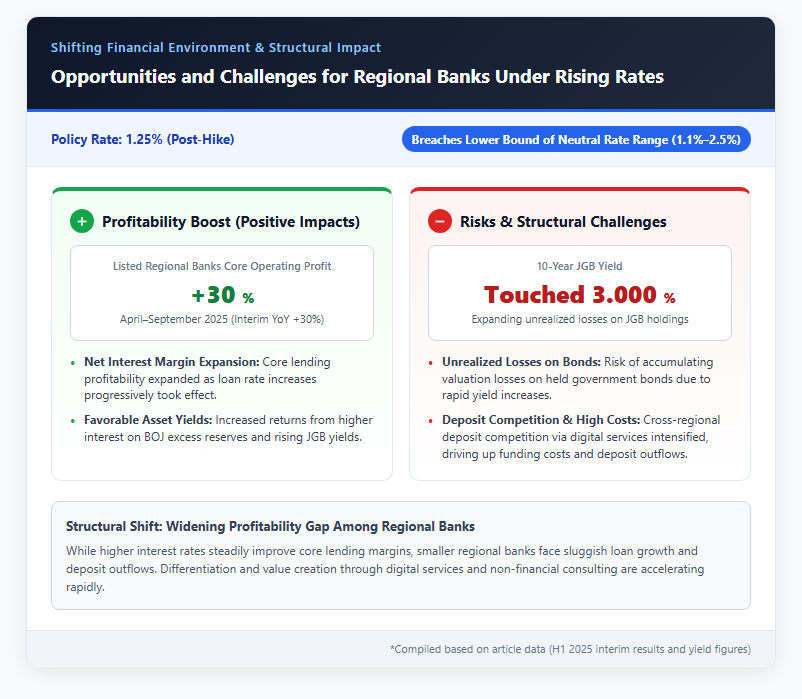
Intense competition for deposits across broader geographical regions using digital services has emerged, widening the profitability gap among regional banks as smaller institutions face rising funding costs and deposit outflows.
The Dawn of Corporate and Household Selectivity Under Rising Borrowing Costs
Higher interest rates are directly affecting both households and corporations. In the mortgage market, major commercial banks have begun raising benchmark floating rates for new borrowers to 3.375%, while fixed mortgage rates have also adjusted upward in line with long-term bond yields. On the household side, although nominal wage growth reached 4.7% year-on-year in July 2026, elevated costs for daily necessities such as energy and food continue to weigh heavily. Real consumer expenditure fell 3.6% year-on-year in the July 2026 Family Income and Expenditure Survey, marking the second consecutive monthly decline. For businesses, higher borrowing costs directly increase interest payment burdens. As the August 2026 CGPI remained elevated at 7.6%, a widening performance gap has emerged between firms capable of passing on higher raw material and labor costs to sales prices and those unable to do so. The prolonged era of zero interest rates, which helped sustain low-margin businesses and financially weak firms, is giving way to intensified corporate restructuring and capital efficiency screening.
Outlook and Key Focus Areas for Future Monetary Policy
Fiscal Risks and the Outlook for the Price-Wage Dynamics
A critical factor shaping the future financial environment is the potential rise in risk premiums driven by fiscal sustainability concerns. As the Japanese government pursues expansionary fiscal initiatives—including strategic sector investments and tax relief measures—the structural primary balance deficit is projected to widen, stoking market anxiety over mounting government debt servicing costs. Some market forecasts suggest 10-year JGB yields could rise toward 3.6%. Meanwhile, a research paper published by the BOJ in August 2026 analyzed how downward nominal wage rigidity during Japan’s deflationary decades led firms to suppress precautionary wage increases, resulting in stagnant real wages and subdued labor mobility. While the recent distribution of wage growth has shifted positively, easing this historical rigidity, the long-term anchor for the Japanese economy hinges on whether a self-sustaining, virtuous cycle between wage increases and moderate inflation can be permanently established.
Policy Trajectory Scenarios and Key Economic Indicators to Watch
The primary scenario for future monetary policy involves a gradual series of rate hikes toward 1.75%–2.00% by 2027, conditioned on confirming steady economic growth and price stability. However, should geopolitical conflicts in the Middle East drive crude oil prices higher or trigger a renewed slide in the yen, underlying inflation could significantly overshoot the 2% target, accelerating the timeline for further hikes. Conversely, if household consumption remains subdued for an extended period, or if rising borrowing costs severely constrain small and medium-sized enterprises and cool the real estate market, a pause in policy tightening cannot be ruled out. In evaluating future policy adjustments, four key indicators will serve as primary benchmarks: international crude oil price trends, USD/JPY exchange rate movements, underlying core CPI trends (excluding fresh food and energy), and the recovery trajectory of real household consumption.
Reference Pages
- [Bank of Japan: Monetary Policy Meetings Schedule and Minutes] https://www.boj.or.jp/mopo/mpmsche_minu/index.htm
- [Bank of Japan: Corporate Goods Price Index Releases] https://www.boj.or.jp/statistics/pi/cgpi_release/index.htm
- [Ministry of Internal Affairs and Communications: Consumer Price Index] https://www.stat.go.jp/data/cpi/
- [Cabinet Office: Quarterly GDP Statistics] https://www.esri.cao.go.jp/jp/sna/menu.html
- [Ministry of Internal Affairs and Communications: Family Income and Expenditure Survey] https://www.stat.go.jp/data/kakei/
- [Japanese Trade Union Confederation (RENGO): 2026 Spring Wage Negotiations] https://www.jtuc-rengo.or.jp/
- [Bank of Japan Working Paper: “What Prevents Productivity Gains from Translating into Wages”] https://www.boj.or.jp/en/research/wps_rev/wps_2026/wp26e12.htm
【#BankOfJapan #InterestRateHike #MonetaryPolicy #JapaneseEconomy #ForeignExchange #Mortgages #StockMarket #RatesWorld】


コメント