Shimizu Corporation, in joint development with Oji Holdings, has introduced “KAMIWAZA,” a temporary construction solution utilizing paper and corrugated cardboard. This innovative initiative is attracting widespread attention as a key response to critical social challenges in the construction industry, including severe labor shortages and the demand for reduced environmental impact.
- Development of Cardboard-Based Construction Technology and Overview
- Dramatic Operational Efficiency and Cost Reduction in Mountain Tunnels
- Addressing Labor Shortages and the “2024 Problem”
- Decarbonization Demands and Environmental Impact Reduction (GX)
- Applications in Air Ducts and Diverse Job Site Solutions
- Future Technical Rollout and Ripple Effects Across the Construction Sector
Development of Cardboard-Based Construction Technology and Overview
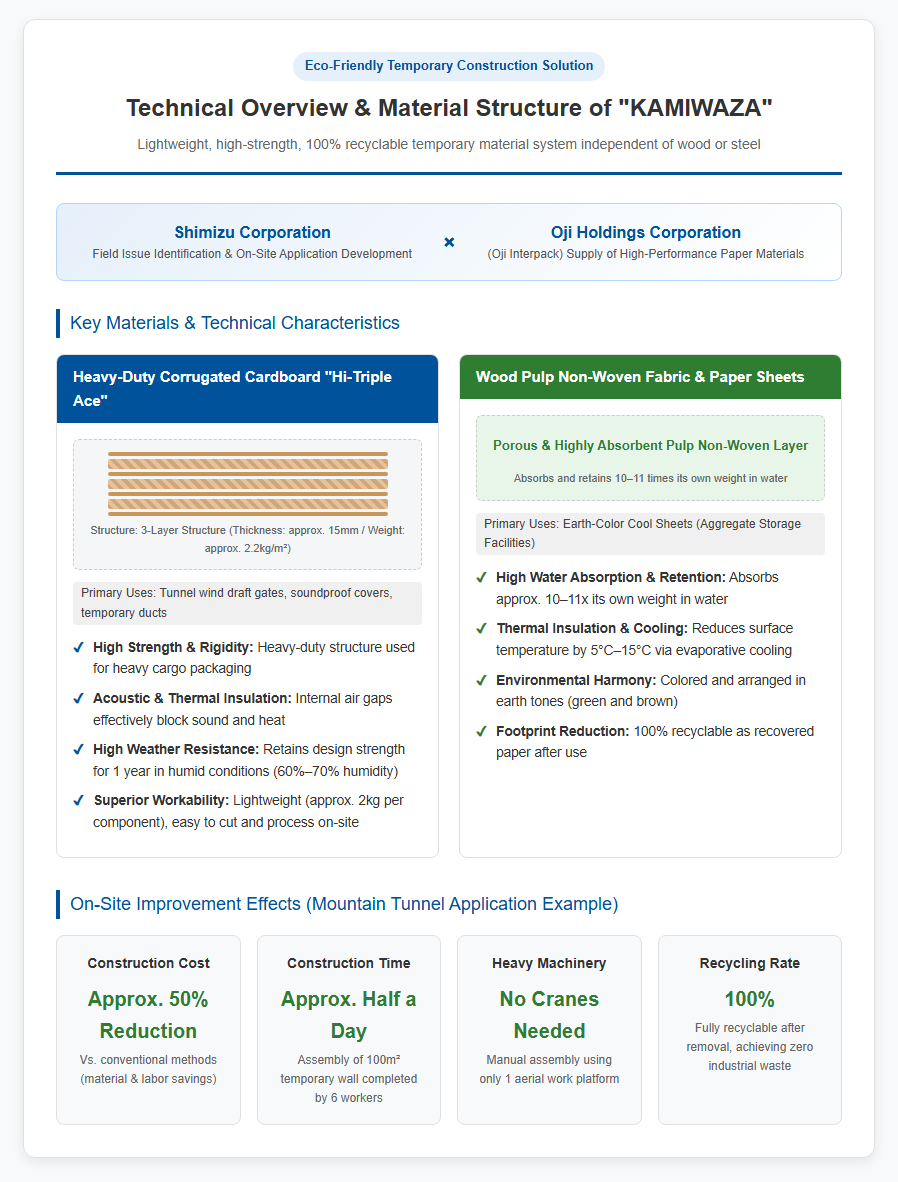
Shimizu Corporation (President: Kazuyuki Inoue) jointly developed “KAMIWAZA,” a technology that utilizes lightweight and easily workable paper materials for temporary structures in civil engineering and building construction sites, in collaboration with Oji Holdings Corporation (President: Masatoshi Kaku), officially announcing it on August 27, 2019. The technology primarily utilizes “Hi-Triple Ace,” a heavy-duty triple-wall corrugated cardboard manufactured by Oji Interpack Co., Ltd. of the Oji Holdings Group, alongside paper-based sheet materials. Hi-Triple Ace features a three-layer cardboard structure combining exceptional shock absorption and structural strength, while its internal air gaps provide thermal insulation and soundproof properties. Traditionally, steel and timber have been widely used as temporary materials on construction sites, but their heavy weight demanded immense labor for transportation and assembly. Replacing these heavy materials with easy-to-handle paper materials significantly reduces physical strain on site workers and dramatically improves temporary construction productivity. Practical implementation is currently progressing as a novel construction approach that directly contributes to achieving the SDGs. For a technical overview and material structure of KAMIWAZA, please refer to the diagram below.
Dramatic Operational Efficiency and Cost Reduction in Mountain Tunnels
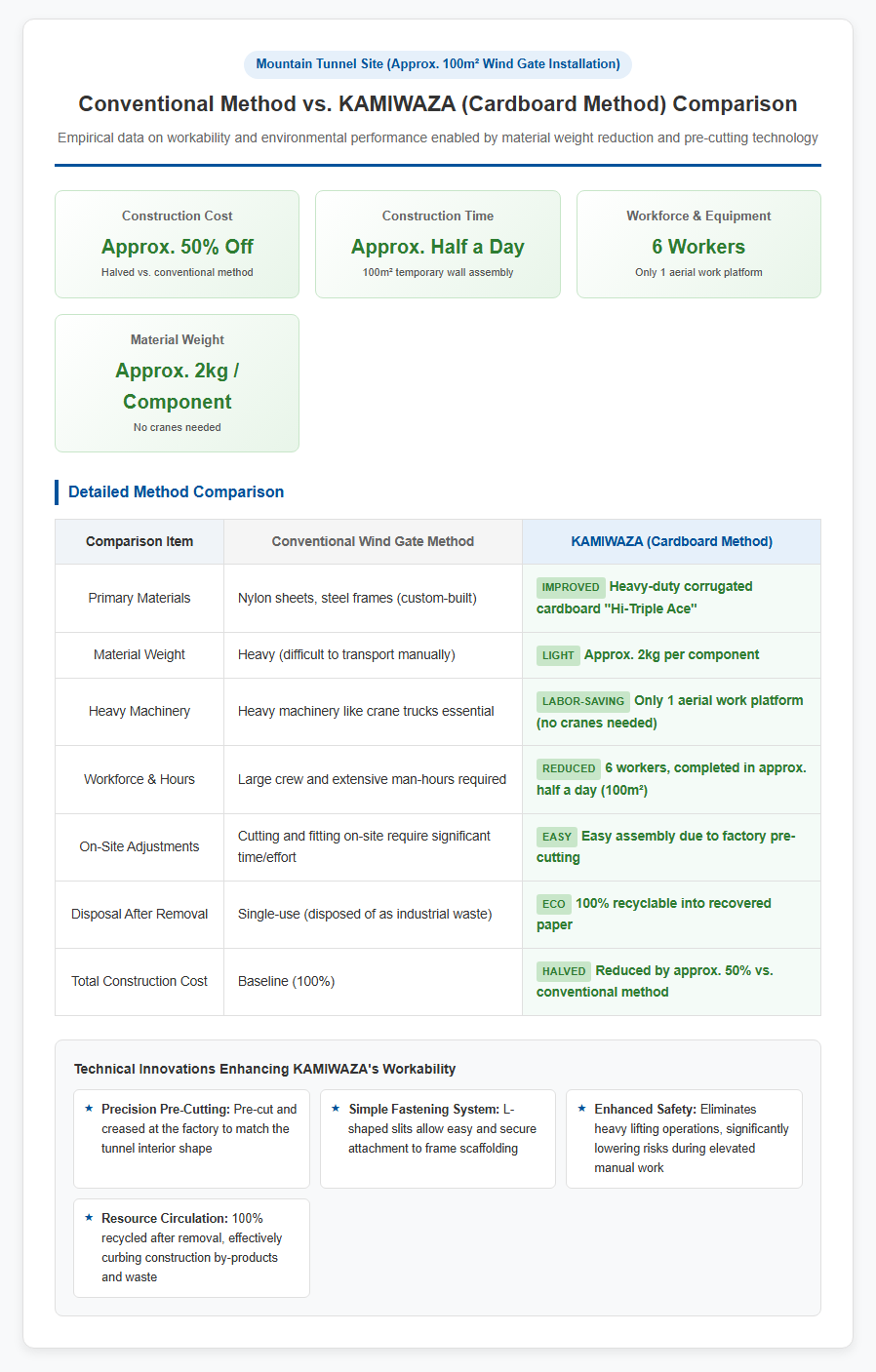
A prime example of KAMIWAZA’s real-world field application is the “tunnel wind draft gate,” a wind-shielding barrier installed inside mountain tunnels. In mountain tunnel excavation, strong air currents that occur after a tunnel breaks through accelerate the drying of lining concrete, causing surface cracks; thus, wind draft gates are essential. Conventional wind gate installation required heavy machinery such as crane trucks to install nylon sheets and steel frames, demanding a large workforce and extensive man-hours. Furthermore, custom barriers had to be fabricated to fit the specific shape of each tunnel, only to be disposed of as industrial waste after removal. In contrast, by using heavy-duty corrugated cardboard precisely pre-cut at the factory, individual components weigh only about 2 kg, completely eliminating the need for heavy machinery like cranes. Using just one aerial work platform and a crew of six workers, a temporary wall covering approximately 100 square meters was assembled in only about half a day. Factory pre-cutting simplified site assembly and adjustments, and because the material can be 100% recycled into paper resources after dismantling, total construction costs were cut nearly in half compared to traditional methods. For details on the mountain tunnel installation, please refer to the diagram below.
Social Background Facing the Construction Industry and Rationale for Development
Addressing Labor Shortages and the “2024 Problem”
The construction industry is facing a rapidly worsening labor shortage driven by the aging skilled workforce and a decline in young entrants. Compounding this challenge is an urgent need to comply with tightened labor regulations, notably the cap on overtime hours known as Japan’s “2024 Problem.” Labor-saving measures at job sites, shorter work hours, and the mitigation of workers’ physical burdens have become top-priority issues for construction firms. In Shimizu Corporation’s Mid-Term Management Plan <2024–2026>, the company established “Strengthening the Management Base for Sustainable Growth” as its core policy, actively promoting an attractive workplace where diverse talent can thrive, alongside productivity gains achieved through ICT and advanced technologies. Introducing lightweight materials like KAMIWAZA reduces hazards associated with operating heavy machinery and moving heavy loads, thereby enhancing safety during high-altitude work. Improved operational efficiency also helps secure proper construction schedules—such as 8 site closures every 4 weeks—and enhances work-life balance, significantly boosting the overall appeal of the construction industry.
Decarbonization Demands and Environmental Impact Reduction (GX)
In recent years, while material and energy prices remain persistently high, global inflationary trends and demands for environmental protection (GX: Green Transformation) have continued to intensify. Reducing construction by-products and industrial waste generated during building operations represents a critical imperative for society as a whole. Conventional metal and wooden temporary materials are frequently discarded as waste after removal, raising concerns regarding disposal costs and environmental footprint. The paper materials used in KAMIWAZA, however, can be collected after use and 100% recycled into recovered paper, effectively suppressing waste generation at the source. Moreover, their lightweight nature decreases fuel consumption for dump trucks and heavy machinery during transport, leading to reduced CO2 emissions during transit. Thanks to these outstanding environmental attributes and contributions to solving societal issues, KAMIWAZA earned the JSCE (Japan Society of Civil Engineers) Environmental Award for FY2020 and the Special Committee Award at the 49th Japan Industrial Technology Awards.
Expansion to Temporary HVAC and Various Construction Operations
Applications in Air Ducts and Diverse Job Site Solutions
The insights and superior characteristics of paper materials gained through KAMIWAZA extend far beyond tunnel wind gates, seeing widespread application across building construction and civil engineering projects. At building sites and temporary event structures, lightweight and easily processed cardboard air ducts (the Cardboard Duct Method) have been adopted, reducing on-site cutting waste and facilitating post-dismantling recycling. Furthermore, soundproofing enclosure technology leveraging the acoustic insulation of heavy-duty corrugated cardboard has been developed. When applied to combat intense noise generated by hydraulic hammer pile-driving, enclosing component covers made of heavy-duty cardboard reduced noise levels by approximately 5 dB, with a notable reduction of up to 9 dB achieved in the general conversational frequency band (1 kHz to 4 kHz). In addition, at aggregate storage facilities for dam construction, installing paper-based “Earth-Color Cool Sheets” suppressed temperature rises caused by direct sunlight, demonstrating a wide array of job site solutions that harness paper’s thermal insulation and water-retention properties.
Future Technical Rollout and Ripple Effects Across the Construction Sector
Under its “Beyond Construction” mindset, Shimizu Corporation intends to continually expand the field deployment of human- and eco-friendly temporary construction technologies centered on KAMIWAZA. Born out of open innovation and co-creation with a papermaking manufacturer from a different industry, this technology serves as an exemplary model of innovation in the construction sector beyond simple cost savings. Combined with construction site digitization (DX) and sustainability management, it holds the potential to fundamentally redefine the concept of temporary works. Moving forward, horizontal expansion into areas such as temporary HVAC equipment and interior protective materials at building construction sites is eagerly anticipated. The fusion of traditional construction expertise with cutting-edge paper material technology is expected to drive powerful momentum toward establishing a truly sustainable construction industry.
Reference Pages
- [Applying Human- and Eco-Friendly Temporary Materials to Civil Engineering Sites | Shimizu Corporation News Release] https://www.shimz.co.jp/company/about/news-release/2019/2019014.html
【#ShimizuCorporation #KAMIWAZA #ConstructionDX #TemporaryMaterials #EnvironmentalTechnology #LaborSaving #SDGs】

コメント