Shimizu Corporation and University of Tokyo-based AI startup Akari Corporation have jointly developed a system to automate and optimize access road design for onshore wind power plants in mountainous areas. To accelerate renewable energy development under Japan’s harsh terrain conditions, they have succeeded in algorithmizing the expertise of skilled technicians and reducing design time to one-tenth of the conventional level.
- Announcement of joint development by Shimizu Corporation and Akari
- Efforts to digitize the expertise of skilled technicians
- A dramatic achievement that reduced design time to one-tenth
- Challenges Toward Carbon Neutrality 2050
- Bottlenecks in ‘Access Roads’ in Mountain Development
- The Role of AI Startup Lights
- Optimal balance between minimizing soil volume and shortest routes
- Human route consideration through “grouping”
- Accelerating digital strategy in the medium-term management plan
- Spillover effects on productivity improvements across the construction industry
Announcement of joint development by Shimizu Corporation and Akari
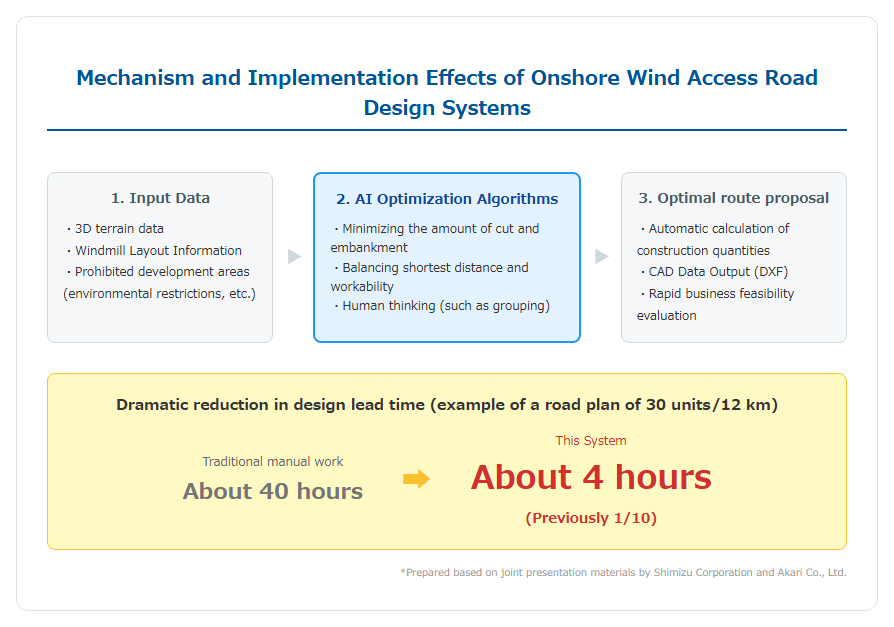
On July 21, 2026, major general contractor Shimizu Corporation and University of Tokyo-based AI startup Akari Corporation announced the development of the “Onshore Wind Access Road Design System,” which automates and optimizes the design of access roads in mountainous areas associated with onshore wind power plant construction. This system aims to shorten the design period of wind power facilities and improve business profitability, achieving optimal route setting in complex mountainous terrain using advanced AI technology. Shimizu Corporation had been developing this system for some time, and by linking with Akari, which has proprietary AI technology, they strengthened the implementation of optimization algorithms that process vast amounts of data at high speed. Please refer to the diagram below.
Efforts to digitize the expertise of skilled technicians
Traditionally, access road design in mountainous areas has been intricately intertwined with terrain, environmental constraints, and construction costs, so experienced and skilled technicians have spent vast amounts of time manually doing the work. The process of comparing multiple route proposals while considering contour lines on topographic maps, distances from main roads, geological conditions, and so on, heavily relied on individual skills. The new system incorporates the thought processes of these skilled professionals into its algorithms, enabling instant calculation and analysis of construction quantities such as soil volume. This created an environment where anyone could create highly accurate design proposals without relying on any specific individual.
A dramatic achievement that reduced design time to one-tenth
To verify the performance of the developed system, simulations were conducted using actual projects previously designed and constructed by Shimizu Corporation. As a result, the plan to connect 30 wind turbines with an approximately 12-kilometer access road was completed in just about 4 hours, which previously took about 40 hours. This means the working time has been reduced to about one-tenth. The derived route proposals closely resemble those actually devised by experienced designers, proving that AI-driven automatic design is sufficiently applicable at the practical level. Because many patterns can be tried in a short period, flexible planning changes in the early stages of the business can be quickly adapted.
Japan’s Geographical Constraints and Development Background
Challenges Toward Carbon Neutrality 2050
Expanding the introduction of renewable energy is an unavoidable challenge in achieving the Japanese government’s goal of “carbon neutrality by 2050.” In particular, onshore wind power is a key sector expected to continue growing as a stable source of electricity supply. However, since Japan is small and there is little flatland already developed, future new business candidates will inevitably be in rugged mountainous areas. Development in mountainous areas requires not only efficient wind turbine placement but also access roads for transporting construction materials and heavy machinery, which is a major factor directly affecting the overall cost and environmental impact of the project.
Bottlenecks in ‘Access Roads’ in Mountain Development
When evaluating the profitability of wind power projects, the route setting of access roads is an extremely important factor. This is because the amount of cut and embankment varies greatly depending on the road alignment, which in turn leads to increased construction costs and longer construction periods. Additionally, for mountain development, areas often have designated prohibition zones for environmental protection, and navigating these constraints while taking an economically viable route required considerable effort. With traditional design methods, every time the wind turbine layout was changed, the road design had to be redone, which became a bottleneck slowing down the pace of project feasibility evaluation. This system development aims to solve these on-site challenges using IT technology.
The Role of AI Startup Lights
Akari Inc., which partnered with Shimizu Corporation for this system development, is an AI startup originating from the University of Tokyo specializing in promoting DX in the construction industry. The company has strengths in highly specialized AI applications, such as offering “AKARI Construction LLM,” which specializes in large language models (LLMs) for construction industry data. The technology that converts complex drawings and numerical data unique to the construction industry, as well as tacit knowledge unique to the site, into a format that AI can understand, is being utilized in algorithms that derive optimal routes for access roads. The co-creation between a general contractor with a traditional company and a startup equipped with cutting-edge AI technology represents a new model case for improving productivity across the entire construction industry.
Proprietary algorithm that replicates the thinking of experienced professionals
Optimal balance between minimizing soil volume and shortest routes
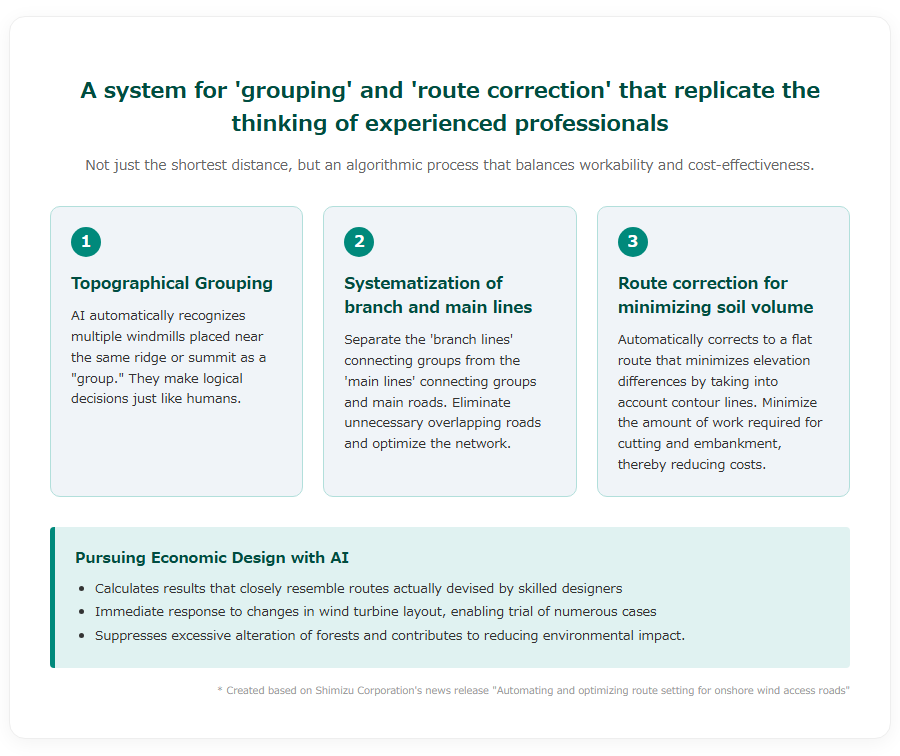
The algorithm, the heart of the system, does more than just connect the shortest route to the destination. It analyzes terrain data in detail and automatically corrects routes with minimal elevation differences and minimal cuts and embankments. Reducing the amount of soil directly linked to construction costs not only improves the profitability of the project but also serves as an environmental consideration by avoiding excessive alteration of the forest. The system calculates to avoid steep slopes and minimize the need to fill valleys or carve mountains. This made it possible to extract routes that highly balanced constructability and economic efficiency.
Human route consideration through “grouping”
Another notable feature of the new system is that it can simulate human-like logical thinking, rather than just a simple route setup. For example, if multiple nearby wind turbines are placed along the same mountain ridge, the system recognizes them as a single group. First, a branch line connecting windmills within the group is set, and on top of that, a main road connecting mountains or mountains and main roads is designed, systematically constructing routes. This “grouping” function avoids unnecessary road overlap and automatically generates a rational and natural road network that satisfies on-site technicians. Please refer to the diagram below.
Future Developments and Contribution to a Decarbonized Society
Accelerating digital strategy in the medium-term management plan
Shimizu Corporation has set the basic policy of “strengthening the management foundation for sustainable growth” in its medium-term management plan from 2024 to 2026, and as one of its pillars, it is promoting the evolution into a “digital general contractor.” This system development perfectly aligns with this strategy and is a case study that embodies productivity improvements through the use of ICT and AI. With a history of over 220 years, the company focuses on technological development beyond existing boundaries and co-creation with external partners under a new mindset of “super construction.” The onshore wind access road design system is expected to become a powerful tool for future infrastructure upgrades and enhancing competitiveness in the renewable energy sector.
Spillover effects on productivity improvements across the construction industry
The optimization algorithm developed this time can be applied not only to wind power plant access road design but also to any large-scale development project. For example, applications are being considered for various civil engineering projects involving cutting and embankment, such as setting pilot road routes in road construction and creating industrial parks with vast sites. The construction industry is facing a severe shortage of personnel, making it urgent to pass on knowledge to younger employees and improve operational efficiency. AI-based design support systematizes the skills of skilled professionals, enabling even less experienced engineers to produce high-quality outputs and contributing to raising the overall level of the industry. Through this initiative, Shimizu Corporation and Akari plan to contribute to the realization of a sustainable society and the further development of the construction industry.
Reference Page
-
[Automating and Optimizing Route Setting for Onshore Wind Access Roads | Company Information – Shimizu Corporation]https://www.shimz.co.jp/company/about/news-release/2026/2026008.html
-
[Shimizu Corporation and Akari develop an ‘Onshore Wind Access Road Design System’ to automate and optimize route setting for access roads in wind power plant construction | Akari Co., Ltd. Press Release – PR TIMES] https://prtimes.jp/main/html/rd/p/000000068.000083531.html
-
[Medium-Term Management Plan (2024-2026) – Shimizu Corporation] https://www.shimz.co.jp/company/ir/management/plan.html
[#清水建設 #燈株式会社 #風力発電 #AI #建設DX #再生可能エネルギー #カーボンニュートラル #土木技術]


コメント