Japan’s Ministry of Land, Infrastructure, Transport and Tourism (MLIT) has designated 29 ports across the nation as “Circular Economy Ports” for the first time. This initiative aims to establish a nationwide resource circulation network going beyond traditional waste management, while boosting logistics efficiency through a shift to maritime transport.
- Selection Overview of the First 29 Designated Ports and Policy Objectives
- Transition from Traditional Recycle Ports and Strategic Significance
- The “Logistics 2024 Problem” and the Urgent Need for a Modal Shift to Maritime Freight
- Surge of Waste in Decarbonization and Carbon-Neutral Sectors
- Regional Strengths and Case Studies: Kitakyushu Port’s Pioneering Initiatives
- Public-Private Collaboration, Future Expansion, and Critical Challenges
Selection Overview of the First 29 Designated Ports and Policy Objectives
On August 27, 2026, the Ports and Harbours Bureau of Japan’s Ministry of Land, Infrastructure, Transport and Tourism (MLIT) designated 29 ports across the country as “Circular Economy Ports” for the first time, aiming to build a wide-area logistics network and foster a cluster of advanced recycling industries for a circular economy. Following a comprehensive review of applications submitted by port managers nationwide, all 29 ports were confirmed to meet the rigorous selection criteria. These criteria evaluated historical track records and future business plans regarding recyclable resource handling, the presence of advanced sorting and recycling facilities, capability to handle small-lot and diverse recyclable resources, and inter-port cooperation frameworks. Moving significantly beyond traditional localized waste disposal, this policy framework seeks to aggressively promote resource collection, reuse, and recycling on both the supply and demand sides, simultaneously reducing environmental impact and curbing the consumption of virgin natural resources. MLIT positions these designated ports as core resource circulation hubs for local communities and industrial sectors, backing the creation of a broad logistics system integrated seamlessly across port authorities, recycling companies, logistics operators, and relevant government ministries.
Transition from Traditional Recycle Ports and Strategic Significance
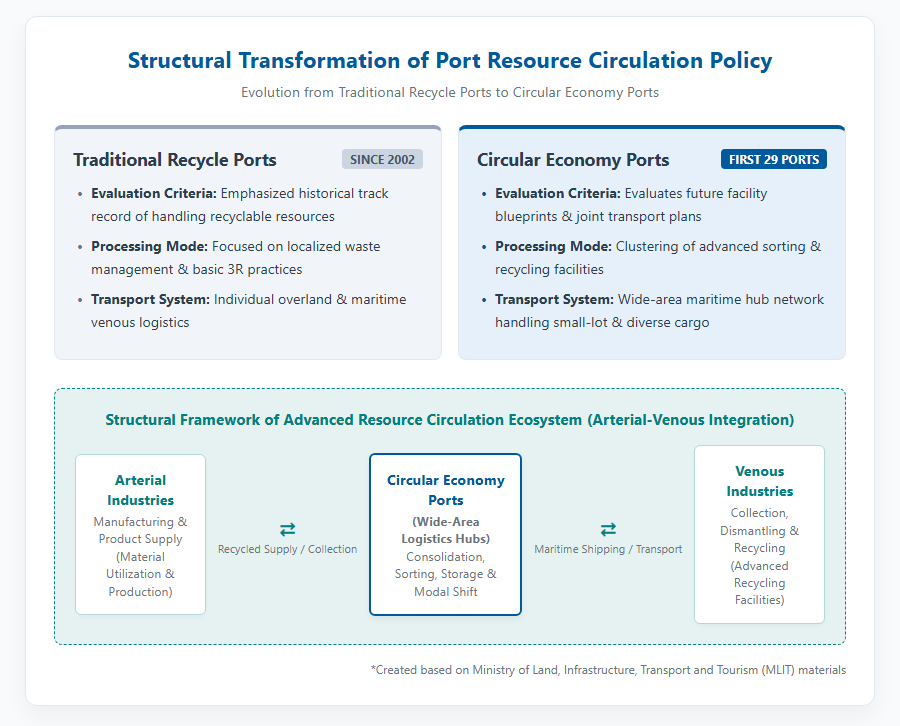
Since around 2002, Japan has designated “Recycle Ports” (Comprehensive Venous Logistics Hub Ports) to construct port-centered waste and recycling logistics systems. However, with the global transition toward a circular economy prioritizing product longevity and reuse alongside Green Transformation (GX) initiatives for a decarbonized society, the volume and diversity of recyclable resources needing handling have surged dramatically. While former policies heavily weighted historical throughput performance, the new Circular Economy Port system sets itself apart by placing high value on forward-looking, concrete facility development blueprints and collaborative transport plans among multiple ports. The strategic objective is to deepen organic ties between arterial industries (manufacturing) and venous industries (waste management and recycling), cultivating an advanced resource circulation ecosystem directly in coastal zones rather than relying on simple end-of-life recycling. The complete structural framework of these interconnected policies is illustrated in the diagram below.
Social Background and Logistics Challenges Accelerating Port Designation
The “Logistics 2024 Problem” and the Urgent Need for a Modal Shift to Maritime Freight
A major driver behind these port designations is the pressing “Logistics 2024 Problem” stemming from a severe shortage of truck drivers. As long-haul trucking capacity declines, maintaining traditional overland logistics networks for venous freight—such as industrial waste and recyclable resources—has become increasingly unsustainable. In response, there is an urgent need to promote a modal shift toward domestic maritime shipping, which offers high-volume transport capacity with significantly lower carbon dioxide emissions. Establishing Circular Economy Ports allows small-lot, highly diverse recyclable materials to be consolidated into containerized cargo, creating efficient maritime transport routes serviced by scheduled container ships, ferries, and bulk carriers. This strategic transition prevents supply chain bottlenecks in recycling streams while simultaneously achieving decarbonization and environmental burden reduction across the entire transport process.
Surge of Waste in Decarbonization and Carbon-Neutral Sectors
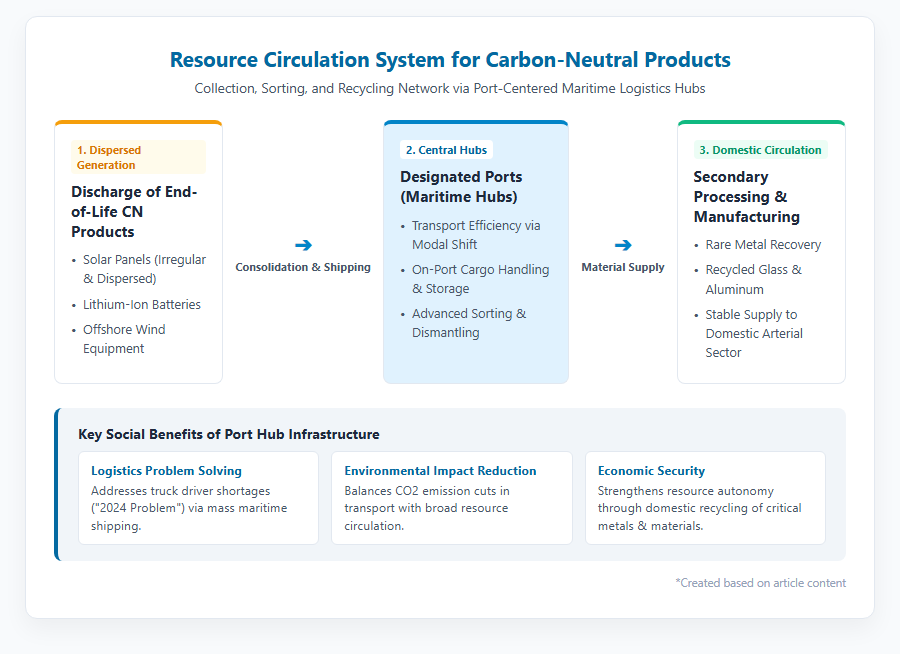
In recent years, the rapid adoption of renewable energy technologies has brought another critical challenge to the forefront: the future mass disposal of carbon-neutral equipment, including end-of-life solar panels, lithium-ion batteries, and offshore wind turbine components. Solar panels present a particularly complex problem, as their decommissioning occurs at irregular times, unpredictable locations, and scattered quantities across the country. Efficiently collecting and processing these items requires maritime logistics hubs located at ports, where materials can be sorted, consolidated, and supplied to secondary processing facilities and material manufacturers. Equipping ports with advanced recycling technology and specialized cargo-handling equipment will streamline the recovery of rare metals and critical materials for domestic circular use, directly bolstering Japan’s economic security. An overview of this wide-area resource circulation framework is shown in the following diagram.
Advanced Regional Examples, Future Outlook, and Key Issues
Regional Strengths and Case Studies: Kitakyushu Port’s Pioneering Initiatives
Among the newly designated locations, Kitakyushu Port and Miike Port were selected as the only two ports in the Kyushu region. Kitakyushu Port stands out for its well-developed infrastructure, including public wharves capable of handling diverse industrial waste, bulk cargo terminals, and container/ferry terminals designed for smooth multimodal transport of recyclable resources. In recent years, Kitakyushu Port’s annual throughput of recyclable resources has exceeded 2 million tons—nearly quadrupling from its level when first designated as a Recycle Port in 2002—and solidifying its expanded role as a major arterial-venous logistics hub. Furthermore, the city of Kitakyushu hosts a dense concentration of manufacturing and recycling industries capable of absorbing recovered materials, with future demand expected to grow as local steelmakers transition to electric arc furnaces. This close integration between port infrastructure and hinterland industrial clusters serves as a primary model for Circular Economy Ports nationwide.
Public-Private Collaboration, Future Expansion, and Critical Challenges
To maximize the operational efficacy of Circular Economy Ports, MLIT is actively supporting the development of port-based storage and handling facilities for recyclable cargo. Furthermore, under the Ministry of the Environment’s “Supply Chain Construction Support Business for Secondary Materials,” government subsidies for port-side cargo handling equipment will grant bonus evaluation points to projects located at designated Circular Economy Ports, establishing a robust cross-ministry support framework. Looking ahead, key challenges include establishing robust traceability to track resource flows transparently, formulating standardized handling guidelines at ports, and adopting objective evaluation metrics to guard against greenwashing. Beyond physical infrastructure development, building a transparent, sustainable national resource circulation network will require rigorous quantitative assessments, such as Life Cycle Assessments (LCA), to verify real environmental impacts.
Reference Pages
- 【Ministry of Land, Infrastructure, Transport and Tourism Press Release】https://www.mlit.go.jp/report/press/port06_hh_000339.html
- 【Ministry of Land, Infrastructure, Transport and Tourism Policy Information】https://www.mlit.go.jp/kowan/kowan_fr6_000007.html
【#MLIT #CircularEconomy #CircularEconomyPort #VenousLogistics #ModalShift #ResourceCirculation #EnvironmentalPolicy】


コメント