Following the finalization of guilty verdicts in the bid-rigging scandal surrounding the Chuo Shinkansen maglev construction project, Kajima Corporation and Taisei Corporation have decided to self-impose a suspension of executive duties and major participation in industry organizations such as the Japan Federation of Construction Contractors. This judicial conclusion casts a heavy shadow over the leadership of top industry bodies and the future of corporate compliance reform.
- Overview of Voluntary Suspensions Following Final Guilty Verdicts
- Severe Repercussions for Industry Association Operations and Leadership Succession
- An 8-Year Legal Battle and the Divergent Fates of the Top Four Contractors
- Core Legal Arguments and the Rejection of “Technical Discussions”
- Client In-Sourcing and the Pitfalls of Unpaid “Soft Fees”
- Future Reforms Toward True Fair Competition and Industry Outlook
Overview of Voluntary Suspensions Following Final Guilty Verdicts
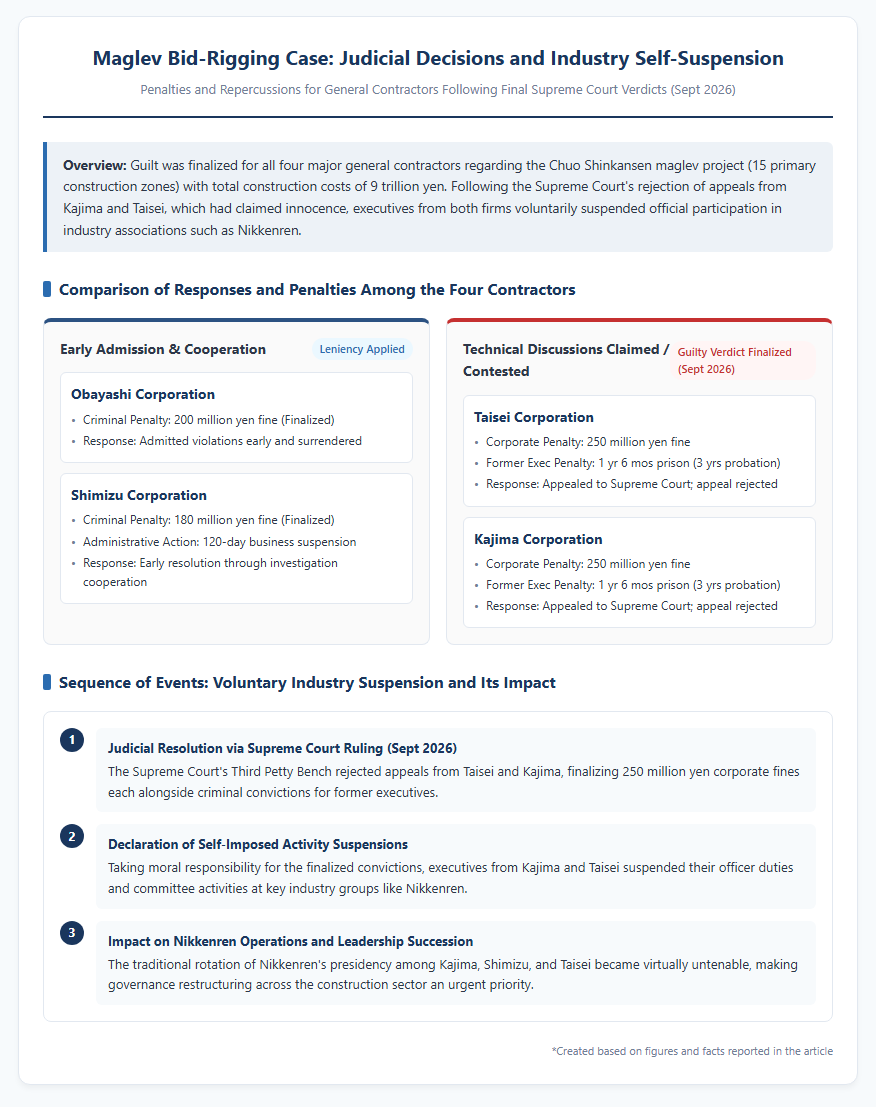
Following the final confirmation of guilty verdicts for antitrust violations surrounding the Chuo Shinkansen maglev construction project commissioned by JR Tokai (Central Japan Railway Company), Kajima Corporation and Taisei Corporation have stepped forward to suspend their official activities within key industry organizations. In September 2026, the Third Petty Bench of the Supreme Court (Presiding Judge Eriko Watanabe) rejected the appeals of both companies and their former executives, finalizing lower court rulings that imposed fines of 250 million yen each on Kajima and Taisei as corporate entities. Taking moral responsibility to prevent further loss of public trust in the construction sector, executives from both firms are stepping back from leadership roles and committee activities at major industry bodies, including the Japan Federation of Construction Contractors (Nikkenren). The exposure of misconduct in a massive national project valued at a total construction cost of 9 trillion yen extends far beyond individual corporate ethics, instilling deep public distrust toward the self-governance of the entire industry. Below is an illustration representing the response of these industry associations.
Severe Repercussions for Industry Association Operations and Leadership Succession
The Japan Federation of Construction Contractors (Nikkenren), regarded as the industry’s flagship organization, comprises major players—including “super general contractors” with annual revenues exceeding 1 trillion yen—and plays a pivotal role in lobbying government agencies and establishing industry guidelines. Historically, the presidency of Nikkenren has followed a longstanding tradition of rotating among three Tokyo-based super general contractors: Kajima Corporation, Shimizu Corporation, and Taisei Corporation. However, criminal penalties (including 1-year-and-6-month prison sentences suspended for 3 years) handed down to former executives of core members Kajima and Taisei, alongside final corporate fines, have made maintaining this rotation virtually impossible. Combined with the fallout for Obayashi Corporation and Shimizu Corporation—which admitted violations early under plea bargains—the forced retreat of major firms from active participation has plunged Nikkenren’s operations and next-generation leadership planning into deep confusion. Amid urgent calls for strict compliance, the foundational nature of industry leadership is being fundamentally reexamined.
The Full Picture of the Maglev Bid-Rigging Case and Judicial Rulings
An 8-Year Legal Battle and the Divergent Fates of the Top Four Contractors
The investigation into the maglev bid-rigging scandal began in March 2017 with an inquiry by the Fair Trade Commission (FTC) and escalated in December of that year when the Tokyo District Public Prosecutors Office’s Special Investigation Team raided the headquarters of the four major general contractors. The focus was on 15 designated high-difficulty sections out of a total of 22 construction zones for the Chuo Shinkansen maglev line, including key hubs like Shinagawa Station, Nagoya Station, and the Southern Alps Tunnel. Joint ventures (JVs) formed by Taisei Corporation, Kajima Corporation, Obayashi Corporation, and Shimizu Corporation had secured approximately 70% of these 15 critical sections. However, the fates of these companies diverged sharply based on their legal strategies. Obayashi Corporation (fined 200 million yen) and Shimizu Corporation (fined 180 million yen alongside a 120-day suspension of business operations), which admitted guilt early by taking advantage of the leniency program for administrative penalties, saw their convictions finalized early. Conversely, Taisei Corporation and Kajima Corporation fought all the way to the Supreme Court, claiming their interactions were legitimate “technical discussions”; ultimately, both firms faced corporate fines of 250 million yen each, while their individual former executives received criminal convictions.
Core Legal Arguments and the Rejection of “Technical Discussions”
The central point of contention in court was whether 38 pre-bid meetings and information exchanges held among the four general contractors constituted an illegal cartel for bid allocation, or merely indispensable technical discussions required to execute unprecedentedly complex engineering feats. Kajima and Taisei argued that, in constructing the Southern Alps Tunnel for the world’s first superconducting maglev, exchanging information was essential to prevent overlapping research and technical development that required years of preparation. They further claimed that strong demands from the client, JR Tokai, created an environment in which free price competition was impossible. However, the judiciary rejected these claims. The Tokyo District Court and Tokyo High Court ruled that the companies engaged in meticulous advance coordination—sharing cost breakdowns and unit prices to ensure price differentiation among bids. The courts strictly condemned these actions as an illegal restraint of trade designed to avoid price competition and secure profit margins, fundamentally undermining market competition.
Structural Flaws in Construction Procurement and Industry Reforms
Client In-Sourcing and the Pitfalls of Unpaid “Soft Fees”
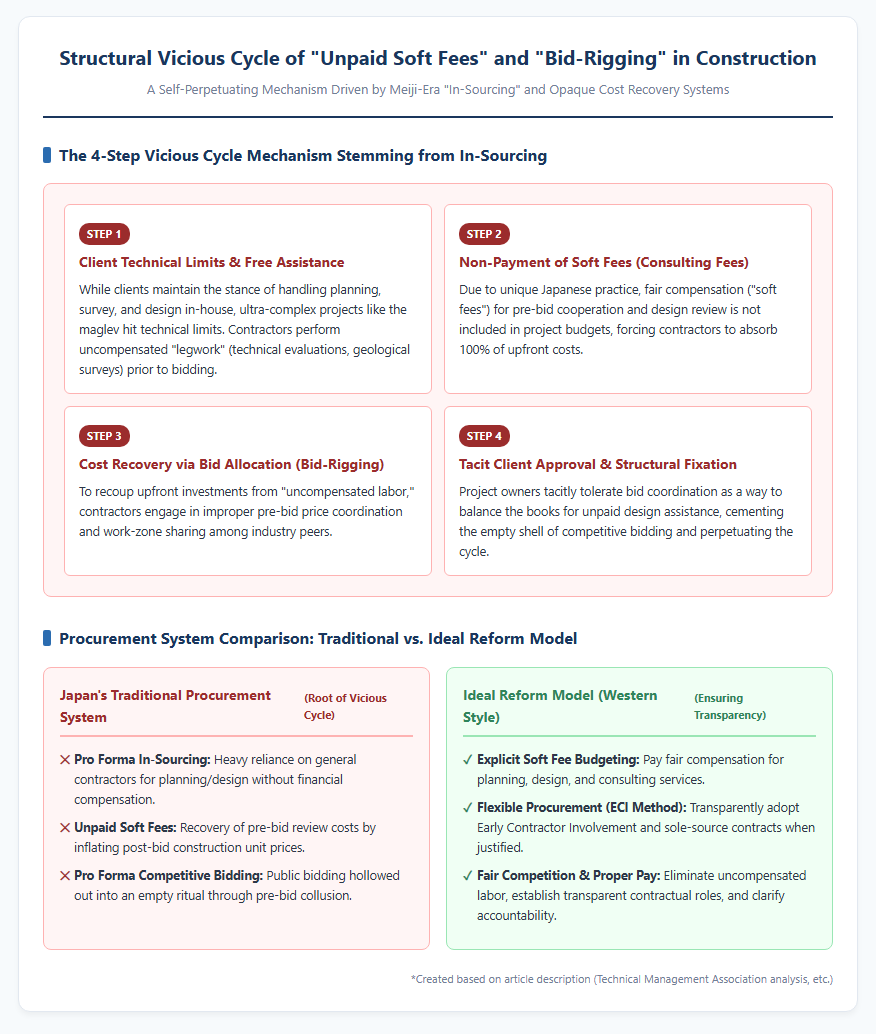
Beyond individual ethics, experts point out that a long-standing structural dilemma within Japanese construction administration and procurement lies at the root of the maglev scandal. Ever since the establishment of the Imperial College of Engineering during the Meiji era, Japanese government bodies and project owners have adhered to a culture of “in-sourcing,” taking the lead across all phases from planning, survey, and design to final construction. Today, however, single project owners cannot independently design or survey massive projects that rely on highly advanced, specialized technology. Consequently, contractors were routinely forced to perform uncompensated pre-bid “legwork,” such as technical assessments and geological surveys. While Western nations pay proper compensation (“soft fees”) for consulting services rendered during planning and design stages, Japan lacks this tradition. As a result, general contractors sought to recover their uncompensated upfront investments by rigging bids to inflate final construction contract prices, creating a systemic vicious cycle. The diagram below illustrates this self-perpetuating cycle.
Future Reforms Toward True Fair Competition and Industry Outlook
To shed old habits once tolerated as a “necessary evil” and restore public trust, the construction sector must undergo radical structural reform and eliminate non-transparent practices. Companies have already initiated preventive measures, including top management turnover, voluntary return of executive compensation, the appointment of third-party ethics committees composed of outside experts, and stricter rules governing interactions with industry peers. For instance, Kajima Corporation established the “Kajima Group Code of Conduct,” implementing mandatory annual e-learning compliance training for all employees (achieving a 100% completion rate in fiscal 2025) and conducting legal seminars on antitrust law led by external attorneys. Looking ahead, key reforms must include explicitly budgeting “soft fees” for pre-bid technical collaboration, transparently awarding single-source contracts when technically justified, and adopting highly transparent procurement models like Early Contractor Involvement (ECI). Preventing formal competitive bidding from becoming an empty shell and building a sustainable construction market where fair compensation and honest competition coexist remain urgent imperatives for the entire industry.
Reference Pages
- 【Compliance | Governance | Kajima Corporation】https://www.kajima.co.jp/prof/governance/compliance/
【#KajimaCorporation #TaiseiCorporation #MaglevBidRigging #Nikkenren #Compliance #ConstructionIndustry #AntitrustLaw】
コメント