In response to recurring urban flooding, Japan’s Ministry of Land, Infrastructure, Transport and Tourism (MLIT) has begun reviewing its sewerage drainage capacity targets for local municipalities. This policy shift comes as localized torrential downpours—such as the August 2026 Chiba torrential rain and the September 2026 Tokai region heavy rain—frequently exceed conventional design assumptions.
- Announcement and Background in September 2026
- Conventional Drainage Targets and Proposed Revisions
- Recent Severe Downpours and Urban Flood Realities
- Historical Flood Cases and Evolution of Inundation Guidelines
- National Resilience and Addressing Aging Sewer Infrastructure
- Key Future Focuses: Combining Structural and Non-Structural Measures
Announcement and Background in September 2026
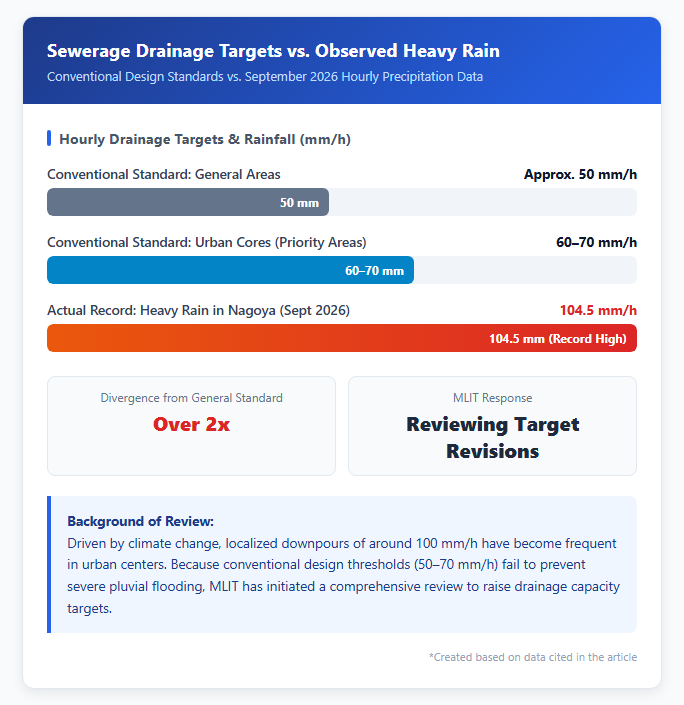
On September 18, 2026, the Ministry of Land, Infrastructure, Transport and Tourism (MLIT) held the initial meeting of its expert panel, the Water Disaster Investigation and Countermeasure Committee, revealing that it had begun reviewing sewerage drainage capacity targets (standard rainfall criteria) primarily for urban areas. This initiative stems from the increasing frequency of localized torrential downpours caused by recent climate change, which have led to severe pluvial flooding, flooded roadways, and inundated underground spaces. During the August 2026 torrential rain in Chiba Prefecture, major roadways and underpasses in urban areas like Chuo Ward, Chiba City, suffered severe inundation. Shortly after, on September 8, 2026, heavy rainfall in the Tokai region recorded an hourly precipitation of 104.5 mm in Nagoya City, Aichi Prefecture—an all-time high—temporarily paralyzing urban functions through widespread pluvial flooding. As flood damage beyond traditional design thresholds becomes a stark reality, MLIT indicated that it will simultaneously re-examine the expected rainfall figures used as the foundation for hazard maps. The ministry plans to compile comprehensive measures by the end of the year, incorporating both structural infrastructure upgrades and non-structural enhancements such as evacuation procedures.
Conventional Drainage Targets and Proposed Revisions
Historically, local municipalities have established sewerage drainage targets based on guidelines provided by MLIT. For standard residential areas, facilities were designed to safely discharge rainfall of approximately 50 mm per hour. Even in high-density urban centers with concentrated populations and key economic functions, drainage pipes and pumping stations were engineered to handle 60 to 70 mm per hour. However, driven by climate change, extreme rainfall events reaching around 100 mm per hour have become increasingly common in urban centers, far exceeding historical design parameters. The central focus of the panel’s review is determining how high the design capacity targets should be raised, particularly for high-risk urban cores and areas with dense underground commercial networks. Low-lying residential pockets with a history of recurring flood damage will be pinpointed for prioritized drainage interventions. Additionally, MLIT intends to bolster emergency readiness by expanding the deployment of mobile drainage pump trucks and raising public awareness regarding the dangers of underground flooding. Refer to the figure below.
Structural Risks of Urban Flooding and Lessons from History
Recent Severe Downpours and Urban Flood Realities
Recent urban flooding events have highlighted critical vulnerabilities in civic infrastructure and daily life. During the August 2026 Chiba torrential rain, rainwater rapidly concentrated into underpasses—sunken road structures beneath railways and highways—overwhelming sewer capacities and exceeding the operational limits of dedicated drainage pumps. This incident underscored the severe hazards of vehicles entering rapidly flooded underpasses and becoming submerged. On September 8, 2026, intense downpours in the Tokai region halted operations on all six lines of the Nagoya Municipal Subway, while JR Central and major private railway operators suffered widespread cancellations and delays during the evening commute, stranding vast numbers of travelers. In Nagoya City alone, approximately 200 vehicles were abandoned on flooded streets, and Emergency Safety Measures (Alert Level 5)—the highest advisory level—were temporarily issued to roughly 550,000 households (about 1.17 million residents). Because urban landscapes are heavily paved with asphalt and concrete, rainwater cannot seep into the ground, creating a structural risk where runoff rushes directly into drainage networks.
Historical Flood Cases and Evolution of Inundation Guidelines
A major historic precedent for urban pluvial flooding occurred on June 29, 1999, during the Fukuoka Flood. Although Fukuoka City had installed drainage infrastructure capable of handling 50 mm of rain per hour at the time, the city was struck by a record-breaking downpour of 79.5 mm per hour. Surface runoff overflowed onto roadways, causing water levels around Hakata Station to reach depths of up to one meter. Tragically, in the first basement level of a commercial building near the station, a female restaurant worker was trapped and lost her life due to a sudden surge of floodwater. Refer to the figure below.
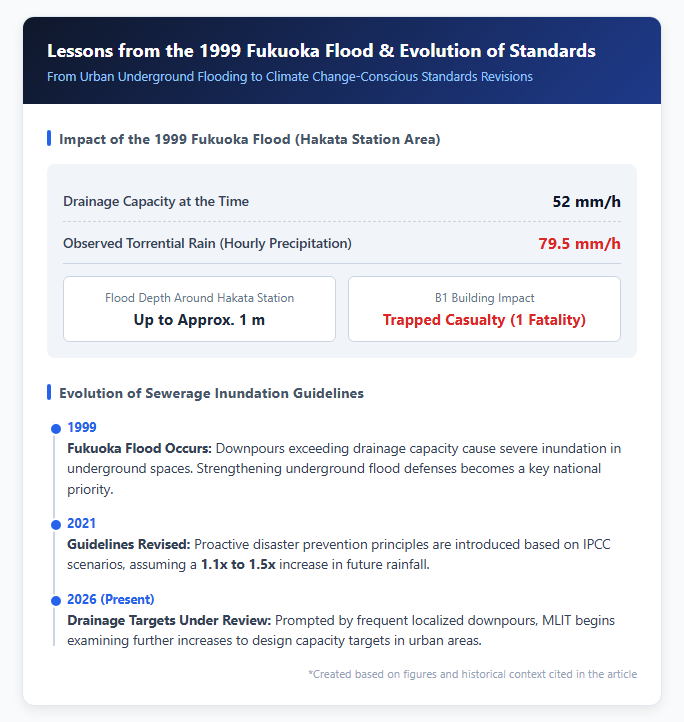
Drawing from such tragic lessons, MLIT has progressively revised technical guidelines for underground flood prevention and sewerage management. In 2021, the ministry updated its Stormwater Management Comprehensive Plan Formulation Guidelines to integrate proactive disaster prevention principles based on IPCC climate projection scenarios, assuming a 1.1- to 1.5-fold increase in future rainfall. The current review of drainage targets represents a step beyond previous guidelines toward establishing significantly more resilient infrastructure standards.
Infrastructure Maintenance and the Future of Urban Disaster Prevention
National Resilience and Addressing Aging Sewer Infrastructure
Japan’s sewerage network spans approximately 490,000 kilometers nationwide. However, pipelines exceeding their 50-year statutory service life or built over 40 years ago now account for roughly 25 percent of the total network. Aging pipelines are prone to cracks and structural deterioration, which not only degrades drainage capacity but can also cause severe road cave-ins by washing away subterranean soil, as seen in recent incidents in Yashio, Saitama Prefecture, and Osaka City. Under its National Resilience initiative, the Japanese government allocated over 20 trillion yen in the fiscal 2026 budget, prioritizing seismic reinforcement, large-scale upgrades, and flood risk mitigation for sewerage facilities. Recognizing the financial and operational constraints faced by individual municipalities, the government is expanding support for inter-municipal consolidation and allowing prefectural governments to execute emergency repair works on behalf of local authorities. Furthermore, the adoption of Water PPP models (such as Level 3.5 concession-style arrangements), autonomous drone inspections inside pipelines, and AI-driven image diagnostics are accelerating, balancing cost efficiency with structural safety.
Key Future Focuses: Combining Structural and Non-Structural Measures
Raising sewerage drainage targets is vital to strengthening urban flood defense at its core. However, constructing large-diameter trunk sewers and underground storage reservoirs requires substantial capital investment and long construction timelines. Consequently, robust non-structural measures are essential to protect communities while long-term infrastructure projects remain underway. A multi-layered defense strategy requires close public-private coordination, including promoting flood barriers for homes and businesses, installing rainwater storage tanks, utilizing green infrastructure, and delivering real-time flood risk updates. If higher drainage targets become official national policy, local municipalities will bear the operational responsibility. Given declining sewerage revenues due to population aging and shrinking municipal budgets, sustained federal subsidies and financial support are imperative. At the same time, regional collaboration across entire river basins must expand so neighboring municipalities, river managers, and sewerage authorities can jointly implement integrated water management strategies powered by IoT sensor networks and AI-driven predictive flood modeling.
Reference Pages
- 【Inundation Countermeasures via Sewerage Systems – MLIT】https://www.mlit.go.jp/mizukokudo/sewerage/crd_sewerage_tk_000117.html
- 【Promoting Urban Inundation Countermeasures Considering Climate Change – MLIT】https://www.mlit.go.jp/mizukokudo/sewerage/mizukokudo_sewerage_tk_000659.html
- 【Cabinet Approval of Bill to Partially Amend the Sewerage Act – MLIT】https://www.mlit.go.jp/report/press/mizukokudo13_hh_000722.html
【#PluvialFlooding #MLIT #SewerageInfrastructure #UrbanFlooding #ClimateChange #NationalResilience #DisasterPreventionInfrastructure】

コメント