The Ministry of Land, Infrastructure, Transport and Tourism has approved the advanced rail transport implementation plan for the extension of the Utsunomiya Light Rail to the west of JR Utsunomiya Station. The move comes amid efforts to build an integrated east-west public transportation network and revitalize the central urban area, following the successful early opening of the eastern section.
- Official Approval and Legal Significance of the Advanced Track Transport Implementation Plan
- Route Structure and New Stops of the Western Extension Section
- Breakdown of the estimated project cost of 69.8 billion yen and profitability projection
- The Operation Plan for Through-Services Crossing Tokyo East-West and Its Impact on Real Estate Along the Lines
- Key Issues Regarding Road Traffic Regulations and the Restructuring of Regional Transportation
- Future Construction Procedures and Outlook Aiming for Opening in 2036
Official Approval and Legal Significance of the Advanced Track Transport Implementation Plan
On October 9, 2026, the Ministry of Land, Infrastructure, Transport and Tourism officially approved the “Advanced Rail Transport Implementation Plan” jointly submitted by Utsunomiya City, Haga Town, and Utsunomiya Light Rail Co., Ltd. At a presentation ceremony held at the Kanto District Transport Bureau, Bureau Director-General Shun Sawai handed the certificate of approval directly to Shigeoki Tanaka, Deputy Mayor of Utsunomiya City.
This certification is based on the “Act on Revitalization and Rehabilitation of Local Public Transportation,” and with the approval of the plan, it is deemed that a license for the tramway business has been obtained under Article 3 of the Tramway Act. As a result, following the eastern section (between JR Utsunomiya Station East Exit and Haga-Takanezawa Industrial Park, 14.6 km) that opened ahead of schedule on August 26, 2023, legal procedures toward the construction of the western section have taken a major step forward. Utsunomiya Mayor Eiichi Sato has expressed expectations that the extension will connect the eastern and western hubs, stimulate the exchange of people and goods, and foster a greater sense of unity throughout the city. For an overview of the development project, please refer to the following image.
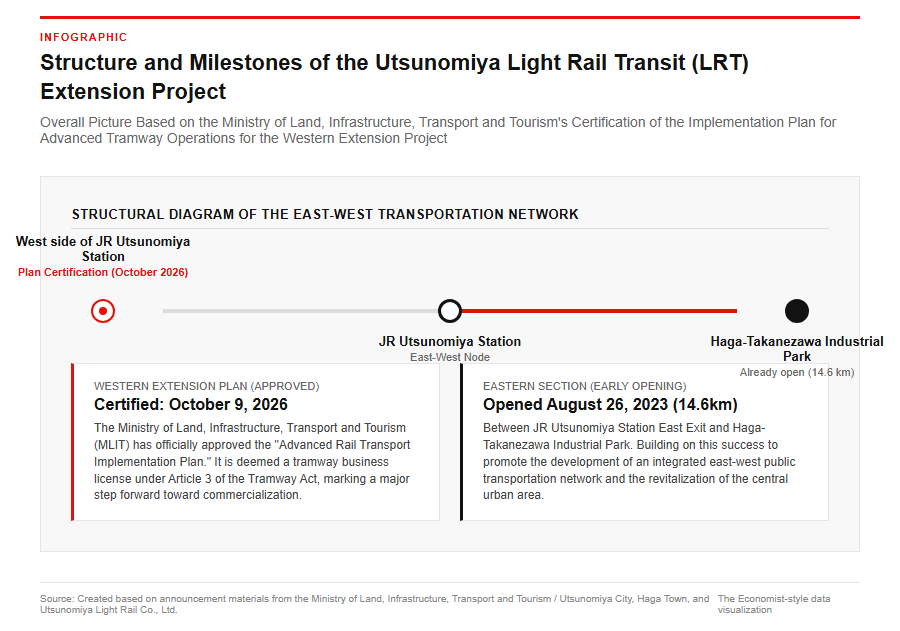
As for the business scheme, similar to the eastern section, a publicly owned and privately operated “vertical separation” model will be adopted. Infrastructure ownership and maintenance will be handled by the municipal government of Utsunomiya (including Haga Town for some rolling stock) serving as the track infrastructure operator, while operations and routine management will be undertaken by the third-sector Utsunomiya Light Rail Co., Ltd. serving as the track transport operator.
Route Structure and New Stops of the Western Extension Section
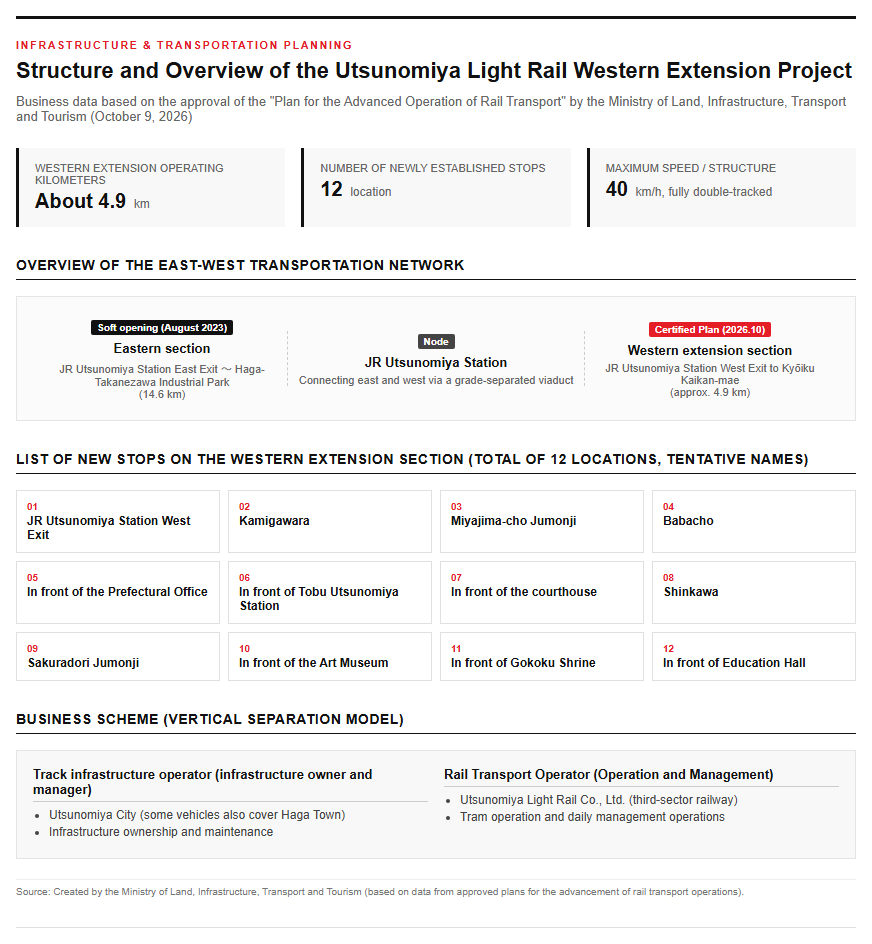
The newly certified western extension section is a route spanning an operating distance of approximately 4.9 km, running from “Miya Mirai” at the west exit of JR Utsunomiya Station to “Kyōiku Kaikan-mae” in Komanyū 1-chōme, Utsunomiya City. In the future, a further extension from Kyōiku Kaikan-mae to the vicinity of the Oya tourist area is also positioned as a section under consideration, but the immediate target for development will be this 4.9 km. The route of the extension section and the list of newly established stops are as follows.
- Route structure: Completely double-track street-running section (maximum speed: 40 km/h)
- JR Line Crossing Section: Runs from the east exit of Utsunomiya Station via an elevated bridge, crossing over the JR Utsunomiya Line and Tohoku Shinkansen to enter the west exit.
- New stops (12 locations in total, provisional names):
- JR Utsunomiya Station West Exit, Kamigawara, Miyajimacho Jumonji, Babacho
- In front of the Prefectural Office, In front of Tobu Utsunomiya Station, In front of the Courthouse, Shinkawa
- Sakuradori Intersection, In front of the Art Museum, In front of Gokoku Shrine, In front of the Education Hall
Along the railway line, administrative institutions such as the Tochigi Prefectural Government and Utsunomiya City Hall are concentrated, alongside educational and cultural facilities including Tobu Utsunomiya Station, the Tochigi Prefectural Museum of Fine Arts, and the Sakushin Gakuin campus. The plan involves placing tracks in the center of the main boulevard, significantly enhancing accessibility to key hubs in the central urban area. The layout of the major transit points is shown in the diagram below.
Business Scale, Operation Plan, and Economic Ripple Effect
Breakdown of the estimated project cost of 69.8 billion yen and profitability projection
The estimated project cost for the western extension is calculated to be approximately 69.8 billion yen excluding tax. This is about a 1.8-fold increase from the initial estimate of roughly 40 billion yen made in August 2022. Behind this massive project cost escalation are recent surges in labor and material costs (about 1.25 times), increased rolling stock purchase costs (surging from roughly 2-fold to 4-fold) resulting from an increase in the number of trains to be introduced from the initial 5 sets to 11 sets based on demand forecasts, and rising land acquisition and compensation costs associated with road widening and the securing of a train storage facility west of Saibansho-mae.
The main cost breakdown and financing methods are as follows:
- Breakdown of estimated construction costs (approx. 69.8 billion yen excluding tax):
- Civil engineering expenses: Approx. 28.5 billion yen
- Land acquisition compensation: Approx. 14.2 billion yen
- Vehicle costs: Approx. 11.2 billion yen (procuring 14 new trainsets with a capacity of 159 passengers each)
- Orbital costs: Approx. 7.09 billion yen
- Power line and communication line costs: approx. 5.73 billion yen
- Funding: Utilizing national subsidy systems such as the Social Infrastructure Development Comprehensive Grant, and assuming general public works bonds (90% allocation rate) for local government bonds.
According to the financial projections, by incorporating actual performance data from the eastern section, the project is expected to secure a single-year operating profit starting from the first year of operation. Furthermore, cumulative losses caused by initial pre-opening expenses are calculated to be completely eliminated by the 12th year of operation, confirming the long-term stability of the business operations.
The Operation Plan for Through-Services Crossing Tokyo East-West and Its Impact on Real Estate Along the Lines
Under the operation plan, through-operations will run between the existing eastern section (14.6 km) and the newly established western section (4.9 km), forming a core transportation network with a total length of approximately 19.5 km crossing Utsunomiya City from east to west. Operating hours will be set from the 6 a.m. hour to the 11 p.m. hour, with services running 10 times per hour (at 6-minute intervals) during morning and evening commute and school peak hours, and 6 times per hour (at 10-minute intervals) during off-peak hours. Travel times are projected to be approximately 20 minutes toward the Utsunomiya Station area and approximately 22 minutes toward the Education Center area.
According to demand forecasts, the estimated daily number of users for the combined east and west sections is approximately 31,500 on weekdays (and about 22,500 on weekends and holidays). Strong demand, comparable to that of the eastern section, is anticipated for the western section alone, and Utsunomiya Light Rail Co., Ltd. plans to strengthen its operational structure by hiring 53 new personnel, including 38 drivers, prior to the opening.
This transport infrastructure development is also having a positive impact on the real estate market and redevelopment projects along the route. At the west exit of JR Utsunomiya Station, the mixed-use building “Atlas Tower Utsunomiya” was completed in August 2026, and land prices along Odori Avenue continue to show an upward trend. In the 2026 land price survey, the average rate of change for commercial areas turned positive for the first time in 35 years, with locations along the LRT line occupying the top spots for growth rates, powerfully attracting private investment toward the realization of a compact city.
Addressing Issues and Future Business Schedule
Key Issues Regarding Road Traffic Regulations and the Restructuring of Regional Transportation
In promoting the westward extension, there are also challenges to be resolved and issues requiring careful coordination. On Odori, a major arterial road (three lanes in each direction), the center two lanes will be used for the LRT tracks and station spaces, resulting in a reduction of lanes for general automobiles. Along with this, issues such as traffic detours, congestion, and securing loading/unloading spaces for stores have been pointed out, and reports indicate that some civic groups and opponents are considering administrative litigation due to concerns over traffic congestion and a decline in convenience.
In response to this, Utsunomiya City is implementing the following measures and thorough explanations.
- Traffic Environment Improvement on Major Streets:
- Creation of pedestrian spaces protected from rain and vibrant public spaces
- Establishing loading/unloading spaces with consideration for surrounding stores, and reviewing traffic regulations
- Consideration of a Transit Center (Transfer Hub) near the Sakura-dori Jumonji Intersection
- Regional Transportation and Bus Route Restructuring:
- Securing Alternative Transportation Following the Discontinuation of JR Bus Kanto Routes in Utsunomiya City and Haga Town
- Demonstration trials of city-operated jumbo taxis and the establishment of a smooth transfer environment with demand-responsive transport
The city plans to encourage a shift from car use to public transportation through repeated discussions with the national government, related organizations, and citizens, while working to improve and harmonize the overall mobility of the city.
Future Construction Procedures and Outlook Aiming for Opening in 2036
Following the recent approval of the implementation plan for the advancement of rail transit operations, the project will move to the next phase: formulating a “construction plan” and obtaining construction authorization from the Ministry of Land, Infrastructure, Transport and Tourism (MLIT). Utsunomiya City completed urban planning amendment procedures in September 2026, and will now proceed with authorization procedures following consultations with road administrators and the submission of related proposals to the city council. The main schedule and outlook moving forward are as follows.
- Future business process:
- From October 2026: Holding explanatory meetings for residents along the railway line, business operators, etc., and implementing urban planning procedures.
- December 2026: Proposal of bills related to the track maintenance project and city road recognition to the city council
- November 2027: Completion of business initiation and construction authorization procedures
- By the end of 2028: Construction of the western extension section to begin
- March 2036: Start of operation (opening) of the western extension section
The initially planned opening target of 2030 has been revised to March 2036, following a careful assessment of the time required for land acquisition and coordination for the viaduct construction crossing the JR lines. Emphasizing the need not to miss the momentum for redevelopment investment, Mayor Eiichi Sato stressed his commitment to strictly adhering to the established schedule and steadily advancing the construction work. While managing the risks of fluctuations in prices and labor costs and deepening public understanding, efforts toward the full-line opening in 2036 are now entering full swing.
Reference Page
- 【Certified the Implementation Plan for the Advancement of Tramway Operations Applied for by Utsunomiya City, Haga Town, and Utsunomiya Light Rail Co., Ltd. | Ministry of Land, Infrastructure, Transport and Tourism】 https://www.mlit.go.jp/report/press/tetsudo04_hh_000142.html
- 【Regarding the “Advanced Rail Transit Implementation Plan (Draft)” | Utsunomiya City】[suspicious link removed]
[#UtsunomiyaLRT #WesternExtension #MinistryOfLandInfrastructureTransportAndTourism #RegionalRevitalization #PublicTransportation #CompactCity #UtsunomiyaCity]


コメント