Prime Minister Sanae Takaichi departed Haneda Airport late on the night of September 21, 2026, bound for New York to attend the United Nations General Assembly. Key highlights of her visit include unveiling an economic cooperation framework aimed at averting energy crises stemming from escalating Middle East tensions, as well as reinforcing the US-Japan alliance and economic security through a bilateral summit with US President Donald Trump.
- Late-Night Departure from Haneda on September 21, 2026, and Agenda at the UN General Assembly
- Escalating Middle East Tensions and Crisis Management for Strait of Hormuz Blockade Risks
- Joint US Oil Procurement and Stockpiling Initiatives: Restructuring Energy Supply Chains
- The Second Tranche of US Investments and Joint Securing of Critical Minerals like Rare Earths
- Yen Selling Pressures vs. US-Japan Interest Rate Differentials and Intervention Vigilance
- Re-acceleration of the “Takaichi Trade” and Economic Recovery Scenarios Beyond 2026
Late-Night Departure from Haneda on September 21, 2026, and Agenda at the UN General Assembly
Prime Minister Sanae Takaichi departed Haneda Airport aboard a government aircraft late on the night of September 21, 2026, to attend the United Nations General Assembly in New York. During her visit, Prime Minister Takaichi will address the General Debate, articulating Japan’s fundamental position on pressing global issues. In her address, she plans to strongly advocate for the rule of law and the maintenance of international order, while calling for full international understanding and cooperation regarding the immediate resolution of the abduction of Japanese nationals by North Korea. Furthermore, addressing the worldwide concerns over energy security, she will announce a new economic cooperation plan for the Middle East led by Japan. This initiative encompasses ambitious efforts aimed at securing a stable energy supply and restructuring global supply chains. During her stay, a US-Japan bilateral summit with US President Donald Trump is also scheduled, where the two leaders are expected to align their perspectives on China and East Asian security ahead of President Trump’s upcoming US-China summit. Prior to her departure, Prime Minister Takaichi instructed Chief Cabinet Secretary Kihara and Minister Hosono to maintain high vigilance in handling domestic damage caused by Typhoon 25, ensuring domestic stability before stepping onto the diplomatic stage. Observers are closely watching how Japan demonstrates leadership amid an increasingly complex international landscape.
Escalating Middle East Tensions and Crisis Management for Strait of Hormuz Blockade Risks
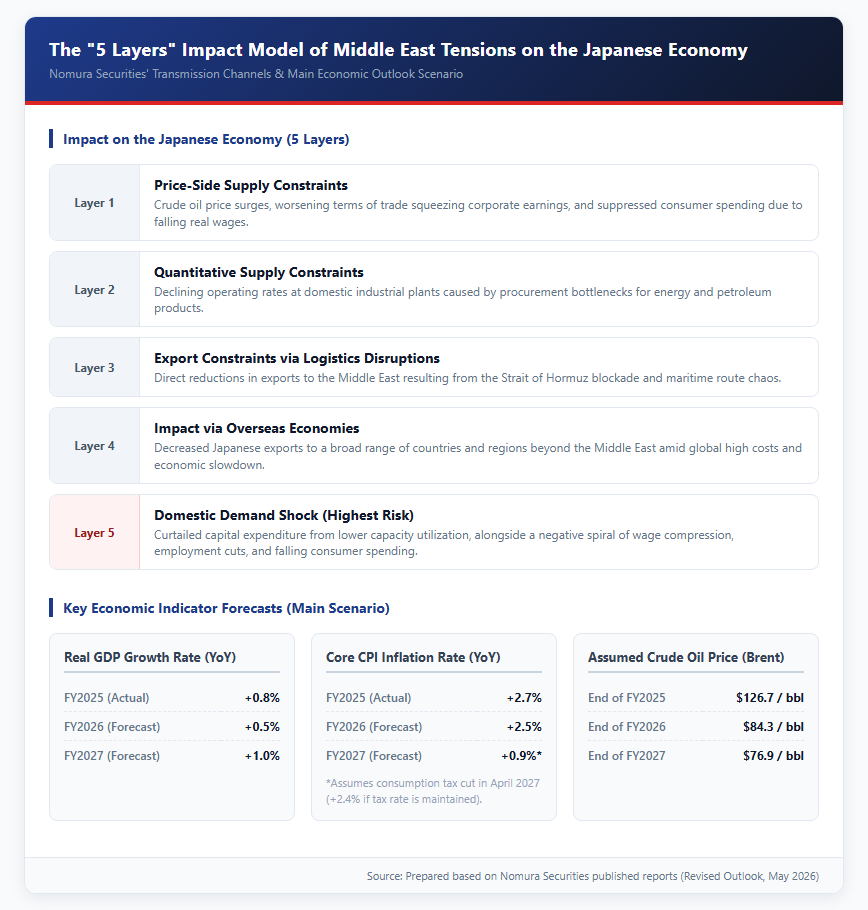
Geopolitical risks in the Middle East escalated dramatically following military strikes launched by the United States and Israel against Iran on February 28, 2026. In particular, the effective blockade of the Strait of Hormuz—a crucial maritime choke point for global oil transportation—has severely disrupted global energy supply chains and logistics networks. Because Japan relies on the Middle East for over 90% of its crude oil imports, most of which pass through the Strait of Hormuz, securing energy resources and managing price spikes have become urgent challenges threatening the foundation of the Japanese economy. Since taking office, Prime Minister Takaichi’s cabinet has swiftly convened 11 emergency ministerial meetings to formulate and execute crisis management measures. Concrete steps include securing alternative supply routes for crude oil and liquefied natural gas (LNG), authorizing flexible releases from national petroleum reserves, and implementing an emergency petroleum fund to cap domestic gasoline prices around a national average of 170 yen per liter. A prolonged crisis in the Middle East risks expanding beyond cost-push inflation to trigger severe demand shocks, such as reduced domestic industrial capacity and curtailed capital investment. For further details on the impact of Middle East risks, please refer to the diagram below.
US-Japan Summit: Deepening Economic Security and Energy Strategy
Joint US Oil Procurement and Stockpiling Initiatives: Restructuring Energy Supply Chains
During the scheduled US-Japan summit with President Donald Trump, key discussion points will include responses to the Iranian crisis and deeper economic and energy cooperation between the two nations. In previous meetings, both leaders reached a shared understanding on joint efforts to expand US energy production in order to reduce reliance on Middle Eastern crude and stabilize global energy supplies. Prime Minister Takaichi is proposing a joint framework to increase Japan’s procurement of US crude oil—which utilizes maritime routes free from Middle Eastern choke points—and establish joint stockpiling facilities within Japan for the acquired US oil. This proposal aligns with the Trump administration’s agenda to boost domestic oil production and expand US strategic reserves, and it is expected to contribute to medium- to long-term energy security. However, because new resource development and production capacity expansions require significant lead time, this initiative will not immediately resolve short-term supply bottlenecks, making continued diplomatic efforts toward regional stabilization in the Middle East indispensable. Additionally, Japan has presented its “Power Asia” project aimed at building resource-securing networks across the Indo-Pacific, seeking to establish resilient energy supply chains through strong alliance partnerships.
The Second Tranche of US Investments and Joint Securing of Critical Minerals like Rare Earths
The Japanese and US governments are rapidly advancing cooperation in the realm of economic security. Under the summit framework, both nations announced the second tranche of Japanese investments and loans into the US, identifying concrete projects valued at up to \$73 billion in total. Major projects include the construction of Small Modular Reactors (SMRs) in Tennessee and Alabama (approximately \$40 billion), as well as natural gas power plant developments in Pennsylvania (\$17 billion) and Texas (\$16 billion). As the Trump administration faces surging power demand driven by data centers and rising domestic electricity costs, Japanese corporate expertise and technology are set to play a pivotal role. Furthermore, regarding critical minerals such as rare earths—where supply restrictions by China have intensified—a joint US-Japan action plan was formulated. Discussions are progressing on policy support for specific mining projects (such as copper and lithium) and the potential implementation of a “price floor” mechanism to shield private investment from sudden market price crashes. Reducing dependence on China for strategic goods and establishing reliable procurement chains remain top shared priorities for both nations.
Market Impact and Medium- to Long-Term Outlook for the Japanese Economy
Yen Selling Pressures vs. US-Japan Interest Rate Differentials and Intervention Vigilance
Monetary policy decisions and political developments in both Japan and the US continue to exert a powerful influence on foreign exchange and equity markets. Following the Federal Open Market Committee’s (FOMC) 25 basis point (bp) rate hike on September 16, 2026, the Bank of Japan (BOJ) also decided to raise interest rates by 25 bp on the same day. However, two BOJ policy board members voted against the rate increase. Because the dissenting members were reflationists appointed under the Takaichi administration, internal policy divergence regarding monetary tightening in Japan has once again come to light. Meanwhile, US Treasury Secretary Scott Bessent issued cautionary remarks indicating that Japan should move away from reflationary policies, highlighting growing pressure from Washington. Under normal circumstances, persistent interest rate differentials between the US and Japan would favor dollar buying and yen selling. However, with the USD/JPY trading in the lower 157 range, strong vigilance over potential currency intervention by Japanese authorities, combined with political pressure from the US, has placed a cap on the dollar’s upside, preventing an unchecked depreciation of the yen. Market participants are closely watching the upcoming dialogue between Prime Minister Takaichi and President Trump for further clues.
Re-acceleration of the “Takaichi Trade” and Economic Recovery Scenarios Beyond 2026
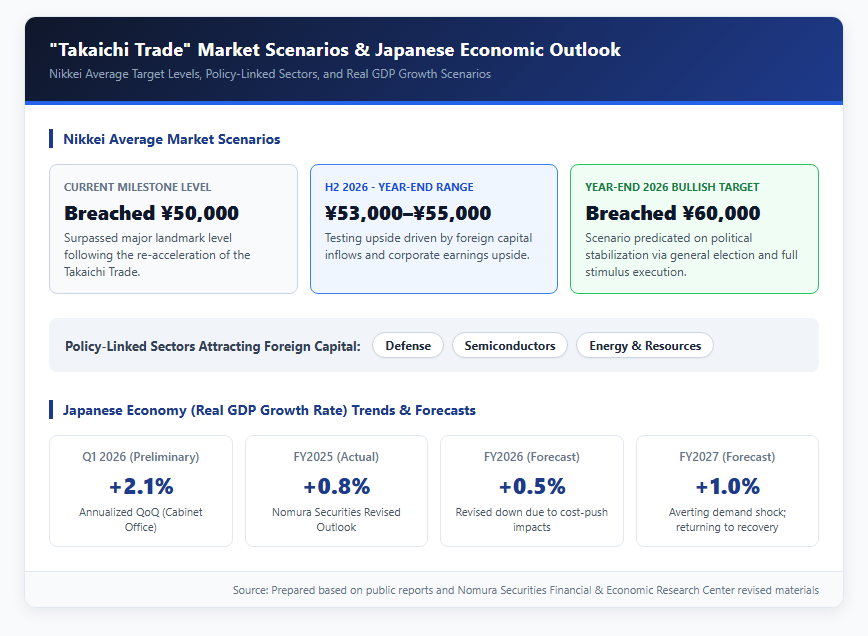
In equity markets, expectations are rising that the “Takaichi x Trump” dynamic will usher in a robust bull market, driven by Prime Minister Takaichi’s emphasis on fiscal expansion and a cautious stance toward interest rate hikes. The re-acceleration of the so-called “Takaichi Trade” recently pushed the Nikkei Stock Average past the landmark 50,000 level, drawing enthusiastic market interest. Analysts suggest that foreign capital continues to flow into policy-linked sectors such as defense, semiconductors, and energy resources, creating scenarios where the Nikkei Average could test 53,000 to 55,000 by late 2026 and potentially breach 60,000 by the end of 2026. Conversely, while Cabinet Office statistics showed real GDP growth for Q1 2026 at a solid +2.1% annualized, risks remain, including cost-push inflation and falling real wages caused by Middle East tensions, which could weigh on consumer spending. Nomura Securities’ revised economic outlook projects real GDP growth at +0.8% for FY2025, +0.5% for FY2026, and +1.0% for FY2027. The central question remains whether Japan can avoid domestic demand shocks and sustain a moderate recovery trajectory. For a detailed view of market trends and economic projections, please refer to the diagram below.
References
- [Economic Security and Geopolitical Risk 2026 – KPMG International] https://kpmg.com/jp/ja/insights/2026/01/economic-security-2026.html
【#PrimeMinisterTakaichi #UNGeneralAssembly #USJapanSummit #EconomicSecurity #MiddleEastTensions #EnergyPolicy #TakaichiTrade #JapaneseEconomy】
コメント