
In its September economic trends report, Yamagata Prefecture upgraded its basic assessment of the prefectural economy and revealed that signs of a recovery are spreading. Behind this are large-scale fiscal stimulus for recovery from heavy rainfall disasters and the recovery of manufacturing production driven by the expansion of semiconductor- and AI-related demand.
- Upward Revision for the First Time in 1 Year and 2 Months and Improvement in Major Economic Indicators
- Trends by Demand Component and Fiscal Stimulus Associated with Heavy Rain Disaster Recovery
- Semiconductor Equipment Driving the Manufacturing Sector and the Ripple Effect of AI Demand
- Challenges of High Costs and Employment Wages in Service and Non-Manufacturing Sectors
- Tourism Big Data Analysis in the Shonai Area and Creation of Wide-Area Sightseeing Circuits
- Building a Sustainable Local Community Envisioned Through the Medium-Term Fiscal Outlook
Upward Revision for the First Time in 1 Year and 2 Months and Improvement in Major Economic Indicators
In the monthly economic trend report released by Yamagata Prefecture on September 24, 2026, the basic assessment of the prefectural economy was raised from the previous evaluation, with an upward revision to “showing a moderate pick-up, although some weaknesses are observed.” According to data published by the Bank of Japan Yamagata Office, an upward revision of the overall economy was also made, marking the first time in a year and two months—since September 2025—that such an economic assessment has been raised. Looking back at key indicators, the active job openings-to-applicants ratio, which reflects the employment situation, rose to 1.39, maintaining a very high level of job openings in the Tohoku region. In addition, data indicating a broadening of demand was confirmed consecutively, such as new car registrations—reflecting trends in personal consumption—recording a 6.7% increase compared to the same month of the previous year. Please refer to the figure below.
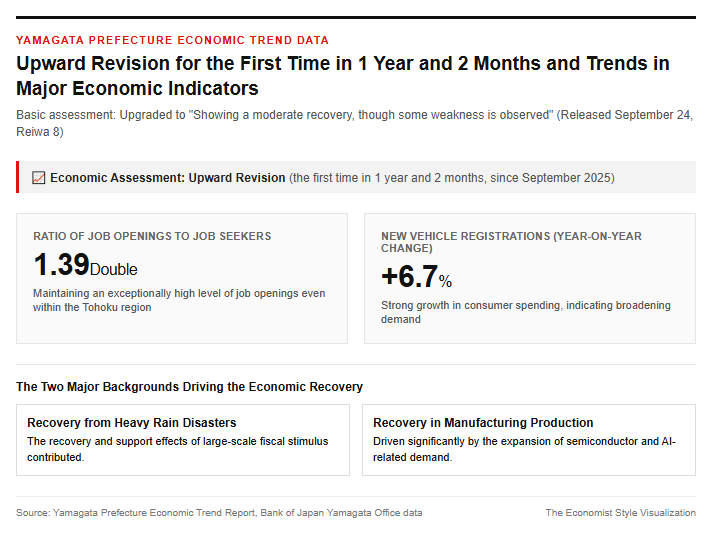
Such resilient trends in employment and consumption are strongly supporting the upward revision of the economic assessment for the prefecture as a whole.
Trends by Demand Component and Fiscal Stimulus Associated with Heavy Rain Disaster Recovery
A closer look at the breakdown by demand category reveals that assessments were upgraded in three items: public investment, housing investment, and employment and income. The background behind the upward revision of the public investment assessment to “is increasing” in particular includes the fact that construction contract amounts have remained solid with positive year-on-year growth, alongside proactive fiscal responses by the administration. The Yamagata Prefectural Assembly passed a record-breaking supplementary budget bill incorporating recovery costs for the heavy rain disaster that occurred in July of Reiwa 8. The early rollout of public works orders related to this recovery and reconstruction project has provided a direct underpinning effect on the regional economy. On the other hand, constraining factors such as stubbornly high material prices and a shortage of engineers and workers at construction sites also remain deeply entrenched. Please refer to the figure below.
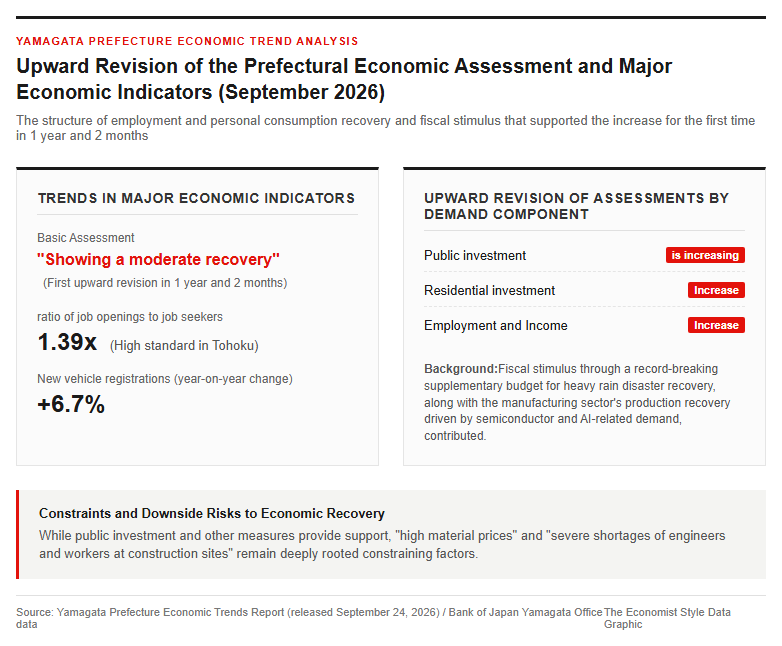
Smooth execution of construction work and infrastructure development through public-private partnerships hold a critically important key to the stable trajectory of future regional economies.
Current State of Industrial Structure and Divergence by Industry
Semiconductor Equipment Driving the Manufacturing Sector and the Ripple Effect of AI Demand
Looking at trends by industry, the rebound in production activities, centered on the manufacturing sector, is driving the economic recovery. The seasonally adjusted production index in the Yamagata Prefecture Indices of Industrial Production recorded 128.1, an increase of 5.6% from the previous month, marking the second consecutive month of gains. This background is driven by the rapid expansion of global demand related to artificial intelligence (AI), which has led to a spillover of orders into manufacturing lines within the prefecture, such as electronic parts and devices, production machinery, and chemicals. According to the 88th Yamagata Prefecture Corporate Business Trend Survey published by the Fidea Information Research Institute, the business condition DI for manufacturing companies recorded a positive 10.8, showing a significant surge of 13.8 points from the previous survey and turning positive for the first time in three quarters. Voices from corporate frontlines indicate that orders related to semiconductor manufacturing equipment are performing extremely well, and that capital investments toward labor-saving and digital transformation (DX) are steadily progressing. The easing of procurement bottlenecks is further supporting this virtuous cycle in production activities.
Challenges of High Costs and Employment Wages in Service and Non-Manufacturing Sectors
While the manufacturing sector shows signs of recovery, non-manufacturing and service industries face the severe challenge of squeezed profits due to soaring costs. In the same survey, the business condition diffusion index (DI) for the service industry dropped to minus 15.2, marking the third consecutive quarter of deterioration. Rising food, raw material, and utility costs in the lodging industry, persistently high fuel prices in the transportation sector, and increased hardware procurement costs in IT-related fields are among the wide range of expenses depressing operating profits. Meanwhile, changes are occurring in the labor environment and wage landscape. According to the Monthly Labour Survey, regular earnings as of April 2026 increased by 1.2% compared to the same month of the previous year, and by 4.1% at establishments with 30 or more employees. The upper average of job-offer wages disclosed by Hello Work Yamagata has reached 1,254 yen, driven by moves to raise wages in response to labor shortages and rising prices. Both the promotion of price pass-through and the improvement of the labor environment are required.
Regional Revitalization Policies and Medium-to-Long-Term Economic Outlook
Tourism Big Data Analysis in the Shonai Area and Creation of Wide-Area Sightseeing Circuits
As a new approach toward revitalizing the regional economy, efforts in big data analysis and wide-area collaboration within the tourism sector are attracting attention. In a tourism big data analysis of the Shonai area jointly conducted by the Shonai Tourism Convention Association, The Shonai Bank, and Fidea Information Research Institute, pedestrian flow data and travel patterns of international visitors to Japan were quantitatively visualized. The data demonstrates that a wide-area travel route has been formed, spanning from the Murayama region—including Yamagata City, Ginzan Hot Spring in Obanazawa City, and Tendo Hot Spring in Tendo City—all the way to Sendai City and Matsushima Town in Miyagi Prefecture. The development of tourism infrastructure holds the potential not only to simply attract tourists, but also to contribute to improving regional logistics networks, attracting businesses, and creating new industries. Through the expansion of gastronomic tourism and experiential content, promoting a transition from transient visits to sustainable, stay-based tourism throughout the four seasons is essential for maximizing the economic ripple effects across the entire prefecture.
Building a Sustainable Local Community Envisioned Through the Medium-Term Fiscal Outlook
In forward-looking medium- and long-term economic and fiscal management, addressing structural challenges is inevitable. According to the medium-term fiscal outlook formulated by Yamagata Prefecture (from fiscal 2025 to fiscal 2029), a funding shortfall on the scale of 15 billion to 20 billion yen is projected to occur each fiscal year due to increasing social security-related expenses, rising public debt service costs associated with higher interest rates, and preparations for natural disaster risks. In response, stable fiscal management is planned by thoroughly executing the effective use of prefectural assets, utilizing special account funds, and reducing and streamlining administrative expenses, alongside drawing on the fiscal adjustment fund. To address concerns over labor shortages caused by population decline, fundamental structural reforms are required, including enhancing industrial added value through public-private partnerships, the aggressive adoption of digital technologies, and the establishment of frameworks to accept foreign talent. Toward the establishment of a sustainable regional economy, the promotion of industrial promotion policies through the selective and focused allocation of policy budgets is anticipated.
Reference Page
- 【Prefectural Economic Trends and Statistics – Yamagata Office, Tohoku Local Finance Bureau, Ministry of Finance】https://lfb.mof.go.jp/tohoku/yamagata/j3_chosa/index.html
[#YamagataPrefecture #EconomicTrends #EconomicAssessment #RegionalEconomy #IndustrialPromotion]

コメント