On September 21, 2026, the foreign ministers of Japan, the United States, and South Korea met in New York and issued a joint statement explicitly opposing “economic coercion” by specific countries and pledging closer alignment on economic security. This move reflects growing alarm over actions that leverage trade and natural resources as strategic pressure tactics, including China’s tightened export controls on rare earths and dual-use items targeting Japan.
- Core Outcomes of the New York Foreign Ministers’ Meeting and Joint Statement
- Aligning on Economic Security with China in Mind
- The Reality of Dual-Use Export Controls and the Squeeze on Technology
- Critical Minerals and the Risk of “Weaponized Interdependence”
- Economic Security Management and Building Supply Chain Resilience
- Multilateral Partnerships and the Future International Order
Core Outcomes of the New York Foreign Ministers’ Meeting and Joint Statement
On September 21, 2026, the foreign ministers of Japan, the United States, and South Korea convened in New York, issuing a joint statement that underscored their firm opposition to “economic coercion” and established an indispensable framework for economic security cooperation. Since the historic Camp David Summit in August 2023, trilateral relations have evolved beyond traditional security into a multi-faceted partnership aimed at enhancing supply chain resilience, technology sharing, and overall stability in the Indo-Pacific. The establishment of the Trilateral Coordinating Secretariat in late 2024 institutionalized this partnership, ensuring a durable foundation that remains resilient against domestic political transitions and executive changes across the three nations. During this latest meeting, the ministers reaffirmed their commitment to deepening real-time information sharing and early warning mechanisms to counter unfair trade practices and coercion arising from over-reliance on specific supply networks. Particular urgency was placed on establishing effective emergency support and mutual assistance frameworks in the event of arbitrary trade restrictions targeting critical minerals and advanced technologies. Please refer to the diagram below.
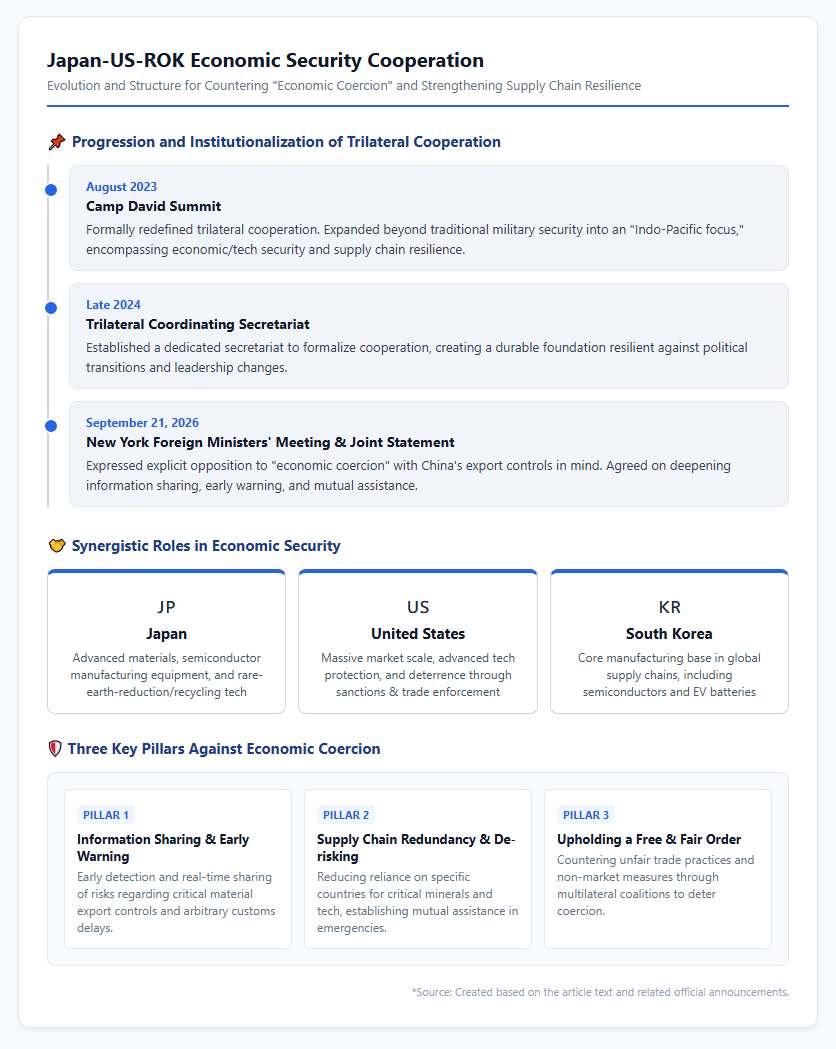
Moving beyond simple bilateral coordination, this alliance serves as a robust structure dedicated to upholding a free, fair, and rules-based international economic order.
Aligning on Economic Security with China in Mind
The strong emphasis on opposing economic coercion in the joint statement stems from shared concerns over China’s increasing willingness to leverage vast market access and dominant supply positions to compel political concessions from other nations. Between 2025 and 2026, Beijing repeatedly introduced export restrictions on critical materials under the guise of national security and environmental protection, presenting a common threat to Tokyo, Washington, and Seoul. Although China was not explicitly named in the official communique, the three foreign ministers jointly criticized “any unilateral attempts to change the status quo by force or coercion” and affirmed a shared refusal to tolerate the improper use of economic levers. Consequently, the three allies are accelerating “de-risking” initiatives designed to reduce excessive dependencies on specific countries for strategic supplies, including semiconductors, EV batteries, and critical minerals. This diplomatic consensus also aims to mitigate policy uncertainty and reinforce mutual trust among allies amidst the Trump 2.0 administration in the U.S. and political transitional periods in Japan and South Korea. By presenting a united front and broadening multilateral support networks, the three nations expect to build an effective deterrent against economic pressure while collectively supporting targeted countries.
Structure of Economic Coercion and Its Impact on Markets and Industry
The Reality of Dual-Use Export Controls and the Squeeze on Technology
On January 6, 2026, China’s Ministry of Commerce (MOFCOM) promulgated “MOFCOM Announcement No. 1 of 2026” under the Export Control Law of the People’s Republic of China, taking immediate effect. The regulation strictly bans the export of all dual-use items to Japanese military end-users, military end-uses, or any end-use that contributes to enhancing Japanese military capabilities. Framed by Beijing as a countermeasure against remarks made by Japanese leaders regarding the situation in the Taiwan Strait, the restriction encompasses 1,122 dual-use items listed in the revised control catalog published in late December 2025. The core challenge for industry lies in the extremely vague definition of “military end-use,” which grants Chinese authorities broad discretion to delay or block export approvals for general commercial goods, semiconductor manufacturing equipment, and industrial chemicals. In practice, covert economic pressure disguised as routine trade procedures has already materialized, as seen in China’s anti-dumping investigations and high margin deposit demands on Japanese dichlorodihydrosilane (DCS), a key semiconductor raw material. Please refer to the diagram below.
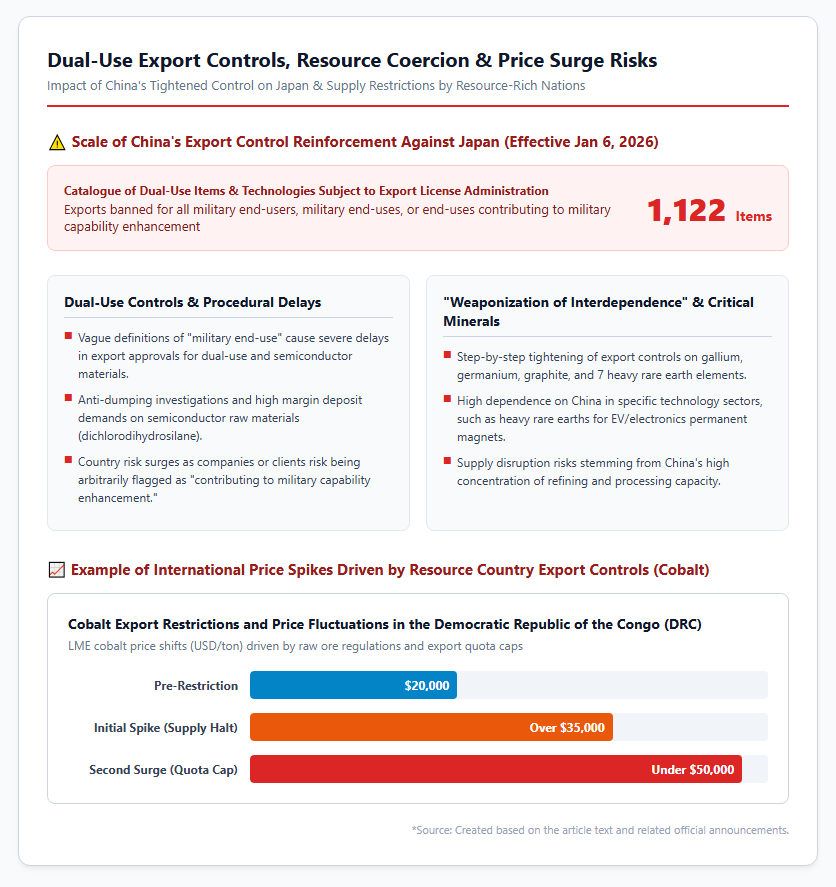
For commercial enterprises, the country risk of having themselves or their customers arbitrarily flagged as restricted entities has surged, triggering widespread anxiety over potential manufacturing line shutdowns and supply chain disruptions.
Critical Minerals and the Risk of “Weaponized Interdependence”
In modern global supply chains, the most pressing vulnerability is the “weaponization of interdependence”—the exploitation of asymmetric trade relationships. China commands a dominant share of global rare earth mining and refining capacity and has progressively tightened export restrictions on gallium, germanium, graphite, and seven heavy rare earth elements. Since the 2010 rare earth supply suspension following the Senkaku Islands maritime incident, Japanese companies have actively pursued supply chain diversification. However, significant dependencies persist in specific technical sectors, such as heavy rare earths required for high-performance permanent magnets in electric vehicles and electronics. Structural dependencies—whether relying on a single country for critical inputs or exporting heavily to a single market—create immediate targets during geopolitical disputes. Furthermore, unilateral export restrictions and tax hikes by resource-rich developing nations are escalating rapidly; for instance, cobalt export restrictions imposed by the Democratic Republic of the Congo (DRC) caused international market prices to spike from \$20,000 per ton to nearly \$50,000 per ton. Disruption in critical mineral supplies poses a structural risk that directly threatens operational capacity and financial performance across major manufacturing industries, including automotive, electronics, and green technology.
Business Defense Strategies and the Future Outlook
Economic Security Management and Building Supply Chain Resilience
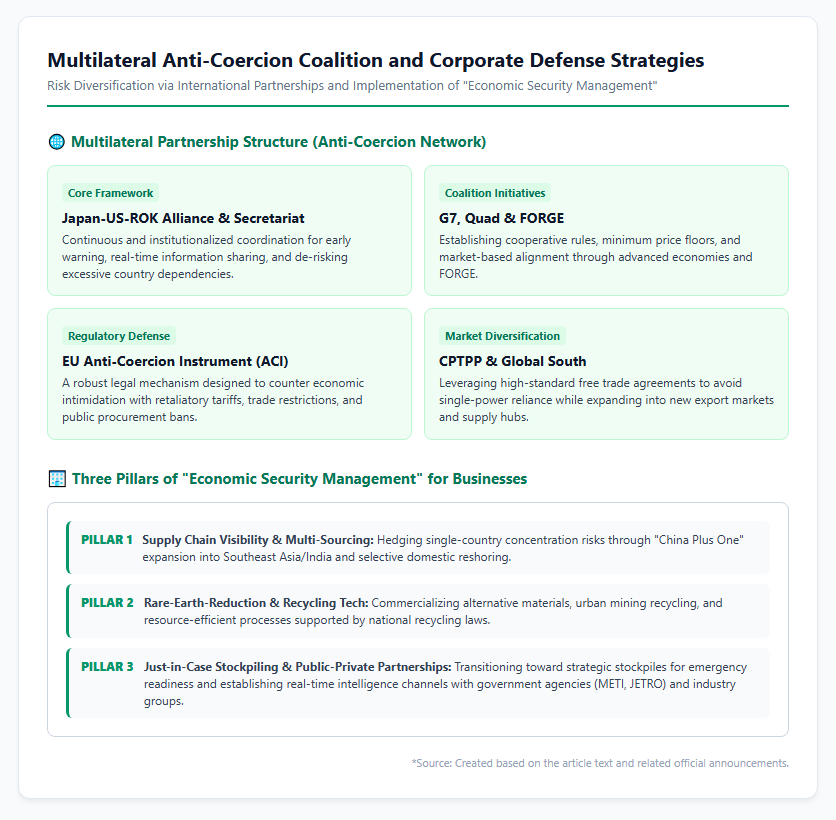
As economic coercion becomes a persistent feature of international commerce, Japanese businesses are compelled to pivot from traditional cost-driven procurement toward “economic security management” that integrates geopolitical risk directly into corporate strategy. Key defensive measures center first on complete supply chain visibility and multi-sourcing. Companies must accelerate “China Plus One” strategies by expanding production hubs into Southeast Asia and India, alongside selective reshoring of critical manufacturing. Second, businesses must invest in research and development for reduced-rare-earth or rare-earth-free technologies, while building robust recycling capabilities for “urban mining.” Leveraging domestic legislative frameworks, such as Japan’s Act on Promotion of Resource Circulation, allows companies to embed circular economy principles into their operations to mitigate long-term procurement risks. Third, organizations need to transition toward “Just-in-Case” strategic stockpiling for essential materials. Because individual companies cannot absorb these systemic shocks alone, establishing strong public-private partnership models—sharing real-time intelligence with government agencies like METI and JETRO, as well as industry associations—is crucial for swiftly navigating discriminatory boycotts or customs bottlenecks through bilateral and multilateral channels.
Multilateral Partnerships and the Future International Order
Looking ahead, global counter-coercion efforts will expand beyond the trilateral Japan-U.S.-South Korea alliance into a broader “anti-coercion coalition” encompassing the G7, Quad (Japan, U.S., Australia, India), the European Union (EU), and Global South nations. The EU has already established its Anti-Coercion Instrument (ACI) to counter economic intimidation with retaliatory trade and investment restrictions, underscoring the growing necessity for market-based alignment, shared rules, and price-floor mechanisms among democratic economies. Simultaneously, rising protectionism and “America First” tariff policies threaten to disrupt traditional free trade architectures. To navigate this environment, Japan must maintain close alignment with its key allies while leveraging comprehensive free trade agreements such as the CPTPP to prevent excessive reliance on any single power. Please refer to the diagram below.
Strategic competition over critical minerals and dual-use technologies will remain intense for years to come. Whether Japan can preserve a free and fair international economic framework while strengthening corporate resilience will be a defining factor in safeguarding its economic future.
Reference Pages
- [Ministry of Foreign Affairs of Japan] Joint Statement on the Establishment of the Multilateral Sanctions Monitoring Team (MSMT) https://www.mofa.go.jp/mofaj/press/release/pressit_000001_01273.html
- [Ministry of Commerce of the People’s Republic of China] Announcement on Strengthening Export Controls on Dual-Use Items to Japan https://www.mofcom.gov.cn/zwgk/zcfb/art/2026/art_8990fedae8fa462eb02cc9bae5034e91.html
- [The Japan Institute of International Affairs] New Trilateral Security Cooperation among Japan, South Korea, and the US and Responses to the North Korean Issue https://www.jiia.or.jp/research-report/missile-risk-fy2025-01.html
- [Mitsubishi Research Institute, Inc.] Changing Course for the Japanese Economy amidst US-China Economic Coercion https://www.mri.co.jp/knowledge/insight/20240422.html
- [PwC Japan Group] Policy Competition and Future Scenarios over Critical Minerals (2026 Edition) https://www.pwc.com/jp/ja/knowledge/column/geopolitical-risk-column/vol41.html
【#EconomicSecurity #JapanUSSouthKorea #EconomicCoercion #SupplyChain #ChinaRisk #CriticalMinerals #GeopoliticalRisk】

コメント