The Ministry of Land, Infrastructure, Transport and Tourism (MLIT) announced plans to accelerate joint Japan-U.S. public-private-academic research and development on AI-driven shipbuilding technology and the co-construction of a shared simulation platform. Against the backdrop of declining U.S. shipbuilding capacity and China’s growing maritime influence, the initiative aims to realize next-generation shipbuilding through cutting-edge digital technologies.
- Core Highlights: Joint Development of AI Shipbuilding Robots and Simulation Platforms
- Results of U.S. Delegations and Key Public-Private-Academic Players
- The Strategic Power of “Digital Twin” Simulation Beyond Simple Automation
- The U.S. Shipbuilding Crisis and the Overwhelming Gap with China
- Japan’s Shipbuilding Revival Roadmap: Target of 18 Million Gross Tons by 2035
- Spinoff Opportunities for Domestic Supply Chains and Tech Newcomers
- Road Ahead: FY2026 Platform Completion and Key Implementation Hurdles
Core Highlights: Joint Development of AI Shipbuilding Robots and Simulation Platforms
On September 18, 2026, the Maritime Bureau of Japan’s Ministry of Land, Infrastructure, Transport and Tourism (MLIT) announced the acceleration of a joint Japan-U.S. research and development project focused on integrating artificial intelligence into shipbuilding processes. This national initiative stems from the Memorandum of Cooperation on Shipbuilding signed on October 28, 2025, by Japanese Minister of Land, Infrastructure, Transport and Tourism Kaneko and U.S. Secretary of Commerce Lutnick. The project is carried out under the Cabinet Office’s “Building Research and Innovation with Diversity of Governance and Ecosystems” (BRIDGE) program as part of the “R&D Project for Next-Generation Shipyards via AI Integration.”
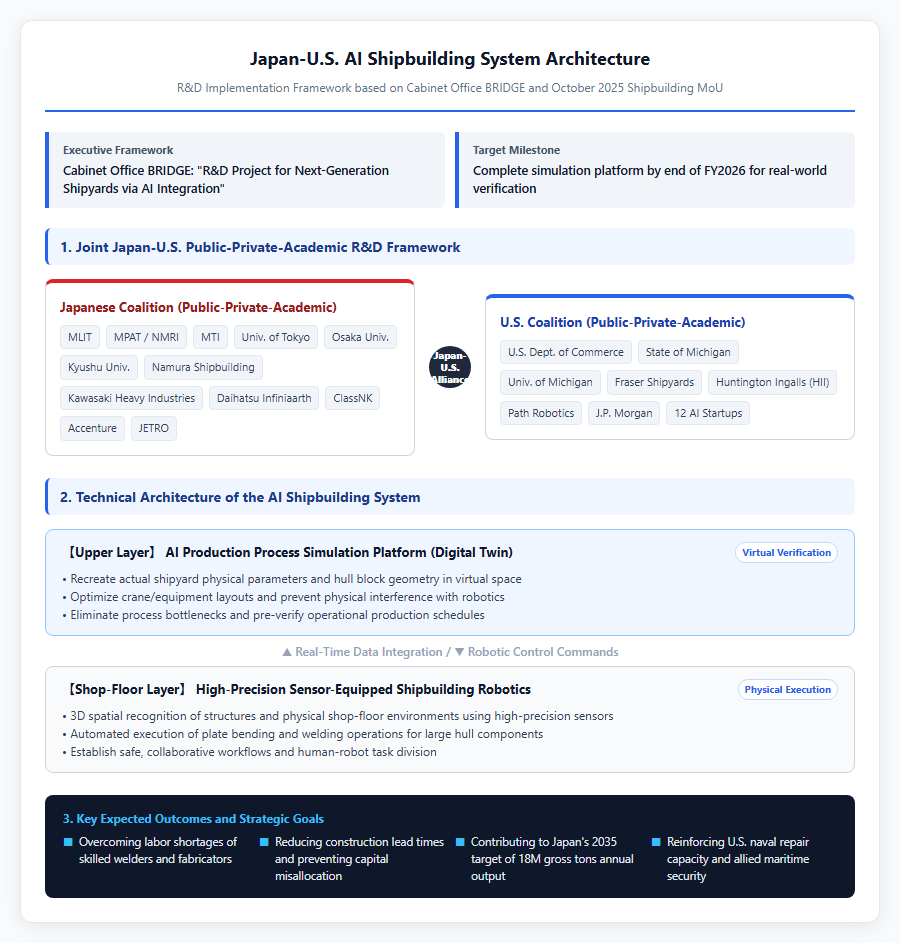
The centerpiece of this initiative is not merely developing standalone robots for plate bending or welding, but building a shared “AI Simulation Platform” where joint Japanese and American teams can virtually simulate robotic movements and entire shipyard workflows. By importing real hull block data and actual shipyard facility parameters into a virtual space, the joint team plans to complete this simulation platform by the end of fiscal year 2026 and initiate real-world operational testing. The structural architecture of the AI shipbuilding system is illustrated below.
For Japanese shipyards currently grappling with an aging skilled workforce and severe labor shortages, this project aims to deploy state-of-the-art digital tools and automated robotics to drive a fundamental transformation in manufacturing productivity.
- Announcement Date: September 18, 2026 (MLIT Maritime Bureau)
- Foundational Framework: Japan-U.S. Shipbuilding Memorandum of Cooperation (Signed October 2025)
- Execution Program: Cabinet Office BRIDGE “R&D Project for Next-Generation Shipyards via AI Integration”
- Key Milestone: Completion of the AI simulation platform by the end of FY2026 followed by early deployment
Results of U.S. Delegations and Key Public-Private-Academic Players
To accelerate project execution, a Japanese delegation of development partners visited Ann Arbor and Detroit, Michigan, from September 8 to 11, 2026, meeting with U.S. counterparts to finalize concrete joint development milestones. Both sides agreed to conduct robotic verification tests using large-scale mock hull structures installed at the University of Michigan, jointly develop high-precision sensor systems for robotics, and run digital twin simulations modeling operational shipyards in both Japan and the United States.
A joint workshop held during the visit drew broad participation from public, private, and academic leaders across both nations. The U.S. side included the University of Michigan, Fraser Shipyards, Huntington Ingalls Industries (HII), Path Robotics, J.P. Morgan, the U.S. Department of Commerce, and the State of Michigan. In addition, 12 American AI and robotics startups expressed strong interest in participating, holding individual consultation sessions with the delegation.
The Japanese delegation brought together a formidable coalition, including MTI, the University of Tokyo, Osaka University, Kyushu University, ClassNK, Namura Shipbuilding, Kawasaki Heavy Industries, Daihatsu Infiniaarth, Accenture, MLIT, the National Institute of Maritime, Port and Aviation Technology (MPAT), and JETRO. Bringing financial institutions, regulatory bodies, and certification authorities to the same table alongside technology developers creates a powerful ecosystem designed to bridge the gap between innovation and commercial deployment.
- Japanese Participants: MTI, Namura Shipbuilding, Kawasaki Heavy Industries, University of Tokyo, Osaka University, ClassNK, MPAT, and others
- U.S. Participants: University of Michigan, Fraser Shipyards, HII, Path Robotics, J.P. Morgan, U.S. Department of Commerce, and others
- New Commercial Entrants: 12 U.S. AI and robotics startups participating in project discussions
The Strategic Power of “Digital Twin” Simulation Beyond Simple Automation
The technological core of this joint initiative lies in the co-development of a “Production Process Simulation Platform.” Traditional automation efforts in manufacturing often focus on isolating individual processes, such as welding or cutting. In shipbuilding, however, accelerating a single isolated task yields little benefit if upstream or downstream processes remain bottlenecked.
This simulation platform functions as a sophisticated “digital twin” for shipbuilding operations. By modeling physical shipyard layouts and hull block geometry in a virtual environment, the system enables pre-implementation verification across several critical dimensions:
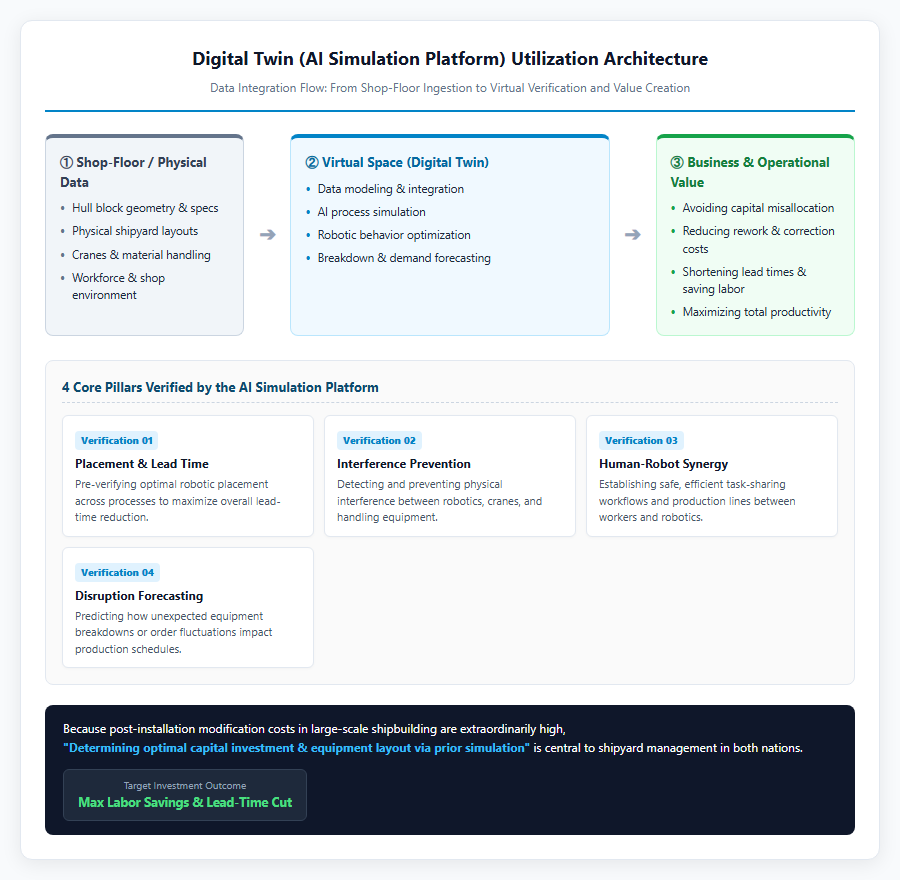
- Identifying optimal robotic placement to maximize overall lead-time reduction across the facility
- Detecting and preventing physical interference between robotics, cranes, and material handling equipment
- Designing safe, highly efficient task-sharing workflows between human workers and robotic systems
- Predicting how unexpected equipment downtime or order fluctuations will impact production schedules
Because the financial penalty for correcting layout or workflow flaws after installing heavy industrial machinery in a shipyard is extraordinarily high, virtual pre-verification is vital. By eliminating costly trial-and-error, digital twin simulations allow shipyards in both nations to maximize labor savings and throughput per dollar invested.
Geopolitical Drivers: Rebuilding U.S. Shipbuilding and Japan-U.S. Alliance Needs
The U.S. Shipbuilding Crisis and the Overwhelming Gap with China
The urgency driving Japan and the United States to accelerate joint AI shipbuilding technology stems from a historical collapse in American commercial shipbuilding capacity and growing concern over China’s dominant maritime power. While the United States ranked first globally in commercial shipbuilding in 1975, its share has plummeted to less than 1% (approximately 0.2% to 0.25%) of global output today. With annual commercial vessel construction down to just 3 to 5 large ships, shipyard closures and a severe loss of skilled labor have crippled the industrial base.
Conversely, backed by massive state subsidies and a military-civil fusion strategy, China now commands over 50% of total global shipbuilding volume. According to analysis by the U.S. Congressional Research Service and other bodies, China’s shipbuilding industrial capacity exceeds that of the United States by an estimated 230-fold. This staggering disparity has caused maintenance backlogs of thousands of days for U.S. Navy vessel repairs and overhauls, exposing a critical strategic vulnerability in sealift capacity during a crisis.
In response, the Trump administration issued executive directives, including the “Restoring America’s Maritime Dominance” memorandum, aiming to revitalize domestic shipbuilding. Recognizing that rebuilding domestic capacity unilaterally within a short timeframe is impossible, Washington has turned to allied nations with world-class shipbuilding capabilities and advanced manufacturing infrastructure—specifically Japan and South Korea.
- U.S. Commercial Share: Dropped from 1st globally in 1975 to approximately 0.2% today
- China’s Global Market Share: Exceeds 50% of total worldwide production
- Industrial Capacity Gap: China’s shipbuilding capacity estimated at 230 times that of the U.S.
- U.S. Defense Bottleneck: Multi-year naval repair delays and near-total loss of commercial fleet capacity
Japan’s Shipbuilding Revival Roadmap: Target of 18 Million Gross Tons by 2035
For Japan, joint AI shipbuilding collaboration with the United States represents a critical opportunity to revitalize its domestic maritime sector. In December 2025, the Japanese government formulated a “Shipbuilding Revival Roadmap” that targets doubling annual domestic production from approximately 9 million gross tons in 2024 to 18 million gross tons by 2035. To back this plan, Tokyo established a 350-billion-yen “Shipbuilding Revitalization Fund” over a 10-year horizon, aiming to catalyze a total public-private investment of 1 trillion yen.
Japanese shipyards face an acute labor bottleneck driven by rapid population aging and a shrinking pool of skilled welders and fabricators. Achieving the ambitious target of doubling production by 2035 is impossible through traditional labor-intensive hiring. Consequently, shipyards must digitize design data, production workflows, and shop-floor operations, transitioning toward automated, high-efficiency manufacturing systems powered by robotics.
This collaboration addresses complementary national imperatives: solving America’s shortage of dockyard infrastructure and production capacity while helping Japan overcome severe labor shortages and regain global cost-competitiveness.
- Japan’s 2035 Target: Double annual output from ~9 million gross tons to 18 million gross tons
- Policy Backing: 350-billion-yen Shipbuilding Revitalization Fund driving 1 trillion yen in total investment
- Structural Challenge: Rapid decline of skilled workers due to demographic aging
- Core Strategy: Shifting from labor-intensive construction to AI- and robotics-driven productivity reforms
Industry Impact and Future Outlook
Spinoff Opportunities for Domestic Supply Chains and Tech Newcomers
The joint development of AI shipbuilding technology extends far beyond major shipbuilders and heavy equipment manufacturers, unlocking significant commercial opportunities for a wide range of supply chain partners and tech enterprises. Automating ship construction requires specialized technologies capable of operating within massive, highly irregular steel structures.
Niche suppliers and technology startups are poised to capitalize on demand across several key domains:
- Specialized robotic end-effectors for welding, painting, and surface cleaning in confined or curved hull spaces
- High-precision sensor suites, including 3D spatial measurement, LIDAR, and force-torque sensors tailored for industrial environments
- Reconfigurable jigs and standardized structural components designed to facilitate robotic handling
- High-speed shipyard wireless communications, edge data collection, and robust cybersecurity infrastructure
- AI-driven predictive maintenance platforms and solutions for digitizing tacit trade knowledge from veteran shipbuilders
Succeeding in AI shipbuilding requires solving the messy, physical realities of shipyard operations rather than delivering off-the-shelf software. Fusing Japan’s expertise in precision machinery, sensing, and software with real-world shipyard challenges promises to broaden the maritime industrial base and foster a high-value technology ecosystem.
Road Ahead: FY2026 Platform Completion and Key Implementation Hurdles
The primary focus for the Japan-U.S. AI shipbuilding initiative now centers on completing the simulation platform by the end of FY2026 and rapidly transitioning from R&D to commercial shipyard integration. Moving smoothly from experimental prototypes to daily operational systems will determine the project’s long-term impact.
Several key hurdles remain on the path to full implementation. Industry leaders must overcome organizational inertia on the shop floor and successfully translate the unwritten, intuitive expertise of veteran shipbuilders into AI algorithms. On the regulatory side, navigating U.S. cabotage laws such as the Jones Act, compliance with International Traffic in Arms Regulations (ITAR), and establishing bilateral regulatory frameworks for joint construction will require sustained diplomatic coordination.
Ultimately, success will not be measured by the raw count of robots installed on factory floors. The true test lies in whether Japan and the United States can re-engineer design, supply chain, and production management into a unified digital system—restoring competitive commercial shipbuilding while reinforcing allied maritime security.
- Near-Term Milestone: Completion of the AI simulation platform by the end of FY2026
- Operational Challenge: Digitizing veteran trade knowledge and driving shop-floor adoption
- Regulatory Focus: Addressing Jones Act restrictions and export control regulations for joint production
- True Benchmark: Re-engineering overall manufacturing systems rather than simply expanding robot count
Reference Pages
- [MLIT Press Release] https://www.mlit.go.jp/report/press/kaiji05_hh_000330.html
【#Shipbuilding #AIShipbuilding #JapanUSAlliance #MLIT #EconomicSecurity #NextGenTech】

コメント