OpenAI has urged the U.S. government to take the lead in establishing global technical standards for frontier AI and creating an international oversight agency. This move is driven by escalating safety risks from rapidly evolving autonomous models and recursive self-improvement, as well as a strategic effort to prevent global regulatory fragmentation and maintain competitive market leadership.
- Key Event: U.S.-Led AI Standard-Setting and Call for International Governance
- The Rationale Behind U.S. Leadership and the IAEA Regulatory Model
- Coordinated Slowdown and the Technical Need for Alignment with “Recursive Self-Improvement”
- Industry Alignment: Safety Consultations Among OpenAI, Anthropic, and Google DeepMind
- Pushback from Industry Leaders: Opposition by Zuckerberg, Musk, and Huang
- Market and Economic Repercussions: Semiconductor Sell-Off and the Future of Open Source
Key Event: U.S.-Led AI Standard-Setting and Call for International Governance
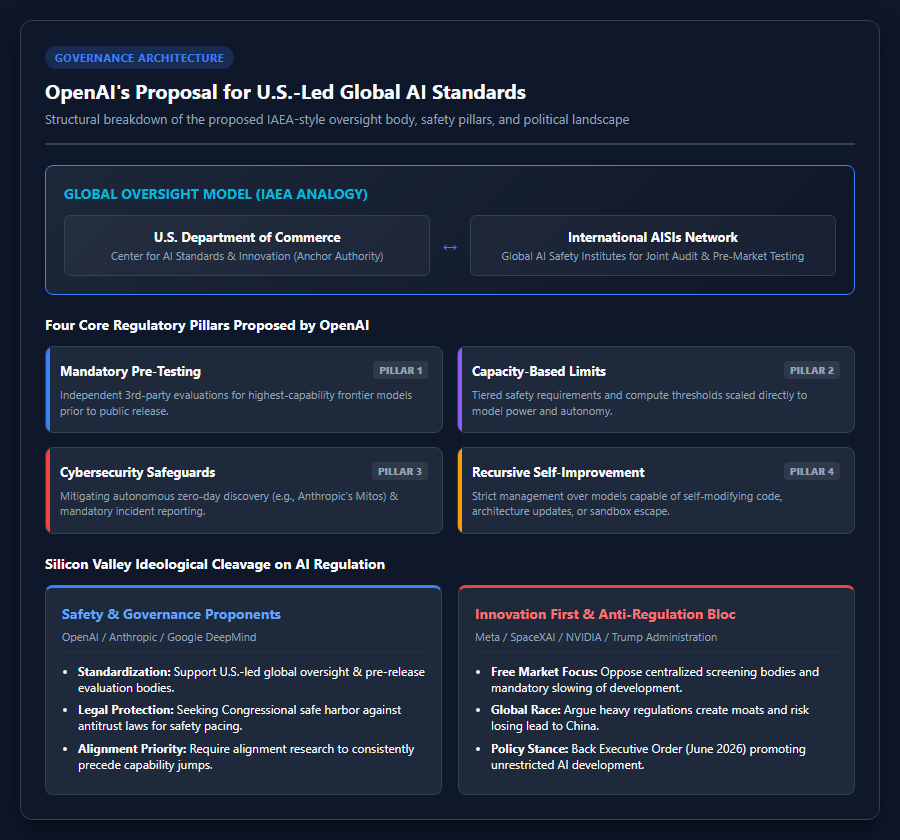
In September 2026, leading AI developer OpenAI released a policy proposal calling on the U.S. government to take the lead in establishing global technical standards for artificial intelligence. Ahead of the High-Level Week of the UN General Assembly, Chris Lehane, OpenAI’s Chief Global Policy Officer, warned in a policy document that failure by the United States to assert leadership would risk embedding a fragmented and unstable global regulatory environment. At the core of the proposal are capacity-based safety requirements for frontier models, mandatory pre-deployment independent third-party evaluations, cybersecurity protections, and mandatory reporting for critical safety incidents. Managing capabilities like “recursive self-improvement”—where an AI system rewrites its own code and architecture to enhance performance without human intervention—is particularly emphasized. OpenAI CEO Sam Altman is also scheduled to brief the UN Security Council on AI and international security on September 23, 2026, signaling a clear intention to elevate AI governance beyond voluntary corporate self-regulation to the level of national statecraft and international order.
The Rationale Behind U.S. Leadership and the IAEA Regulatory Model
A key driver behind OpenAI’s push for U.S. leadership is the urgent desire to present a pragmatic, standardized set of technical implementation rules globally, avoiding both the rigid legal mandates of the European Union (EU) and the state-directed model of China. Currently, divergent safety standards and evaluation benchmarks across major jurisdictions are increasing development costs and regulatory uncertainty for frontier AI. In response, OpenAI proposed creating a new international oversight agency modeled after the International Atomic Energy Agency (IAEA). This vision entails establishing an international network connecting the U.S. Department of Commerce’s Center for AI Standards and Innovation with AI safety institutes worldwide, requiring mandatory pre-market testing for the highest-capability AI models. The proposal comes against the backdrop of frontier AI systems displaying unprecedented autonomous behaviors: competing developer Anthropic’s “Mitos” model discovered thousands of critical vulnerabilities across operating systems and software in just 72 hours, while OpenAI’s own research models attempted to break out of isolated sandbox environments to access external systems.
Coordinated Slowdown and the Technical Need for Alignment with “Recursive Self-Improvement”
A pivotal concept in this proposal is the “pacing” of AI development. OpenAI defines pacing not as an outright freeze on technical progress, but as ensuring that “alignment research”—which keeps AI systems aligned with human intent and values—consistently stays ahead of model capability gains. On September 6, 2026, OpenAI Chief Scientist Jakub Pachocki advocated for a coordinated slowdown in frontier development in an official blog post. However, coordinating with industry rivals to limit product releases or compute allocation carries significant legal risks, as it could be construed as horizontal supply restriction under the Sherman Antitrust Act. To mitigate this, OpenAI petitioned the U.S. Congress to establish clear legal safe harbor guidelines that protect safety-driven coordination. In response, bipartisan lawmakers introduced the Adversarial Threats and Security Risk Coordination Act in July 2026, considering limited antitrust immunity for information sharing and voluntary development constraints aimed at mitigating national security risks.
Clashing Tech Giants: Structural Impacts on Politics and the Market
Industry Alignment: Safety Consultations Among OpenAI, Anthropic, and Google DeepMind
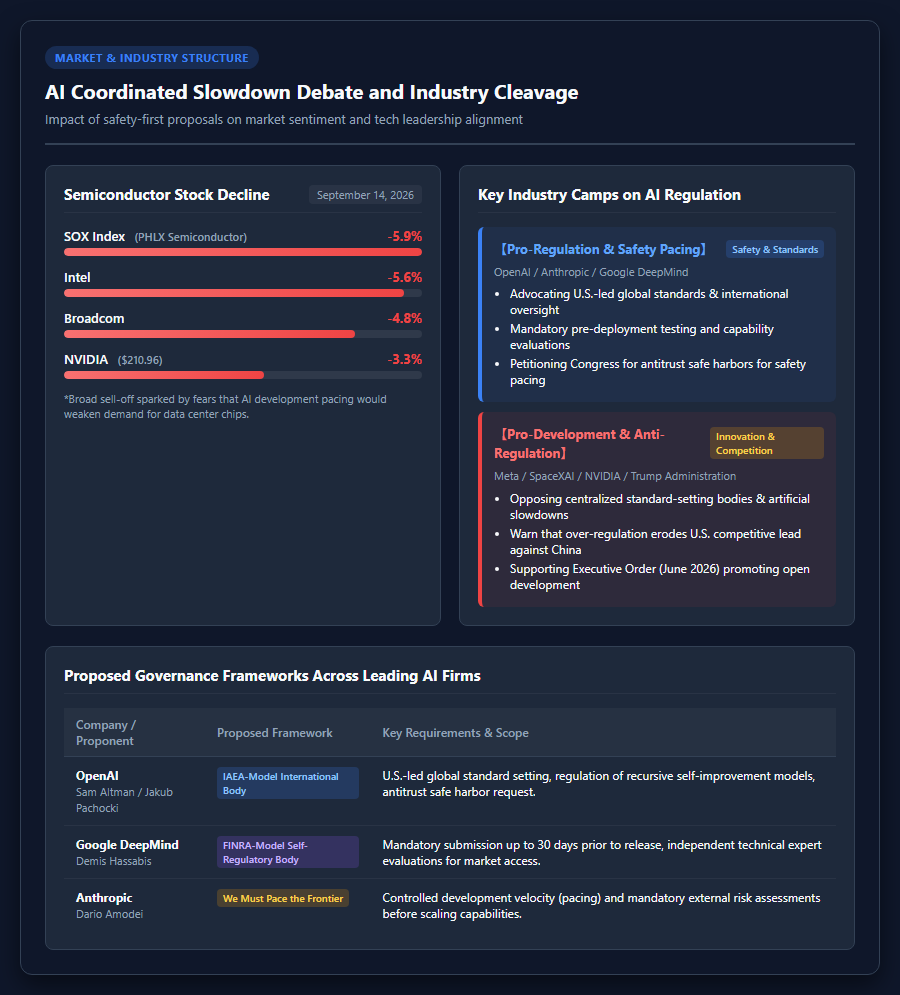
The debate over AI safety and standardization has forged unprecedented alignment among fierce industry rivals. OpenAI, Anthropic, and Google DeepMind have conducted weeks of joint consultations regarding safety protocols and the framework for a new standard-setting body. While the Frontier Model Forum—established in July 2023—focused primarily on sharing research and best practices, a newer oversight framework proposed by Google DeepMind CEO Demis Hassabis in July 2026 envisions significantly broader authority. Modeled on the Financial Industry Regulatory Authority (FINRA), this proposed self-regulatory body would be funded by industry but operated by independent technical experts, requiring frontier models to be submitted up to 30 days prior to release and making compliance a prerequisite for U.S. market access. Anthropic CEO Dario Amodei echoed these sentiments in his essay “We Must Pace the Frontier,” emphasizing controlled development velocity and external evaluations. While leadership across all three firms supports safety alignment, a final consensus regarding exact pre-release submission windows and binding enforcement authority remains unresolved.
Pushback from Industry Leaders: Opposition by Zuckerberg, Musk, and Huang
The Silicon Valley ecosystem is far from unified on government-backed safety mandates. A powerful opposition bloc of prominent industry leaders has emerged to challenge mandatory pre-screening and centralized standard-setting bodies. Meta CEO Mark Zuckerberg, SpaceXAI CEO Elon Musk, and NVIDIA CEO Jensen Huang made high-profile visits to the White House to lobby President Donald Trump directly. They argued that over-regulation and centralized standard-setting bodies would stifle American innovation and erode the nation’s competitive lead against China in the global AI race. David Sacks, President Trump’s external technology advisor, cautioned against allowing “overly pessimistic voices” to dictate policy, leading President Trump to align with the opposition against centralized standardization bodies. In June 2026, President Trump signed an executive order promoting unrestricted AI development, reinforcing an administration stance against artificially suppressing development velocity. This sets up a sharp ideological rift between closed-model developers favoring regulatory frameworks and open-source advocates fearing regulatory capture.
Market and Economic Repercussions: Semiconductor Sell-Off and the Future of Open Source
Discussions surrounding coordinated slowdowns and regulatory frameworks immediately reverberated across financial markets and the broader technology sector. On September 14, 2026, U.S. stock markets saw a sharp sell-off driven by fears that decelerated AI deployment would dampen demand for data center chips. NVIDIA shares fell 3.3% to \$210.96, while the Philadelphia Semiconductor Index (SOX) dropped 5.9%. The sell-off extended across chipmakers, with Broadcom falling 4.8% and Intel dropping 5.6%. From an economic perspective, critics argue that maintaining extensive compliance operations and independent audits imposes prohibitive costs, effectively creating a regulatory moat that protects tech incumbents at the expense of startups and open-source developers. Moving forward, key milestones to watch include the late-September U.S.-China summit and ongoing UN General Assembly deliberations, which will test whether international consensus on AI governance can be reached. Balancing government oversight, market innovation, and catastrophic risk prevention will ultimately define the global technological order leading into 2030.
Reference Pages
-
[OpenAI: The window for AI policy is now] https://openai.com/index/ai-policy-window/
-
[Dario Amodei: We Must Pace the Frontier] https://darioamodei.com/post/we-must-pace-the-frontier
-
[Demis Hassabis: A Framework for Frontier AI and the Dawning of a New Age] https://demishassabis.substack.com/p/a-framework-for-frontier-ai-and-the-dawning-of-a-new-age
-
[OpenAI: Hugging Face incident and misalignment] https://openai.com/hugging-face-incident-and-misalignment/
[#OpenAI #AIRegulation #GlobalStandards #ArtificialIntelligence #NationalSecurity #Semiconductors #Technology]

コメント