The Japanese government has finalized a policy to establish a new agency in fiscal 2027 that will integrally promote defense equipment exports and the strengthening of domestic defense production capabilities. This decision is driven by growing urgency over a shrinking domestic market, corporate exits from the defense sector, and the critical imperative to secure operational sustainability in an increasingly volatile security environment.
- Key Developments: Mission and Setup of the Proposed FY2027 Agency
- Launch of the “Japanese-Style FMS” and Government-to-Government (G2G) Transactions
- 43 Trillion Yen Defense Budget and the GOCO (Government-Owned, Contractor-Operated) Approach
- Revision of Defense Equipment Transfer Principles and Abolition of the “Five Categories”
- Stock Market Dynamics and Shift in Megabank Financing Attitudes
- Future Outlook and Key Issues: Pacifism Debates and Global Strategy
Key Developments: Mission and Setup of the Proposed FY2027 Agency
The Japanese government has finalized plans to create a new independent administrative agency or similar entity in fiscal 2027 to comprehensively drive defense equipment exports and bolster domestic production capabilities. Under the legacy system, private defense contractors had to directly handle complex international negotiations and contracts with foreign governments—creating substantial commercial and reputational risks that hindered overseas expansion. The new agency will serve as an interagency command hub bridging the public and private sectors, establishing a state-led, comprehensive support structure.
Specifically, the agency will gather requirements from foreign governments, purchase defense hardware for export, mediate matching between overseas buyers and domestic contractors, and provide post-transfer operational guidance and maintenance, repair, and overhaul (MRO) services. To support operational training abroad, the government is considering hiring retired Japan Self-Defense Forces (JSDF) personnel as specialist advisors. The government plans to explicitly include the organizational blueprint in updated strategic documents, such as the National Security Strategy expected later this year, before submitting enabling legislation to the ordinary session of the Diet next year. For an illustration of this unified public-private support system, please refer to the diagram below.
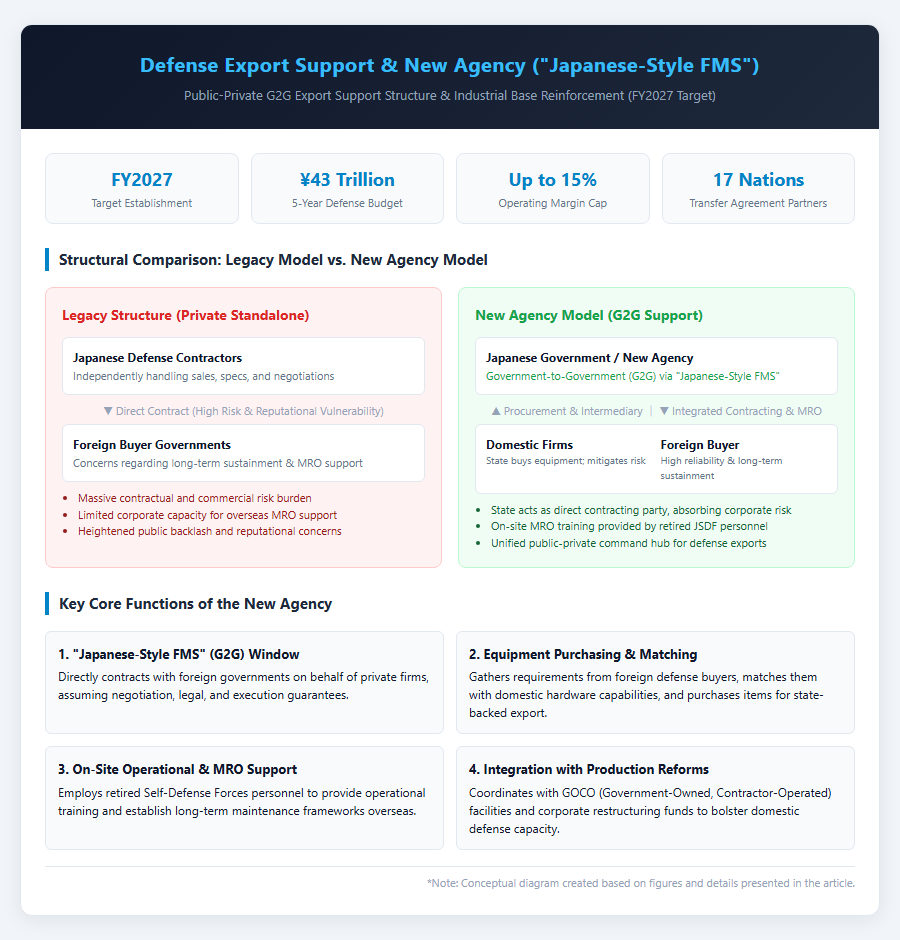
By overcoming the structural limitations of the domestic defense market and promoting state-backed defense exports, Japan aims to swiftly reinforce a defense industrial base capable of withstanding emergency scenarios.
Launch of the “Japanese-Style FMS” and Government-to-Government (G2G) Transactions
A core function of the new agency will be establishing and operating a “Japanese-style FMS” (Foreign Military Sales) framework. Modeled after the U.S. FMS program, this system enables the Japanese government and the new agency to act as the direct contracting party in government-to-government (G2G) transactions with foreign buyer governments, replacing private defense manufacturers.
Navigating international markets requires not only supplying equipment, but also customizing specifications to meet buyer security needs and guaranteeing long-term sustainment and maintenance frameworks. However, private contractors faced immense hurdles attempting to handle complex technical guarantees, diplomatic negotiations, and long-term supply chain support on their own. By stepping to the forefront of transactions, the new agency will dramatically reduce corporate contractual burdens and diplomatic friction risks. Furthermore, for companies that previously hesitated to export due to public relations concerns and backlash over defense exports, the government’s buy-and-export scheme provides a buffer that significantly lowers entry barriers.
By consolidating support functions previously fragmented across the Ministry of Defense, the Ministry of Economy, Trade and Industry, and other agencies into a single, specialized public-private entity, Japan is laying a robust foundation to make its defense equipment competitive in the global market.
Current State and Structural Reforms of Japan’s Defense Industry
43 Trillion Yen Defense Budget and the GOCO (Government-Owned, Contractor-Operated) Approach
Japan’s defense sector is currently undergoing a historic expansion, backed by a 5-year defense budget totaling 43 trillion yen. However, the industry has suffered from deep structural challenges, with over 100 defense-related suppliers exiting the market over the past two decades. A single-customer market structure reliant almost exclusively on the JSDF, combined with a traditional cost-plus-margin pricing model, severely limited corporate profitability, making future R&D investments and production line upkeep difficult to sustain.
To address these structural vulnerabilities and ensure the sustainment capabilities needed for prolonged conflicts, the Ministry of Defense is undertaking a radical revamp of its production base. A prominent example is the introduction of the GOCO (Government-Owned, Contractor-Operated) model, where the state acquires and owns manufacturing facilities and production lines while outsourcing daily operations and management to private firms. For specialized military assets with no civilian demand, such as ammunition and uncrewed aerial vehicles (UAVs), direct state capital expenditure eliminates corporate capital investment risks. For a detailed breakdown of this operational transformation, please refer to the diagram below.
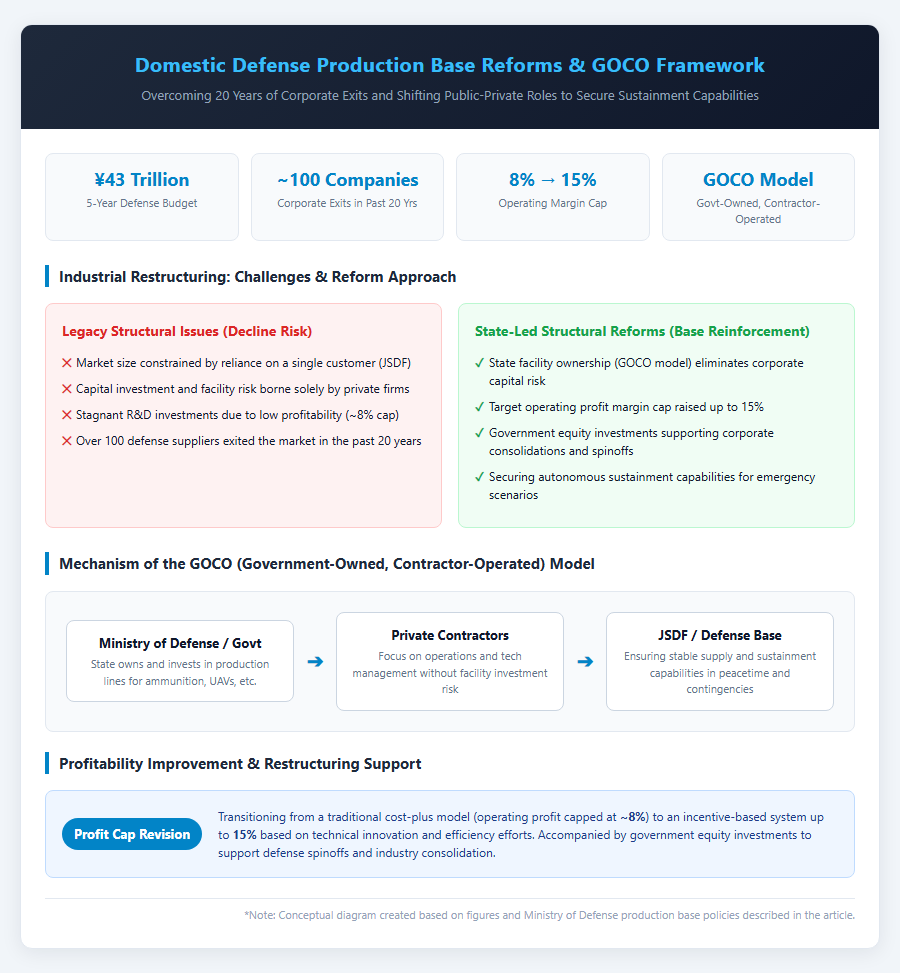
In parallel, a new government equity-investment scheme will support small and medium-sized enterprises (SMEs) pursuing business consolidation or corporate spinoffs of defense divisions. In addition, the Ministry of Defense is raising the target operating profit margin cap from roughly 8% to a maximum of 15%, creating an environment where companies can secure appropriate returns.
Revision of Defense Equipment Transfer Principles and Abolition of the “Five Categories”
The establishment of the new agency and export promotion efforts are strongly reinforced by the landmark revision of the “Three Principles on Transfer of Defense Equipment and Technology” and its operational guidelines, approved on April 21, 2026. Under prior guidelines, finished defense equipment exports were strictly restricted to five non-lethal categories: rescue, transport, warning, surveillance, and minesweeping. The recent overhaul completely eliminated this “five-category” restriction.
The new regulatory framework clearly distinguishes between defense equipment based on whether items possess lethal or destructive capacity under the Self-Defense Forces Act. For non-lethal finished equipment, destination country restrictions have been broadly lifted. Conversely, for finished goods classified as lethal “weapons,” transfers remain restricted to international joint development partner nations and the 17 countries that have signed bilateral Defense Equipment and Technology Transfer Agreements with Japan (including the U.S., UK, Australia, India, and the Philippines).
However, transfers of weapons to countries actively engaged in armed conflict remain prohibited in principle, subject to rigorous review by the National Security Council (NSC) and prior notification to the Diet. This historic deregulation has catalyzed major joint development and export initiatives with aligned nations, such as the Global Combat Air Programme (GCAP) next-generation fighter jet project with the UK and Italy, and frigate exports to Australia.
Economic Impact and Future Outlook
Stock Market Dynamics and Shift in Megabank Financing Attitudes
These government policies and structural reforms are triggering major shifts across capital markets and financial institutions. Driven by surging defense spending and higher profit margin caps, major Japanese defense contractors—such as Mitsubishi Heavy Industries (7011), Kawasaki Heavy Industries (7012), and IHI (7013)—have reported record-high earnings and order backlogs. Specialist manufacturers like The Japan Steel Works (5631) and Tokyo Keiki (7721) are also seeing heightened market evaluations due to expanding defense sales.
Equally notable is the clear shift in stance among major commercial megabanks and financial institutions, which previously exercised caution toward defense sector financing due to ESG investment concerns and reputational risk. Major domestic banks, led by MUFG Bank, have actively embraced lending and financial support for defense contractors, accelerating capital flows not only to heavy industry giants but also to supply chain SMEs.
As the defense industry transitions from a “low-margin, high-risk sector” into a “nationally supported growth industry,” emerging tech startups in fields like AI, uncrewed systems, and cybersecurity are increasingly motivated to enter the market. Improved capital circulation across the industry is fostering a virtuous cycle of new investment.
Future Outlook and Key Issues: Pacifism Debates and Global Strategy
While momentum grows behind defense export promotion and the creation of the new agency, significant issues requiring careful navigation remain. The Japan Federation of Bar Associations (JFBA) has submitted an official opinion opposing the expansion of lethal weapon transfers, warning that increased defense exports risk exacerbating international conflicts and undermining the constitutional principle of pacifism. For defense companies, navigating export control legal risks and mitigating reputational backlash from civil society remain critical considerations.
Moreover, concerns exist regarding democratic oversight, particularly over procedures relying on post-facto Diet notifications, placing strong demands on the government to maintain rigorous transparency and oversight mechanisms. In global markets, Japanese contractors will face intense competition from established players like South Korea (“K-Defense”), which has gained market share in Eastern Europe and the Middle East through rapid delivery times and price competitiveness. Winning overseas contracts will require Japanese companies to offer comprehensive value propositions beyond raw technological capability.
As fiscal 2027 approaches, the key point to watch will be how enabling legislation and public debate unfold ahead of the agency’s launch. Whether Japan’s defense industry can establish a sustainable and resilient foundation while remaining aligned with its pacifist principles will test the long-term strategy and execution capabilities of both the government and the private sector.
References
- [Japan Federation of Bar Associations] Statement Opposing the Expansion of Defense Equipment Transfers https://www.nichibenren.or.jp/document/opinion/year/2025/250123_2.html
【#DefenseEquipment #DefenseIndustry #JapaneseEconomy #NationalSecurity #DefenseExportPrinciples #EconomicNews】


コメント