
According to the Flow of Funds accounts released by the Bank of Japan, the combined value of equities and investment trusts held by Japanese households has surpassed insurance and pension reserves for the first time, while the share of cash and deposits dropped below 45%. Underlying this historic structural shift away from a long-standing preference for savings are the widespread adoption of the expanded New NISA tax-exempt framework, strong stock market performance, and Japan’s broader economic transition toward an inflationary environment.
- Key Takeaways: Equities and Mutual Funds Overtake Insurance for the First Time
- Cash and Deposits Below 45%: A Changing Preference for Safe Assets
- Impact of the Expanded New NISA and Massive Capital Inflows
- Market Tailwinds: Equity Gains, Yen Weakness, and Low-Cost Index Funds
- Underlying Vulnerabilities: Valuation Gains and Widening Wealth Inequality
- The Vital Role of Financial Literacy and Economic Education
- Key Milestones for Long-Term Household Wealth Accumulation
Key Takeaways: Equities and Mutual Funds Overtake Insurance for the First Time
According to the Flow of Funds accounts for the second quarter of 2026 (April–June) published by the Bank of Japan, total financial assets held by Japanese households reached a record high of 2,519 trillion yen as of the end of June 2026, marking an 11.0% increase year-on-year. The most striking milestone within these statistics is a historical reversal in the composition of household wealth. Household holdings of equities reached 486 trillion yen, while investment trusts (mutual funds) rose to 193 trillion yen, bringing the combined total of risk assets to 679 trillion yen. In contrast, reserves for insurance, pensions, and standardized guarantees stood at 586 trillion yen. For the first time since comparable data became available, the combined value of stocks and mutual funds surpassed that of insurance and pension products. Please refer to the diagram below.
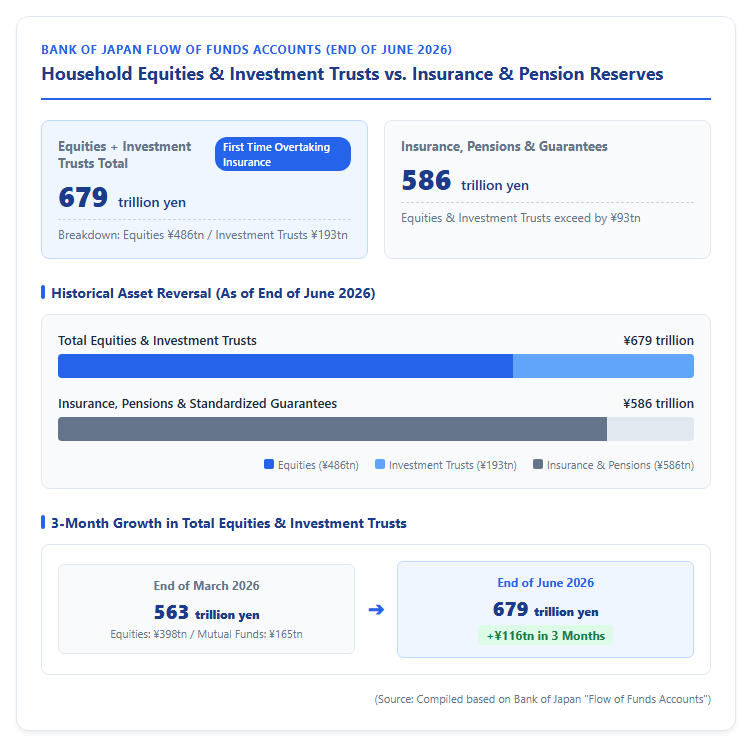
As of the end of March 2026, household equity holdings were 398 trillion yen and mutual funds were 165 trillion yen (totaling 563 trillion yen), meaning risk asset balances surged by a staggering 116 trillion yen in just three months. On a year-on-year basis, equities surged by 47.0% and investment trusts grew by 36.8%. This extraordinary momentum represents a historic turning point, delivering concrete numerical proof that the government’s long-standing policy initiative of moving “from savings to investment” has taken firm root.
Cash and Deposits Below 45%: A Changing Preference for Safe Assets
Along with the rapid expansion of equity and mutual fund holdings, a clear structural shift is occurring in the cash-heavy portfolio preference long characteristic of Japanese households. Cash and bank deposits rose slightly to 1,132 trillion yen as of the end of June 2026, but their share of total household financial assets fell to 44.9%. This marks the first time in recorded statistical history that the deposit ratio dropped below the 45% threshold, setting a new record low. Given that cash and deposits accounted for 54.2% of assets as of the end of March 2023, the ratio has dropped by nearly 10 percentage points in just over three years. During Japan’s prolonged deflationary era, holding cash in zero-interest bank accounts was a rational choice, as falling consumer prices preserved real purchasing power. However, with the economy shifting toward persistent inflation, households increasingly recognize that hoarding low-yielding bank deposits exposes their wealth to real erosion. Although more than 1,100 trillion yen remains in cash and deposits, the era in which households keep over half their wealth in safe havens is coming to an end, marking a fundamental turning point in personal asset management behavior.
Structural Factors Driving the Acceleration into Investments
Impact of the Expanded New NISA and Massive Capital Inflows
The single greatest institutional catalyst driving this household investment shift is the widespread adoption of the “New NISA” (Nippon Individual Savings Account) tax-exempt framework, which underwent a major overhaul in 2024. By substantially expanding non-taxable investment limits and making the tax exemption permanent, the revised system dramatically enhanced convenience for retail investors and broadened participation among beginners and younger demographics. According to data from the Financial Services Agency (FSA), the number of NISA accounts reached 26.96 million as of the end of June 2025, with cumulative purchases under the new system totaling approximately 63 trillion yen. This surpassed the government’s target of 56 trillion yen in purchases by the end of 2027 well ahead of schedule, achieving a 112% completion rate. In the first half of 2025 alone, investors poured approximately 7.4 trillion yen into the Growth Investment Allowance and 3.1 trillion yen into the Cumulative Investment Allowance, demonstrating that monthly dollar-cost averaging mechanisms are firmly entrenched. The New NISA has proven to be far more than a passing investment fad; it now functions as a permanent engine sustaining a structural reallocation of Japanese household capital.
Market Tailwinds: Equity Gains, Yen Weakness, and Low-Cost Index Funds
Alongside institutional reforms, favorable market conditions and attractive financial products have significantly accelerated the investment shift. Japanese equity markets hovered near record highs, propelled by corporate governance reforms and burgeoning investments in generative AI technology, which sharply boosted the market valuation of household shareholdings. Furthermore, persistent weakness in the Japanese yen expanded unrealized gains on foreign-currency assets and global equity mutual funds held by households. On the product side, low-cost index funds optimized for long-term, systematic, and diversified investing have become the gold standard. Popular product lines such as Mitsubishi UFJ Asset Management’s “eMAXIS Slim” series—which pledges to continually maintain the industry’s lowest expense ratios—offer annual trust fees between 0.05775% and 0.22%. These low-cost funds have empowered retail investors to easily build globally diversified stock portfolios. Please refer to the diagram below.
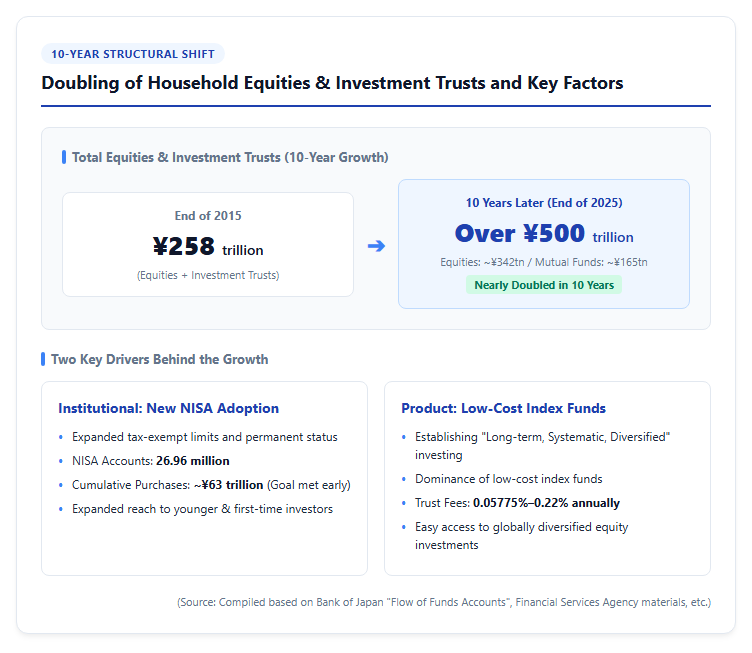
As a result, household holdings of equities and mutual funds nearly doubled over a decade, surging from 258 trillion yen at the end of 2015 to over 500 trillion yen.
Challenges Ahead and Future Outlook for Sustainable Wealth Building
Underlying Vulnerabilities: Valuation Gains and Widening Wealth Inequality
A closer analysis of the surge in household equity and mutual fund balances reveals critical emerging challenges for long-term market stability. The 116 trillion yen surge in risk assets recorded in the Flow of Funds accounts was not driven solely by new cash inflows from bank deposits; rather, a major portion stemmed from unrealized valuation gains fueled by rising stock prices and a weaker yen. Bank of Japan data explicitly separates transaction-driven flows from price-adjustment factors, indicating that much of the increase reflects market appreciation of assets already held. This trend underscores a growing wealth disparity between households that allocated capital to risk assets and those that remained exclusively in cash and deposits. Additionally, analysts point to concentration risks stemming from the overwhelming flow of New NISA funds into specific global and U.S. equity index funds, such as All-Country and S&P 500 funds. This heavy concentration in a limited asset class leaves household wealth vulnerable to potential future market downturns.
The Vital Role of Financial Literacy and Economic Education
As the number of retail investors expands rapidly, boosting financial literacy and establishing sound risk management practices among the public have become urgent priorities. According to the “Financial Literacy Survey 2025” conducted by the Japan Financial Literacy Development Organization (J-FLEC), while the proportion of individuals purchasing risk assets has grown, nearly 30% of buyers admitted to purchasing financial products without fully understanding key product mechanics, such as principal guarantees and risk structures. The survey revealed that individuals who received financial education achieved significantly higher accuracy rates on financial knowledge tests (66.7% vs. 52.6%) and demonstrated a stronger inclination to compare competing products and formulate long-term financial plans. In its Strategic Priorities for the 2026 Financial Year, the Financial Services Agency (FSA) designated the expansion of workplace and community financial education in partnership with J-FLEC, alongside the enforcement of fiduciary duties and product governance among financial institutions, as top policy objectives. Providing educational opportunities that prepare investors for market downturns, rather than relying solely on “success experiences” gained during market rallies, will be essential.
Key Milestones for Long-Term Household Wealth Accumulation
With total household financial assets surpassing 2,500 trillion yen and the centerpiece of personal finance transitioning from traditional savings to active investment, attention is focused on ensuring sustainable long-term growth. In an environment marked by persistent inflation and rising interest rates, individuals can no longer afford a passive “leave it in the bank” approach; instead, they must proactively build portfolios tailored to their risk tolerance and life stage. Policy authorities, including the FSA and the Bank of Japan, are pushing forward institutional reforms to enhance the usability of corporate DC plans and iDeCo (individual defined contribution pensions), enforce strict fiduciary standards for financial institutions, and direct growth capital toward startups. For retail investors, maintaining a disciplined investment strategy grounded in long-term, systematic dollar-cost averaging and diversification—without being swayed by short-term market volatility—remains critical. Whether this structural transition from savings to investment translates into genuine economic growth and household prosperity will depend heavily on the deep embedding of financial literacy across Japanese society.
References
- [Bank of Japan “Flow of Funds Accounts”] https://www.boj.or.jp/statistics/sj/sj.htm
- [Financial Services Agency “NISA Usage Statistics”] https://www.fsa.go.jp/policy/nisa/20250924/2506nisa-graph.pdf
- [Japan Financial Literacy Development Organization (J-FLEC) “Financial Literacy Survey 2025”] https://www.j-flec.go.jp/data/literacy_chosa_2025/
【#HouseholdFinancialAssets #FlowOfFunds #NewNISA #SavingsToInvestment #FinancialLiteracy #InflationManagement #WealthBuilding】


コメント